

The Chicken Kyiv is now “cutlet in butter.” We have the recipe.
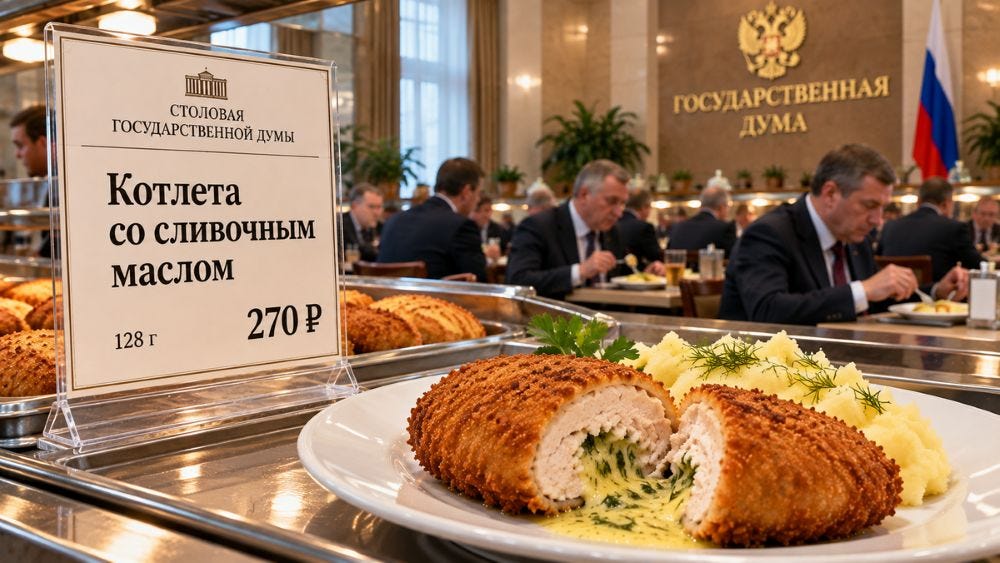 Chicken Kyiv in the cafeteria of the State Duma.
In an apparent attempt to distance itself even further from Ukraine and demonstrate its loyalty, the management of the Russian State Duma’s cafeteria has renamed one of the most popular dishes served to MPs. Chicken Kyiv, a traditional dish associated with the Ukrainian capital, has been removed from the menu and replaced with “cutlet with butter.”
The change was reported by journalists of the media pool of the Russian parliament’s lower chamber who regularly have lunch in the cafeteria. The recipe itself of the 128-gram cutlet that costs 270 rubles (US$3.25 or €2.87) has not changed. The food is the same Chicken Kyiv but its name is different.
The decision has attracted attention precisely because it appears to separate the dish from the geographical and cultural identity with which it is internationally associated. In that sense, the renaming looks like a miniature version of a practice associated with U.S. President Donald Trump, who has repeatedly sought to rename geographical features and places in ways reflecting his political preferences.
This includes the Gulf of Mexico, which he ordered U.S. federal agencies to call the “Gulf of America,” and Denali, which he ordered renamed “Mount McKinley,” and Lake Ontario, which he instructed in August this year to be called “Lake America.”
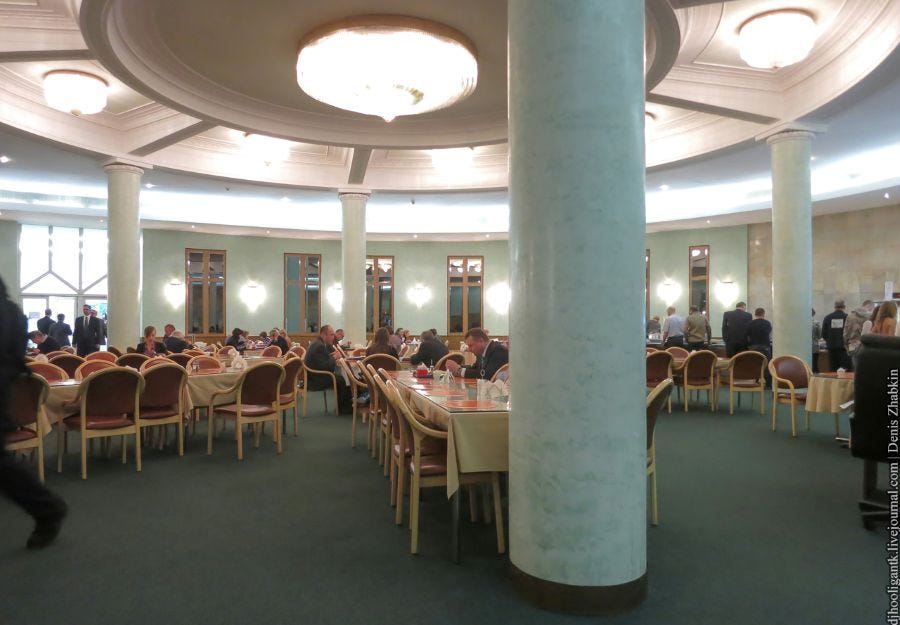 The State Duma cafeteria.
Whether the renaming of a dish is a precedent-setter remains to be seen. At present, in the Russian capital alone there are dozens of places, sites and monuments connected with Kyiv and Ukraine.
The strongest example is Kyivsky Railway Station. Moscow’s official transport portal still calls it that way. The station dates from the early 20th century and remains one of the city’s nine major railway terminals. Its name derives from its historical role as the railway terminal serving Kyiv and southwestern destinations.
Even more interestingly, the square immediately outside it is still Kyivsky Station Square.
There are also three Kyivskaya stations on three different Moscow Metro lines. One of them, Circle Line Kyivskaya, was designed by architects from Kyiv after their proposal won a competition among 73 entries. Its decoration is explicitly connected with Ukrainian architectural traditions, and its official description says that the artistic design is devoted to the friendship of the Russian and Ukrainian peoples. A second one, Arbatsko–Pokrovskaya Kyivskaya, is decorated with mosaics and frescoes depicting Soviet Ukraine, Ukrainian workers and the historical relationship between Ukraine and Russia.
Even more — there is an 800-meter-long Ukrainian Boulevard and a 2.6-kilometer-long Kyiv Street in the Russian capital.
One would be surprised to learn how many streets and places in cities and towns across Russia bear the names “Kyiv/Kyivskaya,” or “Ukrainian” or names of Ukrainian historical personalities. Tens of thousands. Will Russian authorities care to rename them all? Unlikely.
But before such a directive comes from the top or similar initiatives emerge from the bottom, let’s crack open the recipe for Chicken Kyiv, just in case.
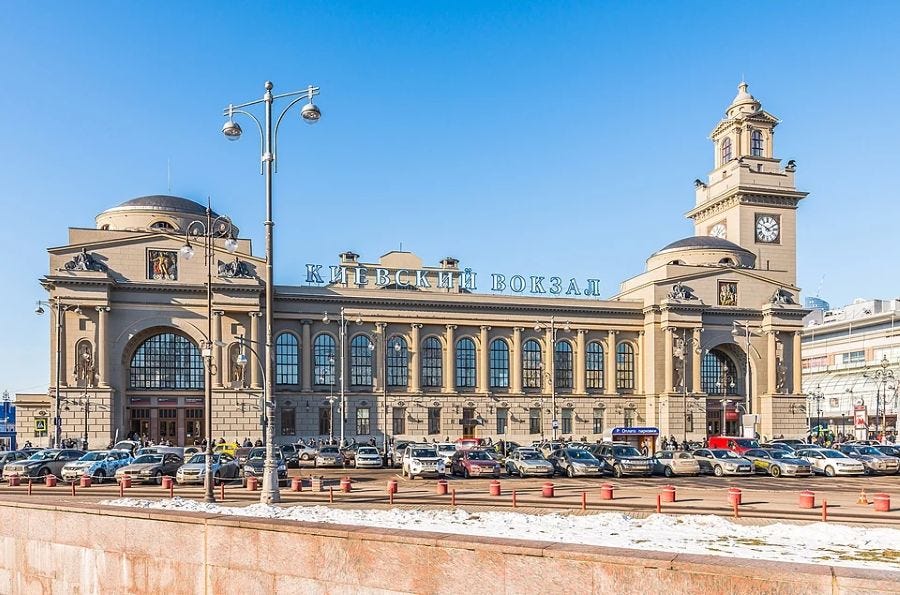 Kyivky Railway Station in Moscow.
Who invented Chicken Kyiv, and why is it called that?
Chicken Kyiv, known in Ukrainian as “kotleta po-kyivsky” and in Russian as “kotleta po-kievski,” is a breaded chicken cutlet containing a core of cold butter, usually mixed with herbs and sometimes garlic. When properly prepared, the butter melts during cooking and flows out when the cutlet is cut.
Despite its name, the dish’s precise origin remains disputed. Its history appears to involve French culinary techniques, Russian imperial-era restaurants and later Ukrainian culinary development.
One of the oldest culinary traditions associated with Chicken Kyiv is the French côtelette de volaille, a preparation involving poultry and techniques that became fashionable in the kitchens of European aristocracy.
During the 18th and 19th centuries, French chefs and French culinary practices had a considerable influence on the dining culture of the Russian Empire. French-style meat dishes were adapted to local ingredients and preferences, and some historians connect this tradition to the development of Chicken Kyiv.
A related dish known as Mikhailovska cutlet is sometimes identified as an ancestor of the modern recipe. According to a Ukrainian chef interviewed by U.S. public radio station GBH, a veal-based French preparation was adapted in Moscow using chicken. The exact connection between these early preparations and the modern cutlet is not conclusively established.
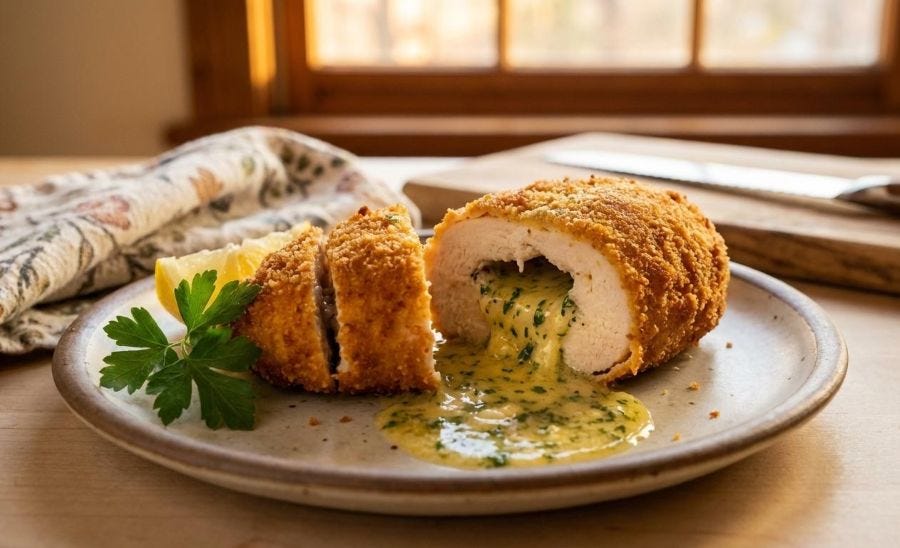 Chicken Kyiv.
The early 20th-century recipes
A particularly useful historical reference is a recipe published in a Russian culinary periodical in 1913–1914, which was described as Kyiv cutlets made of chicken or veal.
According to Russian culinary historians writing for The Moscow Times, the early recipe used minced meat, with a piece of butter placed in the center of each cutlet. The patties were then coated in egg and breadcrumbs and cooked. This differs from the familiar modern version, which uses a whole piece of chicken breast wrapped around the butter filling.
Another historical reference is a 1915 cookbook recipe for Kyiv cutlets made with chicken or veal. These early recipes establish that the Kyiv name was already in culinary use before the Soviet era, although they do not establish who first created the dish or why it was named after the city.
Kyiv’s role in popularizing the dish
One account places the dish’s revival in Kyiv in 1947, after the Second World War. According to this version, a cook serving diplomats at a reception in the city prepared chicken cutlets containing butter. The dish subsequently became popular in restaurants along Khreshchatyk, Kyiv’s central street, and spread through the Soviet restaurant system.
By the 1950s, Chicken Kyiv had become a recognizable dish associated with the Ukrainian capital. It later gained international popularity, particularly through Soviet tourist restaurants and international travel.
There are also records of Chicken Kyiv being mentioned in the United States before the postwar reconstruction in Kyiv. The Chicago Tribune reportedly described chicken breasts prepared à la Kiev in 1937. This suggests that the dish’s name was already circulating internationally, although the early American reference does not clarify where the modern recipe originated.
How to make traditional Chicken Kyiv
The modern version is made from whole chicken breast rather than minced meat. The essential technique is to enclose cold butter inside the chicken, seal it carefully, coat it in breadcrumbs and fry or bake it until cooked through.
The following is a practical recipe for four portions, based on established modern preparations. I asked ChatGPT to look for the recipe on the Internet, so this is its version.
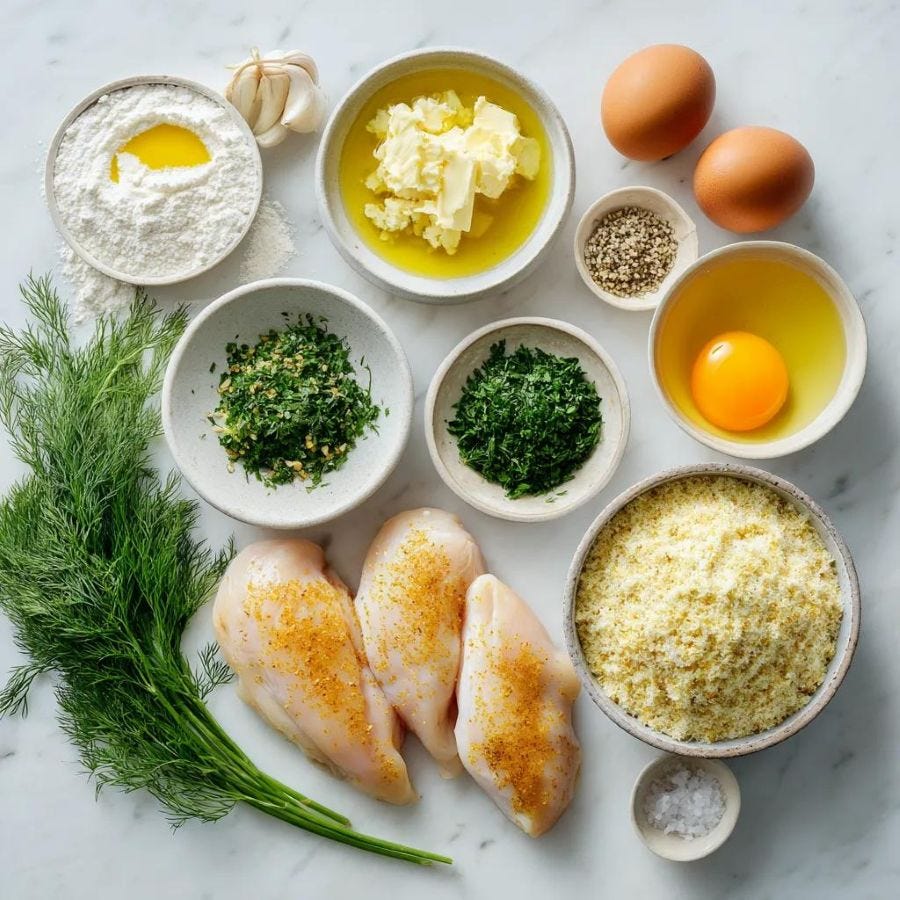 The ingredients for Chicken Kyiv.
Ingredients:
For the chicken
· 4 boneless, skinless chicken breasts (approximately 150–180 g each)
· 100 g unsalted butter, softened
· 2 garlic cloves, finely crushed
· 2 tbsp finely chopped fresh parsley
· 1 tsp lemon juice
· Salt and freshly ground black pepper
For the coating
· 75 g plain flour
· 2 large eggs
· 150 g fine breadcrumbs
· Vegetable oil, for frying
· To serve (optional)
· Mashed potatoes
· Green peas or steamed vegetables
· Lemon wedges
Preparation
Prepare the herb butter.
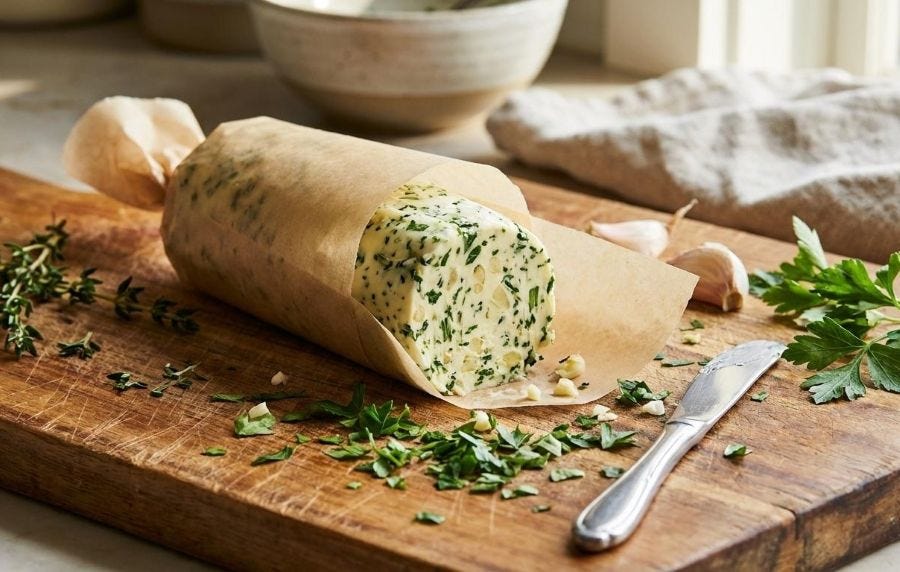
Mix the softened butter with crushed garlic, parsley, lemon juice, salt and pepper. Shape the mixture into a small log, wrap it in baking paper and refrigerate until firm. You can also divide it into four individual portions and freeze them briefly.
 2. Prepare the chicken breasts.
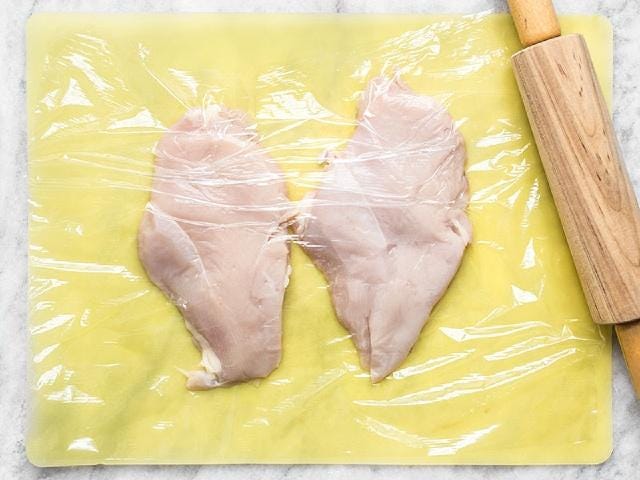
Slice each breast horizontally to open it like a book, without cutting all the way through. Place it between two sheets of cling film and gently pound it with a meat mallet until it is evenly thin, approximately 5–7 mm. Avoid tearing the meat.
 3. Enclose the butter.
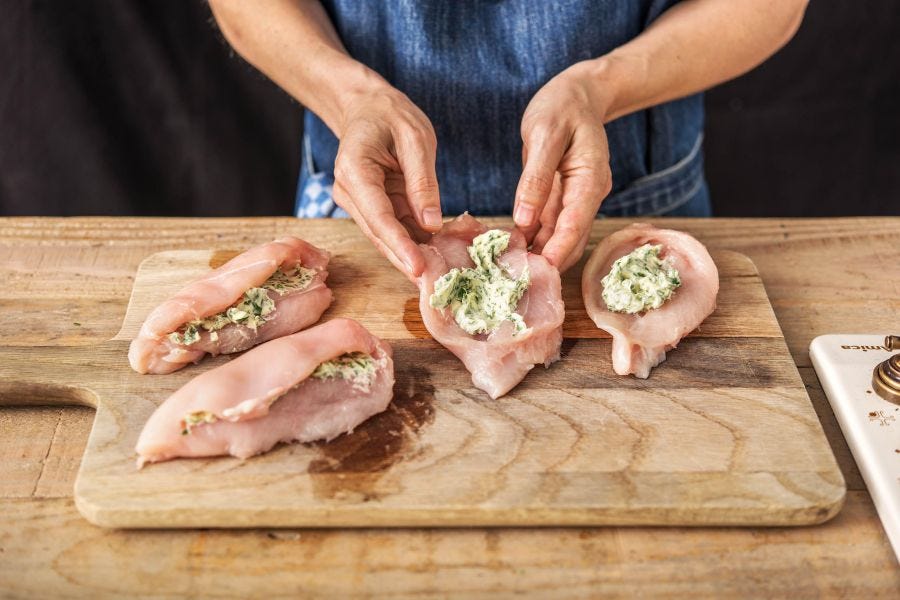
Place a portion of chilled herb butter in the center of each chicken breast. Fold the sides over the filling, then roll the chicken tightly into an oval shape, fully enclosing the butter. Ensure there are no openings through which the butter could escape.
 4. Chill the cutlets.
Wrap each cutlet tightly and refrigerate for at least 30 minutes, or briefly freeze until firm. This helps the chicken retain its shape and keeps the butter from melting too early.
5. Bread the cutlets.
Prepare three shallow dishes: one with flour, one with beaten eggs and one with breadcrumbs. Coat each cutlet in flour, dip it in egg and cover it thoroughly with breadcrumbs. For a more secure crust, repeat the egg and breadcrumb coating. Press gently to make the coating adhere.
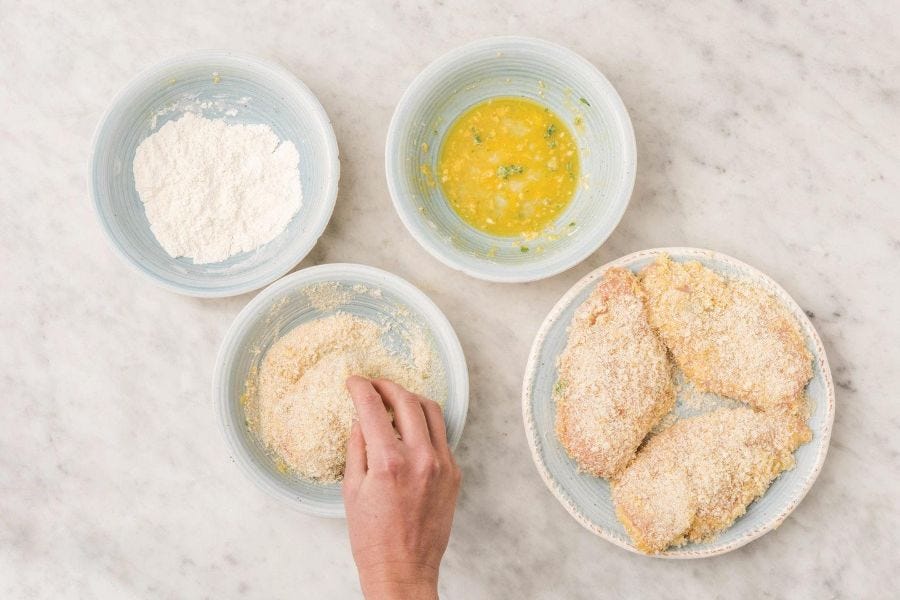 6. Fry until golden.
Heat vegetable oil in a deep pan to approximately 160–170°C. Fry the cutlets in batches, turning them carefully, until the coating is golden brown. Depending on their size and thickness, allow approximately 6–9 minutes, taking care not to overcrowd the pan.
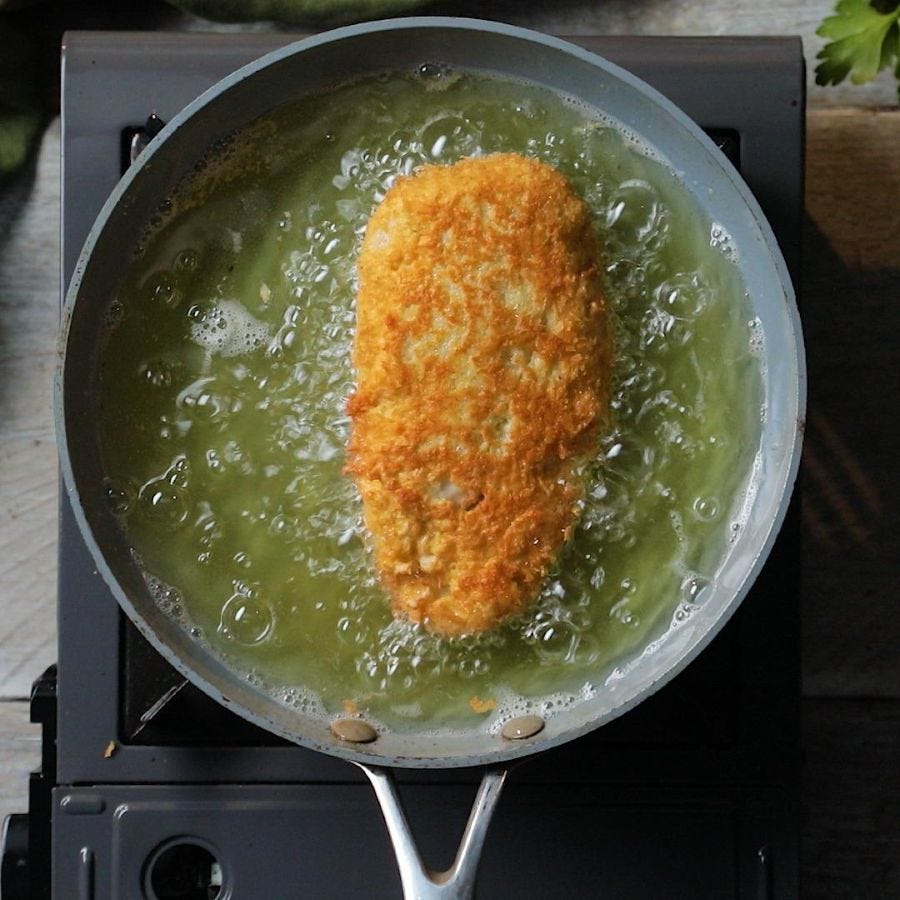
7. Finish cooking in the oven.
Transfer the cutlets to a baking tray and finish in a preheated oven at 180°C until the centre of the chicken reaches 74°C. The required time will depend on the thickness of the cutlets; approximately 10–15 minutes is a useful guide. Use a food thermometer to check the thickest part of the chicken without touching the butter filling.
8. Rest and serve.
Allow the cutlets to rest for approximately five minutes before serving. Serve whole or sliced open, accompanied by mashed potatoes, green peas or vegetables. The melted garlic and herb butter should flow out when the cutlet is cut.
Bon appetite.
You may support my writing effort via BuyMeCoffee. Any help is welcome.
Sources and references:
- TV Rain — Original report on the State Duma cafeteria’s renaming: https://tvrain.tv/news/v-stolovoj-gosdumy-pereimenovali-kotletu-po-kievski-teper-eto-kotleta-so-slivochnym-maslom-576611/
- Kommersant — State Duma cafeteria renames Chicken Kyiv: https://www.kommersant.ru/doc/8989583
- OSW — Putin’s article on the historical unity of Russians and Ukrainians: https://www.osw.waw.pl/en/publikacje/analyses/2021-07-13/putins-article-historical-unity-russians-and-ukrainians
- Kyiv History Museum — Kyiv for the Feast: https://kyivhistorymuseum.org.ua/en/exhibitions/to-kyiv-for-the-feast-a-delicious-history-through-the-ages/
- The Guardian — How to make Chicken Kyiv: https://www.theguardian.com/food/2023/oct/18/how-to-make-chicken-kyiv-recipe-felicity-cloake
- The Moscow Times — How Chicken Kyiv conquered the world: https://www.themoscowtimes.com/2024/09/07/how-chicken-kyiv-conquered-the-world-a86295
- The Chicago Tribune — Pastrama (1914); Chicken Kiev; Chicago Piano & Chicago Typewriter:
https://listserv.linguistlist.org/pipermail/ads-l/2004-May/038478.html