

These may be the final four years of American democracy and the beginning of an oligarchic era.
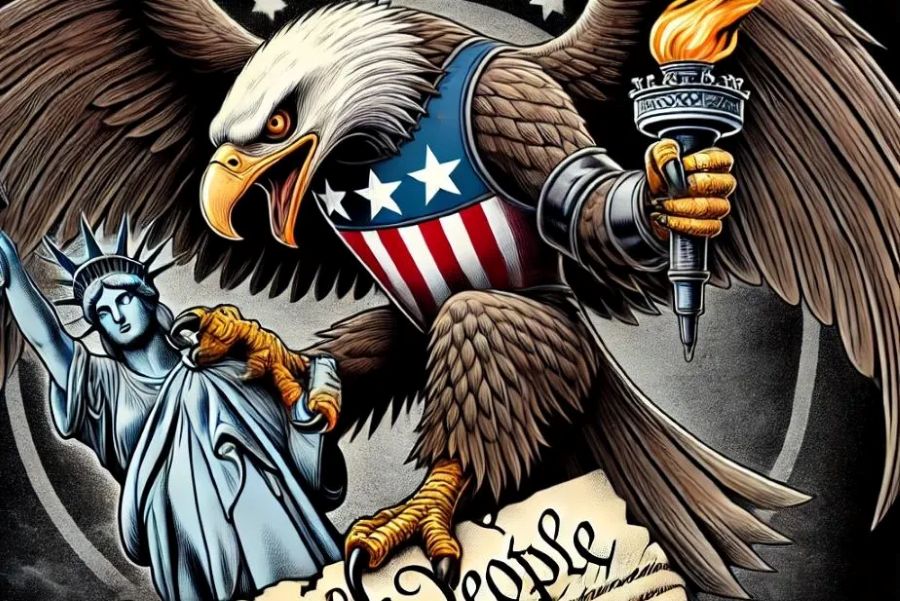 Generated with AI to illustrate the story.
Do you remember what U.S. President Donald Trump promised back in July 2024 — when he was still the Republican candidate — during a rally of Christian voters?
“You won’t have to do it anymore. Four more years, you know what? It’ll be fixed, it’ll be fine. You won’t have to vote anymore, my beautiful Christians,” he told the religious congregation at Turning Point Action’s “Believers Summit” in West Palm Beach, Florida.
What did Trump mean by this?
He meant exactly what he said. More than anything else, Trump despises losing, viewing it as a personal humiliation rather than a normal democratic process. Running for office does not guarantee victory, as he learned in 2020, so he may be strategizing to eliminate elections altogether.
Trump can’t do it overnight — that would be too radical — but he has nearly four years to make it happen. His approach could mirror that of Benito Mussolini in 1920s Italy: stripping the goose of one feather at a time, eroding democracy gradually to avoid triggering widespread resistance.
A Step-by-Step Plan to Dismantle Democracy
Mussolini dismantled democratic institutions incrementally, ensuring each move was small enough to avoid immediate backlash. Trump is employing a similar strategy. His flood of executive orders — many contradicting existing U.S. laws — aims to reshape institutions to serve his personal ambitions.
His administration has already begun dismantling agencies and initiatives that could challenge his authority, including USAID, the Foreign Influence Task Force, the Consumer Financial Protection Bureau, and Task Force KleptoCapture.
In addition, Trump has slashed student loan forgiveness and federal funding for school meals.
The question is: How far will he go? Which actions from his conservative Agenda 2025 can still be anticipated and thwarted? Just a few things to remind what Agenda 2025, developed by billionaire-backed think tanks, is about:
✔ Abolish independent regulatory agencies (EPA, FTC), ensuring unchecked corporate control.
✔ Replace civil servants with loyalists who prioritize business interests over public welfare.
✔ Privatize public services, making healthcare, education, and infrastructure for-profit ventures.
✔ Expand digital surveillance, allowing tech oligarchs to control information flow and suppress dissent.
As the document’s name suggests, all must be done by the end of 2025.
Echoes of the Past: Historical Parallels
Some key tactics from history illustrate the playbook Trump may follow:
1. Creating Political Turmoil — Mussolini exploited post-World War I economic crises, social unrest, and fears of communism to position himself as a strong leader. Trump, too, leverages economic instability and war-induced inflation, promising swift solutions while consolidating power.
2. Staging a Show of Force — Mussolini’s 1922 March on Rome forced King Victor Emmanuel III to appoint him as Prime Minister to prevent civil war. Trump’s own attempt at a coup — the January 6, 2021, Capitol attack — was a preview of how he might use political violence to his advantage.
3. Gradual Legal Changes — Mussolini passed laws like the Acerbo Law (1923) to ensure his party’s dominance. Trump’s executive orders are methodically altering the U.S. legal framework to entrench his authority.
4. Suppressing Opposition — Mussolini used secret police and censorship to weaken rivals. Trump is installing loyalists in key departments and law enforcement agencies (Justice Department, FBI) to ensure opposition faces legal retaliation.
5. Propaganda and Indoctrination — Mussolini reshaped public perception through state-controlled media and nationalist rhetoric. Trump is doing the same, using conservative media outlets while ensuring independent journalists are squeezed out of institutions like the Pentagon.
By the time Mussolini declared himself Il Duce and Italy a one-party fascist state, opposition had been eroded. Trump is following the very same script.
Hitler Comparison: Another Warning
While different in ideology and context, Trump and Adolf Hitler share strikingly similar strategies:
✔ Rising to Power Through Legal Means — Hitler was legally appointed Chancellor in 1933, then dismantled democracy. Trump, despite losing the popular vote in 2016, gained power and has since worked to weaken democratic institutions.
✔ Scapegoating Minorities — Hitler blamed Jews; Trump blames immigrants and minorities, using policies like Muslim bans and mass deportations to justify authoritarian measures.
✔ Undermining the Free Press — Hitler called journalists the “Lügenpresse” (lying press); Trump brands them “Fake News” and the “Enemy of the People.”
✔ Exploiting Crises — Hitler used the Reichstag Fire to justify emergency rule; Trump falsely claimed election fraud and incited the January 6 insurrection.
✔ Targeting the Judiciary — Hitler replaced independent judges with loyalists; Trump has packed courts with judges who will shield him from legal consequences.
How Trump Could Stay in Power Indefinitely
Knocking down one of the basic pillars of democracy — free and fair elections — will significantly weaken the democratic regime. Trump could follow these pathways to extend his rule:
1. Undermining Elections — Republican-led states have already enacted restrictive voting laws. Future tactics may include purging voter rolls, limiting polling stations, and manipulating the Electoral College.
• Restrictive Voting Laws: Republican-led states, as you noted, have already implemented laws that restrict voting access, especially targeting marginalized groups. This could evolve with Trump’s influence to further gerrymander districts, suppress opposition voters, or make it harder for individuals to participate in elections.
• Purging Voter Rolls and Limiting Polling Stations: These actions could disproportionately affect voters in urban and minority-heavy areas. If Trump’s administration pursued these tactics on a larger scale, it could systematically disenfranchise key voting blocs that typically oppose his policies.
• Electoral College Manipulation: The Electoral College, which already allows a candidate to win the presidency without winning the popular vote, could be manipulated to secure a more favorable result for Trump, especially in key swing states. This would further undermine the will of the people and deepen the erosion of democratic norms.
2. Overriding Term Limits — The 22nd Amendment, which limits U.S. presidents to two terms, is a crucial safeguard to prevent any individual from holding power indefinitely. However, if Trump were to push for its repeal or find ways around it, it could set a dangerous precedent. Repealing term limits would open the door for a shift toward authoritarianism.
• Repealing the 22nd Amendment: This would require a constitutional amendment, which is no small feat. Yet, in a more polarized political climate, and with a willing Congress, Trump could leverage his influence to garner support for this repeal, framing it as a “necessity” for the country’s stability or security.
• Exploiting Emergency Powers: In extreme cases, a president could declare a national emergency and suspend certain constitutional provisions, including term limits. This might be couched in terms of national security, economic crises, or civil unrest. Trump could argue that the nation needs a strong, stable leader for an indefinite period, bypassing democratic checks and balances.
3. Declaring a State of Emergency — By manufacturing or exaggerating crises (terror threats, economic collapse), Trump could justify the suspension of democratic norms and institutions, invoking emergency powers to suspend elections and remain in office indefinitely. This tactic is particularly concerning because it places control in the hands of the executive, often sidelining legislative or judicial oversight.
• Manufacturing or Exaggerating Crises: In the past, Trump has been known for amplifying threats, both real and imagined. He could use the pretext of terrorism, economic collapse, or even public health crises to justify expanding executive power. These manufactured threats would likely involve a narrative of chaos and danger that only his leadership could quell.
• Suspending Elections: Once emergency powers are invoked, elections could be postponed or even canceled under the guise of national security. In a state of emergency, Trump could argue that the country is too unstable to conduct free elections, allowing him to stay in power indefinitely.
A Hidden Hand: The Rise of the Oligarchs
While Trump dominates headlines, his erratic leadership and lack of expertise suggest he is not acting alone. Rather than a strategic mastermind, Trump functions as a puppet — a lightning rod absorbing public outrage while the real architects of power operate in the background.
Behind him stands a new class of oligarchs: tech moguls, corporate elites, and financial power players who manipulate weak, controllable politicians to secure their grip on the country.
In fact, Trump is a weak individual, and therefore an ideal puppet. He craves attention, not governance — his obsession with rallies and media coverage makes him the perfect figurehead while real policy is dictated by those behind the scenes.
He serves as a distraction for the masses — his scandals keep the public fixated on him rather than the structural shifts occurring in government. He is also easily manipulated — oligarchs understand Trump’s need for praise and leverage it to influence policy in their favor.
What Comes After Trump?
By weakening the core structures of democratic systems — such as elections, term limits, and emergency powers — Trump would be working to reshape the political landscape into one where his rule could persist far beyond what democracy typically permits. This undermines the checks and balances that prevent any one person from accumulating too much power.
Even if Mr. Trump eventually exits, the oligarchic infrastructure will remain, ensuring future leaders serve corporate interests rather than the people. The U.S. could become a façade democracy, where elections exist in name only, political opposition is controlled, and the media landscape is shaped by a few powerful entities.
The question is no longer whether Trump will stay in power — it’s whether the American people will recognize and resist the deeper shift toward permanent oligarchic rule before it’s too late.