

A billionaire privateer who triggered the world’s first global manhunt quit the trade to vanish from history for good.
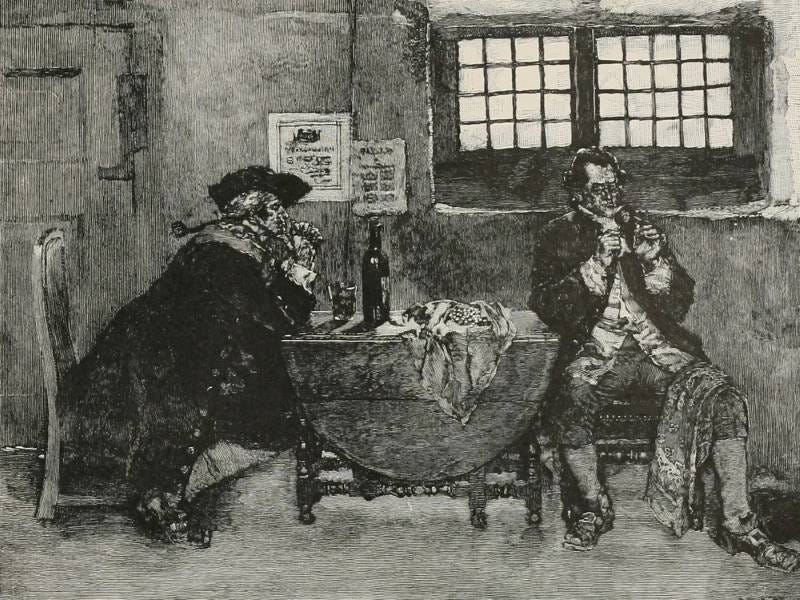 An illustration of Henry Every selling his diamonds.
Henry Avery was wealthier than most monarchs at his time — and by a wide margin. He was not only the most successful pirate of all time, but also the first man to trigger what could fairly be called a global manhunt. By modern estimates, his fortune would place him in the same league as Elon Musk or Jeff Bezos — except Avery earned his wealth with cannons rather than code or shipping.
Born near Plymouth, England, in 1659, Avery went by an impressive collection of names over his lifetime: Henry Avery, John Avery, Jack Avery, Henry Bridgeman, and Benjamin Bridgeman. Moderately educated and clearly ambitious, he served in the Royal Navy and likely aboard several merchant vessels and warships, particularly during England’s war with France beginning in 1688.
Career change
Like many sailors of his era, he eventually noticed that piracy paid better than loyalty.
In early 1694, Avery was appointed first mate aboard the privateer Charles II, a ship officially in the service of the King of Spain. The mostly English crew, however, had little affection for their Spanish officers, who treated them poorly and paid them worse.
After months of frustration, the crew allegedly persuaded Avery to lead a mutiny. In May 1694, they seized the ship, renamed it the Fancy, and made a collective career change.
Given the circumstances, piracy was less a moral choice than an economic one.
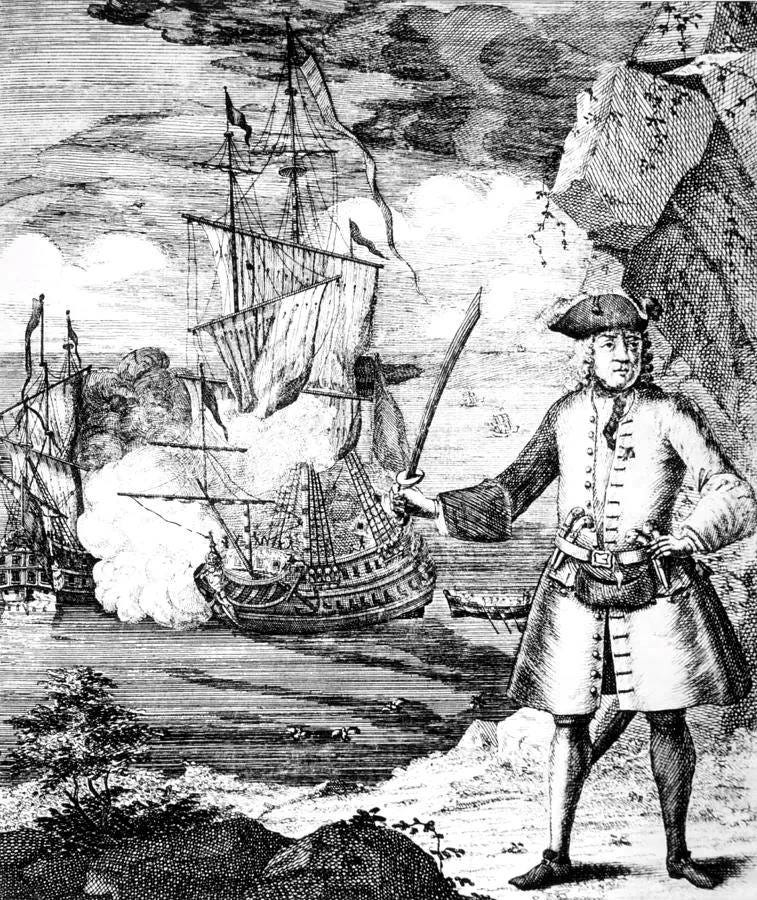 An illustration of Captain Avery watching a naval battle.
Captain Avery soon began attacking English and Dutch merchant ships off the African coast, later expanding operations into the Atlantic and Caribbean, where Spanish and French vessels proved particularly profitable. He turned out to be a capable leader and an excellent sailor. Before long, he earned the nickname “the Pirate King” and a reputation as the most successful pirate of his generation.
Avery was clearly intelligent and highly pragmatic. His rise was not accidental: he successfully led a mutiny, maintained discipline aboard the Fancy, navigated complex trade routes, coordinated with other pirate captains, and chose targets with exceptional care.
Unlike many pirates who relied on indiscriminate violence, Avery demonstrated strategic patience, attacking only when the odds were decisively in his favor, using intelligence from a network of spies including official figures from various jurisdictions.
The exact number of ships he captured remains unknown, but Avery’s fame rests on a single, extraordinary raid. Off the Indian coast, he seized the Ganj-i-Sawa’i (also known as the Gunsway), a heavily armed treasure ship belonging to the Grand Mughal Empire. It was carrying gold, silver, and diamonds valued by historians at between $200 million and $400 million in today’s money.
Overnight, Avery and his crew became multimillionaires — an outcome few corporate bonus schemes have ever matched.
His capture of the Ganj-i-Sawai was not a reckless act but the result of planning, intelligence-gathering, and opportunism, suggesting a calculating and forward-thinking mind rather than a purely impulsive temperament.
Avery maintained unusual cohesion and loyalty among his crew, at least during the height of his career. This implies a leadership style that balanced authority with incentives — most likely a fair distribution of loot and clear command structure.
His ability to keep order after the single largest pirate heist in history suggests he was calm under pressure and capable of managing men in volatile circumstances, a trait not common among pirate captains.
Global manhunt
The raid alarmed the English Crown, which was keen to avoid a diplomatic crisis with the Mughal Empire while expanding its trade routes and colonial reach. Since the Fancy had operated across both the Indian and Atlantic Oceans, Avery suddenly found himself wanted by the English, Spanish, French, and — most urgently — the Mughals.
It was the first truly global manhunt for a single individual.
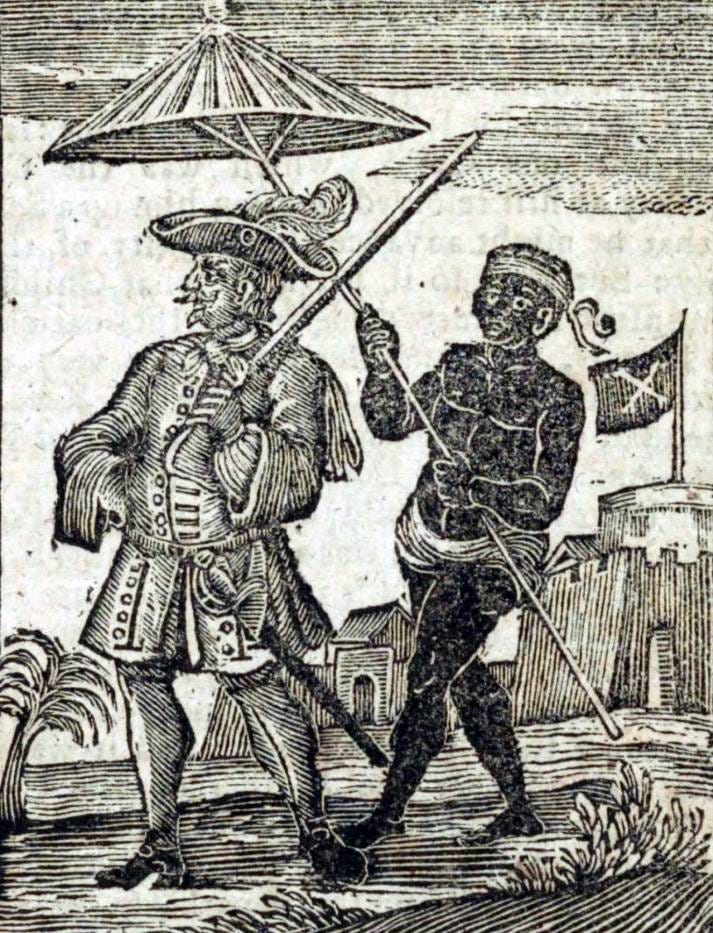 An illustration believed to depict Henry Avery inspecting his base.
London alone offered a £1,000 bounty for his capture, an enormous sum at the time. Authorities were not the only ones looking for him. Fellow pirates, opportunists, and former friends were equally interested in locating a man rumored to be carrying unimaginable wealth.
Avery understood that his luck could not last forever. Rather than wait for betrayal or capture, he chose to disappear.
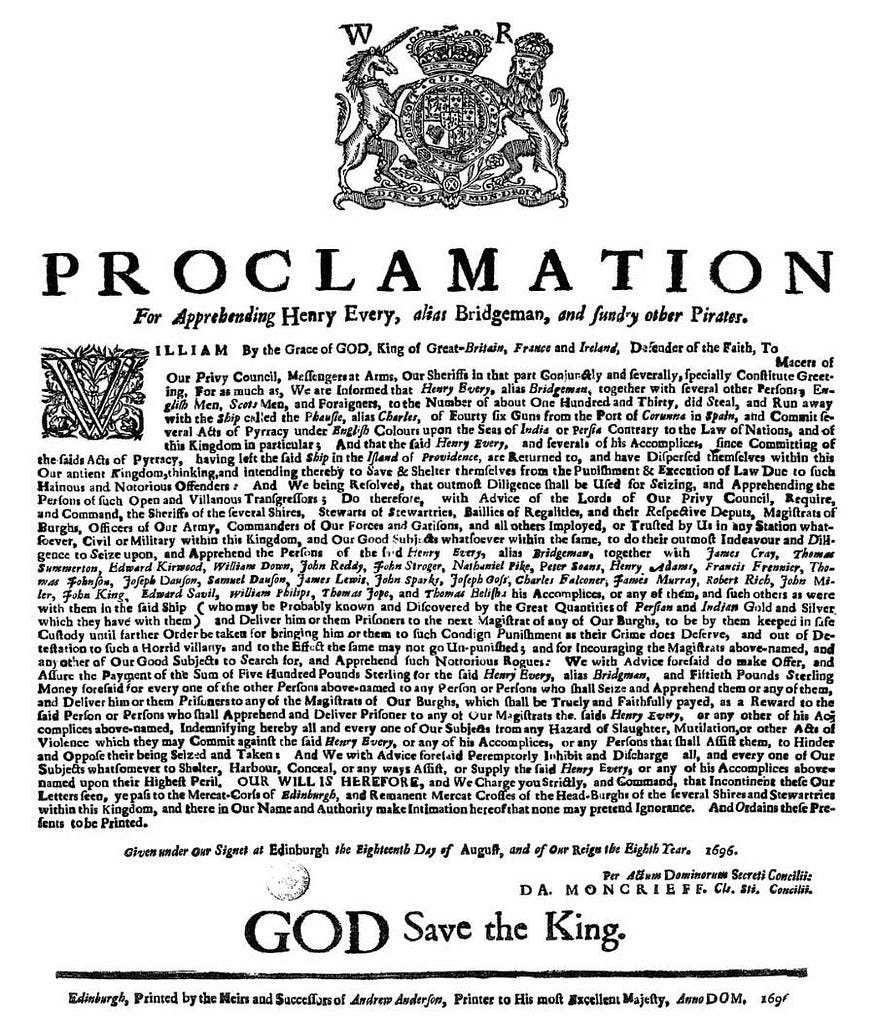 The official bounty proclamation on the name of Henry Avery, issued by the Privy Council in London in 1696.
Witness accounts suggest that in early April 1696, the Fancy anchored near New Providence in the Bahamas. Avery bribed the local English governor, Nicholas Trott, to secure temporary protection for himself and his 160-man crew.
Legend holds that this pirate encampment marked the beginning of New Providence’s transformation into an international piracy hub in the decades that followed. Avery’s money helped build a genuine settlement, complete with a church, and the island was largely spared pirate attacks — partly because few pirates were foolish enough to attack a place full of other pirates.
As for Avery himself, the “Pirate King” appeared unsure what to do next. He allegedly considered returning to England under a new identity, becoming a plantation owner in America, or vanishing on a Caribbean island. Instructing his crew to call him Benjamin Bridgeman, he disappeared several months later.
The crew scattered. Some were captured and hanged, others squandered their fortunes on drink and women, some joined new pirate crews, and a few quietly bought farms and retired — proof that even pirates occasionally dreamed of peaceful old age.
British records are full of details about pirates such as Francis Drake, Henry Morgan, Blackbeard, Calico Jack, and William Kidd. Curiously, they say very little about what happened to Henry Avery after New Providence.
Avery’s behavior after the Mungal heist is revealing. Rather than continuing piracy indefinitely — as many would have — he disappeared almost immediately, strongly suggesting his goal was one decisive success followed by escape, not domination or notoriety.
One account claims he landed in Ireland in June 1696 and narrowly avoided arrest. Another suggests he settled in Madagascar and founded a small utopian republic, ruling as its “president for life.” Yet another rumor holds that he purchased a royal pardon and became an English spy, living quietly and anonymously.
What is known is that when England declared an amnesty in 1698 for pirates willing to surrender and enlist in the king’s forces, two men were explicitly excluded: William Kidd and Henry Avery.
At just 36 years old, Avery vanished for good. He was never seen again. Historians believe he died sometime between 1699 and 1714, with no location of his graveyard known. His immense fortune — which would let him compete successfully with the most monarchs at that time — was never recovered.
For the wealthiest pirate in history, it was a remarkably clean exit. Some historians speculate that he may had acquired a new identity, bought an estate, married, and lived a quiet life long enough to see his grandchildren grow.
Sources: Smithonianmag, Wikipedia, WorldHistory, The Guardian, Thoughtco, Screenrant, Unchartered.Fandom