

From the Soviet invasion of Warsaw Treaty allies to NATO’s divided responses to modern conflicts, history shows that collective commitments have always had limits. Unless they are linked financially.
 Generated with AI to illustrate the story.
Budapest, 7 November 1956. Heavy battlefield tanks are rolling through the streets and men in regular army uniforms are occupying governmental institutions and key infrastructure. Gunshots and cannon blasts echo through the city as fires break out in many places.
But no new war has started. The last one, World War II, ended more than one decade ago and the country is protected by the Warsaw Treaty Organization — a Soviet Union-led alliance of new communist countries in Eastern Europe.
And yet, the soldiers of the invading force wore Soviet military uniforms and the tanks had red stars on their turrets.
Hungarians were defending themselves against a political and military ally that felt threatened by their reforms.
Twelve years later, history repeats itself in Czechoslovakia. Under strikingly similar circumstances, Soviet-led Warsaw Pact forces invade another member of the alliance to suppress a political transformation Moscow considers unacceptable.
The organization’s statute clearly stated that an attack on a member country would be interpreted as an attack on the entire bloc. Nonetheless, it turned out the enemy was not external, but internal. Instead of uniting against the aggressor, the rest of the members — except for Romania — joined the operation.
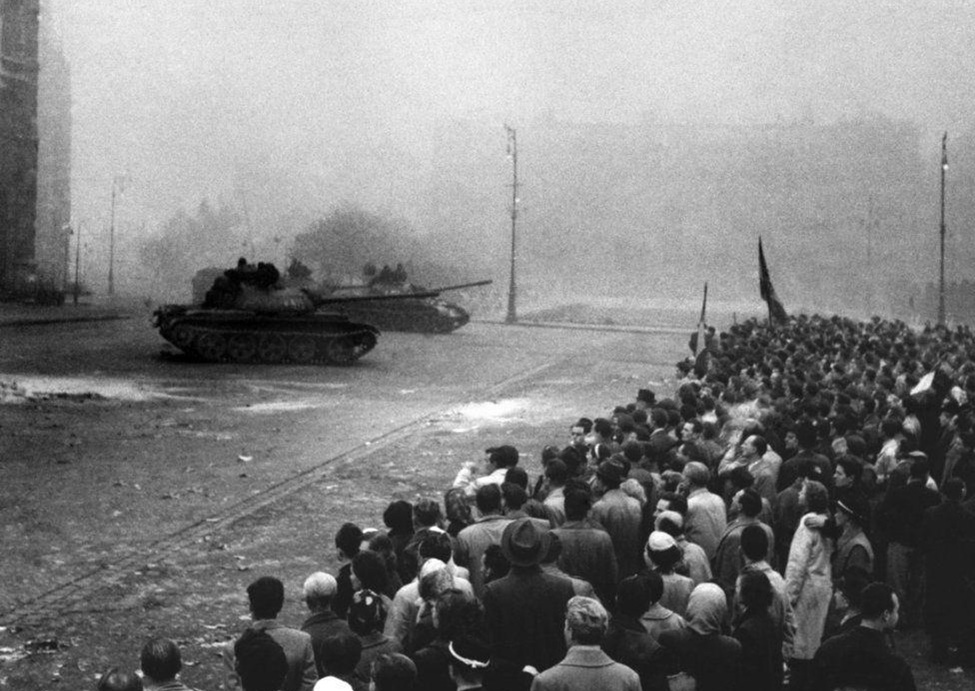 Soviet tanks crushing public protests in Budapest. Image credit: Wikipedia
Example #2: NATO
Fast forward to our days, and we find another example — North Atlantic Treaty Organization (NATO), the world’s most powerful military-political alliance. The parallel is not exact, because none member has attacked another member. On the contrary — almost all of its members have, at one time or another, contributed to military campaigns led by the alliance’s hegemon, the United States.
In 1999, NATO launched its bombing campaign against Yugoslavia over the Kosovo conflict. All 19 NATO members at the time supported the operation, although not all contributed combat aircraft or other military assets. Some members sent peacekeeping forces.
On 11 September 2001, the U.S. suffered the worst terrorist attack on its soil. Washington requested assistance from its NATO allies, and Article 5 of the North Atlantic Treaty was invoked for the first and only time in its history, declaring that an attack against one member was an attack against all.
The attacker was identified as al-Qaeda, a terrorist organization, not a state. The same year, the U.S. launched a military campaign in Afghanistan, though its government was not itself responsible for 9/11 but — it was only sheltering the suspect.
Nonetheless, NATO members subsequently joined the U.S. operations in Afghanistan. The mission eventually grew to more than 50 NATO and partner countries.
 The World Trade Center in New York being destroyed. Image credit: Getty images
Then came Iraq.
In 2003, the United States invaded Iraq. NATO as an organization did not launch the war, but several of its members joined the U.S.-led coalition, while others opposed the invasion. Britain, for example, became Washington’s principal military partner, while France and Germany strongly rejected the operation.
Iran as the litmus paper for NATO
Finally, there’s the best example that illustrates the illusion of military alliances.
President Donald Trump ordered Pentagon to strike targets in Iran in late February 2026. Within months, this a limited conflict in scale has grown to a full war between the two countries. Washington formally invoked Article 5 and asked the member states to side by Americans.
And surprise! — everyone told Trump to go fuck himself. Politely and in a very diplomatic language, of course.
The U.S. was not attacked, they argued, so there was no legal ground for NATO to join the offensive. NATO itself stayed outside the war, although individual European allies provided the United States with access, logistics and other forms of enabling support.
And there’s an even bigger surprise here. Tehran responded with drone and ballistic missile attacks against countries hosting American bases and troops — and some projectiles fell in Türkiye, a NATO member. NATO subsequently increased its ballistic-missile defense posture and helped protect Turkish territory. Yet neither Türkiye nor NATO invoked Article 5, although Ankara had every legitimate right to ask for it.
Let’s recap the facts before going to the next argument.
2001: the U.S. is attacked → Washington asks allies for help → NATO invokes Article 5 → allies support the U.S.
2003: The U.S. invades Iraq → NATO does not join the war as an alliance → only some members do, while others oppose the campaign.
2026: the U.S. attacks Iran → Washington wants European/NATO support → NATO does not join the offensive → some members offer supporting infrastructure.
Then: Iran attacks a NATO member, Türkiye → NATO provides defensive assistance, but Article 5 is not invoked.
Russia
Russia’s war against Ukraine offers another test of the limits of military-political alliances. While waging a full-scale war against its neighbor, Moscow has also conducted hostile operations against European countries, including drone incursions into NATO airspace and sabotage of communications and critical infrastructure.
The timing and patterns of some of these incidents suggest that Russia is deliberately probing European air defenses, testing political resolve and measuring how far it can go without provoking a direct military confrontation.
 A Russian military drone after landing on Polish territory. Image credit: Polish television
NATO and its members have responded with interceptions, reinforced air defenses, investigations and other security measures, but nothing serious. They have avoided direct military retaliation against Russia, wary of turning a campaign of hybrid attacks and provocations into an open war between nuclear-armed adversaries.
This restraint may be strategically rational. But it also exposes a fundamental dilemma: how much risk are alliance members willing to accept in defense of one another when the threat is persistent, deliberate and potentially escalating, but remains below the threshold of a conventional armed attack? The short answer is: not much.
The main takeaway from this chapter is that military alliances are not unconditional guarantees of solidarity. Their members may share a treaty, military infrastructure and strategic objectives, but each government ultimately weighs collective commitments against its own national interests, political priorities and the risks of unwanted escalation.
The same alliance may mobilize when its leading power is attacked, remain divided when that power launches a war of choice, and limit its response when a member is threatened by the consequences of that war.
Then, why stick together? What is the purpose of military alignment?
Economic calculus
The answer may lie less in military solidarity than in the economic and strategic interests that make such alliances valuable in the first place.
First, military alliances are expensive. They require defense spending, permanent military infrastructure, joint exercises, weapons procurement, intelligence sharing and, ultimately, the willingness to risk lives. On the other hand, they can also generate substantial economic benefits. They reduce the cost of defense through shared capabilities, make long-term security planning more predictable, protect trade routes and supply chains, and create favorable conditions for investment and economic cooperation.
 U.S. ammunition deployed to Ukraine after being paid for by the E.U. Image credit: Politico
For smaller countries, alignment with a major military power can provide security guarantees that would otherwise be prohibitively expensive to build independently. In return, the leading power gains strategic access, military facilities, political influence and reliable partners in key regions.
The relationship, as practice demonstrates, is not necessarily equal, but it can be mutually beneficial.
The same logic applies to the economic ties that develop within and around military alliances. Defense contracts support industries and jobs across member states. Common standards make it easier to coordinate procurement and operate shared systems. Political alignment can also reinforce trade, investment and technological cooperation, while reducing the risks associated with geopolitical uncertainty.
But …
these interests can also pull allies in different directions.
A country heavily dependent on a particular energy supplier, export market or foreign investment may be reluctant to support policies or actions that threaten those ties. See the examples above.
Governments may calculate that the economic and political costs of joining a military operation outweigh the benefits of demonstrating solidarity. Even close allies can therefore disagree when their commercial interests, security priorities or domestic political pressures diverge.
This is not necessarily hypocrisy or a failure of diplomacy. It is how sovereign states operate and always have since nationalism. Governments, ideally, are accountable first and foremost to their own populations, economies and political systems. Treaty obligations matter, it’s true, but they are interpreted and implemented after consideration of the consequences of every decision.
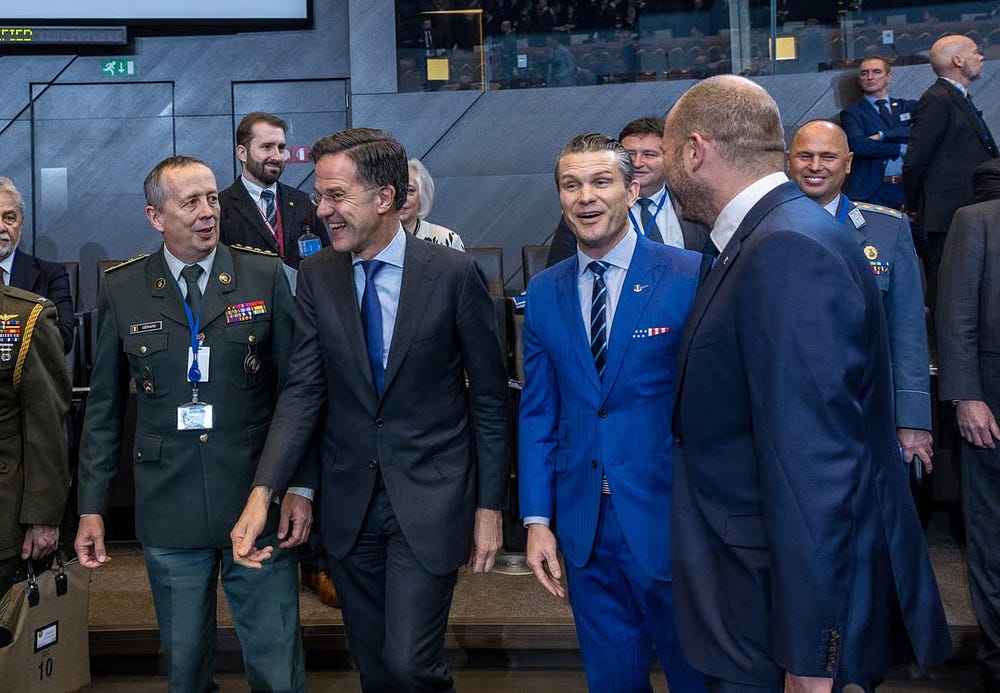 NATO Secretary-General Mark Rutte and U.S. War Secretary Pete Hegseth. Image credit: Politico
The Trump case
Donald Trump’s approach to NATO provides perhaps the clearest modern illustration. His relations with American allies have repeatedly combined military requirements with economic demands.
The Greenland dispute was the most striking example. In January 2026, Trump threatened to impose additional customs duties on Denmark and several other European NATO members unless they accepted to cede its sovereignty over Greenland to the U.S. The threat was explicitly linked to Washington’s territorial ambitions in the Arctic, rather than being presented as a necessary trade measure.
The message was difficult to miss. The United States was asking its European allies to remain committed to a common military alliance while simultaneously threatening one of those allies with economic punishment over an issue concerning its own territory.
A few months later, the same logic appeared in a different form. At the NATO summit in Ankara, Trump ordered a halt to trade with Spain, linking the measure to Madrid’s refusal to accept the Alliance’s new 5% defense-spending target and to its position on the war against Iran. Spain is not an adversary at all — it is an ally. Yet disagreements over military policy were accompanied by direct economic pressure.
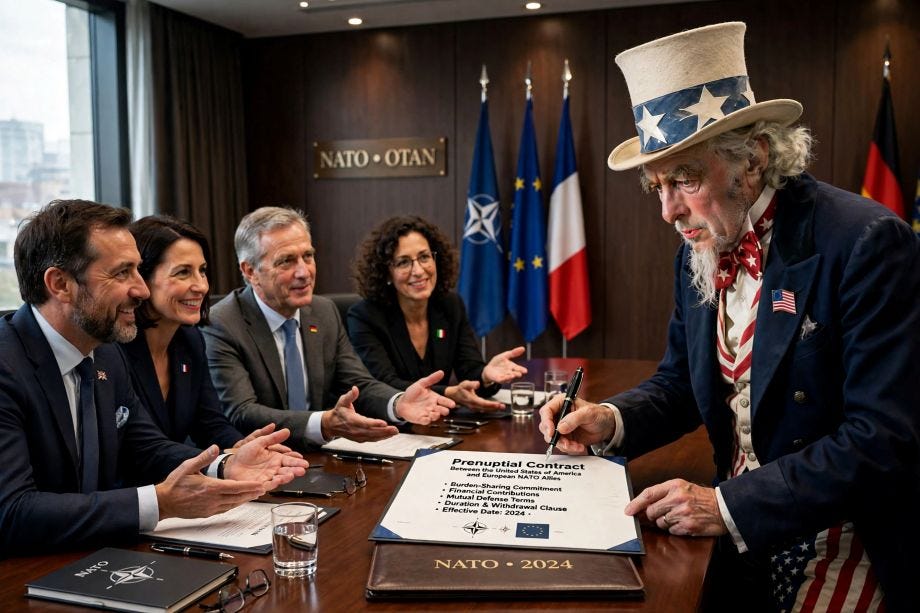 Generated with AI to illustrate the story.
There is another side to this equation, however. Trump’s pressure on NATO members to spend more on defense was not a security concern as many had thought and still think of it — it was meant to boost the American economy. Because much of the additional money spent by European allies goes into the transatlantic defense industry, including purchases from U.S. manufacturers. At the 2026 NATO summit, the White House openly admitted it, highlighting new contracts and joint ventures involving major U.S. companies.
In other words, military alignment creates an economic ecosystem. In the case of NATO, the European allies need American military technology; American defense companies need foreign customers; European governments need the American security umbrella; and Washington wants its allies to pay more for that security while buying more of the equipment needed to provide it.
This may be closer to the real foundation of a durable military alliance than declarations about eternal friendship. While former U.S. leaders praised the relationship for shared values, Trump was simply more honest about the whole thing, exposing the true alliance philosophy up to its bones.
The case of Armenia
Another revealing example comes from Russia’s relationship with Armenia and Azerbaijan.
Armenia was a member of Russia-led Collective Security Treaty Organization (CSTO), whose Article 4 contains a collective-defense commitment broadly comparable to NATO’s Article 5. Yet when Armenia came under attack along its internationally recognized territory in 2021 and 2022, Russia and the CSTO did not intervene militarily.
When Azerbaijan launched its decisive offensive in Nagorno-Karabakh in September 2023, Russian peacekeepers stationed there did not prevent Azerbaijan from taking control of the territory.
For Armenia, the message was devastating. Its supposedly indispensable military ally had failed to provide the security it expected from the alliance. In 2024, Prime Minister Nikol Pashinyan announced that Armenia had effectively frozen its participation in the CSTO, explicitly saying that the organization had failed to fulfil its objectives, particularly during the crises of 2021 and 2022.
Meanwhile, Moscow maintained important relations with Baku. Azerbaijan was richer, controlled substantial oil and gas resources and had developed close strategic relations with Türkiye, itself a NATO member. Russia and Azerbaijan therefore had reasons to preserve a pragmatic relationship even while Russia formally remained Armenia’s principal military ally.
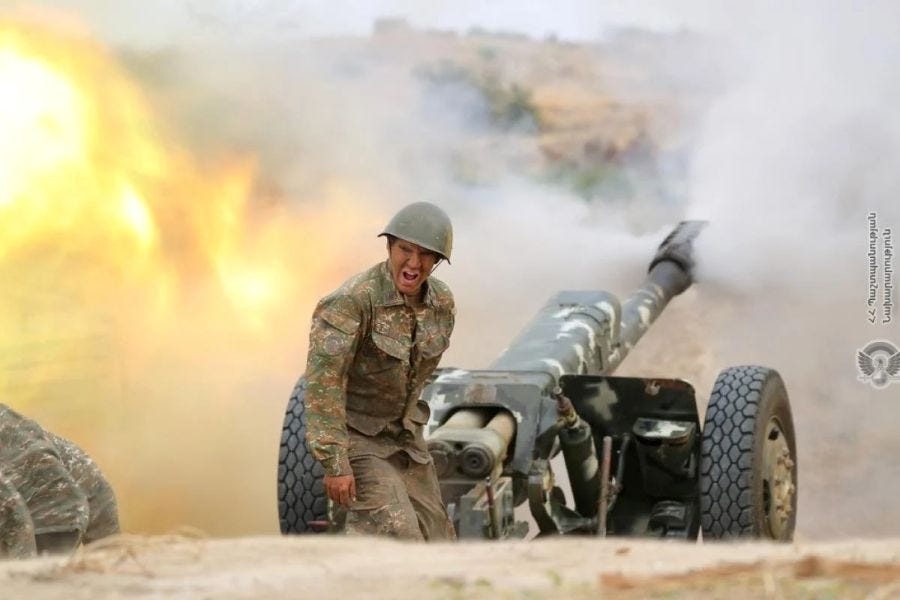 An Armenian soldier firing a howizer. Image credit: Foreign Affairs
Russia did not simply abandon Armenia because Azerbaijan had more money. International relations are rarely that simple. But the episode demonstrates something fundamental: treaty commitments operate alongside economic interests, regional influence and strategic calculations.
When those interests collide, the written promise of collective defense may prove less decisive than the broader relationship between the parties involved.
Let me compress this episode into one sentence: Armenia was formally Russia’s ally, while Azerbaijan was not — but Azerbaijan ultimately proved more valuable to Moscow’s regional calculations.
The epilogue
In the end, the relationships within a military alliance are transactional — and it always has been this way. Countries cooperate when cooperation serves their interests and spend when the expected security, political or economic return justifies the expense. But they reconsider their commitments when the costs become too high.
So no, military alliances have never been about defense based on friendship or merely shared threats. Because states do not have friends in the way individuals do — they have interests.
For a military alliance to be truly iron-clad, strong and enduring, it needs to be built around shared economic interests, joint ventures, trade and investment ties, technological interdependence, common infrastructure, and integrated supply chains.
Not the promise to fight together, but having enough to lose together.
***