
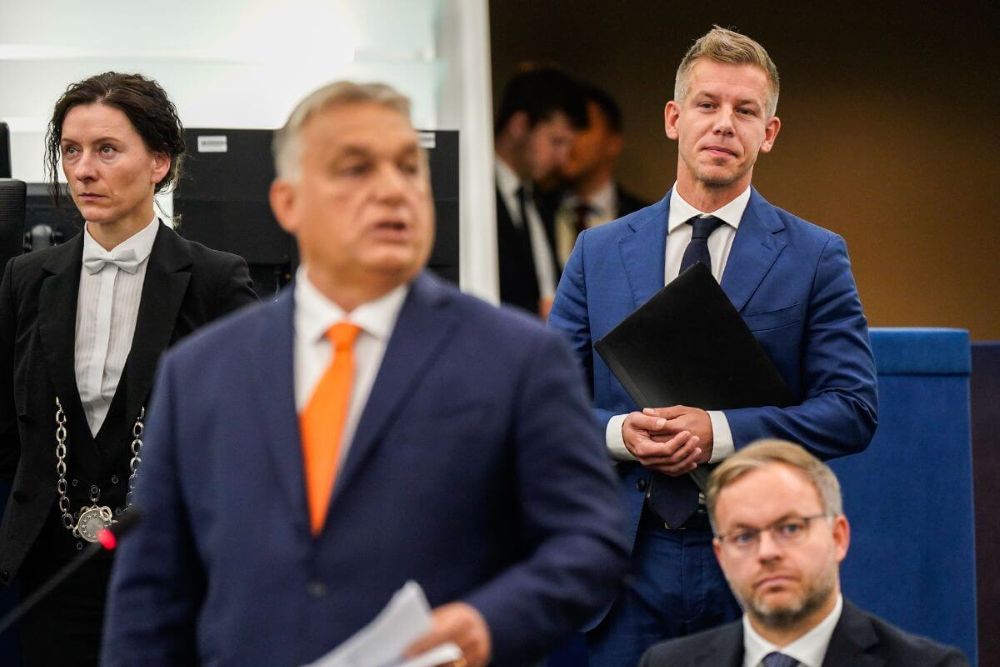
 Péter Magyar, in the background, listening to a speech by Viktor Orbán. European Policy Center / EP
A few months ago, I published a piece saying that the parliamentary election outcome in Hungary in April 2026 was a victory of Russia’s intelligence services. I know it’s a bold claim and I assume full responsibility for it. But not without evidence. As someone familiar with Russian covert operations, the election result suggested to me that Viktor Orbán simply let Péter Magyar win while formally participating in the spring scrutiny.
The latter had competed as the chairman of Tisza, a political party formed in 2020, whose leaders had been educated and promoted in various governmental roles by Fidesz, which dominated Hungarian politics between 2010 and 2026.
Unfortunately, the latest moves by the new government in Budapest reinforce my suspicions that Prime Minister Péter Magyar, whom Europe sees as the fresh face in Hungarian politics, continues at least some of the old policies of his predecessor, Viktor Orbán.
 CLICK ON IMAGE TO OPEN THIS STORY
Two events contribute to my conclusion.
First, the Magyar government has blocked the negotiations for Ukraine’s European Union membership three times since it came to power five months ago. Among the reasons cited for this hostile move was the old demand for linguistic guarantees for ethnic Hungarians in Ukraine. Orbán had often used this pretext to keep Ukrainian negotiators at home.
There are two things one must know about the linguistic issue in Ukraine.
The largest minority in Ukraine is Russian, followed by Romanian including Romanian-speaking Moldovans. Yet Bucharest formulated more timid requests regarding the Romanian-speaking minority in the neighboring country. Only Moscow straightforwardly accused Kyiv of ethnic cleansing while Budapest repeated some of those narratives.
Ukraine has indeed made Ukrainian the solely official language in the country – and mandatory in much of its education system – and the refusal of many ethnic Russians to integrate culturally into Ukrainian society and learn the Ukrainian language was precisely the argument behind its rigid language law.
In order to avoid accusation of bias towards Russian, the Ukrainian parliament made no exceptions for any language. But the same law guarantees that people can freely use other languages outside areas where the official language is legally required – a formulation compatible with European practice.
For comparison, in Germany the official language is German; there’s no status for Turkish in spite of the presence of a multi-million-strong Turkish minority there.
 CLICK ON IMAGE TO OPEN THIS STORY
Russia, in contrast, is a federation with dozens of republics, many of which formally have their own state languages alongside Russian. But this status is heavily constrained by federal law: Russian remains mandatory in federal and inter-regional official administration, document management and judicial proceedings. In practice, Moscow has steadily reduced the space in which these languages can genuinely function in public life.
Also important is the fact that Hungary’s objections were raised at a time when Kyiv was already working in changes to its language legislation to please Budapest.
The second thing I’d like to draw your attention to is Orbán’s [expected] announcement that he has decided to return to big-time politics and compete for power. His decision suggests that there are no legal impediments for him seeking a new mandate. That means he is not under investigation for alleged illegal enrichment, large-scale corruption or abuse of office, although Magyar promised to “look” into the allegations.
I expected, however, that the former prime minister would keep a low profile for a while to let the spirits calm down. But he appears to feel confident and unabated. No charges filed so far, no new scandal in the media around Orbán, no searches at his family’s properties – nothing. Looks like nobody cares to prosecute him for anything.
This is exactly why I think Magyar is actually a protégé of Orbán, and the two are accomplices in an operation called in Russian rokirovka. The kind of power swap Vladimir Putin and Dmitry Medvedev successfully completed in 2008-2012.
The Hungarian parliamentary election analysis is available here.