

The film industry has amplified unjustifiably a defense method that was rarely used.
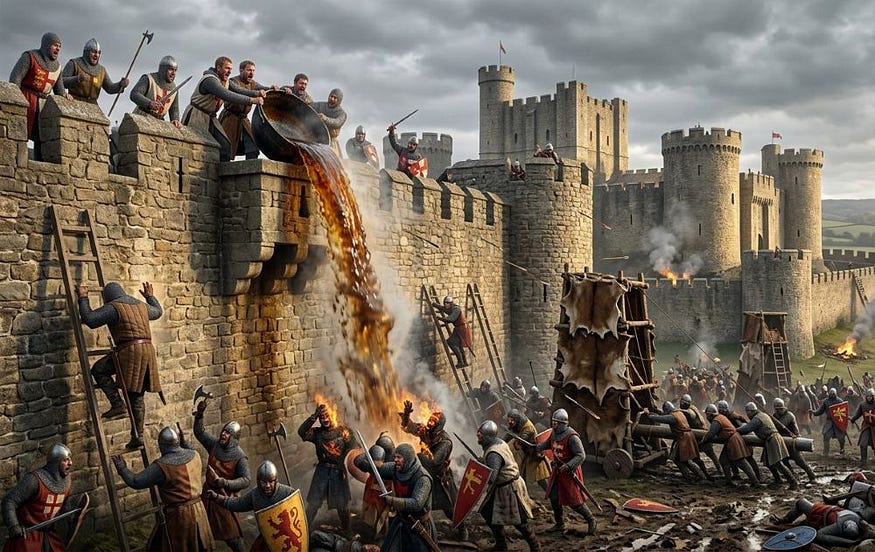 Generated with AI to illustrate the story.
Defending a fortress or castle against an attacking force was never an easy task. It required skilled manpower, strong and often formidable walls, adequate reserves of food and water, and a supply of materials that could be used as weapons against enemies attempting to breach or scale the defenses.
Among the most famous images associated with ancient and medieval siege warfare is that of defenders pouring boiling oil from the walls onto attackers below. The scene has appeared in countless films and television productions and has become almost inseparable from the popular image of a fortification siege.
Most famous ones include the Braveheart (1995), which is probably one of the clearest examples of the Hollywood trope. During the Scottish assault on York, English defenders pour pots of boiling oil down onto the attackers around the gate.
Historically, however, it is highly questionable. The film is notorious for taking considerable liberties with medieval history.
Another good example is the Kingdom of Heaven (2005). Ridley Scott’s film shows the city defenders using boiling oil/pitch against Saladin’s warriors during the assault on the Jerusalem walls.
But for this particular film I could not find a reliable contemporary account that explicitly says the defenders of Jerusalem threw boiling oil or pitch on Saladin’s fighters. The principal near-contemporary accounts actually give us a rather different picture.
Ibn al-Athir, a major Muslim chronicler writing about Saladin’s campaigns, describes Saladin’s assault, the use of archers and the fighting around the breached wall, but the surviving account does not mention boiling oil or pitch being poured by the defenders.
Baha ad-Din ibn Shaddad, another important contemporary source and a close associate of Saladin, similarly describes the attack, artillery, archers and the breach, but did not mention any boiling-oil episode.
Other recent films exploiting boiling oil for visual effects are the 1991 Robin Hood: Prince of Thieves (Nottingham Castle), the 2011 Ironclad (Rochester Castle), and Luc Besson’s 1999 Joan of Arc / The Messenger: The Story of Joan of Arc (Siege of Orléans).
But how common was this practice in reality?
For this piece, I’ve examined a variety of materials that defenders used against attackers approaching or scaling fortified walls. I also wondered how often boiling oil was actually used, how practical it was, and whether the historical record supports the Hollywood version of the story.
Not Just a Hollywood Invention
The familiar cinematic scene — defenders standing above a gate and tipping enormous cauldrons of boiling oil onto attackers — is not completely fictional, but it was certainly not the standard method of defense of a fortified settlement.
The first thing to know is that vegetal or animal oil was generally a valuable commodity, making it an expensive choice for use as a siege weapon, particularly in the large quantities suggested by modern films. Defenders preferred instead to use much cheaper materials against men climbing ladders such as boiling water, heated sand, stones and, where available, quicklime.
Although scarce, there are, however, historical accounts of heated oils and fats being used. For example, Flavius Josephus, a Roman–Jewish historian and military leader born Yosef ben Mattityahu, describes defenders at Jotapata using oil against Roman troops during the siege in 67 A.D.
Josephus himself was a participant in that war.
A later example appears in Laura E. Richards’ 1919 biography Joan of Arc, where she says the defenders of a small French fortress called Les Tourelles as pouring boiling oil and lime onto attacking English infantrymen during the 100 Years War. The account is useful evidence that the boiling-oil tradition had entered popular historical narratives, as Richards’ book is based on research in medieval archives and referred to both French and British sources.
So, boiling oil was possible — and certainly happened — but it appears more frequently in modern popular culture than in old manuscripts.
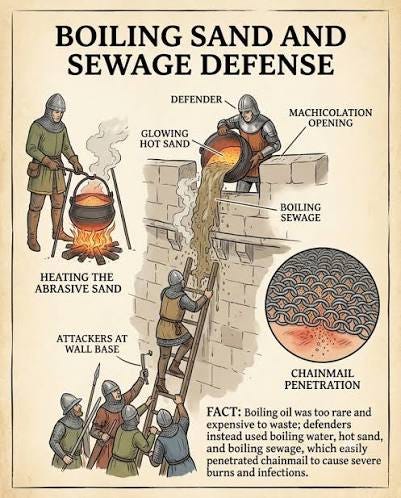 Credit: History group on Facebook.
How Was the Oil Heated?
In fact, “boiling oil” is largely a modern shorthand. Historically, hot or scalding oil would often be a more accurate description. Oil does not need to reach its true boiling point to cause severe burns. Josephus, describing the siege of Jotapata, calls the substance scalding oil and notes that its fatty nature allowed it to heat quickly and cool slowly.
This account is particularly interesting because it does not describe the familiar Hollywood scene of enormous cauldrons permanently stationed above the gates. Josephus says that many defenders quickly brought the oil, poured it onto Roman soldiers from several positions, and threw down the vessels themselves while they were still hot.
That does not prove that medieval fortresses never used large cauldrons. Medieval castles possessed furnaces, fires, hoists and other equipment capable of moving heavy loads. Some defensive arrangements even included facilities for heating inflammable liquids such as oil and tar.
But the surviving evidence gives us little reason to imagine that giant cauldrons of expensive oil were routinely kept boiling on castle walls, waiting for an assault.
How Much Oil Was Needed?
This question is much harder to answer. Neither ancient nor medieval sources provide a standard quantity of oil required for defensive use.
Josephus mentioned “great quantity” in Jotapata, but he gives us no measurement.
Consequently, any modern estimate of how many liters were required to cover a group of attackers would be a reconstruction rather than a historical fact. This chapter remans poorly covered and I apologize for that.
There is also another important unknown:
What Kind of Oil Was Used?
Neither Josephus nor other historians could identify the source of oil. It could have been a vegetable oil, an animal fat or another fatty substance available to the defenders. We should therefore avoid automatically imagining olive oil in the case of Romans or animal fat in the case of French castles.
Also, we must especially avoid confusing ordinary heated oil from petroleum or naphtha, which belonged primarily to a separate tradition of incendiary warfare. The distinction matters. Scalding oil was intended to burn the attackers through heat; petroleum-based substances, pitch, resins and similar materials could instead be employed for their ability to catch and sustain fire.
What the evidence does show, however, is that defenders had a much wider range of materials at their disposal. The surviving accounts point to stones and other heavy objects as the standard projectiles, but also hot sand, boiling water, quicklime, pitch, oil and other heated or incendiary substances.
Hot oil was, therefore, only one option among many. When it came to what to pour onto attackers, defenders had a surprisingly broad arsenal of cheaper and readily available materials: hot water, hot sand, and quicklime.
Hot Sand and Quicklime as Genuine Weapons
Hot water requires little explanation. It could scald attackers just as effectively as any other hot liquid and was considerably easier to obtain than oil.
Hot sand and quicklime are way more interesting weapons and deserve a brief description in the context of siege warfare. Both are well documented in ancient and medieval chronicles.
Heated sand.
Heated sand had an obvious practical advantage compared to oil: it was cheap and available in large quantities. Sand is essentially free, and a relatively small quantity can be heated in metal or ceramic containers. It can penetrate clothing and armor and inflict severe burns.
The earliest documented case is the siege of Tyre in 332 B.C. by Alexander the Great’s army.
For fighters in chainmail this weapon was particularly unpleasant. Chainmail isn’t a continuous sheet of metal. It consists of thousands of interlinked rings, providing excellent protection against cuts and fair protection against many projectiles, but it doesn’t completely isolate the body from the environment.
And once extremely hot particles get inside clothing or armor though the openings between mail rings or gaps around the neck, they can remain in contact with the skin.
The psychological effect was also considerable. An attacker climbing a ladder could not simply stop, remove his armor and deal with the problem. The first reaction almost always was to jump down and strip naked — or dive into water, if there was a water reservoir nearby.
Quicklime.
Quicklime (calcium oxide) was used as a chemical and thermal weapon in ancient and medieval warfare to blind, choke, and burn enemy combatants. It reacts aggressively with water and moisture, releasing intense heat (up to 300–400 degrees Fahrenheit or 150–200 degrees Celsius) that can burn skin, destroy proteins, and ignite flammable materials.
Quicklime’s contact with sweat, tears, or saliva triggers the chemical burn instantly, making it especially dangerous to the eyes, nose, and lungs.
When ground into a fine powder and thrown or dispersed by the wind, it acts as a blinding and choking smokescreen.
why the film industry has been neglecting the methods that were far more often employed by defenders during the siege of fortified establishments, focusing instead on the one used the least.
It is therefore strange how rarely these less spectacular but equally efficient weapons appear in popular representations of sieges in Antiquity and Middle Ages. Heated sand, quicklime, hot water, pitch and other substances are present in historical accounts, yet cinema has overwhelmingly chosen the visually irresistible image of a giant cauldron of boiling oil cascading over the walls.