

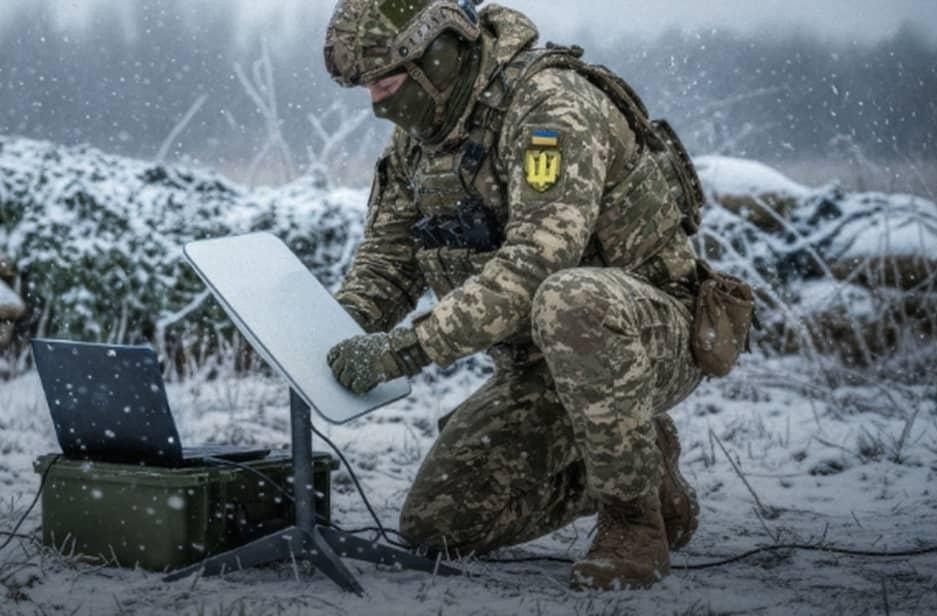
 A Ukrainian serviceman installing a Starlink antenna.
On 14 October 2026, Ukrainian officials reported that SpaceX had introduced restrictions affecting satellite terminals operating while in motion. The speed threshold was approximately 160 km/h (100 mph), although some Ukrainian units reported connectivity problems at even lower speeds.
The changes disrupted a number of important drone missions and affected logistics and other military operations throughout the front.
SpaceX, which belongs to billionaire Elon Musk, denied any meddling with the Starshield connection settings while the White House, which on the eve had issued warnings to Kyiv to comply with Donald Trump’s conditions for peace, dismissed any role in the matter.
Both have lied, of course.
In reality, SpaceX, at the White House’s request, sent a clear signal to President Volodimir Zelensky what might happen if Ukraine continued to refuse the American terms. This is obvious and needs no explanation.
What isn’t obvious is whether restrictions or full disconnection from Starshield is possible again. Trump desperately needs his Republican Party to win the mid-term election in November and a successful truce in the Russo-Ukrainian war could boost the chances to retain Republican control over Congress.
Ukraine does not agree to surrender its territories, on the other hand, and rejects the Trump plan for unilateral concessions.
An old saying goes like “Hope for the best but expect the worst,” therefore, under these circumstances, I assume Ukraine has to prepare for the worst scenario.
My guess: Starshield could go offline by Christmas.
In such case, what can Ukraine — and its true allies — do?
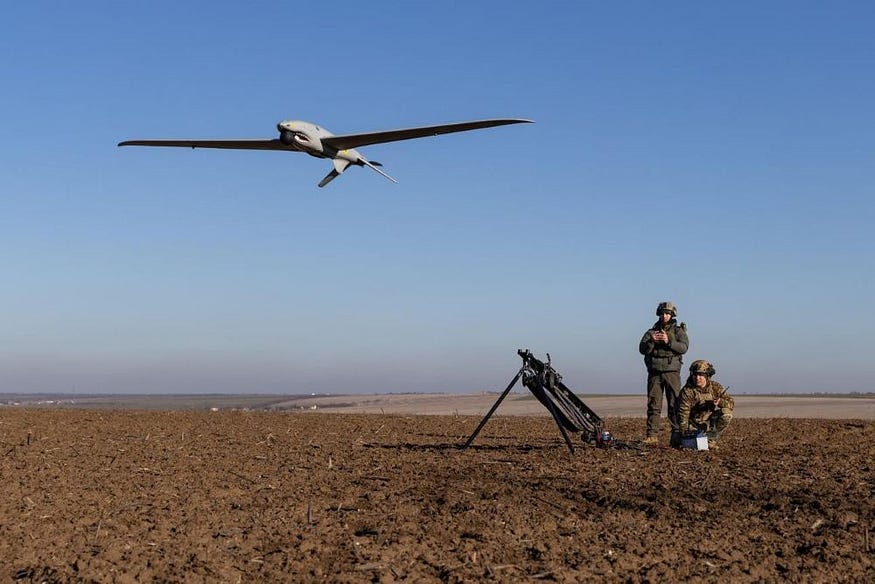 Ukrainian soldiers launching a UAV towards Russian positions.
The communication vulnerability
· First, what is Starshield?
Starshield is SpaceX’s government-focused program for secure communications and other national-security applications including military. It is distinct from Starlink — the company’s commercial satellite-internet service used by civilians, businesses and Ukrainian military units — although both rely on SpaceX’s satellite infrastructure.
The central issue here is Ukraine’s dependence on a satellite communications system controlled by an external provider, with the United States playing a major role in military satellite services and intelligence. A sudden restriction can affect battlefield operations immediately, while replacing the infrastructure, terminals and capabilities may take years.
· What does Starshield do?
Starlink is important. It provides broadband connectivity in locations where conventional communications infrastructure is absent, damaged or unreliable. Its more secure version, Starshield, does more: it can support communications between units and headquarters, transmission of imagery, coordination of operations and some drone-control functions. All in real time.
These are the primary functions of Starshield — and the consequences of restriction or full suspension:
- Securing battlefield communications — disrupted voice, data and video links; slower coordination between dispersed units.
- Unfolding drone operations — loss of connectivity for missions dependent on Starlink-linked control or data transmission; some missions might need to be suspended or adapted.
- Reconnaissance — delays in transmitting live imagery and other battlefield information.
- Artillery coordination — slower transmission of target information and corrections where the relevant workflow depends on satellite connectivity.
- Logistics and evacuation — more difficult coordination where units operate beyond reliable cellular or terrestrial coverage.
- Air defense — disruption to particular systems or workflows that depend on Starlink connectivity, including some drone-interception operations.
What happens if the service is switched off?
One important note to retain is that not every Ukrainian unit or weapons system depends on Starlink. A complete cutoff would affect different units in different ways. The impact would depend on which terminals lost access, what other communications systems were available and whether the affected equipment could switch to an alternative.
Starlink’s importance to Ukraine comes from the combination of scale, deployment speed, bandwidth and widespread integration into military operations. That combination is difficult to reproduce quickly.
The speed restriction from the 14 October incident (let’s call it incident for now) illustrates why the service matters beyond ordinary internet access. A terminal that works perfectly well for a stationary user may fail to meet the requirements of a fast-moving military platform. If a drone needs a continuous data link at speeds above the permitted threshold, the restriction can make that particular connection unsuitable for the mission.
I foresee three possible scenarios.
· Scenario 1: Temporary disruption or degraded performance.
Some units lose connectivity or experience reduced performance. Operations continue through alternative channels where available, but affected missions may be delayed, interrupted or cancelled.
Ukrainian defenses would resist.
· Scenario 2: Military restrictions while civilian service continues.
SpaceX or the relevant government authority restricts particular military uses, terminals, geographic areas or operating conditions. Ukraine could retain civilian Starlink access while losing capabilities that are important to specific military missions.
Ukrainian defenses would resist but with larger military losses and civilian destruction.
· Scenario 3: Broad suspension of service in Ukraine.
If military and civilian terminals were broadly disconnected, the consequences would extend beyond the armed forces to households, businesses and emergency services that depend on satellite internet. Military units would have to rely on other communications infrastructure, with the degree of disruption varying across the country.
In some parts of the battlefield, the front could collapse, complicating Ukraine’s situation. Russian advances would be insignificant, however, because Starlink is only one part of Ukraine’s reliance on the United States.
 CLICK ON IMAGE TO OPEN THIS STORY
The uglier aspect is the dependence on U.S. intelligence systems, including the Space-Based Infrared System, which detects missile launches. This is a separate capability from Starlink connectivity. Losing both communications services and access to particular intelligence feeds would create distinct, more serious problems.
What alternatives does Ukraine have?
Ukraine has alternatives to Starlink, but each addresses a different part of the problem. The main challenge is replacing a mature network at scale, with compatible terminals, sufficient bandwidth, reliable coverage and equipment suitable for military use.
Ukraine currently does not have that.
It may switch to European systems to compensate the loss — but not all of it.
· Eutelsat OneWeb, a commercial low-Earth-orbit satellite broadband.
OneWeb is among the most relevant European alternatives. Its low-Earth-orbit constellation can provide broadband connectivity, but it operates at a substantially smaller scale than Starlink and uses different terminals.
A 2025 Euronews report cited approximately 630 OneWeb satellites versus roughly 7,000 Starlink satellites at that time. It also reported that OneWeb had far fewer terminals in Ukraine and that its equipment was considerably more expensive. Those figures are historical snapshots, and not yet available for October 2026.
 CLICK ON IMAGE TO OPEN THIS STORY
There is a limitation: Ukraine cannot simply activate OneWeb on existing Starlink dishes. Replacing terminals, integrating networks and testing them under operational conditions would take time. Months.
· IRIS² and GOVSATCOM, the European governmental satellite communications.
The European Union is developing its own secure satellite communications capabilities through IRIS² and GOVSATCOM. These initiatives could reduce European dependence on non-European providers for government and security communications.
GOVSATCOM pools existing governmental satellite capacity, while IRIS² is intended to provide a more advanced, secure multi-orbit system. Neither should be treated as an immediately available, one-for-one replacement for Starlink’s entire Ukrainian military role.
They also have limitations: Available capacity is low, terminal compatibility is unknown, deployment and the specific technical requirements of military users need to be determined before actually replacing Starlink.
· Tactical radio and terrestrial networks.
Ukraine can still use military radios, cellular networks, fiber links where infrastructure remains intact, and mesh communications that relay data between connected nodes.
These systems can preserve essential communications when satellite internet is unavailable. They can also provide redundancy, so the loss of one network does not automatically isolate every unit.
The limitations include small coverage, low bandwidth, reduced mobility and poor resistance to interference. Also, traditional radio does not automatically reproduce Starlink’s ability to carry large volumes of data across dispersed formations.
· Other commercial and government satellite services.
Operators such as SES and other satellite providers could contribute additional capacity. Different systems can serve fixed installations, headquarters, logistics facilities or specialized users.
 CLICK ON IMAGE TO OPEN THIS STORY
However, a satellite being available in orbit does not guarantee a usable military connection. Terminals, service agreements, encryption, bandwidth and integration all matter. A system suitable for a stationary command post may be unsuitable for a fast-moving drone.
How quickly could Ukraine adapt?
The following ideas represent my assessments, not predictions of Ukraine’s actual military response. I also checked with several AI chatbots to have a critical view of these ideas.
So, the first
· 0–6 hours
after the immediate operational disruption. Units that lose connectivity must use whatever alternative channels they already have. Some operations can continue; others may be interrupted because their communications architecture depends on the unavailable service.
The next
· 6–24 hours
require prioritization and acceptance of degraded communications. Commanders would need to prioritize available communications capacity, identify critical gaps and rely more heavily on existing radio and terrestrial networks where feasible.
The following
· 1–3 days
are about emergency adaptation. Units could reorganize their use of available systems, redistribute compatible equipment and adjust operations to the connectivity they retain. Some functions might recover quickly; others would remain constrained by unavailable hardware or insufficient bandwidth.
· Weeks–months-years
The next logical phase requires building a sustainable replacement to Starlink. Procuring terminals, securing capacity from alternative providers, integrating systems and establishing resilient communications across the armed forces would need a much longer effort.
 CLICK ON IMAGE TO OPEN THIS STORY
The timeline would depend on funding, industrial capacity and the scale of the replacement required — and readiness of Ukraine’s allies to help. This is the most complicated phase.
Then, it must be noted that the speed of adaptation and speed of recovery are two different things. A provider can restrict access centrally while soldiers look for alternative ways, whereas a replacement network must be procured, deployed, integrated and tested. Europe has no immediate substitute for Ukraine’s reliance on U.S. satellite services.
What would a Starlink cutoff mean for Russia?
What is bad for my enemy is good for me, right? However, a cutoff would not automatically hand Russia a military victory, thought it would certainly alter the conditions under which Ukrainian forces operate.
The immediate effects would depend on which Ukrainian units lost connectivity and how quickly they could adapt. Russian forces could benefit if Ukrainian reconnaissance, coordination or drone operations became less effective. The scale of any resulting advantage would depend on the location, duration of the disruption and the availability of alternative systems.
Russia would also have to contend with the wider military environment. A Starlink cutoff would not eliminate Ukraine’s conventional communications, locally developed technology, intelligence capabilities or European support. Neither would it automatically give Russian forces access to the same service: SpaceX has imposed geographic restrictions on its networks, and the October restriction concerned only Ukrainian military use within Ukraine.
In short, Ukraine would have to adapt its operations to the available communications architecture, while Russia would seek to exploit any resulting gaps.
What should Ukraine and Europe do in the perspective?
Aserious and credible response would involve four parallel efforts.
1. Diversify satellite connectivity. Secure access to more than one provider, with alternative terminals and service arrangements already in place.
2. Build communications redundancy. Maintain overlapping satellite, radio, cellular and terrestrial networks. Test whether essential functions can continue when any one provider becomes unavailable.
3. Prioritize European capacity. Invest in governmental satellite communications, terminals and secure infrastructure that can serve immediate needs as well as longer-term strategic autonomy.
4. Reduce right now their dependence on external intelligence. Strengthen independent surveillance, early-warning and intelligence capabilities wherever technically and financially feasible. Replacing broadband connectivity alone cannot replace missile-warning or other intelligence services.
These measures, however, demand substantial funding and coordination. They would reduce the consequences of a cutoff, but they would not make every alternative equivalent to Starlink or Starshield.
For Ukraine, communications resilience is a military necessity. For Europe, developing independent satellite and intelligence capabilities is a question of strategic autonomy.
The sooner, the better.