

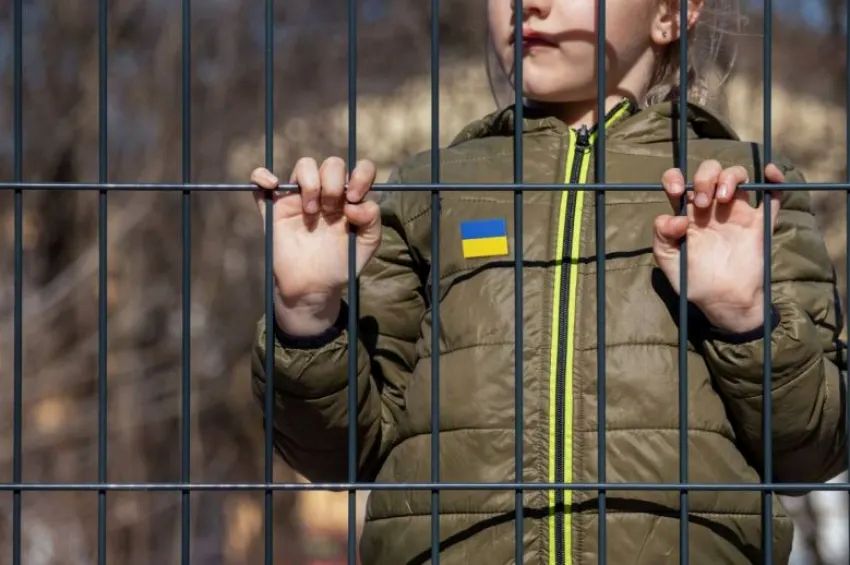
 Photo: Save Ukraine
The scale and apparent impunity of Russia’s program of deporting Ukrainian children from occupied territories is staggering. Critics argue that the system — centralized, bureaucratic, and geographically dispersed — reflects not merely wartime evacuation, but a deliberate policy of forced assimilation and long-term demographic reconfiguration and identity re-engineering.
This is the story of how Russia took those children, where it hid them, and why bringing them home may already be nearly impossible.
Modern Russia, according to many accounts, appears to have revived a brutal historical practice: the mass removal of children from conquered lands for purposes of ideological conversion, exploitation, and military utility.
The comparison most frequently invoked is the Ottoman Empire’s devşirme system, under which Christian boys were taken from their families, converted to Islam, and trained as elite soldiers — the so-called “Janissaries.”
Girls were also absorbed into Ottoman households according to social and political needs. The underlying logic was the same: sever children from their origins and reshape them into loyal instruments of the state.
The captured Christian boys and girls were filtered according to their appearance and personal skills, and then assimilated within Turkish society.
Forced relocation and re-education
Russian forces have reportedly abducted at least 19,000 Ukrainian minors from their homeland, with administrative authorities later dispersing them across a sprawling network of 210 facilities inside its territory and in occupied regions of Ukraine — an unprecedented system of forced relocation and re-education.
While Moscow portrays the abduction and deportation of Ukrainian children as part of a humanitarian plan to keep them away from the war zone, in reality it is working to indoctrinate, militarize, and abuse these minors, making their recovery and return home a near-impossible task, according to the Ukrainian government and international human rights organizations.
Researchers at Yale University’s Humanitarian Research Lab (HRL) revealed that 156 of those facilities had not been previously identified, while 54 had appeared in earlier reports. The true number is likely higher, as HRL is still investigating additional sites.
The locations vary widely: cadet academies, military bases, hospitals, churches and monasteries, secondary schools and universities, hotels, family support centers, orphanages, and most commonly — camps and sanatoriums. About half of these institutions are directly controlled by the Russian state.
“Russia is operating a potentially unprecedented system of large-scale re-education, military training, and dormitory facilities capable of holding tens of thousands of children from Ukraine for long periods of time,” the report says.
Inside these facilities, children are subjected to ideological indoctrination designed to instill loyalty to Russia, followed by compulsory militarization programs. These include combat drills, ceremonial parades, war games, assembly of drones and other military equipment, as well as courses in Russian military history.
The cadets would later become assassins as it was customary during the Soviet era and professional soldiers — a sort of modern Russian “Janissaries.”
Nathaniel Raymond, executive director of HRL, said in comments on the situation: “The good news is that we now fully understand the scale of the problem we face. The bad news is that resolving it — and bringing these children home — depends on absolute global unity.”
Child trafficking accusations
Ukrainian NGOs also accused Russia of “state-sponsored child trafficking” after administrators in Russia-controlled areas of Ukraine published an online catalog of what they called Ukrainian orphans (screenshot below).
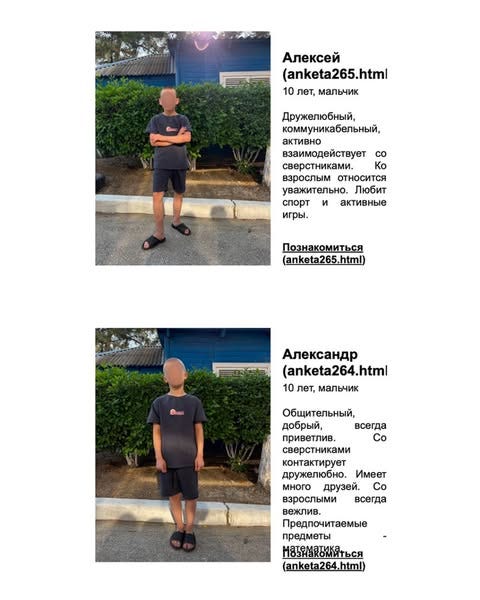 A page from a Russia child catalogue for “boys who’d like to meet.”
While these advertisements look like adoption posters, in reality, they serve as child sex advertisements.
Mykola Kuleba, head of Save Ukraine, said the database from the Russia-installed administration’s Education Ministry in the Luhansk Region contains information about 294 Ukrainian children under the age of 17 who have been separated from their parents.
“Russia isn’t even trying to hide it anymore. It’s openly trafficking Ukrainian children,” Kuleba told Free Europe Radio, noting that the website shows the names, photos, descriptions of their personalities and hobbies.
This claim is corroborated by a 2023 Council of Europe report, which expressed concerns from member states’ heads of state and government regarding the “sexual abuse of Ukrainian children.”
It’s not clear who are the concrete operators or clients of the state-sponsored child trafficking.
Russian strategy
The dispersal strategy makes the challenge of locating and returning the children particularly daunting. Ukrainian officials estimate that more than 19,000 minors have been deported illegally since the full-scale invasion began. By the end of August 2025, only 1,564 had been successfully repatriated. In September, Russia had handed over 16 more children.
The forced transfers have drawn international condemnation. In March 2023, the International Criminal Court in The Hague issued arrest warrants for Russian President Vladimir Putin and his children’s rights commissioner Maria Lvova-Belova, charging them with the illegal abduction and deportation of minors from occupied Ukrainian territories.
Earlier this year, the U.S. State Department discontinued funding for the HRL project that tracked these deportations. The Washington Post said this decision may have put at risk an archive of data on some 30,000 affected children.
Ukraine continues to push for international pressure and coordinated efforts to bring its youngest citizens back. But as researchers note, Russia’s deliberate scattering of children across such a vast and opaque system is designed precisely to slow — and perhaps prevent altogether — their return.
As the Kremlin contends with heavy battlefield losses and persistent manpower challenges, some analysts and Ukrainian officials warn there is a plausible — if deeply disturbing — risk that indoctrinated minors could be treated as future expendable resources against their own fatherland.
There’s been no evidence that Moscow is already carrying out such a plan. The Russian authorities have not allowed Ukrainian or international inspections to the facilities where Ukrainian minors are held.
In March 2023, the International Criminal Court issued arrest warrants for Russian President Vladimir Putin and his children’s rights commissioner, Maria Lvova-Belova, charging them with the illegal deportation of children from occupied Ukrainian territories — a war crime under international law.
This story was first published on my Medium account.