

Scientists have detected a 16% drop in atmospheric pressure, possibly marking the beginning of a long-term decline.
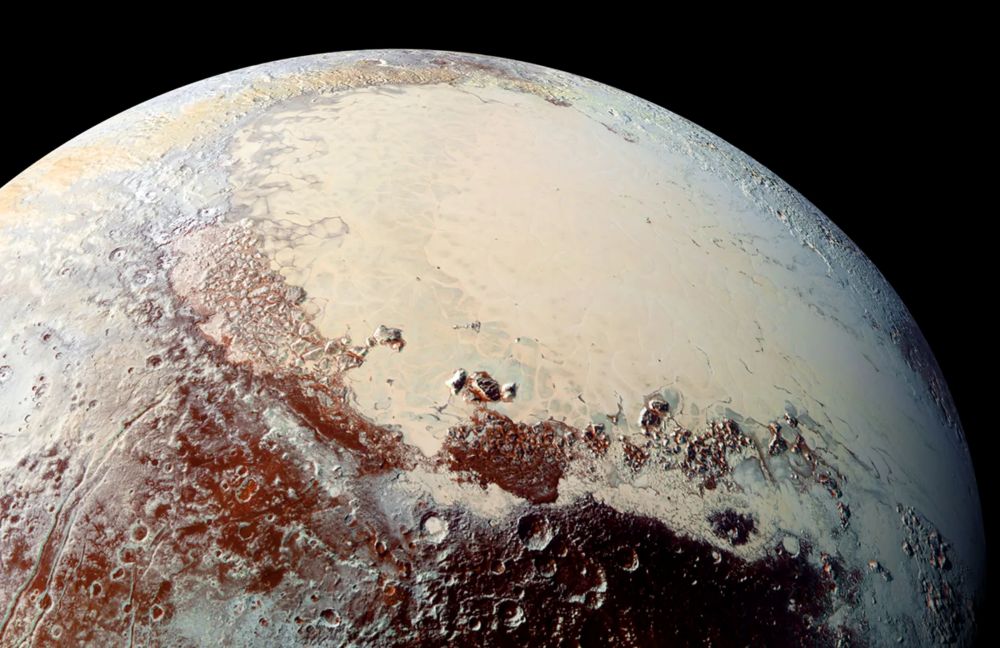 A true photograph of Pluto. NASA
Pluto, a dwarf planet discovered in 1930 at the edge of the Solar System, may be getting thinner or thicker as it moves away from and then closer to our host star in cycles lasting more than two Earth centuries.
New observations suggest that the thin layer of gas surrounding the planet has started to shrink as Pluto moves farther from the Sun, according to researchers at the Planetary Science Institute in Tucson, Arizona. Its atmospheric pressure fell by about 16% between 2021 and 2023.
Why does Pluto move away from the Sun now?
It takes Pluto about 248 Earth years to orbit the Sun. Its path is oval-shaped, so its distance from the Sun changes considerably. It reached its closest point in 1989 and will reach its farthest point in 2113 before moving closer again.
As Pluto moves away, it receives less sunlight. This can cool its surface and cause some of the frozen nitrogen to remain ice instead of turning into gas. As a result, less gas may enter the atmosphere and its pressure may fall, the scientists explained in a study published in The Planetary Science Journal.
 Pluto’s atmosphere seen from orbit. NASA
How scientists study Pluto’s atmosphere
No spacecraft is currently close enough to study Pluto’s atmosphere directly, and telescopes on Earth cannot capture detailed images of it. Instead, scientists observe Pluto as it passes in front of distant stars.
During these events, known as stellar occultations, the star’s light passes through Pluto’s atmosphere before the dwarf planet blocks it. The atmosphere bends the light, and changes in its brightness allow researchers to estimate atmospheric pressure and density.
The team studied 10 such events between 2017 and 2023. The measurements suggest that Pluto’s atmospheric pressure remained relatively stable after NASA’s New Horizons spacecraft visited in 2015, then fell by about 16% between mid-2021 and July 2023.
What happens when Pluto gets colder?
Pluto’s atmosphere consists mainly of nitrogen, with smaller amounts of methane and carbon monoxide. Its surface also contains frozen nitrogen, which can turn into gas when temperatures rise and freeze back onto the ground when temperatures fall.
 Pluto's occultation path recorded between 2017 and 2023. PSI
This exchange between surface ice and atmospheric gas means that Pluto’s atmosphere can change with the seasons and the amount of sunlight it receives. Its surface also retains heat, so the effects of changing distance from the Sun may take time to appear.
Pluto has layers of haze made up of tiny particles, photographed by New Horizons in 2015. According to the researchers’ models, the continued loss of pressure could make these layers thinner and bring them closer to the surface.
Scientists still need more observations to clarify whether the recent pressure drop marks the beginning of a long-term decline or a temporary change.
Pluto’s diameter is 2,376 kilometers or 18.6% of Earth's, while its mass is approximately 13 trillion trillion metric tons and represents 0.22% of Earth's.
Pluto has five known moons: Charon (the largest and the diameter of which is approximately half that of Pluto), Styx, Nix, Kerberos, and Hydra. Pluto and Charon are sometimes considered a binary system because their center of mass does not lie within either body, and they are tidally locked.