

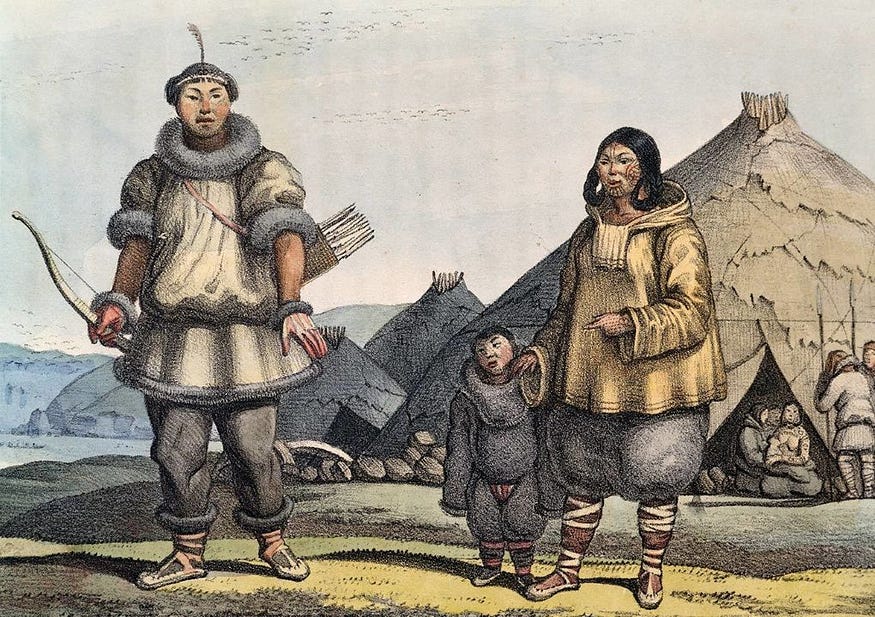
 Part 1 is here.
A stone-era people counting 10,000 reindeer herders fought the Russian Empire to a standstill for half a century, forcing Catherine the Great to beg for peace and agree to their terms — but the Bolsheviks finished what the tsars could not.
The Bolsheviks — predecessors of Soviet Communists — were made of sterner stuff — and they had no patience for indigenous autonomy.
The consequences of the October coup reached Chukotka slowly. For four years after 1917, power fluctuated between Whites and Reds, and the Chukché themselves had only a vague understanding of the cataclysm engulfing the country to their west. If the tsarist era had allowed them de facto independence, the Soviet era would grant them none.
By the early 1920s, the old system of trade and governance had collapsed. The region was in ruins. Then, in December 1930, the Soviet government created the Chukché National Okrug (circuit). The stage was set for a transformation — and a tragedy.
The Soviet approach was systematic, rapid, and brutal, targeting every aspect of Chukché life.
First came collectivization. Nomadic reindeer herders were forced into settled collectives (kolkhozy). Not everyone agreed to hand over their herds to the state. Those who refused were simply declared “kulaks” or “rich peasant” — a term automatically entitling its bearer to dispossession, arrest, or worse.
Then came the assault on the nomadic lifestyle itself. Traditional mobile dwellings (yarangas) were condemned as primitive. Chukché families were moved into permanent brick houses, severed from the seasonal migrations that had defined their culture for millennia. Coastal hunters were organized into state-owned enterprises with mandatory quotas for meat, fat, and fur.
Small private herds were seized and brought under state control; armed resistance to the Sovietization process was suppressed by state security forces and the army. The most vocal Chukché who defended their lifestyles were executed, arrested by the KGB, sent to forced labor camps or relocated far from their clans.
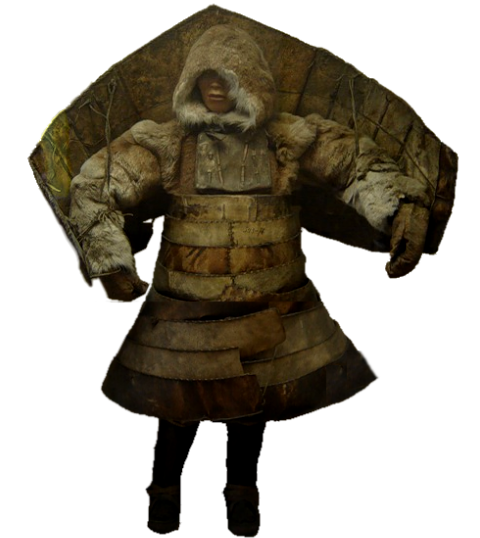
Chukchéwarrior armor. Wikipedia
Enforcing “Soviet civilization”
But brutal force was not the sole method to keep the Chukché under control. Propaganda and indoctrination were efficient tools, too.
Village relocations were a frequent structural form of conflict: the Soviet state reorganized and evacuated dozens of native settlements from coastal and tundra regions (a process lasting into the 1970s). Many Chukché lost access to traditional hunting grounds, provoking social disruption.
Decades of sedentarization, language reform, schooling, and ideological education led to a demographic decline of Chukché communities and loss of traditional authority.
Soviet policy also undermined or banned shamanic practices in a systematic way. Shamanism was central to the cultural and social Chukché life. Shamans often acted as focal points of resistance to Soviet reforms; ethnographic sources interpret their interactions with authorities as points of confrontation and repression.
New bathing rules represented a particularly painful aspect that hit the Chukché.
Soviet officials, teachers, and Communist party members arrived in Chukotka determined to bring “civilization” to the natives. They were horrified that the Chukché, living in the Arctic cold, rarely bathed. So, they built bathhouses in every village and forced the indigenous population to wash regularly with soap.
The result was a demographic disaster. The soap stripped away the natural layer of fat that protected the Chukché’s skin from extreme cold. Without this protection, they became vulnerable to infections and diseases they had never faced before. People began dying in large numbers before doctors finally understood the cause.
The Chukché vs. the Soviet rule
Archive documents are scarce about incidents or open uprises against the Soviet regime.
One police report described how a village elder “abducted” a young female teacher as his bride; she was only returned for a ransom. In the late 1950s, when a local official proposed a new tax on the Chukché, they responded not with threats and action. Despite police guarding his apartment, the Chukché managed to kidnap him in the night. They only released him back into his own home after he personally promised to drop the tax and leave them alone.
There had also been clashes between Soviet Chukché and American Eskimos over fishing zones and sea resources, but no casualties were recorded. The authorities did not intervene, giving the two sides time to settle things between them.
Stalin himself, when faced with a conflict between Soviet Chukché and American Eskimos, did not threaten repression. Instead, like Catherine the Great, he simply gave them gifts to “calm them down.”
As collectivization completed and Soviet governance structures solidified, many Chukché were incorporated into regional party and Soviet councils. Between 1932 and 1993, Chukchi individuals often held leadership posts in the local councils, a practice reflecting both Soviet “indigenization” policies and strategic cooptation of local leaders rather than authentic shared governance.
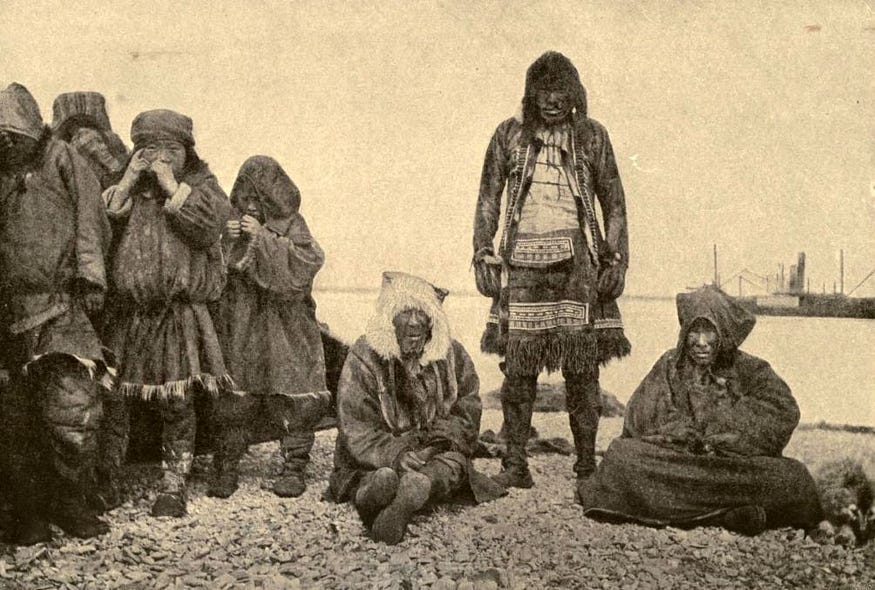 A Chukché family. Photo from the 1920s. Wikimedia
Soviet education, language policy, and mobility regimes gradually shifted Chukché lifestyles toward sedentarism and Russian-language use, sometimes leading to cultural tension over identity and modernity versus tradition.
The Chukché stopped being Luoravetlan — “the true people.” The new system taught them they were backward, primitive, and in need of correction. Children were taken away to boarding schools in cities, where they learned to be Soviet citizens but forgot how to survive in the tundra. Those who returned often fit nowhere.
Alcoholism became rampant. Reports from the time describe both men and women drinking heavily, leading to soaring mortality rates. The people who had once been described as “strong, tall, brave, and loving freedom” fell into a deep collective depression.
Humiliation, however, did not stop there. In the 1960s and 1970s, as the Soviet Union settled into its post-war identity, a new genre of ethnic joke appeared: the “Chukché joke.” In these anecdotes, the Chukché were portrayed as a naive, slow-witted, childlike figure who couldn’t understand basic technology or urban life.
This stereotype was not innocent. It was the cultural justification for what had been done. The fierce, skillful, intelligent warriors who had out-fought the Russian Empire for 150 years were transformed in the popular imagination into simpletons who needed Moscow to tell them how to live.
The joke was, in essence, the final victory speech of the colonizer.
Perestroika
During the perestroika, the loosening of centralized control allowed nascent indigenous activism to surface in Chukotka and the Russian North more broadly. While the Soviet period did not see organized armed resistance like in the 18th century, social movements and claims for rights emerged in the late 1980s, especially among younger, educated Chukché.
After the Soviet collapse, the state-run farms were reorganized and nominally privatized. The result was catastrophic for the local economy. Many rural Chukché and Russians alike have survived only with the help of direct humanitarian aid.
Traditional livelihoods could not be immediately restored, and demographic decline, unemployment, and social dislocation were widespread.
And yet, the Chukché endure. Some have become poets, writers, politicians, and doctors. They are almost 100% literate and fluent in Russian, while some still maintain their language and traditions. They still call themselves Luoravetlan — the true people.
Chukotka, the peninsula that is home to the Chukché is one of Russia’s most resource-rich Arctic regions. Its economy is overwhelmingly extractive, with gold mining as the dominant industry, alongside significant copper, silver, coal, and hydrocarbons.
Unfortunately, these riches have been in the possession of Vladimir Putin’s billionaire friends and allies. The local communities do not benefit anyhow from the export of metals, minerals or ores as Moscow still maintains the colonial-style economics in the region.
Could the Chukché nationalize the local industries or persuade the metropole to accept a meaningful revenue-sharing formula? Could they live independently?
The prospects are exceedingly slim. The Chukotka Autonomous Okrug is today a federal subject of the Russian Federation, where only 15,000 residents out of the total 50,000 population are ethnic Chukché.
The Chukché are still a small people scattered across a vast, underdeveloped region, with an extreme climate, remote logistics, poor infrastructure, permafrost engineering challenges, and very limited economic diversification.
It is a land hard to conquer and even harder to defend.