

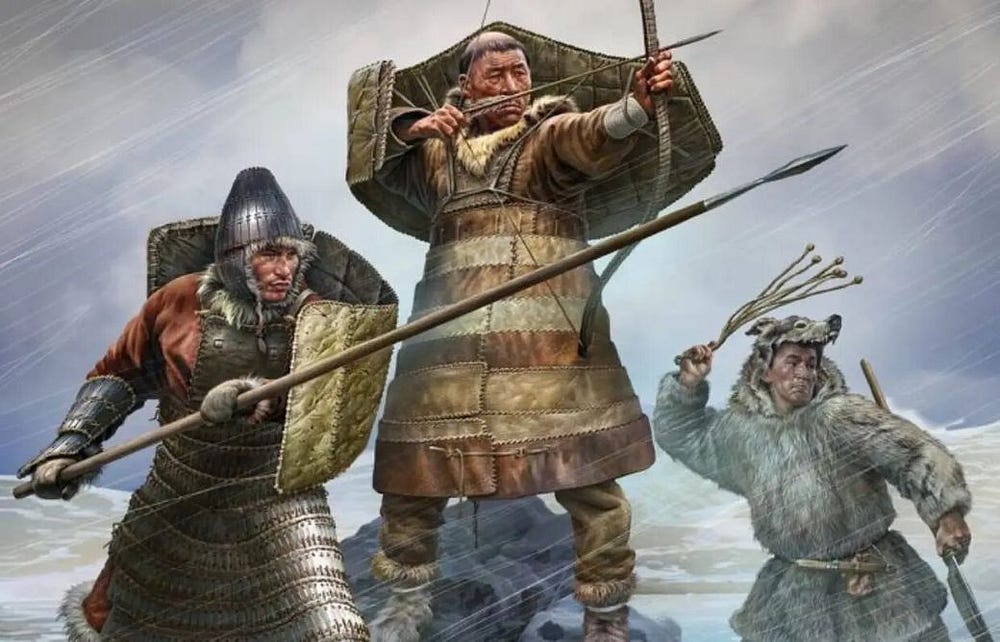
 A modern day picture showing Chukché preparing for fight.
A stone-era people counting 10,000 reindeer herders fought the Russian Empire to a standstill for half a century, forcing Catherine the Great to beg for peace and agree to their terms — but the Bolsheviks finished what the tsars could not.
Despite their remarkable history of resistance, in popular Russian culture — especially in the European part of the country — Chukché (or Choukchee) men are the subject of jokes that portray them as naive, slow-witted, and simple-minded. It is perhaps the cruelest irony of their story.
This stereotype is a classic colonial caricature, but it has a specific and tragic origin. Researchers trace the mass appearance of “Chukché jokes” to the 1960s and 1970s. They emerged as a direct result of the violent and rapid Sovietization of the region.
The image of the “stupid Chukché” replaced the historical reality of the “fearsome warrior” precisely because the Soviet system had succeeded in breaking and humiliating a people who had never been broken in battle. The jokes are, in a sense, the cultural echo of that defeat.
The Russian education system has historically focused on the history of the dominant people, and state policy has often discouraged deep anthropological study of smaller indigenous groups. As a result, most Russians have no idea that the people they mock are descended from warriors who made their empire tremble.
Who are the Chukché?
An indigenous people of the far northeast of Siberia, primarily living on the Chukotka Peninsula. they number just over 16,000 individuals, according to the 2021 federal census. Their traditional lifestyle was divided between coastal, settled Chukché (who hunted sea mammals) and nomadic tundra Chukché (who were reindeer herders). Their self-designation is Luoravetlan, which means “the true people.”
Linguistically, they are part of the Chukotko-Kamchatkan language family, making them close relatives of the Koryaks, Itelmens, and Kereks. Genetically, they are the closest Asian relatives of Indigenous peoples of the Americas (Eskimos, Aynu), sharing common ancestors from ancient populations around the Sea of Okhotsk who were part of the same migration wave that eventually settled the New World.
The first contact
The first recorded contact between Muscovites (they were not Russians yet) and Chukché was a fight. In the summer of 1642, a group of Cossacks led by Dmitry Zyryan reached the Alazeya River, west of the Kolyma River. They demanded yasak — a fur tribute — from the local people. The Chukché refused.
This pattern — demanding submission and being met with arrows — continued for decades. The Muscovite colonists built two wooden camps to intermediate their operations. The Chukché resistance forced the invaders to ignore their tribes for the next 50 years because the locals were warlike and, unlike other Siberian peoples, had few valuable furs to justify the risk. But as Russian expansion pressed eastward toward Kamchatka, securing communications made the “Chukchi problem” impossible to ignore.
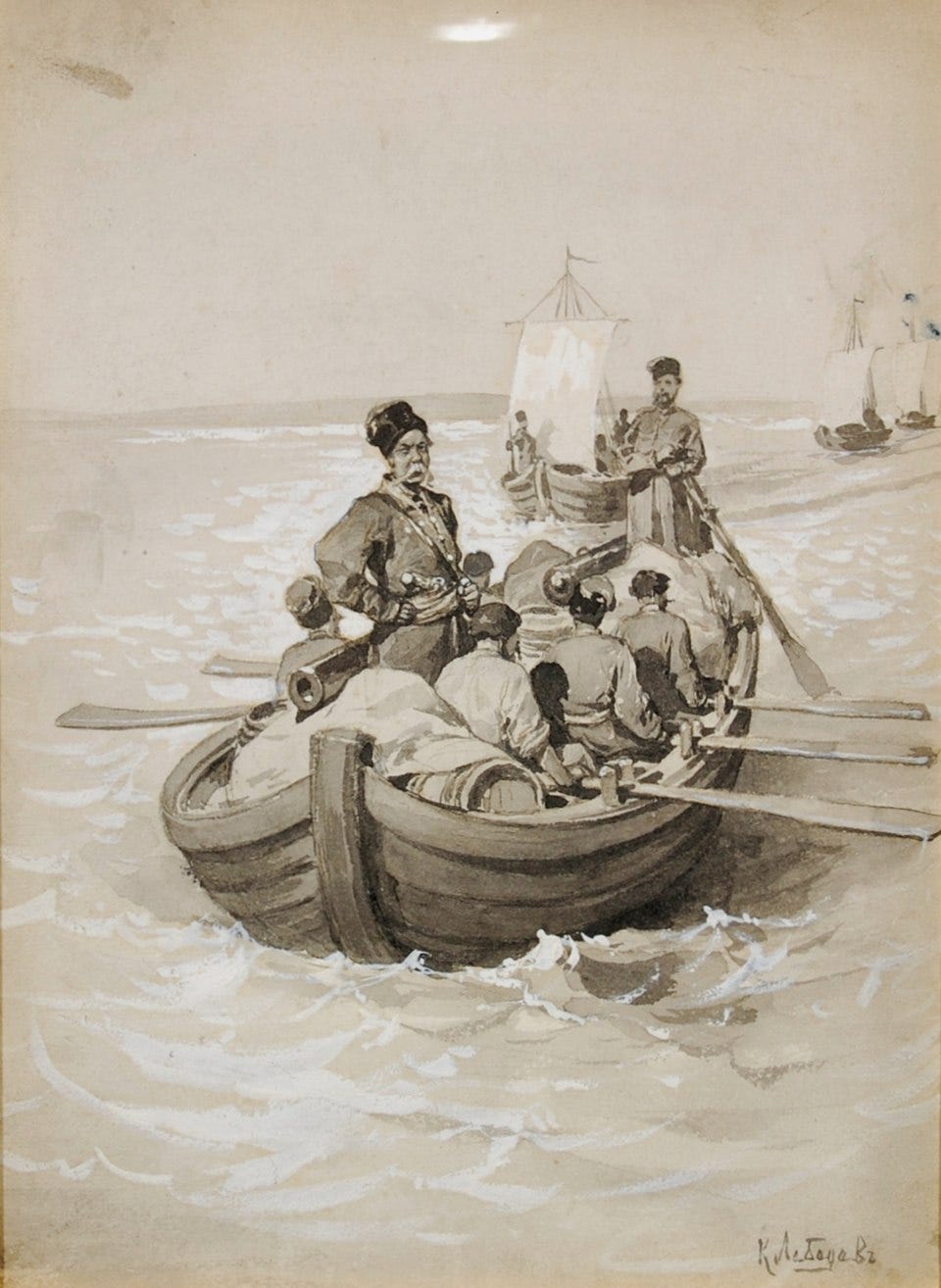 Muscovite Cossacks sailing in Siberian waters. A sketch by painter Lebedev.
The full-scale war
In 1727, Empress Catherine I launched an all-out campaign to finally subdue the Far East. The Imperial Senate ordered that: “Foreigners and peoples who are discovered and adjacent to the Siberian side, but not under anyone’s authority, be conquered under Russian rule and brought into yasak payment.”
The task was given to two men: Afanasy Shestakov, a Cossack leader, and Major Dmitry Pavlutsky, a professional soldier. They were poorly suited for diplomacy and chose brutal force as the default option. The result was immediate escalation from Kamchatka to Chukotka.
In March 1730, Shestakov’s detachment was lured into a trap on the Egache River. Shestakov, wounded by an arrow to the throat, was carried onto a sled by his men, but his reindeer bolted and carried him directly into the enemy lines, where he was speared to death. The leader of the imperial expedition was dead, and his force was shattered.
Pavlutsky then took command after Shestakov’s death. He was even more brutal and determined than his predecessor, adopting a scorched-earth strategy: burning villages, slaughtering entire families, driving off reindeer herds, and capturing women and children.
Terror unleashed
For years, he was the terror of Chukotka. In 1742, Empress Elizabeth ordered her troops “to eliminate all non-peaceful Chukché.” But having learned from every defeat, the Chukché changed strategy too. They avoided open fields where firearms gave Russian men an advantage. Instead, they melted into the tundra and started a guerilla war, striking at his supply lines, hunting isolated groups and individual riflemen.
In March 1747, a force of approximately 500 Chukché warriors raided the Russian stockade at Anadyrsk. Pavlutsky set out in pursuit with 131 men — 96 Cossacks and 35 Koryak allies.
Near the Orlova River, the Chukché ambushed them for a fight. Pavlutsky, wearing iron chain mail, ordered an attack despite being outnumbered. The result was a disaster. His regiment was completely overwhelmed and decimated.
By other accounts, he won that battle, but didn’t get to celebrate: the next days between 2,000 and 3,000 Chukché men — practically the entire male population showed up at Anadyrsk, forcing the Russians to withdraw.
Pavlutsky, unharmed due to his armor, was eventually pulled from his horse with lassoes, like “wolves bringing down a deer.” The Chukché found one weak spot in his armor — under the chin — and killed him. They cut off his head and, by some accounts, kept it as a trophy for years. His body is buried in Yakutsk, but his head remained in Chukotka — as a permanent symbol of Russian defeat.
Russian advance paralyzed
The war continued for nearly another two decades. The Russians sent several more expeditions in the 1750s, but the results were the same: high cost, brutal fighting, and no submission. The Chukché’s guerrilla tactics, their knowledge of the terrain, and their absolute refusal to accept foreign domination made them unconquerable. At one point, due to their partisan actions, all land communication in northeastern Siberia was paralyzed.
In 1764, the Imperial Senate conducted a cost-benefit analysis of the Anadyrsk fort, the main base of operations against the Chukchi. The results were staggering: maintaining the fort had cost 1,380,000 rubles (an amount that would translate in billions of US dollars today), while the entire region had returned only 29,150 rubles in taxes.
The Senate ordered Anadyrsk abandoned. In 1771, the Russians burned their own fort and retreated westward. They had effectively admitted defeat.
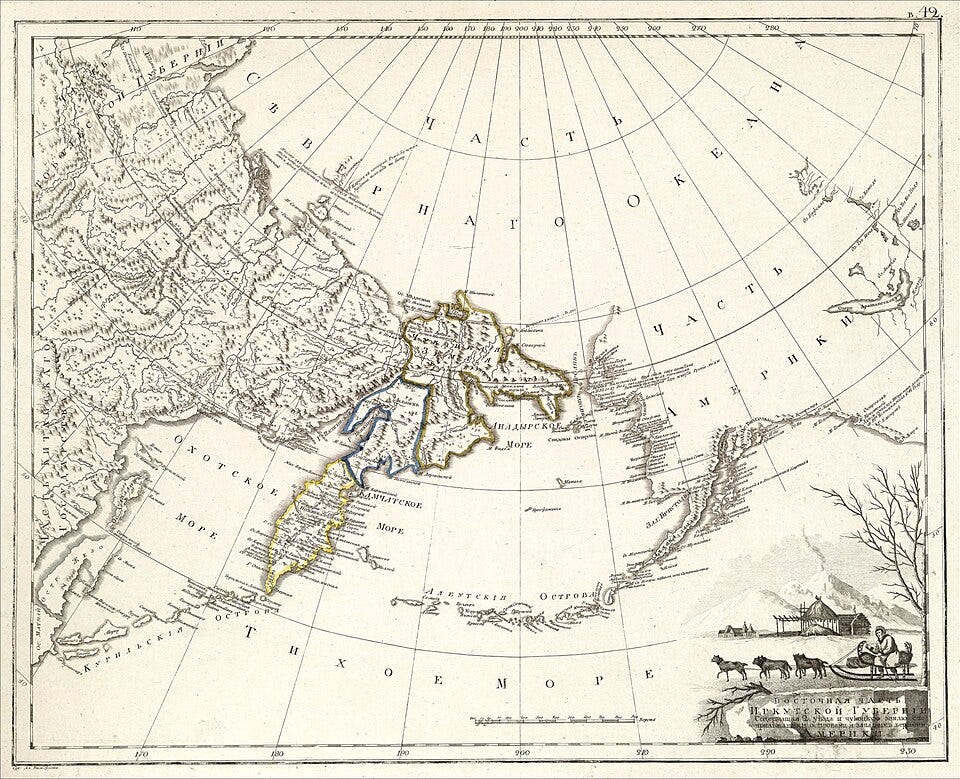 A Russian imperial map of the Far East.
Although the conflict ended with Russian defeat, the 100 plus years of hostilities left a severe mark on the Chukché’s lives. While they refused to become the empire’s subjects, on the other hand they needed trade relations with Russian colonists.
This is where the story becomes farcical. In the 1770s, reports reached St. Petersburg, the empire’s new capital, that British and French ships were nosing around the Chukché coast. The Empire panicked at the thought of another European power claiming the territory it had failed to conquer.
In 1776, Catherine the Great issued a new order: bring the Chukché into the empire not with the sword, but with bribes. Captain Timofey Shmalev and a baptized Chukché nobleman named Nikolai Daurkin were tasked with the mission.
In 1778, the main Chukché toyon (leader), Omulyat Khergyntov, agreed to a treaty. The terms? A ten-year exemption from all tribute and the right to live under their own laws. The Russian Empire formally declared the Chukché its subjects, but the declaration was a fiction. In the 19th-century Russian legal code, the Chukché were officially designated as a “people not fully conquered,” who paid tribute “in whatever quantity and quality they deem desired.”
For nearly 150 years, the Chukché had successfully resisted the Russian Empire, forcing it to accommodate them.
Until the Bolsheviks came in the scene.
***
This story was originally published in Medium. Follow me there for more stories. Support my writing effort please.