

Scientists think a giant interstellar visitor, from another system, may have reshaped it.
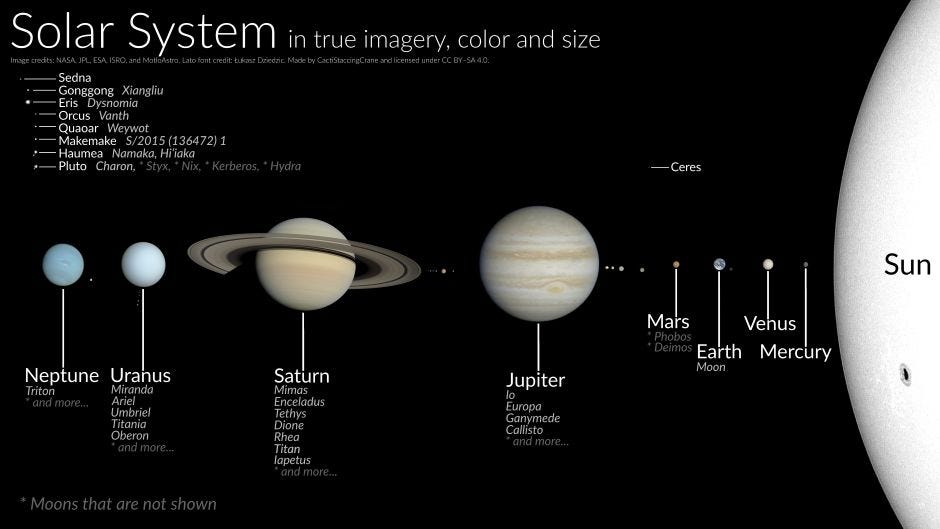 Today, the Solar System seems like a quiet and orderly place. The planets circle the Sun in the same direction, following nearly the same flat plane, as if they have been dancing to the same rhythm for billions of years.
But astronomers have long suspected that this cosmic harmony hides a turbulent past.
When the Solar System formed about 4.6 billion years ago, it looked nothing like it does today. The young Sun was surrounded by a vast, rotating disk of gas and dust. Within this disk, tiny grains gradually stuck together, growing into rocks, then planetesimals, and eventually into the planets themselves.
Because they all formed from the same spinning disk, scientists expected the planets to remain in neat, almost circular orbits.
But they didn’t.
For several decades researchers were gathering proof showing that the planets wandered across the Solar System after they had formed. Jupiter appears to have drifted inward before moving back. Saturn migrated outward. Uranus and Neptune are thought to have been born much closer to the Sun before being flung toward the frozen outer reaches where they orbit today.
Some newborn planets may even have been expelled into interstellar space forever — a mystery that will never be solved.
This planetary migration is now considered a normal stage in the birth of planetary systems. As giant planets interacted with one another and with the remaining gas and debris, gravity slowly rearranged the Solar System into something resembling the one we know today.
But the picture is still incomplete.
One mystery has stubbornly resisted explanation. The four giant planets don’t travel around the Sun in perfectly circular paths. Instead, their orbits are all slightly stretched, or eccentric. Existing migration models reproduce many features of the Solar System remarkably well, but they can’t explain why the giant planets ended up with the orbital shapes we observe today.
A study published in Earth and Planetary Astrophysics suggests that the missing piece of the puzzle may have come from outside the Solar System.
The researchers propose that billions of years ago — don’t expect any accuracy on that, an enormous object passed close to the young Sun. It wasn’t another planet orbiting our star, but an interstellar wanderer, something born around another star system before drifting through the Milky Way.
Using computer simulations, the team consisting of Garett Brown, Renu Malhotra and Hanno Rein found that an object between two and fifty times the mass of Jupiter could have provided exactly the gravitational nudge needed to produce the present-day orbits of Jupiter, Saturn, Uranus and Neptune. According to their calculations, the object would have passed within about 20 astronomical units of the Sun, approximately the distance at which Uranus orbits today.
At the first glance, such an encounter sounds unimaginably impossible.
However, the researchers estimate the odds at roughly one in a hundred.
The reason, according to them, is the Sun’s birthplace.
Astronomers believe our star was born inside a crowded stellar nursery containing hundreds or perhaps thousands of young stars packed much closer together than they are today. During those first few million years, close encounters between stars and with the planets or brown dwarfs surrounding them were far more common than in today’s relatively empty region of the Milky Way.
The question is what exactly was this mysterious visitor?
One possibility is a rogue planet: a giant world already ejected from its own planetary system and left to wander through interstellar space.
Astronomers suspect the Milky Way may contain billions of these lonely worlds. Although they emit little or no light of their own, they occasionally reveal themselves by their gravitational effects, most notably when they pass in front of a distant star, briefly magnifying its light in a phenomenon known as gravitational microlensing.
Another candidate is a brown dwarf, an object larger than a planet but too small to become a true star. Such bodies emit very little light, making them extremely difficult to detect even today.
Whatever it was, it probably didn’t stay for long.
The object would have swept through the Solar System only once, briefly disturbing the giant planets before continuing its journey across the galaxy. The encounter may have lasted only a few years or decades, which is a fleeting moment on astronomical timescales, but its gravitational fingerprints could still be visible billions of years later.
The idea remains a hypothesis rather than an established fact. The simulations show that such a flyby could explain the planets’ present-day orbits, but not that it definitely happened.
The most curious conclusion to be taken from this study is that it reinforces a growing realization about our home’s early history: the early Solar System was probably a far more chaotic place than once imagined.
Instead of evolving peacefully in isolation, our planetary neighborhood was probably shaped not only by the Sun and its own planets, but also by chance encounters with wandering worlds from deep interstellar space.
If this is true, then we all owe our existence to a cosmic stranger which briefly disturbed the forming star system and then vanished forever.