

The way we divide our living spaces into “work zones” and “chill zones” isn’t a modern invention. It’s 60,000 years old.
 Image credit: Magnific.com
Everyone probably has a corner of home where they eat, a separate spot where they work (or doomscroll), and maybe a cozy nook where they actually relax. Some might even have a “clutter pile” that they regard as organized chaos.
Now, imagine stepping into a cave 60,000 years ago. A cave. A Neanderthal cave. What do you see? A brutish, random mess of bones and tools? Food waste here, poop there?
Not quite.
According to a study published in the Journal of Archaeological Method and Theory, Neanderthals — yes, the ones we used to picture as knuckle-dragging cavemen — organized their homes with a logic that feels eerily familiar to us.
Examining the Riparo Bombrini site (pictured below) once occupied by Neanderthal tribes in Liguria, Italy, researchers from the Université de Montréal mapped the distribution of stone tools, animal bones, ochre, and marine shells across the surface, and compared with what they knew about the spatial organization at Homo Sapiens sites.
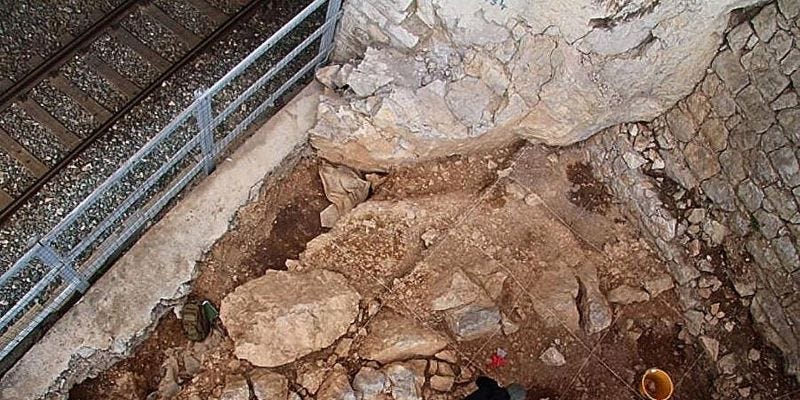 The scientists found that both Neanderthals and early Homo sapiens divided their living areas into distinct high-intensity zones (think: butchering dinner, making tools, arguing about who left a spear lying around) and low-intensity zones (eating, sleeping, telling stories by the fire). Sound familiar? That’s your kitchen vs. your living room right there.
This homogeneity hinted at an underlying structure — by tallying clusters of artifacts, the archeologists could map out the floor plan of these ancient homes.
So, how did Neanderthal logic compare to modern human logic? Let’s break it down.
Then: Neanderthals used hearths as the gravitational center of their cave — cooking, warmth, and social bonding all in one place. They dumped their trash in designated pits (yes, they had trash cans, though not as we imagine). Tools were knapped in a specific corner to keep sharp flakes out of sleeping areas.
Now: We use the kitchen island — others the dining room — as our hearth. We have recycling bins (the modern refuse pit). Our tools are orderly (or not) stored in a utility closet. And we absolutely ban work laptops from the bedroom if we can help it.
That’s the same brain wiring.
Of course, there were minor differences. The study notes that Neanderthal camps tended to have lower artifact densities and fewer clusters — meaning they used their spaces more sporadically, like a seasonal hunting cabin. Homo sapiens, meanwhile, alternated between short-term tents and long-term base camps (the ancient equivalent of renting vs. owning).
 A Neanderthal-occupied cave as imagined with AI.
But here’s the kicker: both species consistently placed hearths and refuse pits in the same relative spots. That’s not coincidence. That’s shared logic. Inherited logic.
What the researchers are really telling us is this: When a Neanderthal family walked into a cave, they didn’t see a blank void. They saw a floor plan. They thought, as it comes to my mind: “Fire goes there. Bones go there. Sleeping goes back there.” They planned ahead.
And guess what? We do the exact same thing when we walk into a new apartment.
Far from being primitive, Neanderthals were already running a household. We didn’t invent the concept of “a place for everything and everything in its place.” We inherited it from prehistoric people who were just as sophisticated as us — they just had worse insulation and no IKEA.
So next time you instinctively drop your keys in the same bowl by the door, or push the coffee table to define your “living zone,” take a moment. You’re not just being tidy. You’re acting out a 60,000-year-old habit.
And that’s strangely comforting, isn’t it?
***
This story was first published on Medium. You can follow me there.