

Scientists have mapped a bug’s brain for the first time.
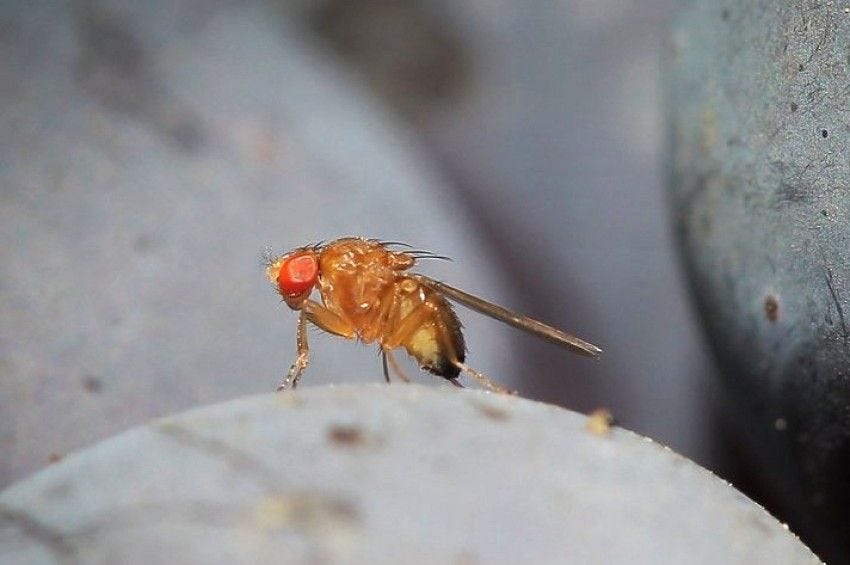 A fruit fly. Getty Images
Ifyou have read my story “How our ancestors fought mosquitos before science”, you may know about my complicated relationship with the flying syringe and its less harmful but more annoying sister — the common housefly. As a nature lover, I usually attempt to drive them out before resorting to the final solution.
Those who tried the same thing have probably noticed how hard it is to persuade these stubborn creatures to leave. An open window doesn’t seem like a sufficient invitation, while a towel used as a propeller is perhaps not a convincing threat.
One may think they don’t have brains at all. You know, those super-tiny neurons that make a connection between an open window, a rotating towel, and the instinct of preservation.
But apparently, flies do have brains. And neuroscience researchers from the University of Cambridge and Johns Hopkins University teamed up to count the neurons in the brain of a fly species called the fruit fly (Drosophila melanogaster), which is roughly half the size of the common housefly (Musca domestica). More precisely, a fruit fly larva.
So, how many neurons does a fruit fly have?
To answer this question, the team focused on the larval stage of the fruit fly. In a study published in the journal Science, they have identified the synaptic wiring that connects the brain of a fruit fly larva, creating the first ever complete map of a bug’s brain.
It turns out that the larva’s brain contains as many as 3,016 neurons and 548,000 synapses. The partial connectome of the brain of an adult fruit fly earlier produced 25,000 neurons and 20 million synapses.
According to the study’s authors, cited by Nature, the brain of a fruit fly larva shares some similarities with the human brain and has specific zones that are responsible for certain functions — one is designed for decision-making, another responds to learning, a third one is for navigation, and so on.
To create the map, which basically is a diagram of the neural connections or pathways within the brain or nervous system of an organism, the researchers used the brain of a six-hour-old female fruit fly larva. They imaged the brain over the course of a year and a half using an electron microscope, generating thousands of visual slices, which were processed with special software.
Imaging a single neuron required about a day, according to a press release from the team.
Another interesting fact is that almost 75% of the most well-connected neurons were linked to the brain’s learning center, underscoring its importance. And while the brain had multiple layers with connections between them, it also had shortcuts that skipped layers.
The experiment revealed that in spite of its resemblance with the human brain, the bug’s left and right sides of the brain were similar, which is not the case with humans’ hemispheres, which have different functions.
Then, it’s worth remembering that a human brain contains 80–110 billion neurons and several hundreds of trillion synapses. Mapping this brain will be a true challenge.
Until now, scientists had fully mapped the nervous systems of only a few simple organisms, including two worm species and a sea squirt larva.
Fruit flies also tend to live slightly longer than common houseflies. While houseflies usually survive for only a few weeks, fruit flies may live more than a month under ideal conditions.
Still, that apparently isn’t enough time to develop the neurons needed to understand that somebody is trying to chase them out of the room.
The authors of the study uploaded two videos on YouTube with their findings. Here and here.
***
This story was originally published in my Medium account. You can follow me there too.