

 Earth's orbit around the Sun has never been perfectly fixed. While the Solar System is remarkably stable on human timescales, its planets are constantly influenced by the gravitational pull of one another. Occasionally, such influence is exerted by stars passing through the Sun's cosmic neighborhood.
A study published in The Astrophysical Journal Letters suggests that one such stellar flyby about 2.8 million years ago may have subtly perturbed Earth's orbit, potentially complicating scientists' efforts to reconstruct our planet's ancient climate history.
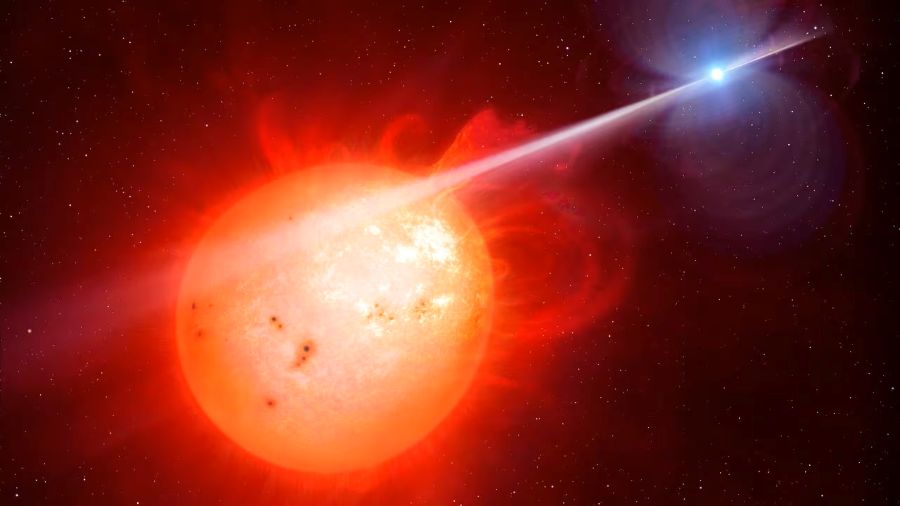
The suspected visitor was a star known as HD 7977, which passed the Sun at a distance estimated between 4,000 and 32,000 astronomical units (AU). One astronomical unit equals the average distance between Earth and the Sun: about 93 million miles or 150 million kilometers.
Although this may seem unimaginably distant, it is close enough, in astronomical terms, for the star's gravity to have disturbed the orbits of bodies in the outer Solar System. According to the researchers, the resulting gravitational effects may even have propagated inward, subtly altering Earth's orbit over millions of years.
According to the Planetary Science Institute, understanding Earth's past orbit is essential for interpreting ancient climate records. If we want to best search for the causes of ancient climate anomalies, it is important to have an idea of what Earth's orbit looked like during those episodes, it said.
Earth's orbital shape, called eccentricity, influences how much solar energy the planet receives over long timescales. These gradual variations, known as Milankovitch cycles, are closely linked to natural climate changes, including the advance and retreat of ice ages.
Using detailed computer simulations, PSI scientists found that the flyby of HD 7977 could have introduced small orbital changes that were later amplified by the gravitational influence of the Solar System's giant planets, particularly Jupiter and Saturn.
These findings suggest that stellar encounters may introduce previously overlooked uncertainties into calculations of Earth's orbital evolution. As a result, reconstructing the exact orbital conditions during ancient climate events could be more difficult than scientists had previously believed.
The researchers point to episodes such as the Paleocene-Eocene Thermal Maximum — a period about 56 million years ago when global temperatures rose dramatically — as examples where precise knowledge of Earth's orbit could help scientists better understand the factors driving ancient climate change.
Interestingly, the effects of the HD 7977 encounter would not have been immediate. The simulations indicate that its influence accumulates gradually, becoming increasingly noticeable only millions of years after the stellar flyby.
Far from being exceptional, such encounters appear to be a normal part of the Solar System's history. On average, a star passes within about 50,000 AU of the Sun once every million years, while an encounter within 10,000 AU occurs roughly once every 10 million years.
For comparison, Neptune, the Solar System's outermost major planet, orbits at an average distance of only about 30 AU from the Sun. Even the closest known stellar flybys remain hundreds of times farther away than Neptune, yet over millions of years they can still leave subtle gravitational fingerprints on the architecture of our planetary system.
The above-mentioned study is a reminder that the Solar System is not evolving in cosmic isolation. As the Sun travels through the Milky Way, there are occasional encounters with neighboring stars, which may slightly reshape planetary orbits – including Earth’s.