

The black holes in the center of galaxies may act as time bombs, shutting down the formation of new stars.
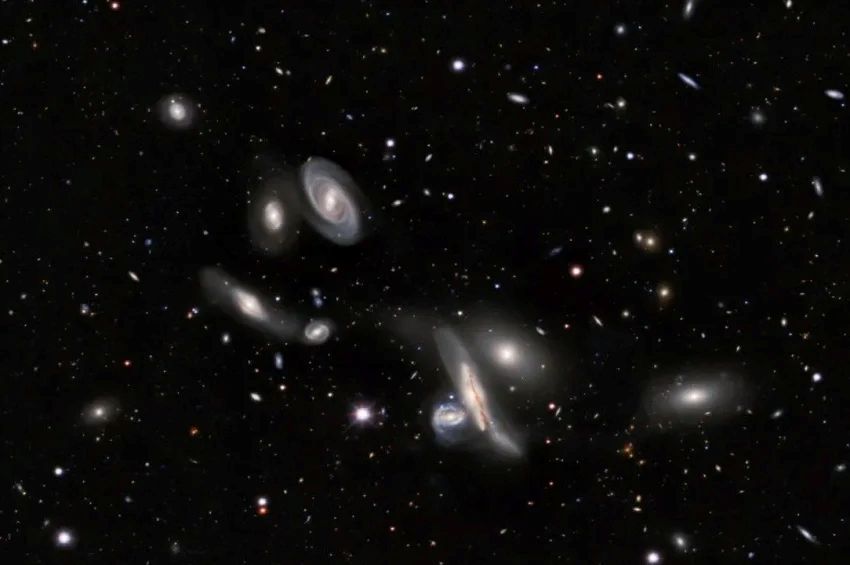 Billions of years from now, our galaxy is expected to collide and merge with the Andromeda galaxy. At the centers of the two galaxies are supermassive black holes: Sagittarius A* in the Milky Way and an even more massive black hole in Andromeda.
When the two galaxies finally settle into a single system, their central black holes are expected to sink toward the center and ultimately merge as well. But will the resulting supermassive black hole eventually consume everything around it — stars, planets and all the other matter that survived the galactic collision?
Probably not. Most stars will never come close enough to the event horizon to be swallowed. Some could be thrown into intergalactic space, while others could remain in orbit around the merged galaxy.
Yet there is a deeper connection between this distant future and the galaxies we observe in the early Universe today.
New research suggests that supermassive black holes may already be playing a decisive role in determining how galaxies die.
Unlike the Milky Way, which still produces around three to four Suns' worth of new stars each year, some galaxies — particularly elliptical galaxies — have experienced a prolonged halt in star formation. They contain few or no young stars, suggesting that something effectively shut down their ability to create new ones.
Astronomers have long suspected that the supermassive black holes at the centers of these galaxies may be responsible.
According to the study led by Kei Ito from the Graduate University for Advanced Studies (SOKENDAI) in Japan, the black holes may not simply sit at the centers of dead galaxies. They may help cause the death itself.
The mechanism behind this star formation shutdown in such smooth, uneventful galaxies has been puzzling.
However, astronomers have long suspected that the central supermassive black holes within galaxies might hold the key.
To explore this idea, an international team of astronomers focused on ancient galaxies that existed 9.5 billion to 12.5 billion years ago. These galaxies resembled the quiet elliptical galaxies we observe closer to us, where star formation is nearing extinction.
To investigate this further, the team utilized various wavelengths of light data collected by powerful telescopes. They first distinguished galaxies where star formation persisted from those where it had ceased, using optical and infrared data.
Next, they analyzed X-ray and radio data to detect signs of supermassive black hole activity, a probable agent of star formation suppression. Active supermassive black holes consume significant amounts of surrounding matter, creating turbulent processes known as "feedback."
This feedback manifests in multiple ways. Firstly, material swirls around the black hole, generating intense radiation that spreads across the universe. Additionally, the black hole emits powerful jets of plasma from its polar regions, accelerated by its magnetic field. Lastly, strong winds are produced, sweeping out into the galaxy.
All three forms of feedback work together to disperse the cold molecular gas crucial for the birth of new stars.
Examining ancient galaxies from such great distances posed challenges due to their small size and faintness. To address this, researchers combined data from multiple galaxies to amplify the radio and X-ray signals indicative of active supermassive black holes billions of years ago.
The study's findings revealed a distinct excess of X-ray and radio signals in galaxies with diminished or no star formation, pointing to the presence of active supermassive black holes. This signal was less pronounced in galaxies with ongoing star formation.
In conclusion, the study suggests that active supermassive black holes likely play a role in the abrupt decline of star formation and eventual death of these galaxies.
And perhaps this is the ultimate irony of galactic evolution.
A supermassive black hole can help kill a galaxy long before it has consumed its stars. By heating, disturbing and expelling the cold gas needed to make new stars, it can turn off the process that keeps a galaxy alive.
The universe contains vast galaxies filled mostly with stellar remnants, white dwarfs, neutron stars and black holes — with very little new starlight being produced.
Our own Milky Way is still forming stars. But its distant future may be very different. After the merger with Andromeda, the two central black holes are expected to become one, enormously larger than Sagittarius A* is today. Most of the stars will survive that event, at least for a while, but the resulting galaxy will gradually become older and darker as its supply of star-forming gas declines.
Perhaps, in the end, everything will disappear into it — not even dust to witness that any of us ever existed will remain.
The full study can be downloaded in a PDF file here.