

The fear is palpable and understandable. We’ve been warned of mass unemployment as artificial intelligence automates both mental and physical work — the very jobs that underpinned the middle class for generations.
 The prospect of a future where a handful of tech oligarchs harvest AI’s immense benefits while the rest scramble for scraps haunts public discourse. But this narrative, however compelling, misunderstands both history and the nature of technological revolutions.
The concern is not unfounded — but it is incomplete.
To those who fear that AI will destroy the traditional economy, rest assured — it won’t. At least not the way you think. It will transform it — much as industrialization, urbanization, and the digital revolution did before.
And while transformation always brings dislocation, it also brings unprecedented opportunity. AI may become one of the most powerful democratizing forces in economic history, empowering millions of micro-entrepreneurs to build businesses, personal brands, and livelihoods in ways previously reserved for large corporations with deep pockets.
This story is not just a projection sourced merely in my natural optimism and positive thinking — it is based on research and historical parallels.
The lessons of the PC revolution
The anxiety surrounding AI mirrors previous technological panics with striking fidelity. When personal computers began infiltrating workplaces in the 1980s, fears of mass unemployment ran high. Spreadsheets, critics warned, would eliminate accounting jobs. Word processing would decimate secretarial pools. Yet what actually transpired tells a different story.
From 1980 to 2000, as personal computers transitioned from hobbyist kits to corporate necessities, the U.S. real GDP nearly doubled, rising from approximately $7 trillion to $13 trillion. Labor productivity growth accelerated sharply in the second half of the 1990s, averaging over 2.5% annually — a significant increase from the roughly 1.5% growth of the prior two decades.
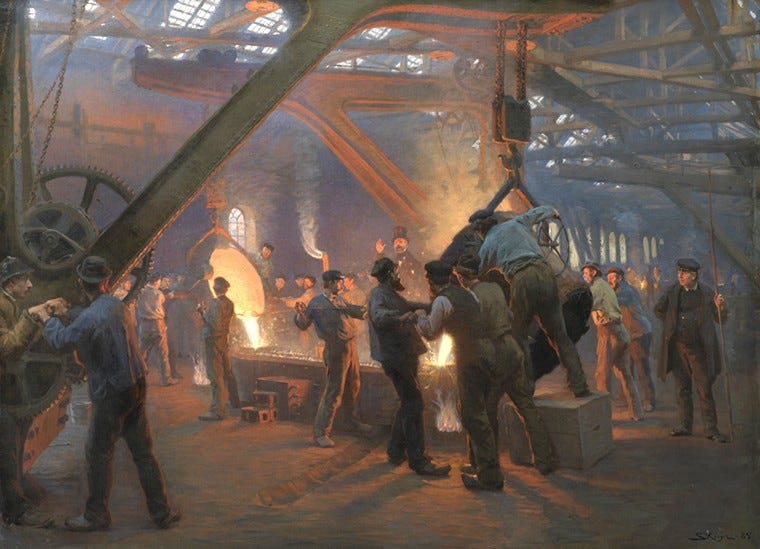 A modern depiction of metallurgic works during the Industrial Revolution. Image: CFR Education
Unemployment, rather than permanently spiking, fell to 4% by 2000.
More revealing is what happened to employment categories. In 1980, there were essentially no software engineers by modern standards. By the early 2000s, millions of Americans worked in computer and mathematical occupations. Today, the Bureau of Labor Statistics counts well over 4 million jobs in these fields — jobs that did not exist in any meaningful way just decades earlier.
As one observer who lived through the transition noted for the Siebert Financial,
“When you grow up, what do you want to be? In 1975, nobody answered ‘cybersecurity analyst.’ In 1985, nobody said ‘app developer.’ In 1995, nobody said ‘cloud architect.’ In 2005, nobody said ‘social media strategist’.”
Who signed up for “AI product manager” or “prompt engineer” in 2015? “AI ethics / alignment specialist”, “synthetic media designer”, “AI agent builder” — have you heard of these professions?
The story of automated teller machines offers another instructive parallel. When ATMs proliferated in the 1980s, economists predicted the demise of bank tellers. Yet teller numbers in the U.S. did not decline; they remained steady and even grew during the late 1990s and early 2000s.
The same pattern was observed in Europe. A 1989 International Labour Organization study reported that Europe was home to nearly 1.5 million bank tellers — roughly three times the U.S. figure — handling most retail customer transactions.
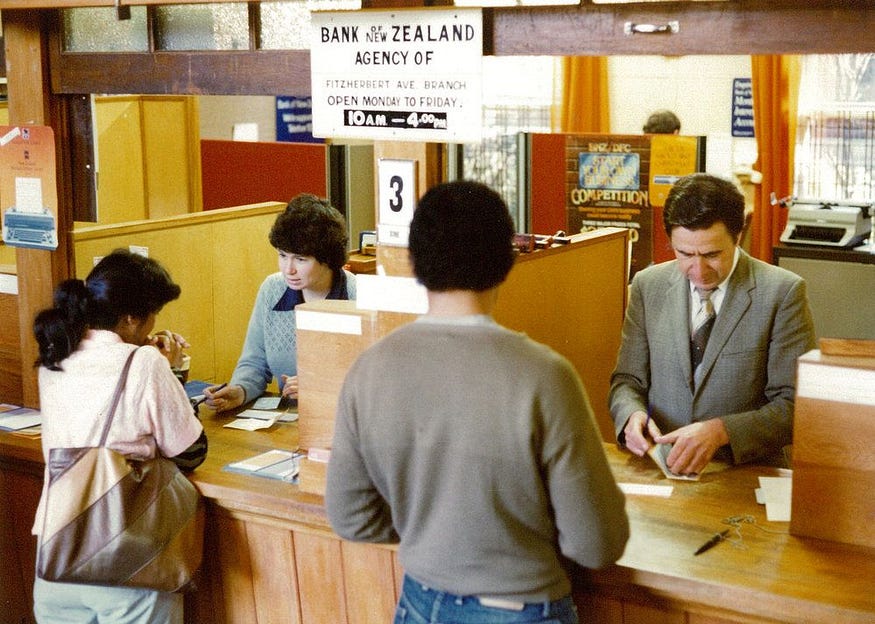 A bank division in New Zealand. Clerks handling cash and papers in the 1980s. Photo: Massey University Library
Contemporary research on banking transformation across nine OECD countries, including Germany, France, Italy, the Netherlands, Spain, and the United Kingdom, confirms that data-based customer relations allowed European banks to shift the mix of self-service and personal service at branches from the early 1980s through the late 1990s.
Rather than being automated out of existence, branch staff transitioned from service providers to a sales force, with their roles evolving toward advisory and client-facing functions.
The explanation is counterintuitive but also indicative: ATMs reduced branch operating costs so significantly that banks could open many more branches, expanding their physical footprint. The new branches created jobs that offset — and even slightly outweighed — displacement within existing branches.
Moreover, the teller role transformed, shifting from routine cash handling to relationship-based activities like selling financial products and providing advice.
The great divergence: A cautionary precedent
History also offers warnings about what happens when technological transformation outpaces society’s capacity to manage its consequences. The Industrial Revolution of the 19th century produced what economists call the “great divergence” — a dramatic split in global fortunes between industrialized nations and those left behind.
By 1800, most countries were poor, with life expectancy below 40 years and literacy rates rarely exceeding 12%. By 1900, however, industrialized powers enjoyed vastly higher incomes and lifespans than those who remained agricultural economies.
This divergence was not inevitable; it resulted from concentrated technological adoption and uneven institutional capacity. The Brookings Institution warns that AI could drive a similar “next great divergence” unless deliberate action ensures its benefits are broadly shared rather than geographically concentrated.
Today, high-income countries are far better positioned to benefit from AI, with the infrastructure, skills, and capital necessary to participate in the AI economy. Meanwhile, roughly one-quarter of Asia-Pacific’s population remains offline, and fewer than one in five rural residents can perform basic spreadsheet calculations.
This capability gap threatens to replicate the patterns of the Industrial Revolution, concentrating AI’s benefits among those already privileged. But the lesson is not that AI inevitably increases inequality — it is that inequality results from policy choices and institutional preparedness, not from technology itself.
So, blaming AI and technology for widening inequality simply misses the point by mistaking the tool for the choices that govern its use.
You normally don’t accuse the neighbor’s tractor (which you don’t have) for your poor agricultural performance. A tractor does not cause a harvest to fail; the failure lies in whether a farmer has access to it, knows how to operate it, and benefits from the infrastructure — roads, markets, fair credit — that turns its power into shared prosperity.
Similarly, AI is not the author of inequality; it is a magnifier of existing institutional strengths and weaknesses. Whether it deepens divides or narrows them depends entirely on whether we choose to invest in the skills, infrastructure, and inclusive policies that allow many to wield it, rather than allowing a few to hoard its benefits.
The democratizing potential: AI as an entrepreneurial enabler
Yet alongside these warnings, a more optimistic picture is emerging. AI is not merely automating existing work; it is lowering the barriers to entrepreneurship in unprecedented ways. Recent data suggests AI may be fueling a small-business boom.
A report published in December 2025 found that 79% of all U.S. small companies have already adopted AI in some form. Among small business employees surveyed, 50% said the “rise of AI has made me consider career paths — like entrepreneurship — that I hadn’t thought about before.”
The same report documented a 69% increase in LinkedIn users who added “founder” to their profiles since July 2024, suggesting more people are making the move to create their own businesses.
This surge in entrepreneurial interest reflects AI’s capacity to handle the administrative and operational tasks that historically made solo entrepreneurship daunting. The opportunity for AI spans every aspect of small-business operations; it can automate routine tasks in customer service, generate marketing content, streamline the hiring process, and enhance decision-making with data insights previously only unlocked by enterprise clients.
So, an entrepreneur can handle multiple tasks without hiring new human resources. The unhired workers, in turn, can become entrepreneurs and follow exactly the same path. As the number of employees shrink, the number of business founders — and registered companies — increases.
The real-world business: A new microenterprise economy
The statistical trends are borne out by concrete examples of entrepreneurs using AI to build businesses that would have been unimaginable just a few years ago.
Vinod Kumar, founder of Dazzling Delights Bakehouse in Malaysia, illustrates how AI empowers small-scale food entrepreneurs. Before attending an AI training program, Kumar simply snapped photos of his products and uploaded them directly to social media. After learning to use tools like ChatGPT, CapCut, Microsoft Copilot, and Google Gemini, he now uses AI three to four times weekly to create promotional videos, design posters, and generate engaging captions.
 Vinod Kumar. Photo: News.utm.my
The result? A 10% to 30% increase in sales, improved brand visibility, and a new partnership to supply his products. Generative AI made his brand look more professional. Even though he doesn’t have a tech background, he can experiment with prompts and images until he finds the best results. For Kumar, it feels like having a creative partner.
Even more striking is the story of Black Paper Party, an entrepreneurial venture that turned a ChatGPT-assisted brainstorming session into a Walmart product line. Founder Jasmine Hudson and her team used ChatGPT to remix the classic “12 Days of Christmas” to better reflect Black culture, generating lyrics about “twelve kings and queens, eleven dancers stepping, ten Tuskegee Airmen.”
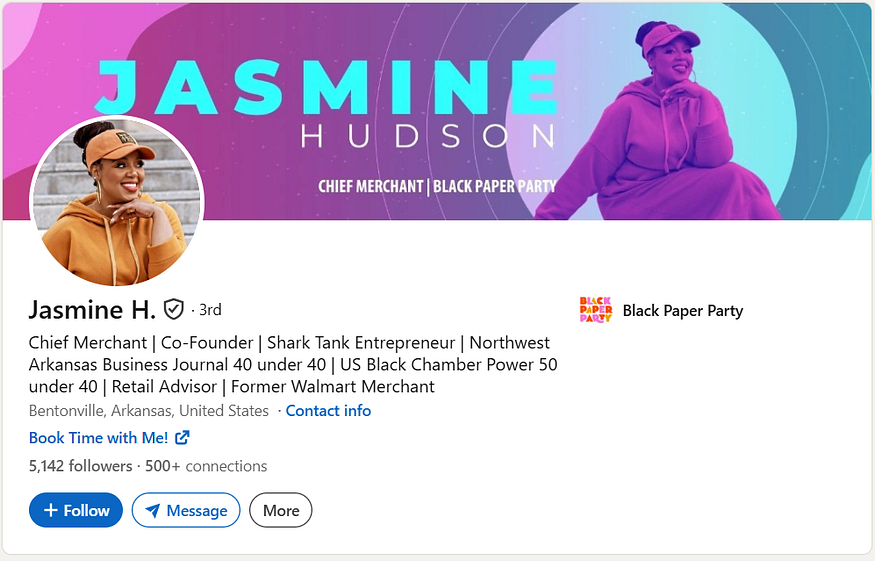 Jasmine Hudson’s LinkedIn profile. Screenshot
The resulting product line — which includes ornaments, wrapping paper, and culturally resonant nutcrackers — is now carried by Walmart stores nationwide.
Beyond creative brainstorming, Hudson uses AI for financial modeling, inventory forecasting, finding partners for pop-ups in new cities, and managing outreach campaigns for her nonprofit supporting Black entrepreneurs.
But why looking for examples afar? I “sinned” too. Just recently, I completed a website for a furniture manufacturer. I am pretty capable of web sketching but I am not a programmer. Yet I did it — both front-end and back-end. The new website (nice-house.md) — already online — took me five days to build from scratch and fetched €440. I used Lovable, a Swedish AI coding app, which cost €25 in monthly subscription.
Highly recommended for beginners, amateurs, professionals and all kind of folks (click HERE to receive 10 extra credits upon non-subscriptional sign-up).
 The front page of Nice-House.md, Hero section. Screenshot
In the end, I learned new design tricks, some coding terminology, had a lot of fun, and earned a few bucks.
These examples represent a new category of entrepreneur: individuals who, lacking extensive teams or marketing budgets, can nonetheless project professional polish and reach markets previously accessible only to larger companies. AI serves as a “creative partner,” a marketing department, a financial analyst, and a copywriter — all available at minimal cost.
The platform economy meets AI
The entrepreneurial potential of AI extends beyond individual microenterprises to entire platforms designed to connect workers with opportunities. Serbiz, an AI-native platform launched in the Philippines, exemplifies this trend. The platform uses two AI agents — Ernie and Scout — to match Gen Z workers with side gigs. Ernie acts as a “personal hustle coach,” analyzing users’ skills and experience to recommend suitable jobs, while Scout helps employers refine vague job descriptions to improve matching.
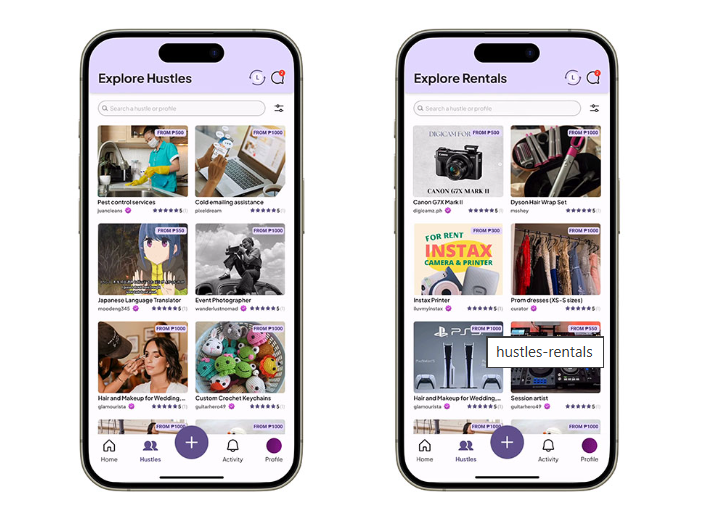 Serbiz’ app. Screenshot
Since its launch in January 2025, Serbiz has attracted more than 80,000 registered users and over 27,000 organic marketplace posts. The most in-demand services include TikTok editing, content creation assistance, and event support, with average weekly earnings ranging from $14 to $90. The platform plans to expand across Southeast Asia by 2026, adding integrated payments, skill-building modules, and global job matching capabilities.
What makes Serbiz significant is its recognition that many potential gig workers lack clarity about what services they can offer. By using AI to identify and articulate users’ skills, the platform lowers the cognitive and confidence barriers to entering the gig economy.
This mirrors a broader pattern: AI can help individuals recognize and market their own capabilities, transforming latent potential into economic activity.
The infrastructure layer
Tounderstand why AI’s entrepreneurial potential may exceed that of previous technological waves, it helps to recognize AI as a “general-purpose technology” — a category that includes electricity and computing. Such technologies do not merely improve existing processes; they restructure the production function of entire economies and create entirely new industries over time.
Electricity did not just replace candle makers; it enabled refrigeration, telecommunications, appliances, industrial scaling, and entirely new consumer categories. Computing did not just eliminate typists; it enabled e-commerce, digital advertising, SaaS, mobile ecosystems, and globalized supply chains.
AI is on the same trajectory — but with a crucial difference. Unlike previous general-purpose technologies that required significant capital investment, many of AI’s most powerful applications are available at minimal cost through cloud-based services and open-source models.
This accessibility changes the dynamics of entrepreneurship. Historically, starting a business required substantial capital for equipment, inventory, marketing, and administrative support. AI collapses these requirements. A single entrepreneur with a laptop and a subscription to AI tools can now perform functions that once required a team of specialists.
The challenge: Managing the transition
I’ll be frank. None of these will minimize the genuine disruption AI will cause. The historical record makes clear that technological transitions impose real costs on displaced workers. When computerized machine tools swept through manufacturing in the 1970s and 1980s, they displaced assemblers, machinists, and lathe operators.
Jobs in the factory transformed, increasingly requiring a sophisticated understanding of the programming of machines and often a college degree. Those who could not or did not adapt faced prolonged unemployment or downward mobility.
The current wave of AI automation differs from previous transitions in ways that may amplify both opportunity and dislocation. Unlike factory automation that primarily affected manual and routine cognitive tasks, AI threatens to automate complex cognitive and creative work — analysis, design, logistics, customer service, even teaching and programming. These are precisely the jobs that underpinned the modern middle class.
Moreover, workers today lack the institutional protections that helped industrial workers navigate previous transitions. As economists David Clingingsmith and colleagues note in an opinion piece for the Forbes, industrial workers in the 1980s had strong unions, concentrated impacts that facilitated collective responses, and clear retraining paths. Today’s knowledge workers face more diffuse disruption without comparable support structures.
Research suggests these vulnerabilities are unevenly distributed. Women’s jobs are nearly twice as likely as men’s to face high exposure to AI-driven automation, with about 4.7% of female employment in high-exposure categories compared to 2.4% for men. Generational divides are also emerging: employment for workers aged 22–25 in high-exposure occupations has fallen by about 5% in recent years, suggesting AI may be reducing entry-level opportunities even as older workers experience productivity gains.
Policy imperative
The divergent outcomes of previous technological transitions offer clear lessons. The Industrial Revolution’s Great Divergence was not inevitable; it resulted from policy choices about infrastructure investment, education, and institutional development. The post-war prosperity of the 20th century was not automatic; it was built on public investments in education, labor protections, antitrust enforcement, and social safety nets that enabled broad participation in economic growth.
The Brookings Institution outlines three strategic choices that will determine whether AI drives convergence or divergence. First, policymakers must invest in “soft infrastructure” — human capital, digital literacy, and institutional capacity — rather than merely deploying technology into unprepared environments.
Example. The One Laptop per Child initiative — launched in 2005 by Nicholas Negroponte (an American computer scientist, educator, and technology visionary) for Latin America, Africa and Asia — demonstrated that technology fails when deployed without trained teachers, localized content, and reliable connectivity. With fewer than 20% of rural residents in developing regions capable of basic digital tasks, human capital must be the priority.
Second, countries should treat core AI enablers — compute infrastructure, data, and foundational models — as regional public goods. Few nations can build complete AI ecosystems independently; pooling resources through regional compute commons and shared data initiatives can widen access and strengthen collective bargaining power.
Third, AI roadmaps must be tailored to local capacity. Lower-capacity contexts may benefit from offline-capable AI applications for healthcare or agriculture, while transitional economies can scale proven pilots and build governance frameworks. Higher-capacity countries can lead on standards, safety, and sustainability, sharing expertise with less-developed neighbors.
Adaptation and opportunity
For individuals navigating this transition, the historical record offers both reassurance and challenge. The “relentless march of automation” has consistently created more jobs than it destroyed — but not necessarily the same jobs, nor for the same people.
The key variable is adaptability.
Research on previous automation waves identifies a consistent pattern: jobs are not so much eliminated as transformed. The typing pool gave way to administrative professionals with broader skills. Bank tellers became financial advisors. Factory workers became CNC programmers.
In each case, those who acquired new skills and embraced new roles found opportunity; those who could not or would not adapt faced marginalization.
The skills in highest demand are shifting. The World Economic Forum estimates that nearly 40% of core worker skills will change by 2030. Technological literacy, analytical thinking, creativity, problem-solving, and social-emotional skills like leadership and empathy are increasingly valuable, while routine cognitive and manual skills decline in importance.
This shift creates both anxiety and opportunity. For those willing to learn, AI tools themselves become the means of acquiring new capabilities. Entrepreneurs like Jasmine Hudson and Vinod Kumar have not become AI experts; they learned to use AI as a tool that amplified their existing knowledge and creativity.
Coupled with the simplification of incorporation / business registration (which, for example, the European Union is actively implementing now), the barrier to entry for entrepreneurship has never been lower.
 A screenshot from the E.U. announcement on the EU Inc. initiative.
From fear to empowerment
The fear that AI will destroy the economy misunderstands how technological transformation works. Yes, AI will eliminate some jobs. Yes, some people will lose tremendously. Yes, the transition will be painful for many. But history suggests that technological revolutions ultimately expand economic opportunity rather than contract it — provided societies make the investments necessary to ensure broad participation.
So, the more accurate frame is not destruction but transformation.
Just as the PC revolution did not eliminate work but created categories of work nobody could have imagined, AI will generate new industries, new professions, and new forms of economic activity. The early evidence of small-business creation and micro-entrepreneurship suggests that AI may be particularly potent as a democratizing force, lowering barriers to entry and enabling individuals to build enterprises that would have required teams and capital just years ago.
The real question is not whether AI will transform the economy — it will. The question is whether we will manage that transformation wisely, investing in human capital, building inclusive institutions, and ensuring that the benefits of AI are broadly shared.
If we succeed, AI may usher in an era of unprecedented entrepreneurial opportunity, where millions of individuals use AI tools to build personal brands, launch microenterprises, and create value in ways we are only beginning to imagine.
I foresee a new class of creative and smart entrepreneurs who are good at multitasking, who embrace learning and experimenting, rising up and falling down, succeeding and failing — but going forward no matter what.
Those who will treat the AI tools with curiosity, critical thinking, and the willingness to learn will survive.
Afterword
The future of work is not predetermined. It will be shaped by the choices we make — as individuals, as societies, and as nations. The tools are here. Whether we will use them to build a more inclusive economy or allow them to replicate the inequalities of the past is up to us.
When this text was almost complete, I asked DeepSeek to polish it and find inconsistencies or logical flaws. The same task for ChatGPT. The Chinese app did a better job (narration flow, edit suggestions, a critical review, and a lot of flattering, of course) but the American one proposed a bulleted structural plan to re-arrange the text.
Not only did I benefit from qualified assistance, but I also had the luxury of choosing among competing tools — each with distinct strengths, each pushing me to sharpen my own judgment, refine my arguments, and to become a more capable writer, ultimately.
AI did not diminish human agency; it amplified it.
***
Thank AI for the summaries of studies and media analyses I relied my article upon as references and sources of inspiration:
Gmyrek, P., Viollaz, M., & Winkler, H. (2026). Disruption without dividend? How the digital divide and task differences split GenAI’s global impact. International Labour Organization Working Paper 166. https://www.ilo.org/publications/disruption-without-dividend-how-digital-divide-and-task-differences-split
Liu Run. (2026). 2026: A Big Opportunity for Small and Medium Enterprises. Sohu. https://www.sohu.com/a/999619647_122014422
Z/Yen. (2026). The New Strategic Dependencies of the Digital Economy. Shaping Tomorrow. https://zyen.shapingtomorrow.com/strategic-intelligence-reports/the-new-strategic-dependencies-of-the-digital-economy
Jaiprakash. (2026). The future of AI: Democratization is the only path to global equity. The Daily Guardian. https://thedailyguardian.com/opinion/the-future-of-ai-democratization-is-the-only-path-to-global-equity-695685/
Chen, X. (2026). Abundant Intelligence and Deficient Demand: A Macro-Financial Stress Test of Rapid AI Adoption. arXiv:2603.09209. https://arxiv.org/abs/2603.09209
Markovitz, G., & Elliott, D. (2026). Five AI Paradoxes to Watch in 2026. World Economic Forum. https://cn.weforum.org/stories/2026/01/ai-paradoxes-in-2026-cn/
U.S. Senate Committee on Commerce, Science and Transportation. (2026). Cantwell, Moran Reintroduce Bill to Help Small Business Leverage AI Tools. https://www.commerce.senate.gov/2026/2/cantwell-moran-reintroduce-bill-to-help-small-business-leverage-ai-tools
Morgan Stanley. (2026). AI Is Now a Macro Variable. Are You Positioned? Morgan Stanley Institute. https://www.morganstanley.com/insights/articles/ai-market-trends-institute-2026
United Nations Conference on Trade and Development. (2026). Releasing the Potential of AI: Reshaping Entrepreneurship in Developing Countries. Cited in Hebei Cyberspace Administration. https://www.caheb.gov.cn/system/2026/01/05/030371279.shtml
Man Group. (2026). AI Boom, Bust or Something Else? Citrini’s Future. Oxford Man Institute. https://www.man.com/insights/ai-boom-or-bust
Clingingsmith, D., et al. (2025). The Economic Shock Of AI; Have We Been Here Before? Forbes. https://www.forbes.com/sites/joemckendrick/2025/11/30/the-economic-shock-of-ai-have-we-been-here-before/
Faculty of Artificial Intelligence, Universiti Teknologi Malaysia. (2025). UTMFAI-DPIM’s AIBEx Program Empowers Entrepreneur to Elevate Brand Visibility Through AI. UTM NewsHub. https://news.utm.my/2025/11/utmfai-dpims-aibex-program-empowers-fb-entrepreneur-to-elevate-brand-visibility-through-ai
Muthukrishna, M., & Schellekens, P. (2026). The Next Great Divergence: How AI could split the world again if we don’t intervene. Brookings Institution. https://www.brookings.edu/articles/next-great-divergence-how-ai-could-split-the-world/
LinkedIn. (2025). How Small Businesses Can Win in 2026. Cited in Crumley, B. (2025). Here’s How AI Is Fueling Small-Business Creation and Driving Growth. Inc.com. https://www.inc.com/bruce-crumley/heres-how-ai-is-fueling-small-business-creation-and-driving-growth/91273692
Quantum Zeitgeist. (2025). The Relentless March of Automation: From Typing Pools to Artificial Intelligence. https://quantumzeitgeist.com/the-relentless-march-of-automation-from-typing-pools-to-artificial-intelligence/
OpenAI Academy. (2026). A cultural remix of Christmas, built for the shelves: How Black Paper Party used ChatGPT to turn a “12 Days” rewrite into a Walmart holiday collection. https://academy.openai.com/en/public/blogs/a-cultural-remix-of-christmas-built-for-the-shelves-2026-01-06
Flynn, A. (2025). In the Shadow of the Algorithm. https://www.andrewflynnpa.com/post/in-the-shadow-of-the-algorithm
BusinessWorld Online. (2025). AI startup links Gen Z to gig work. https://www.bworldonline.com/bw-launchpad/2025/10/15/705392/ai-startup-links-gen-z-to-gig-work/
Siebert Financial. (2026). AI Is Not a Job Killer. It’s a Job Creator. https://blog.siebert.com/kakao-rss-feed-test/ai-is-not-a-job-killer.-its-a-job-creator
News4JAX. (2025). Jacksonville business owner uses AI to boost her business and others. https://www.news4jax.com/news/local/2025/04/06/jacksonville-business-owner-uses-ai-to-boost-her-business-and-others/
Papers Past. Teller jobs depend on customers. Ngā Pukapuka Books. https://paperspast.natlib.govt.nz/newspapers/CHP19890131.2.96.3
The Free Library. From tellers to sellers: Changing employment relations in banks. https://www.thefreelibrary.com/From+Tellers+to+Sellers%3A+Changing+Employment+Relations+in+Banks-a078177934