

Two massive stars are reaching their turbulent final stages. Will our children see their lifetime’s extraordinary spectacle in the sky?
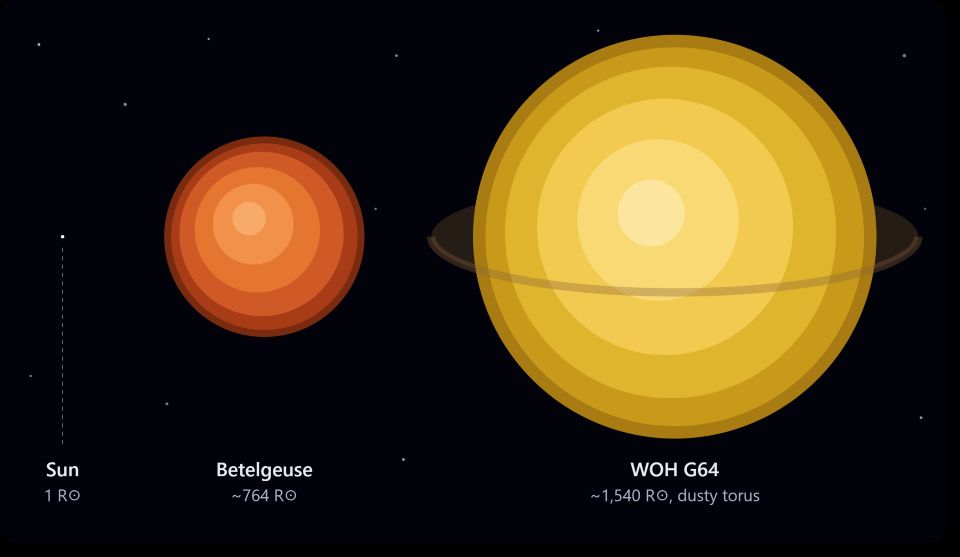 Generated with AI to illustrate the story.
For years, astronomers predicted that Betelgeuse, a reddish star approximately 500–600 light-years from our planet in the constellation Orion, is going to explode as a supernova anytime in our lifetime or next generation’s lifetime. When it happens, the night sky will be dominated by a point of light brighter than almost anything else visible from Earth – for weeks, perhaps months.
But another stellar giant, WOH G64, approximately 163,000 light-years away in the Large Magellanic Cloud, has also attracted attention after observations revealed a dramatic change in its appearance.
Both stars are enormous objects and both are approaching the end of their cosmic lives.
We know this from their size, temperature, brightness, chemical signatures and the way they behave. Massive stars burn hydrogen in their cores much faster than the Sun, evolving within millions rather than billions of years. As their core fuel runs low, they expand, lose material through powerful stellar winds and undergo changes in temperature and luminosity.
Betelgeuse is roughly 16–19 times as massive as the Sun and hundreds of times larger in radius. If placed at the center of our Solar System, its outer layers would extend beyond the orbit of Jupiter.
WOH G64 is an even more extreme object in terms of physical size. It is been estimated to have a radius around 1,540 times that of the Sun and a mass at roughly 30 solar masses.
 CLICK ON IMAGE TO READ MORE STORIES.
Yet they differ significantly in distance, behavior and what scientists can predict about their futures.
The key questions that still puzzle researchers are straightforward: Which star will explode first? Which explosion will appear brighter from Earth? And could either event affect our planet?
The red supergiant Betelgeuse is only about 10 million years old and its advanced evolutionary stage indicates that it has moved well beyond its initial phase of stable hydrogen burning. WOH G64 is also an evolved massive star, surrounded by gas and dust and showing significant changes in its appearance.
Astronomers expect it eventually to collapse and explode as a supernova, although they cannot reliably determine when that will happen.
For decades, astronomers classified WOH G64 as an exceptionally cool red supergiant. However, its appearance changed dramatically around 2013–2014, when it became warmer and appeared more yellow.
A study published in Nature Astronomy in February 2026 interpreted this transformation as a transition into a rare yellow hypergiant. The researchers proposed that the star might have lost part of its extended outer atmosphere through an interaction with a companion star, or that an unusually prolonged eruption had subsided.
But the interpretation remains disputed. A separate study published in Monthly Notices of the Royal Astronomical Society in January 2026 found evidence that WOH G64 may still be a red supergiant. Its unusual appearance could instead be explained by interactions with a companion and the surrounding gas and dust.
 CLICK ON IMAGE TO READ MORE STORIES.
These observations indicate that both stars are in advanced stages of stellar evolution, although astronomers cannot determine precisely how much time either has left before its final collapse or other terminal event.
The key questions that still puzzle researchers are straightforward: Which star will explode first? Which explosion will appear brighter from Earth? And could either event affect our planet?
Which star will explode first?
There is no scientifically reliable answer as yet.
Betelgeuse was widely expected to end its life in a supernova within a few thousand years into the future, but the previous calculations have become obsolete following the discovery of its companion star in 2026. Interactions between the two stars could influence its evolution, potentially accelerating or delaying the explosion.
WOH G64, on the other hand, has a companion, too – a smaller but hotter star – and presents an even more complicated case. Its recent transformation may be related to the final stages of its life, but researchers have not established its internal structure and the nature of its interactions with its companion.
It could eventually become a supernova, collapse into a black hole or merge with its partner.
Betelgeuse is generally believed to be closer to its final collapse, though its evolutionary timetable remains uncertain and its companion complicates the picture. WOH G64 has gone through dramatic changes that must yet be explained while its own companion could bring surprises.
The more science learns about celestial bodies and those two particular stars, the more factors appear in the cosmic equation, and the less accurate researchers’ predictions are.
Consequently, declaring either star the likely first to explode would go beyond the available evidence.
Which explosion would be brighter in Earth's sky?
Here the comparison becomes more interesting.
WOH G64 is extraordinarily luminous in absolute terms. Estimates suggest that it radiates hundreds of thousands of times more energy than the Sun. Betelgeuse is also extremely luminous, shining roughly 100,000 times more brightly than the Sun, depending on the estimates used.
But intrinsic luminosity is only part of the equation. Distance makes an enormous difference to how bright an astronomical object appears to an observer.
 CLICK ON IMAGE TO READ MORE STORIES
Betelgeuse is hundreds of times closer to Earth than WOH G64. Even if WOH G64 released a comparable amount of energy during its eventual explosion, its greater distance would make the event appear much fainter to us.
A Betelgeuse supernova could therefore become an extraordinary celestial spectacle perfectly visible from Earth. It is expected to shine far more brightly than it does today and could rival the brightness of the full Moon, although the exact peak brightness and duration are uncertain.
Depending on the explosion and its circumstances, it might even be visible in daylight. Astronomers would have an unprecedented opportunity to study a nearby supernova using telescopes and instruments across the electromagnetic spectrum.
WOH G64’s eventual explosion could also become visible to the naked eye, depending on its luminosity and the characteristics of the event. However, there is no sound basis to predict that it would outshine a Betelgeuse supernova as seen from Earth.
The apparent winner is therefore Betelgeuse, assuming both stars produce broadly comparable supernova events. Its much smaller distance gives it a substantial advantage.
However, if WOH G64 collapses directly into a black hole without a supernova, it would not produce the same flash of light.
In a supernova, the collapse triggers a powerful explosion that ejects stellar material and releases an enormous amount of energy, making the star temporarily shine across its galaxy. In a direct collapse, gravity overwhelms the star without producing a comparably powerful explosion. Much of the material falls inward, forming a black hole, and the star may fade with no spectacular visible blast.
Could the death of either star threaten Earth?
Despite the spectacular imagery associated with exploding stars, neither of these objects is considered a significant threat to life on Earth.
Betelgeuse is hundreds of light-years away. Its supernova would release enormous amounts of energy, but the radiation and material from the explosion would spread through space before reaching us. At that distance, scientists do not expect the event to cause catastrophic damage to Earth's biosphere.
The explosion could produce detectable neutrinos, high-energy radiation and cosmic rays. These would offer valuable information about the physics of massive-star explosions, the formation of neutron stars or black holes, and the dispersal of elements into space.
The most serious hazards associated with supernovae generally concern much closer explosions. Betelgeuse is not close enough to be regarded as a likely extinction threat.
WOH G64 is much farther away, therefore its distance makes any direct environmental impact on our planet even less concerning.
Scientific opportunities
In both cases, the principal consequences for humanity would be scientific rather than destructive. Astronomers could study the deaths of massive stars in unprecedented detail, learning more about how heavy elements are produced and distributed throughout galaxies, spreading chemical ingredients of possible life.
Betelgeuse, in particular, offers a rare opportunity because its relative proximity and centuries of observations by generations of astronomers.
WOH G64 offers a different perspective due to its extreme size, surrounding material and unusual transformations that challenge existing models of red supergiants’ evolution.
The Milky Way forms approximately 6–7 new stars per year, while roughly one star reaches the end of its life every two years, according to commonly cited estimates.
 ***
***
Sources and references
Nature Astronomy – The dramatic transition of the extreme red supergiant WOH G64 to a yellow hypergiant – the 2026 study of WOH G64’s transformation. https://www.nature.com/articles/s41550-026-02789-7
Monthly Notices of the Royal Astronomical Society – WOH G64 is still a red supergiant, for now – an alternative interpretation of the observations. https://academic.oup.com/mnras/article/546/2/stag012/8416424
NASA – What Is Betelgeuse? Inside the Strange, Volatile Star – Betelgeuse’s properties and the 2019–2020 dimming event. https://science.nasa.gov/universe/what-is-betelgeuse-inside-the-strange-volatile-star/
European Southern Observatory – Astronomers find strongest evidence yet that Betelgeuse has a companion – the July 2026 discovery and its implications for the star’s evolution. https://www.eso.org/public/news/eso2611/
Scientific American – When will Betelgeuse go supernova? – discussion of the uncertain timing and expected effects of a Betelgeuse supernova. https://www.scientificamerican.com/article/when-will-betelgeuse-go-supernova/
Space.com – Astronomers just watched a star 1,540 times the size of our sun transform into a hypergiant. Will it go supernova? https://www.space.com/astronomy/stars/astronomers-just-watched-a-star-1-540-times-the-size-of-our-sun-transform-into-a-hypergiant-will-it-go-supernova
European Southern Observatory – Astronomers take the first close-up picture of a star outside our galaxy. https://www.eso.org/public/news/eso2417/