

Humanity's downward slope began roughly between 50,000 and 25,000 years ago, when Homo sapiens ousted all other human species.
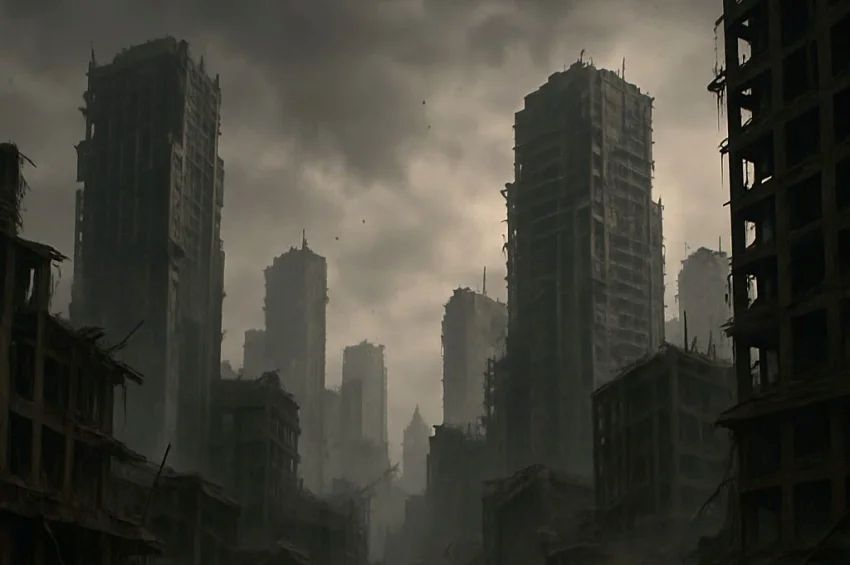 Generated with AI to illustrate the story.
In a sobering essay, a user identifying himself as Krishnan T., an Indian scientist, entrepreneur and innovator, argues that humanity's downfall isn’t looming in the distant future — it may have already begun.
Drawing from evolutionary biology and long-term patterns in species dominance, the author suggests in a blog post that Homo sapiens have been on a slow decline ever since we emerged as the sole surviving human lineage tens of thousands of years ago.
Krishnan’s theory is anchored in what he calls the “Helsinki principle”: the idea that any species — or even genus — that eliminates all natural competitors inevitably begins a long and irreversible slide toward extinction.
In the case of humanity, he contends, that moment arrived between 50,000 and 25,000 years ago, when our ancestors outcompeted and ultimately wiped out all other human species, such as the Neanderthals and Denisovans.
More exactly, the evolutionary clock of Homo sapiens began counting their collapse about 40,000 years ago.
“Every dominant genus in evolutionary history has followed this pattern,” Krishnan writes. “First comes rapid diversification, then singular dominance, and finally, the slow collapse under the weight of environmental randomness.”
In this view, the same evolutionary forces that once gave humans the upper hand are now driving our decline.
The insightful essay explores how humans, by becoming the only species of their kind, sealed their own fate. The disappearance of rival human species removed the evolutionary pressure that once shaped our adaptability and resilience. Although traces of Neanderthal and Denisovan DNA persist in modern genomes, the biological diversity that once existed among human lineages is gone — along with the checks and balances it offered.
What makes Krishnan’s argument especially provocative is his suggestion that humanity may soon face a new form of existential competition — not from another species, at least not biological, but from Artificial Intelligence.
As AI systems evolve rapidly and begin to reshape economies, communication, warfare, and cognition itself, Krishnan warns that we may already be witnessing the rise of a “new genus of intellect.”
“AI is not just a tool,” he writes. “It is the intellectual descendant we did not plan for — an emergent rival we may not survive.”
Though there’s no precise timeline offered, the essay implies that humanity’s long-term survival hinges not on innovation or colonizing other planets, but on recognizing and possibly resisting the deeper biological forces that govern all life on Earth.
Krishnan’s writing doesn’t predict a sudden catastrophe. Instead, it paints a portrait of decline as a slow, structural process — one that began long before modern civilization and may already be too late to reverse.