

Did you know that over 80% of the ocean remains unexplored, yet sonar technology is rapidly changing that?
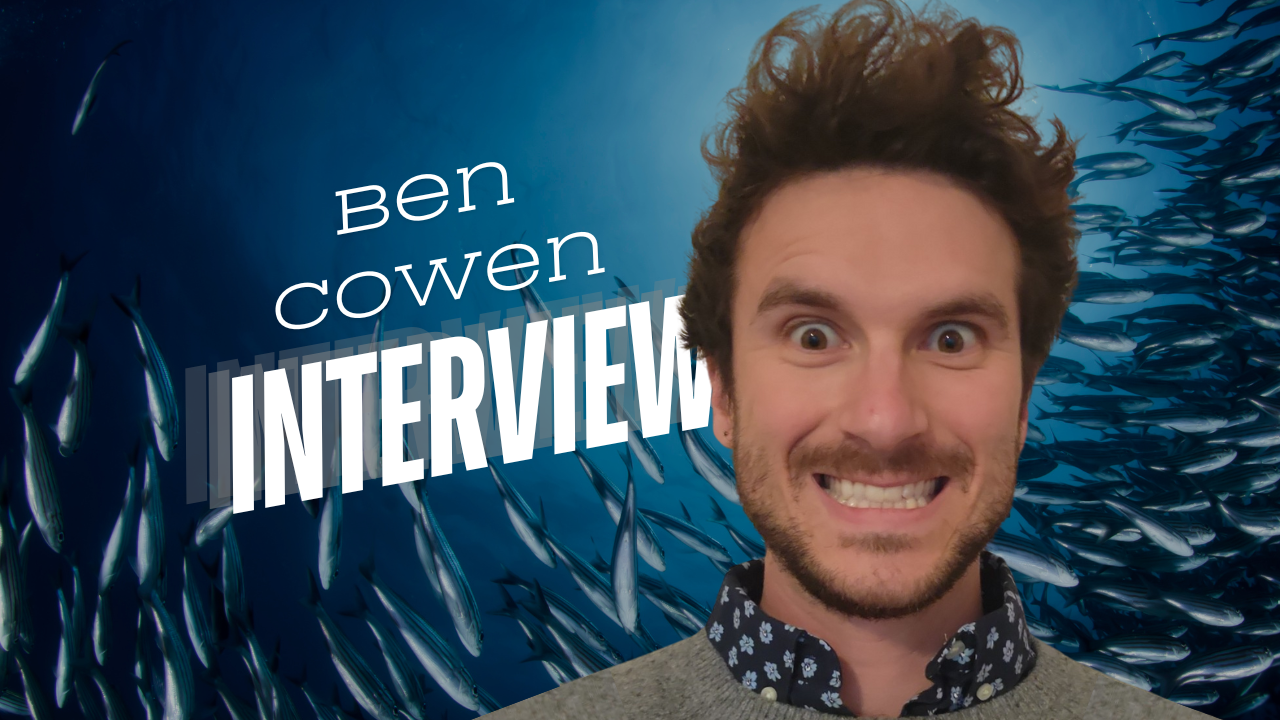
Today, we're diving into the world of sonar with Ben Cowen, an Assistant Research Professor at the Applied Research Laboratory (ARL), Penn State, who works with acoustics and underwater sonar.
Sonar (sound navigation and ranging) has popped up in several of my previous interviews with biologists, but I still didn’t have a good understanding of how it’s used in the field. I really wanted to understand what it’s like to work with and how it is evolving with the integration of new tech, like AI. I knew Ben works with sonar, so I was really excited about this interview.
Sonar Through the Ages: From Leonardo's Tube to AI-Powered Exploration
Ben briefly brought up the history of sonar to give me some background, which prompted me to do some research. Here are a few things about sonar that I found fascinating:
Animals like bats and dolphins have used sonar for millions of years to find food and detect objects.
One of the first recorded uses of sonar was in 1490 by Leonardo da Vinci. He put a tube in the water and, by putting his ear on the other end, could detect marine vessels (the dolphins must’ve thought he was crazy).
Further progress was prompted by the Titanic disaster of 1912, renewing interest and leading to the “creation of an underwater sound-emitting system that could detect icebergs at a distance of two miles.”
The need to detect submarines in WWI led to even further sonar development by the British and French governments. (I was already familiar with this after listening to 23 hours of Dan Carlin’s Blueprint for Armageddon series - thanks a lot, Mom.)
Ben explained that before digital sonar, researchers used giant headphones attached to a microphone, which was lowered into the water, much like a stethoscope. They would then listen and manually record the sounds they heard.
Now, with the development of complex algorithms, machines can detect very quiet sounds that are difficult for humans to hear. This technological advancement allows us to gather more detailed and precise data. Instead of just detecting sounds, today's challenge lies in sifting through all the collected data, identifying relevant information, and providing accurate labels.
I remember learning that humans know more about the surface of the moon than the bottom of the ocean. Sonar technology is changing this, providing us with more knowledge about the depths of the sea and the diverse marine life that inhabits it. This progress highlights the incredible potential of sonar technology in ocean exploration and conservation.
Real-Life Discoveries with Sonar Technology
I really wanted to know if Ben had detected anything notable using sonar. He shared that during one of his recent trips, his team was mapping an underwater mountain range covered in coral. Ben’s job was to analyze the data collected. He found that on one side of this mountain range, there was what looked like a river of fish. It was kilometers long and filled with so many fish that at first, he questioned if they were really fish because there were just so many of them. However, it was confirmed that they were indeed fish.
He also mentioned finding lots of tires, bicycles, ladders, and lobster traps.
I’d love to see this “river of fish” myself, though I’m not as excited about the tires! It’s discoveries like these that make the field of sonar technology so fascinating to me.
Advice for Aspiring Researchers
Ben had some really interesting insights when I asked him if he had any advice for someone looking to pursue a sonar research position. He started by sharing a quote he’d recently read: "The mark of a great man is one who knows when to set aside the important things in order to accomplish the vital ones." - Author Brandon Sanderson.
Ben explained how this can be applied to research. There’s always another question to answer, and you can always dive deeper, but it’s important to have an end goal and know when you’ve gathered enough information to accomplish your goal. He also connected this quote to reading a paper: he asked if you really need to understand every sentence in a paper. Probably not. So it’s important to know when you understand enough to move on. You can always come back later to dive deeper and understand more if you need.
This perspective is crucial for anyone in the field of research, where it’s easy to get lost in the details and all of the data.
Specifically, Ben talked about one of his current projects: the main goal of the project is to find coral in sonar images. Scientists want to measure how much coral there is to see if it's growing or shrinking. Usually, they would have to look at thousands of images by hand, which takes a lot of time. To make it faster, they use AI to help find the coral automatically, only needing people to check the hardest images to teach the AI algorithm effectively.
It sounds like AI is making this work less tedious and more fun (as long as you trust your algorithm). I definitely wouldn’t want to sort through thousands of images unless they were of lizards!
Tips for Future Researchers and Tech Enthusiasts
I always like to ask my interviewees for their advice on what kids should be learning.
Ben believes that math and programming should be taught early-on and in as fun of a way as possible, by gamifying the process. While coding games might seem fun, it often turns into an engineering task. Machine learning is becoming easier to experiment with, which can give a false sense of understanding since running code doesn’t require deep knowledge. However, learning to code from scratch is hard. Finding a balance where students can understand and trust their code is important.
I totally agree with gamifying the learning process, and I’ve got more to say about that in a future blog post.
Takeaways
I really enjoyed interviewing Ben, and I definitely have a better understanding of sonar and what it’s like to work with it. I loved his insights on prioritizing vital things rather than getting lost on all the important ones, and I found the story about the “river of fish” so interesting.
Stay tuned for the next interview (it’s coming out soon), and don’t forget to comment below.