

How nostalgia turned mechanical failures into national treasures: On Tomos engines, Tica sailboats, and the curious art of romanticising what we couldn't replace.
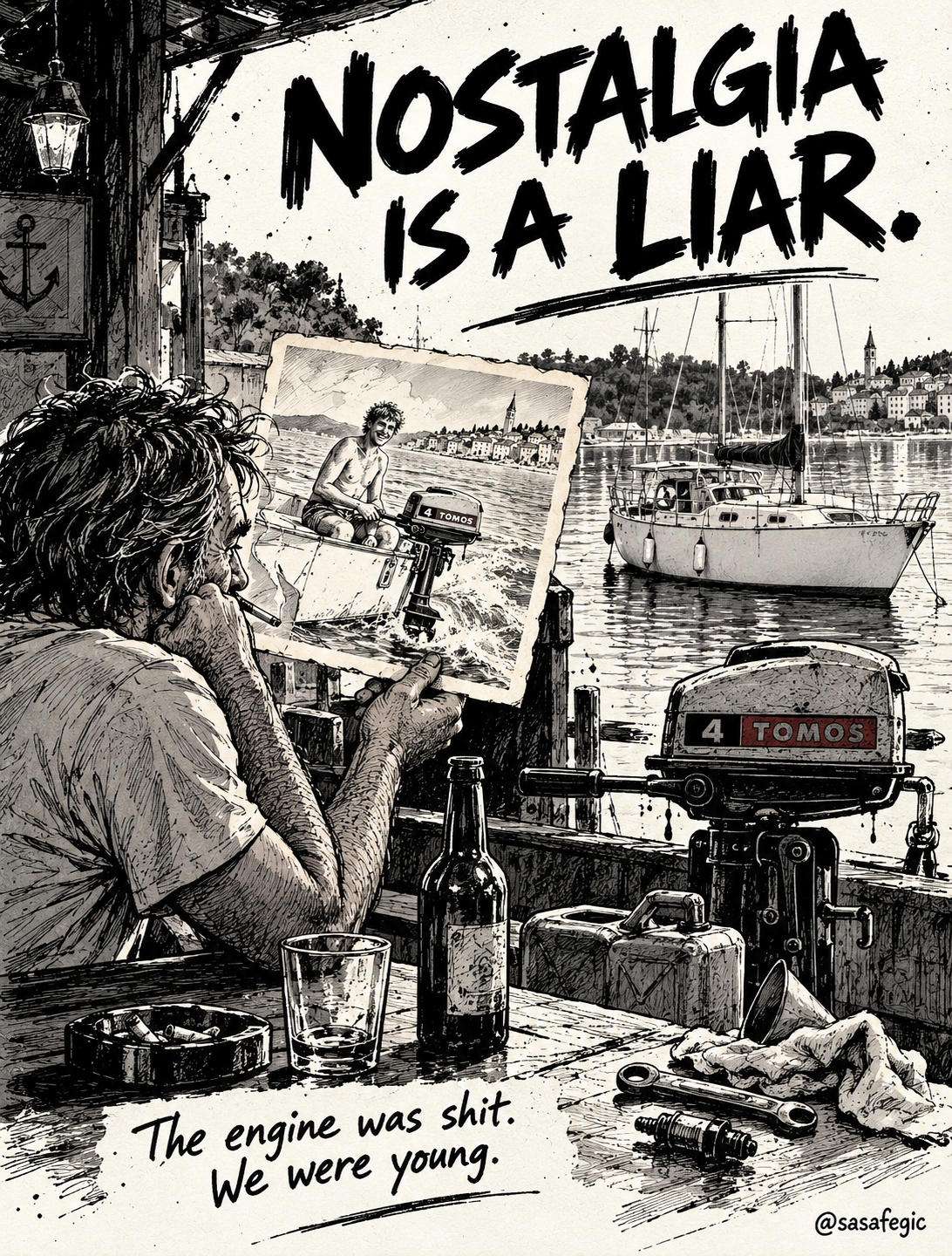 Everybody has a story about the Tomos 4.
You know the engine. The little Slovenian miracle that weighed about as much as a sack of potatoes and started only when it felt like it.
People talk about it now with tears in their eyes, like it was a piece of engineering genius handed down from God himself.
Ah, the Tomos 4. They don't make them like that anymore.
Thank Christ for that.
I had a few of them. Not one. A few. Apparently, I was a slow learner.
Each engine had its own personality. One wanted a little choke. Another wanted half a choke and exactly three millimetres of throttle. The third required you to stand on your left leg, curse the government, and remember something pleasant about your childhood before pulling the starter cord.
Every owner knew his engine intimately.
Not because he wanted to.
Because he had to.
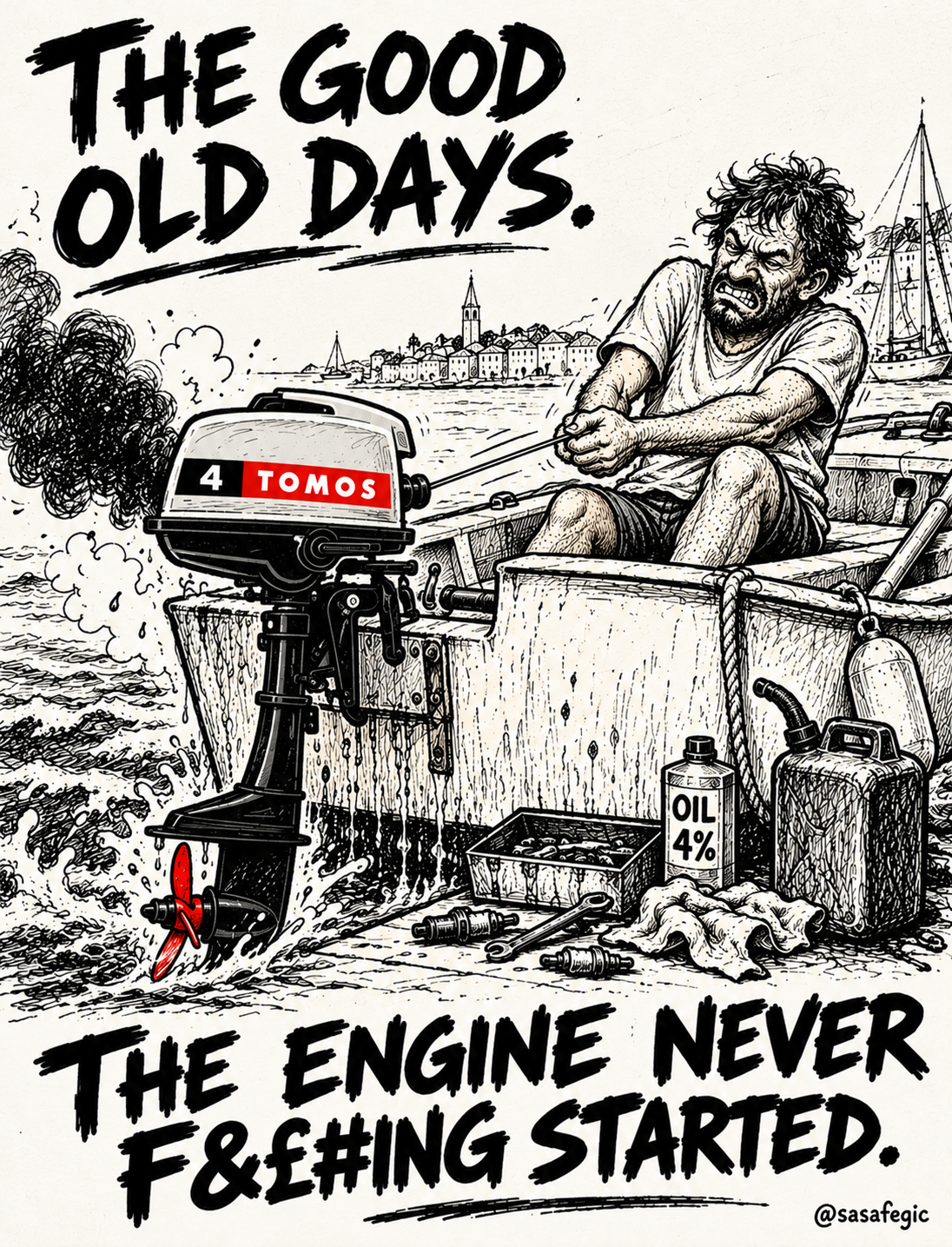
You knew the precise position of the throttle. The exact amount of choke. The right number of pulls before the engine flooded. You knew when to stop, remove the spark plug, clean it, dry it, put it back, and try again.
Cleaning the spark plug was practically a daily religious ceremony.
And the petrol mixture needed four percent oil. Four percent. You poured enough oil into that petrol to make the whole thing smell like a Soviet tractor having a nervous breakdown.
Then you pulled the cord.
Nothing.
You pulled again.
Nothing.
You pulled harder.
A cough. A sneeze. A small explosion somewhere inside the engine.
Then silence.
You gave it another pull and suddenly it started, usually just when you had decided to throw the bastard overboard.
And now people remember it fondly.
They speak about the Tomos 4 as if it were a faithful old dog. A reliable companion. Something that brought them closer to nature.
It brought me closer to the emergency room.
 And the Tomos isn't alone.
There's the Tica sailboat.
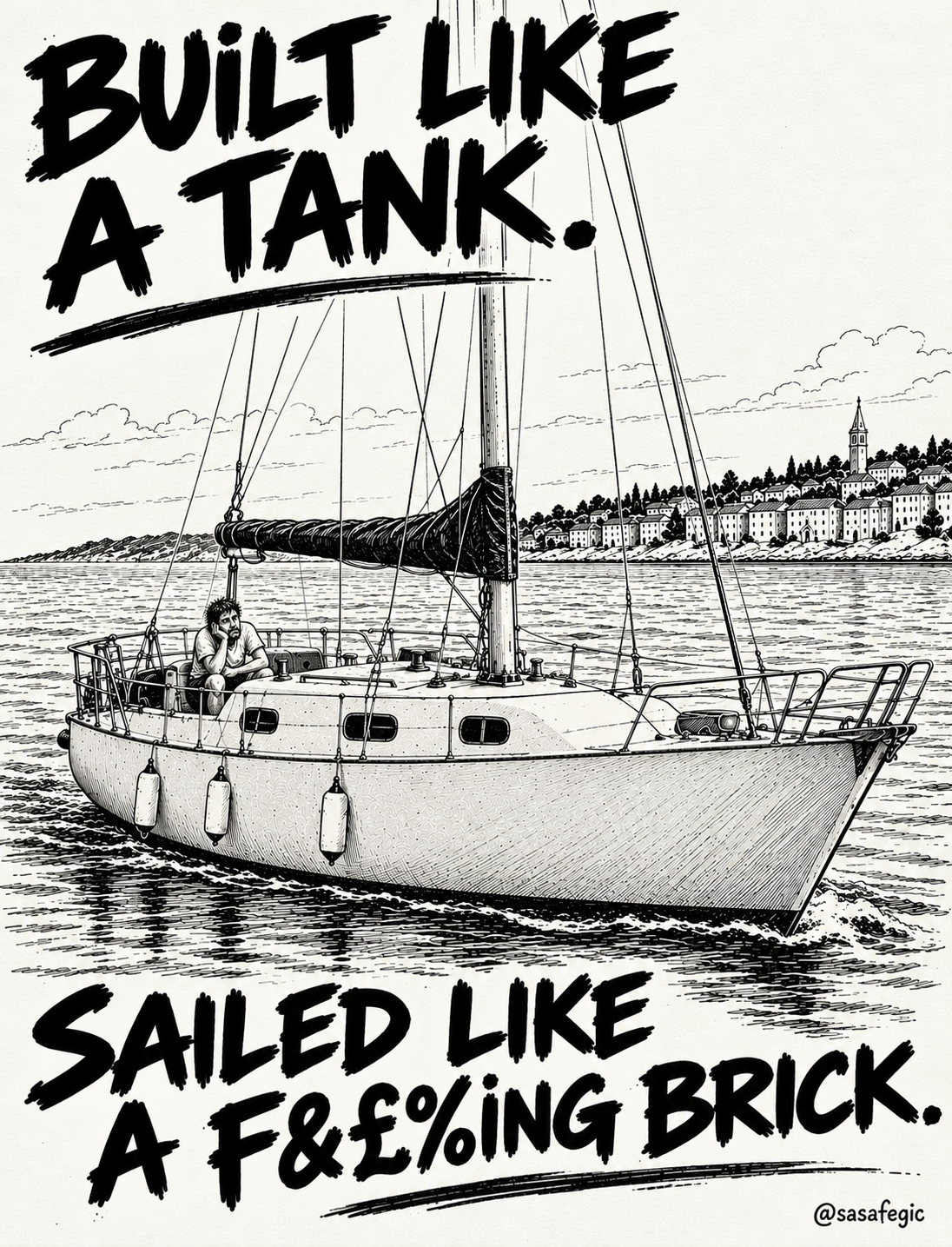
People tell you how well those things were built. Thick plastic, they say. Solid as a tank. Indestructible. You could hit a rock and the rock would have to apologize.
My friend had one.
It was terrible.
He agrees with me. This is one of the beautiful things about our friendship. We can look back at a bad decision without pretending it was a spiritual experience.
The Tica had enough fibreglass to build a small bunker. It was heavy, slow, and about as graceful under sail as a refrigerator being dragged through a swimming pool.
And pretty?
Let's not get carried away.
It looked like somebody had designed a boat after being shown a photograph of a boat, through a dirty window, while suffering from a fever.
But it was thick.
Oh, God, was it thick.
You could knock on the hull and hear a reassuring thud. People loved that sound. It told them the boat was strong. It told them they had bought something that would outlive them.
What it didn't tell them was that the boat sailed like a brick with a mast.
But that didn't matter much. The Tica was a good boat because, at the time, there wasn't much else to choose from.
That was the whole trick.
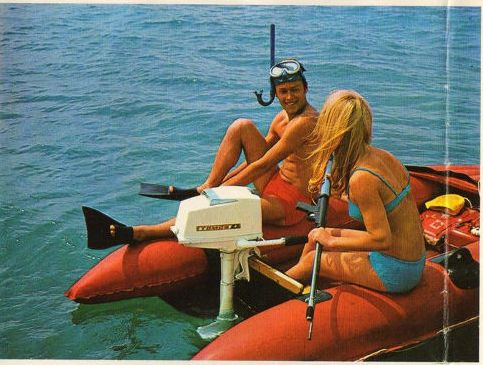
 Back in Yugoslavia, you couldn't simply walk into a marina and admire rows of Beneteaus, Grand Soleils, and modern sailing yachts. Seeing a Yamaha outboard was an event. You looked at it the way a hungry man looks at a steak through a restaurant window.
A decent foreign boat was something you might see in a magazine, at a boat show, or in the hands of some fellow who had connections you didn't want to ask about.
For most people, the Tomos was what you could get.
The Tica was what you could afford.
And when the choices are limited, the thing you own becomes the best thing in the world.
Not because it's good.
Because it's yours.
There is a difference.
But time passes. The old engines rust. The boats end up on trailers, in backyards, or beneath a layer of dust in somebody's memory. And then something strange happens.
The years become polished.
The broken starter cord disappears. The fouled spark plugs disappear. The hours spent pulling at a reluctant engine while the rest of the family waits in the boat disappear.
The lousy sailing disappears.
The wet cushions. The awful fittings. The endless little failures.
Everything unpleasant gets thrown overboard.
What remains is a warm summer afternoon, the smell of petrol, a friend laughing in the cockpit, and a young man who hasn't yet discovered that his back can hurt for three days because he slept in the wrong position.
That young man had no arthritis. No blood pressure medication. No cholesterol numbers to ruin his breakfast.
He could eat an entire roast, drink half a bottle of wine, smoke a cigarette, sleep four hours, and get up the next morning ready for another round.
Now he eats a piece of cake and needs to lie down.
Of course the past looks better.
The engine was shit, but the body pulling the starter cord worked perfectly.
The boat was slow, but the man sailing it had time to spare.
The equipment was primitive, but he had no idea how much better things could be.
He wasn't just remembering an old outboard. He was remembering being twenty-five.
And that's the part nobody wants to admit.
We're not nostalgic for the Tomos 4.
We're nostalgic for ourselves.
We're nostalgic for the days when the world was still open, when every summer seemed endless, when a cheap bottle of wine and a night at anchor were enough to make life feel like a grand adventure.
We confuse the machinery of our youth with the quality of our youth.
So we praise the old equipment as if it had something the modern stuff lacks. Character. Soul. Authenticity.
That's what people say when something doesn't work properly and they don't want to admit they bought a piece of crap.
Character is often just a polite word for a design flaw that you've learned to live with.
A modern outboard starts when you turn the key. It doesn't need a prayer, a ritual sacrifice, and three generations of inherited knowledge about choke position.
Modern sailboats are lighter, faster, more comfortable, and generally better designed. They have layouts that make sense, engines that start, and systems that don't require you to understand the psychological weaknesses of every individual component.
You can spend a week aboard without feeling as if you've been locked inside a poorly equipped prison.
Is that progress?
Of course it is.
And yet somebody will stand beside a rusty Tomos 4 and tell you that they don't make engines like that anymore.
No, they don't.
They make engines that work.
Somebody else will pat the thick fibreglass hull of a Tica and say they don't build boats like that anymore.
Thank God.
We have better boats now. Better engines. Better sails. Better instruments. Better everything, more or less.
We should be enjoying the improvements instead of inventing reasons to be disappointed by them.
But nostalgia is a stubborn old bastard. It doesn't care about facts. It takes the past, removes all the defects, adds a little sunshine, and sells it back to us at an inflated price.
 It's the same reason people say music was better when they were young, cars were better, food tasted better, and people were nicer.
Maybe some things were better.
But everything?
Come on.
A lot of what we call the good old days was simply a time when we didn't know any better.
We had fewer choices. We accepted more nonsense. We called inconvenience an adventure because there wasn't an alternative.
And we were young.
That last part did most of the work.
So keep your Tomos 4 if you love it. Restore your Tica. Tell your grandchildren about the old days. There's nothing wrong with remembering the people you loved, the places you visited, or the summers that changed your life.
Just don't tell me the engine was wonderful.
I owned the bastard.
I know.
And if you want to sail a Tica because it reminds you of your childhood, go right ahead. Memories are worth keeping.
But if you tell me it was a fast, beautiful, well-designed boat, I'll know you've been drinking.
Which, considering how much we used to drink in those days, is probably the most historically accurate explanation of all.
The old days weren't better. We were younger, the alternatives were worse, and our memories have learned how to lie.
If you laughed, learned something, or simply wasted five good minutes... Buy me a coffee☕️. It’s like tipping your bartender, except your bartender is on a leaky sailboat⛵️. https://buymeacoffee.com/mywayaroundtheworld/membership