

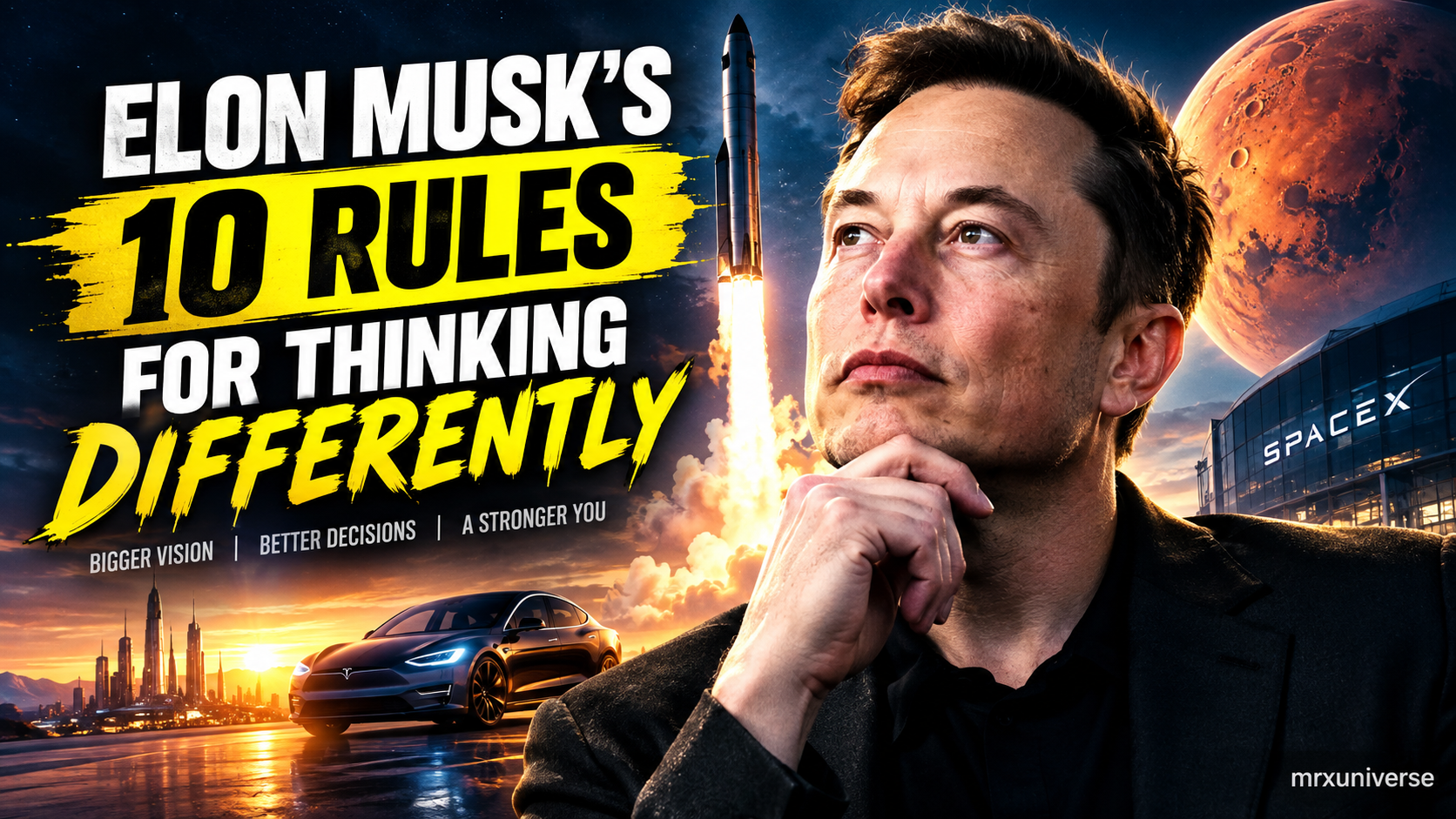
The Deeper Mindset Behind Ambition, Innovation & Building the Future
Great ambitions rarely begin with certainty.
They usually begin with a question, an unusual observation, or the feeling that something could work differently.
Elon Musk's career provides an interesting case study in that kind of thinking. His work has crossed several industries, including online payments, electric vehicles, rockets, satellite communications, artificial intelligence, and social media. These fields are very different, yet many of the challenges surrounding them have something in common: difficult problems rarely have simple answers.
The useful lesson isn't that everyone should imitate Musk's career.
It is much more practical than that.
His projects provide an opportunity to examine how ambitious people approach uncertainty, technology, failure, competition, learning, and long-term goals.
Some ideas will apply directly to business. Others are equally useful for creators, students, entrepreneurs, professionals, and anyone attempting to build something from scratch.
This is the deeper side of ambitious thinking.
1. QUESTION WHAT EVERYONE ELSE ACCEPTS
Progress often begins when someone becomes uncomfortable with an assumption.
An industry can operate the same way for decades. Customers become accustomed to certain prices. Businesses develop familiar processes. Employees learn established methods. Eventually, those methods can begin to feel like laws of nature.
They aren't.
Some limitations are genuine. Others exist because nobody has seriously challenged them.
This distinction matters.
Suppose a product is expensive to manufacture. Saying, “That's simply what it costs,” ends the conversation. Investigating the components, materials, production methods, transportation, labor, and technology opens it again.
The same principle works outside business.
A person might believe a particular career is impossible for them. Another may assume they are too inexperienced to start something. Someone else might think they don't have enough money, time, or technical knowledge.
Sometimes those obstacles really are significant.
But once a limitation is broken into smaller pieces, it becomes easier to understand which parts can change.
That is the value of questioning assumptions.
You don't reject reality.
You examine it more carefully.
This mindset can produce better decisions because it separates genuine constraints from habits, traditions, and inherited beliefs.
Innovation often begins in that gap.
2. SOLVE A REAL PROBLEM
Ideas are exciting.
Problems are useful.
A person can spend months designing an impressive product only to discover that nobody needs it. Another person may begin with a frustrating problem, develop a simple solution, and gradually turn that solution into something valuable.
The difference is the starting point.
A product is only a vehicle for solving something.
Consider a creator who wants to build an educational platform. The first idea might be a mobile application. After talking to potential users, however, they may discover that people actually prefer short videos and downloadable guides.
The original product changes.
The underlying mission doesn't.
This flexibility is important because early ideas are rarely perfect.
A founder who becomes emotionally attached to one particular solution may ignore evidence that suggests a better direction. Someone focused on the problem has more freedom to adapt.
That principle applies to almost every creative project.
Build around a genuine need.
Listen carefully to the people you're trying to help.
Let evidence influence the solution.
And remember that changing the method isn't necessarily abandoning the mission.
Sometimes it is the reason the mission survives.
3. UNDERSTAND THE SYSTEM BEHIND THE RESULT
Successful outcomes can look deceptively simple from the outside.
A viral video appears on a screen.
A successful product sits on a shelf.
A rocket launches.
A website attracts millions of visitors.
What the public sees is the result. Beneath it is a complicated system.
Take content creation as an example.
A strong post may depend on research, topic selection, writing, visual design, editing, publishing, timing, distribution, audience understanding, and feedback. One successful post is therefore not necessarily a single creative event. It may be the product of dozens of decisions.
This is why copying the surface of someone else's success often produces disappointing results.
The visible format is only the final layer.
A more useful approach is to study the machinery underneath it.
How are ideas generated?
How does the creator identify an audience?
How are weak ideas discarded?
How does feedback influence future work?
Which parts of the process can be improved?
Once you understand those connections, you stop chasing individual outcomes and begin developing a repeatable system.
That shift can transform creative work.
You are no longer hoping for success.
You are building a process capable of producing better attempts.
4. PLAY THE LONG GAME
Modern platforms encourage short-term thinking.
A post receives attention for a few hours. A trend dominates conversations for a few days. A new technology becomes the subject of constant discussion and then disappears from the headlines.
Long-term projects operate on a completely different clock.
Companies may spend years developing technology before customers fully understand its potential. Creators often spend years developing a recognizable voice. Businesses need time to establish trust. Technical projects can require countless iterations before they become commercially viable.
Long-term thinking doesn't mean ignoring immediate results.
It means giving today's actions a larger purpose.
Imagine spending one year learning valuable skills instead of chasing every short-lived trend. The immediate reward may be modest. Five years later, however, those skills could influence your career, business, income, or creative opportunities.
The same principle applies to audiences.
A million random views may create temporary attention.
A smaller group of people who genuinely value your work can become a lasting community.
Short-term metrics matter, but they don't tell the entire story.
Some of the most valuable things you can build are difficult to measure in the beginning.
Trust is one.
Knowledge is another.
Reputation is another.
All three compound with time.
5. LET FAILURE TEACH YOU SOMETHING
Failure has a strange reputation.
People often treat it as proof that an idea was bad or that the person behind it wasn't capable enough.
In reality, failure can mean many different things.
The timing may have been wrong.
The market may have been misunderstood.
The technology may not have been ready.
The execution may have been weak.
The communication may have failed.
Or the original assumption may simply have been incorrect.
Those distinctions matter.
A failed experiment can provide information that success sometimes hides.
Imagine publishing several different types of content. One format performs exceptionally well while the others receive little attention. That result doesn't automatically mean the successful post was brilliant and everything else was worthless.
It creates a research opportunity.
Perhaps the subject was more relevant.
Perhaps the headline was clearer.
Maybe the visual presentation created more curiosity.
Perhaps the timing was better.
Each possibility can be tested.
This creates a powerful cycle:
Experiment → Result → Analysis → Adjustment → New Experiment
The objective isn't to avoid every failure.
That would be impossible.
The objective is to avoid wasting the information contained inside failure.
A mistake becomes much more valuable when you understand why it happened.
6. RELEASE THE FIRST VERSION
Perfection can become a comfortable hiding place.
A creator keeps editing.
An entrepreneur keeps planning.
A developer keeps rebuilding.
A writer keeps researching.
Eventually, preparation becomes a substitute for action.
There is a point where the only meaningful way to improve an idea is to expose it to reality.
The first version may be rough.
That's normal.
A prototype isn't supposed to compete with a finished product. Its purpose is to reveal what needs improvement.
The same applies to content.
Your first article may not have the strongest structure. Your first video may feel awkward. Your first website may look basic.
None of that prevents progress.
Once the work exists, it can receive feedback.
Readers can react.
Customers can respond.
Viewers can leave comments.
Analytics can reveal patterns.
Those signals give you something that planning alone cannot provide: evidence.
A better question than “Is this perfect?” is:
“Is this ready to be tested?”
That small change in thinking encourages movement.
Version one creates version two.
Version two creates version three.
Improvement becomes a process rather than a distant goal.
7. KEEP LEARNING AS THE WORLD CHANGES
Knowledge has a shelf life.
Technology develops. Markets shift. New tools appear. Entire industries can change within a few years.
Artificial intelligence is one obvious example of how quickly the capabilities available to ordinary people can evolve.
For that reason, continuous learning is no longer something reserved for students.
It is a lifelong advantage.
Learning doesn't have to mean spending every evening reading technical textbooks.
It can happen through experimentation.
A new software tool.
A difficult conversation.
A failed campaign.
A customer complaint.
A competitor's successful product.
A book.
A documentary.
A course.
Even an unexpected mistake.
The important part is remaining intellectually active.
A person who keeps learning can adjust when circumstances change.
Someone who stops learning may eventually find themselves using yesterday's solutions for tomorrow's problems.
There is another benefit.
Learning across different fields creates connections.
A creator who understands design, technology, psychology, and marketing may see opportunities that someone focused on only one discipline misses.
You don't have to master everything.
You simply need enough curiosity to explore beyond your immediate specialty.
8. PROTECT YOUR ATTENTION
Attention has become one of the most valuable resources in modern life.
Every platform wants it.
Every notification competes for it.
Every headline is designed to interrupt it.
The problem isn't information itself.
The problem is having so much of it that meaningful information becomes difficult to distinguish from noise.
A productive day can disappear through dozens of small interruptions.
Five minutes here.
Ten minutes there.
A quick scroll becomes half an hour.
Another notification arrives.
Another video begins.
Eventually, there may be very little mental space left for deep work.
Creators face the same problem.
It is easy to spend hours studying what other people are creating and almost no time creating something yourself.
Consumption has value.
It provides entertainment, education, inspiration, and context.
But creation requires protected attention.
A useful rhythm is:
Consume → Think → Create → Review.
The balance matters.
The world doesn't need another person who knows every trend.
It needs people who can turn information into useful ideas.
9. LET REALITY CHALLENGE YOUR BELIEFS
There is a moment in every ambitious project when reality disagrees with the plan.
The customer doesn't behave as expected.
The product doesn't perform.
The audience doesn't respond.
The technology doesn't work.
The numbers don't match the forecast.
That moment can be uncomfortable because it forces you to choose between protecting your original belief and adapting to new information.
Adaptability is often the more productive option.
This doesn't mean following every metric blindly.
Data can be misleading.
A single result can be an accident.
A small sample may not represent the larger audience.
Context matters.
Good decision-making therefore requires both evidence and judgment.
Still, reality deserves a seat at the table.
If an idea consistently produces poor results, something needs investigation.
Perhaps the idea should change.
Perhaps the execution needs improvement.
Perhaps the audience is wrong.
Perhaps the timing isn't right.
Perhaps the entire approach needs to be reconsidered.
Being willing to change your mind isn't weakness.
Sometimes it is evidence that you're paying attention.
10. TAKE CALCULATED RISKS
Ambition without risk is difficult.
At the same time, reckless risk-taking isn't a substitute for courage.
There is a major difference between jumping blindly and making an informed decision under uncertainty.
Before taking a significant risk, consider the possible downside.
How much could be lost?
Can the experiment be made smaller?
Can the idea be tested before committing major resources?
What information is still missing?
If the experiment fails, is recovery possible?
These questions don't remove uncertainty.
They make uncertainty easier to understand.
A creator might test a new format with five posts rather than rebuilding an entire channel.
An entrepreneur might launch a small version of a product before expanding.
A business owner might validate demand before investing heavily in production.
Small experiments can reveal whether a larger commitment deserves consideration.
Risk becomes more manageable when it is divided into stages.
THE POWER OF SMALL BEGINNINGS
Large achievements can create a misleading picture of how progress actually happens.
People see the enormous company, the advanced technology, the global audience, or the finished product.
They rarely see the earliest stage.
The first sketch.
The first prototype.
The first customer.
The first employee.
The first failed experiment.
The first person who believed in the idea.
Every large project once looked small.
This is especially important for new creators and entrepreneurs because comparison can distort reality.
You may look at someone else's mature project and compare it with your own beginning.
That isn't a fair comparison.
Their visible result contains years of accumulated effort.
Your current position contains the beginning of yours.
Measure progress differently.
Is your work better than it was six months ago?
Are your skills stronger?
Is your audience more engaged?
Are your decisions becoming smarter?
Have you learned something that you didn't understand last year?
Those changes may look insignificant individually.
Over time, they can become enormous.
SKILLS BECOME MORE POWERFUL WHEN THEY CONNECT
One skill can open a door.
Several complementary skills can create an entirely new opportunity.
Consider a creator who learns writing.
Then visual design.
Then video editing.
Then audience research.
Then basic analytics.
Then marketing.
None of these skills alone guarantees success.
Together, however, they create a much broader toolkit.
This is one reason multidisciplinary learning can be so valuable.
Technology and communication can work together.
Design and psychology can work together.
Business and engineering can work together.
Writing and data analysis can work together.
The most interesting opportunities sometimes exist between traditional categories.
You don't have to become the world's greatest expert in every field.
Developing useful combinations may be enough to differentiate yourself.
CURIOSITY IS A CREATIVE ADVANTAGE
Curiosity sounds simple, but it can dramatically change how someone sees the world.
A curious person doesn't just see a product.
They wonder how it works.
They don't just see a successful company.
They wonder why customers chose it.
They don't just see a viral post.
They examine what made people stop scrolling.
They don't just encounter a problem.
They wonder whether another solution exists.
That habit creates better questions.
Better questions often lead to better experiments.
And better experiments produce better information.
Curiosity also protects against intellectual stagnation.
Once you believe you already understand everything important, learning slows down.
The world doesn't stop changing simply because your current explanation feels comfortable.
Stay curious.
There is always another question.
CREATE YOUR OWN DEFINITION OF SUCCESS
One of the easiest mistakes is borrowing somebody else's definition of success.
Society may tell you that success means wealth.
Social media may suggest it means followers.
Business culture may suggest it means growth.
Another person may define it through status.
None of those definitions has to become yours.
For one person, success could mean building a technology company.
For another, it could mean financial independence.
Someone else may value creative freedom.
Another person may care most about family, education, community, or meaningful work.
A clear personal definition makes decision-making easier.
Without one, every opportunity competes for your attention.
With one, you can evaluate opportunities according to whether they actually move you toward the life you want.
Ambition becomes healthier when it has a purpose.
VISION NEEDS EXECUTION
There is a difference between imagining something and constructing it.
A vision describes the destination.
Execution deals with everything unpleasant between here and there.
Planning.
Budgeting.
Testing.
Hiring.
Learning.
Problem-solving.
Changing direction.
Repeating difficult tasks.
Dealing with setbacks.
That is why execution matters so much.
A brilliant idea with no execution remains an idea.
A modest idea executed extremely well can become a real product, business, or community.
This is not an argument against dreaming.
Dreams provide direction.
Execution gives them a physical form.
The strongest combination is simple:
Imagine boldly. Execute realistically. Adapt continuously.
WHAT THIS MEANS FOR CONTENT CREATORS
For creators, the principles above can be surprisingly practical.
Originality doesn't require inventing an entirely new subject.
It can come from your perspective, storytelling, presentation, research, editing, design, or combination of ideas.
Study what performs well.
Learn why it works.
Then develop your own voice.
A recognizable identity takes time.
It grows through repetition, experimentation, and consistency.
The objective isn't to reproduce another creator's success exactly.
Your audience should eventually recognize your work before they even see the name attached to it.
That recognition is built through thousands of small creative choices.
Your tone.
Your visual style.
Your topics.
Your storytelling.
Your standards.
Your relationship with the community.
Those elements become part of the brand.
THE FUTURE WILL REWARD ADAPTABILITY
Predicting the future is difficult.
Adapting to change is more practical.
No one knows exactly how artificial intelligence, robotics, transportation, space technology, social platforms, or other emerging technologies will develop over the next decade.
Some predictions will be correct.
Others will fail.
The people who remain flexible have an important advantage.
They can learn new tools.
Change strategies.
Develop new skills.
Experiment with unfamiliar ideas.
Move toward emerging opportunities.
Adaptability doesn't mean abandoning your principles every time something new appears.
It means understanding which parts of your strategy are permanent and which parts can evolve.
Your mission can remain stable while your methods change.
That is often the difference between being rigid and being resilient.
THE REAL LESSON
The most useful lesson isn't to become Elon Musk.
It is to understand why certain ways of thinking can be valuable.
Question assumptions.
Study problems.
Understand systems.
Learn from failure.
Protect your attention.
Develop complementary skills.
Experiment before making enormous commitments.
Think beyond the immediate moment.
And remain open to evidence.
These principles aren't guarantees.
No mindset can eliminate uncertainty.
No strategy can prevent every failure.
No entrepreneur can predict every market.
But better thinking can improve the quality of your decisions.
And over many years, better decisions can compound.
YOUR NEXT 24 HOURS
A long article is only useful if something changes after you finish reading it.
So choose one idea from this article and turn it into an action.
Maybe you have been postponing a project.
Maybe there is a skill you've wanted to learn.
Maybe you've been consuming more content than you create.
Maybe you're holding onto an assumption that deserves another look.
Maybe an old project failed and you never properly studied why.
Pick one.
Make the next step small enough that you can actually complete it.
You don't need to transform your life overnight.
You need to create movement.
One useful action creates evidence.
Evidence creates learning.
Learning improves the next decision.
And that process can continue indefinitely.
FINAL THOUGHT: BUILD THE FUTURE ONE DECISION AT A TIME
Big dreams can make the distance between today and tomorrow feel enormous.
The solution isn't to stare at the entire distance.
Focus on the next step.
Build the first version.
Run the first experiment.
Learn the first skill.
Publish the first piece.
Talk to the first customer.
Make the first improvement.
Then do it again.
The future isn't normally built through one spectacular moment.
It emerges from thousands of decisions that seem ordinary when viewed individually.
Some work.
Some fail.
Some lead somewhere unexpected.
Eventually, those decisions form a direction.
And that direction can become a career, a company, a community, a body of work, or simply a better version of your life.
You don't need perfect conditions to begin.
You need enough clarity to take the next step.
Then enough humility to learn from what happens.
Then enough persistence to continue.
Think differently.
Build patiently.
Learn relentlessly.
Let reality make you better.
And above all, remember that a big future can begin with an incredibly small decision made today.
🔒 PREMIUM MEMBER MESSAGE
Thank you for supporting mrxuniverse and this independent community.
Premium membership allows us to spend more time developing deeper articles, original ideas, visual content, and exclusive discussions rather than focusing only on short social-media posts.
If you enjoyed this deeper exploration of innovation and ambitious thinking, there is more premium content planned for members who want to go beyond the headlines.
Your support is completely voluntary, and every member helps make this creative work possible.
Thank you for being part of the journey. ❤️
Think bigger. Learn continuously. Keep building. 🚀
— mrxuniverse