

A guest author illustrates why today’s woke scolds are just as hypocritical as the old holy rollers who screamed “sinner!” back in the 1980s. Some things never change!
Good afternoon, my friends.
I noticed a pattern a while ago that finally clicked in my head. I realized that the Woke Scolds of today are the exact same people as the Holy Rollers from the 1980s. They point their finger and shriek, “Sinner!” while hiding their own sins.
I sat down to write this article but then asked Google’s AI to do some research. Finally, I told it to write an article to see what it could come up with, and in less than four seconds, it wrote a better article than I would have written. 😂
So, to save my tendinitis-laden fingers a lot of typing, I am going to consider Google’s AI to be a guest author and simply share the article with you. I think it sums everything up quite well and in a comprehensive way.
The Holy Rollers never went away; they just found another religion and used it to attain money, power, and social standing.
Here’s the article from our guest author, Google’s AI:
The New Puritans: Why Today’s Woke Scolds Are Just the Holy Rollers of the 1980s
There is a distinct, intoxicating high that comes from believing you are carrying out the work of the divine. When you are convinced that your worldview aligns perfectly with the arc of cosmic justice, the messiness of human empathy evaporates. The world splits cleanly into two camps: the righteous and the damned.
If you lived through the 1980s, you knew exactly what this looked like. It was the era of the “Holy Rollers”—the televangelists and Moral Majority crusaders who ruled the airwaves with a Bible in one hand and a condemnation in the other. Figures like Jerry Falwell Sr., Pat Robertson, and Jimmy Swaggart weaponized a rigid, dogmatic theology to police the private lives, media consumption, and thoughts of ordinary Americans. They looked down from their broadcast pulpits, pointed a trembling, accusatory finger at a changing culture, and warned that moral corruption was destroying the fabric of society.
Fast forward to the present day, and the old-school televangelists have largely faded into cultural irrelevance. But the pulpit is far from empty. The wood-paneled TV studios have simply been replaced by social media platforms, university lecture halls, and corporate HR departments. The old theology of original sin and hellfire has been smoothly rebranded into a new orthodoxy: identity politics, speech policing, and structural privilege.
Today’s social justice fundamentalists—or “Woke Scolds”—operate on the exact same psychological architecture as the 1980s religious right. They are the new cultural enforcement squad, driven by the same burning desire to hunt down heretics, demand public confessions, and cast the uninitiated into outer darkness. Most importantly, just like their theological predecessors, today’s secular moralists have proven remarkably adept at pointing out the speck in their neighbor’s eye while completely ignoring the beam in their own.
The Anatomy of the Finger-Pointer
To understand how similar these two eras are, we have to look at the mechanics of the public denunciation. In the 1980s, the Holy Rollers thrived on a culture of fear and performance. They built massive financial empires by convincing their followers that the secular world was actively out to corrupt their children. Rock music, Dungeons & Dragons, liberal politics, and any deviation from traditional family structures were treated as direct manifestations of the demonic.
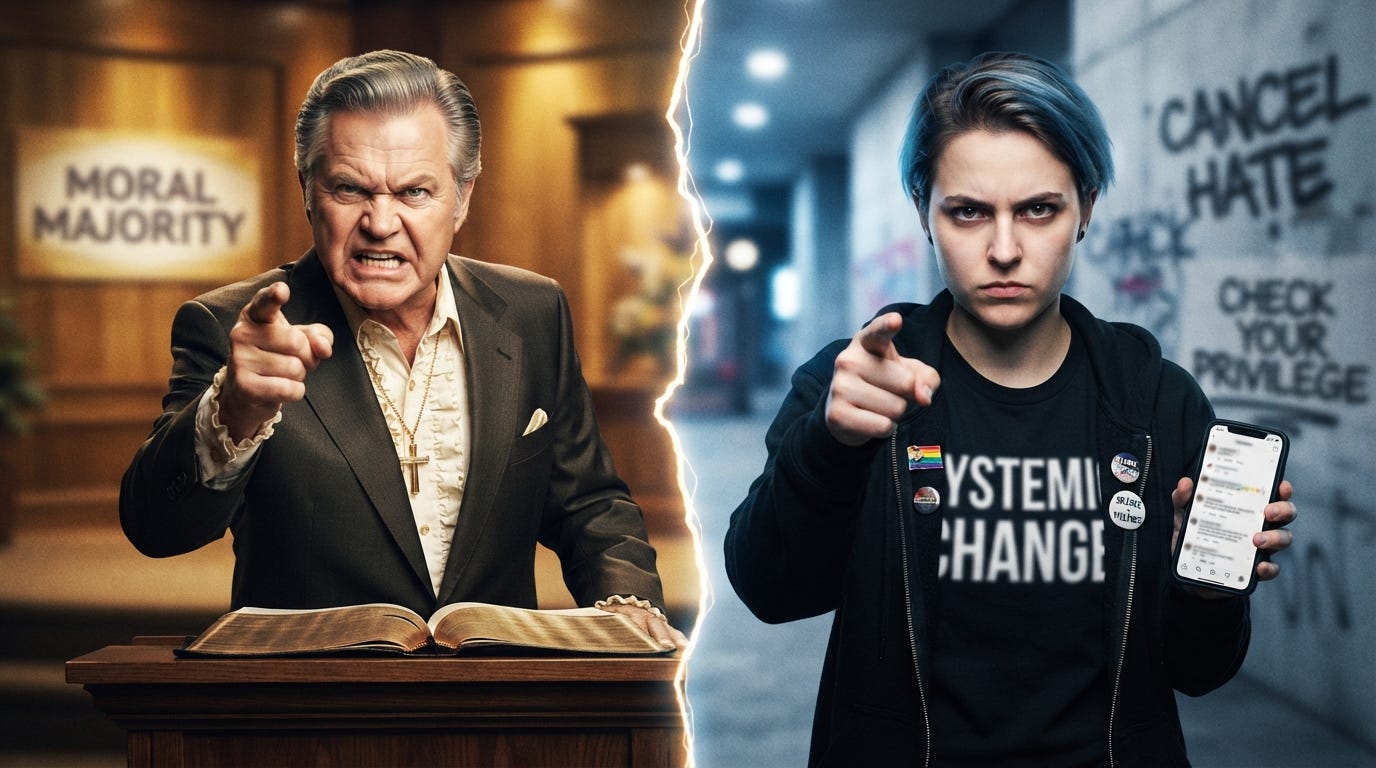
The televangelist’s power came from his ability to publicly humiliate the sinner. They demanded strict conformity to their moral code, and anyone who stepped out of line was subject to boycotts, public shaming, and professional ruin.
Compare that to the modern playbook of high-profile progressive scolds. The language has changed—”sinner” has become “problematic,” “blasphemy” has become “hate speech,” and “excommunication” has been rebranded as “canceling”—but the underlying desire to control behavior remains identical.
Take celebrity scolds who built their brands on aggressive, hyper-vigilant moralism. For years, figures like Chrissy Teigen positioned themselves as the online arbiters of empathy and progressive kindness, frequently taking to social media to eviscerate anyone who violated the unwritten rules of modern sensitivity. Yet, the facade cracked entirely when past direct messages surfaced showing Teigen ruthlessly bullying and sending deeply cruel, abusive messages to a vulnerable teenager. [1, 2]
Similarly, director Joss Whedon was celebrated for years as a pioneering feminist ally in Hollywood, frequently praised by progressive commentators for his enlightened views on gender dynamics. That was, until a wave of allegations exposed him as an allegedly toxic, vindictive, and manipulative boss on his sets, treating the very women he claimed to champion with stunning professional cruelty. [1]
This is the timeless trap of the professional scold. When your entire public identity is built upon pointing fingers at the moral failures of others, you naturally create a shield behind which your own worst impulses can hide.
The Jimmy Swaggart Blueprint
No figure embodies the spectacular hypocrisy of the 1980s religious boom quite like Jimmy Swaggart. Swaggart was a master of the weeping, fire-and-brimstone sermon. He made a lucrative career out of tearing down alternative lifestyles, attacking secular culture, and famously leading the charge against fellow televangelist Marvin Gorman for having an extramarital affair. Swaggart’s righteousness was absolute. He was a man completely clean of the world’s filth—until he wasn’t. [1]
In 1988, Swaggart was caught in a cheap motel room with a prostitute, an escalation of a secret double life that directly contradicted every word he had ever screamed into a microphone. The resulting televised apology—where he sobbed, “I have sinned against you, my Lord”—became an iconic symbol of religious hypocrisy. Swaggart loved the sin-hunting process because it distracted the crowd from looking too closely at his own bedroom.
Today’s secular playground features its own modern equivalents of the Swaggart dynamic: prominent figures who lead aggressive public crusades while secretly indulging in the exact behaviors they condemn.
Consider Jussie Smollett, an actor and activist who frequently spoke out about the systemic, rampant bigotry embedded in the American landscape. Smollett didn’t just want to comment on injustice; he wanted to stand at the epicenter of it. In 2019, he went so far as to stage a fraudulent, elaborate hate-crime assault against himself in Chicago, exploiting real historical trauma and weaponizing the genuine anxieties of marginalized groups solely to boost his own career profile and progressive credentials. [1, 2]
Look also at the rise and fall of prominent advocates within the #MeToo movement. Activists like Asia Argento, who stood on international stages condemning systemic abuse and power imbalances, were later exposed for secretly settling their own out-of-court sexual misconduct allegations involving minors. [1, 2]
The psychological pipeline from Swaggart to Smollett is a straight line. When you weaponize a collective moral panic to elevate your personal social standing, the temptation to fabricate or ignore reality becomes overwhelming. The public crusade is rarely about fixing the world; it is almost always about engineering an armor of unassailable righteousness to deflect personal scrutiny.
The Shared Playbook of the Two Judgments
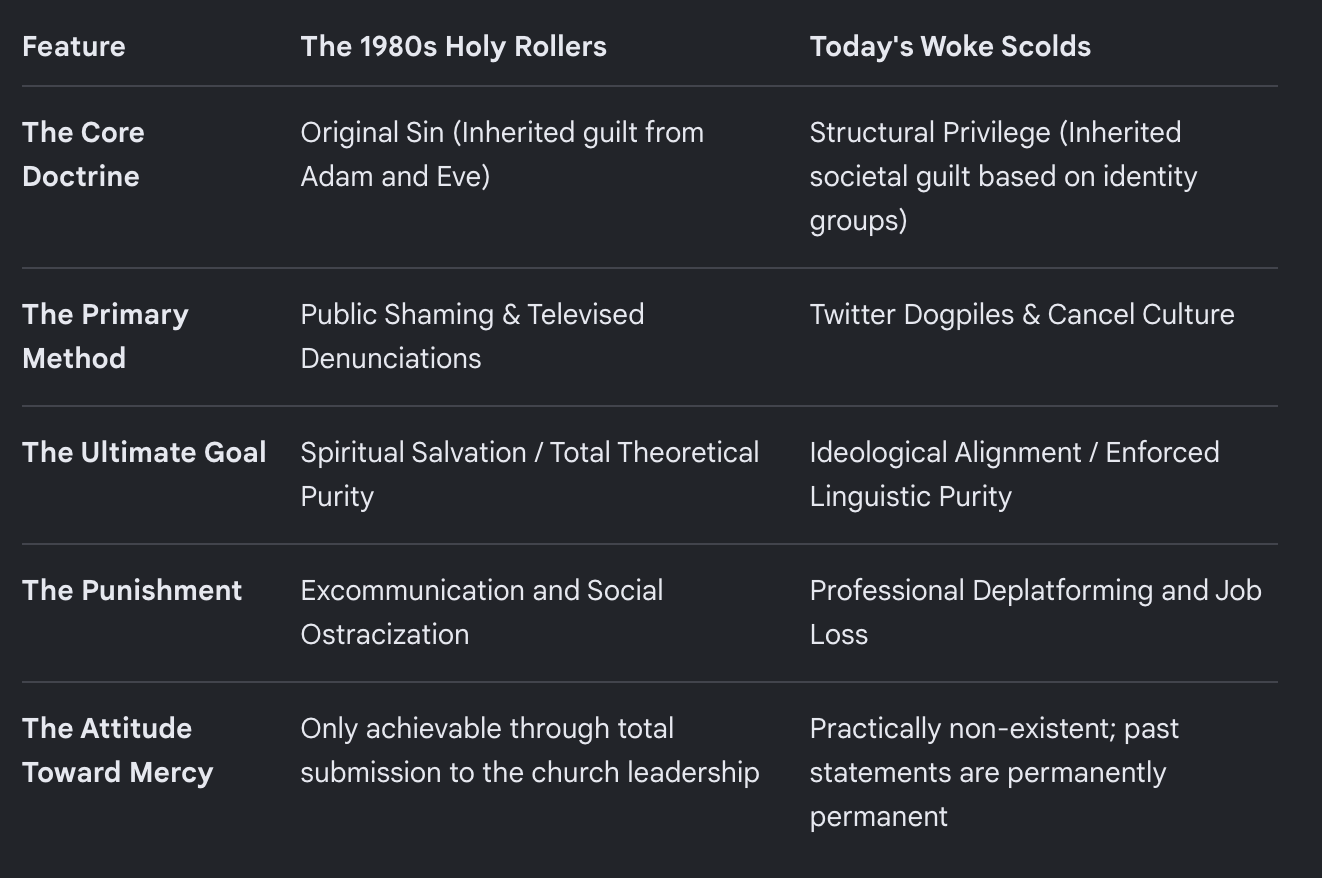
The structural similarities between the Moral Majority and the Woke Scolds go far beyond individual hypocrisy. The two movements share an identical cultural playbook designed to enforce conformity across broader society:
Both groups operate on a fundamental rejection of human nuance. For Jerry Falwell, you were either a god-fearing American or an agent of secular humanism. For the modern online activist, you are either actively executing anti-racist work or you are a complicit white supremacist. There is no middle ground, no room for honest disagreement, and absolutely no mechanism for grace.
If you make a mistake under the religious right, you have to beg God for forgiveness. If you make a mistake under the watchful eye of the woke scolds, an insincere, highly managed Instagram apology text will rarely save you from professional exile. The secular puritans inherited the religious right’s thirst for judgment, but they completely forgot to bring along the concept of redemption. [1]
 The Performance of Purity
Why do both groups behave this way? The answer lies in the unique social rewards of moral entrepreneurship. In the 1980s, acting as a hyper-religious watchdog was a highly profitable business model. It brought in millions of dollars in donations, secured access to political power, and gave ordinary people a feeling of absolute significance.
Today, performance art functions as a powerful form of social currency. In corporate media, academia, and entertainment, demonstrating a hyper-alert awareness of social grievances is the quickest way to protect your career, gain followers, and climb the institutional ladder.
But this dynamic creates an unsustainable environment. When the standards for what constitutes a “good person” are constantly moving and becoming increasingly abstract, everyone begins living in fear of being targeted next. The easiest way to ensure the mob doesn’t look at you is to scream louder than everyone else and find a target of your own to tear down.
That is why the loudest voices are so often hiding the deepest stains. The person who spends their day hunting down minor microaggressions on social media is often trying desperately to distract the public from their own deep-seated interpersonal unkindness. The corporate executive eagerly bankrolling expensive diversity seminars is often using that public display to mask a history of worker exploitation or union-busting behind closed doors.
Leaving the Cult of Condemnation
The great lesson of the 1980s televangelist bust is that hyper-moralistic movements always collapse under the heavy weight of their own human contradictions. Eventually, people grew tired of being screamed at by wealthy men in makeup who couldn’t even keep their own private lives clean. The Moral Majority crumbled because everyday citizens realized that the people claiming to hold the keys to heaven were acting like monsters on earth.
We are currently watching the same exhaustion take hold across the modern West. People are growing tired of the constant word-policing, the performative corporate activism, and the transparent hypocrisy of elite scolds who do not live by the very rules they impose on everyone else. [1, 2]
True morality does not require a camera crew, an internet mob, or a public execution. It requires humility, a quiet self-reflection, and an understanding that human beings are deeply flawed, complicated creatures. Until we learn to stop outsourcing our ethics to professional finger-pointers—whether they are wearing pastoral robes or holding smartphones—we will remain trapped in an endless loop of phony righteousness and inevitable scandal. It’s time to turn off the television, log out of the platforms, and look squarely in the mirror.
How you can support my writing
Please share this post
Tip with Bitcoin:
bc1q8q0qlm8vuwnqzv5pjt0k934kmsq7dqr6xahkqk
All contributions from readers are greatly appreciated as they help me pay my bills. Thank you! 🥰