

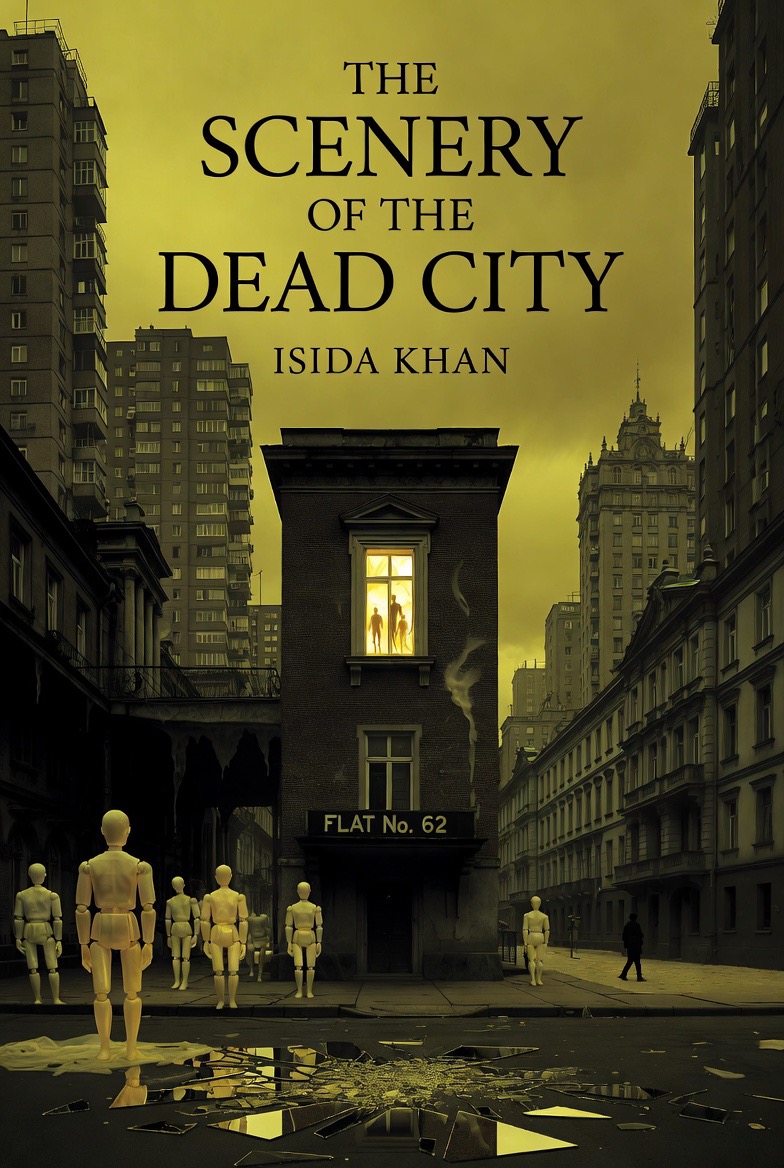
 The Scenery Of The Dead City
In this opening movement of a new cycle within The Molecule of Eternity, the narrative withdraws into the aftermath of the ‘Orensgrad Reset’. In this bleak yet mesmerising instalment, Isida Khan probes the nightmarish province of ontological horror, rendering a terminal landscape of existential exhaustion. The Scenery of the Dead City marks the harrowing hour of civic expiry. Its edginess and whimsy deliver a metaphysical requiem for the ‘normal’, as the reign of vacuity, the erasure of common sense, and the death of meaning pronounce the most insidious triumph of the Expelled.
Here begins the tenth descent into the fragmented cosmology of The Mirror Shards. In the offing—a sterile delirium of the city whose decorum stands, though the principles sustaining the very matter of things have long since ceased to exist. A world bereft of its animating order, whose very atmosphere has congealed into an instrument of oppression. A metaphysical nullification, tracing the last gestures of habit emptied of fidelity. A suffocating stasis of life without substance, wherein slack plasticine husks hunt the scent of consciousness—hungry to devour the last vestiges of human reason. There, beneath the outward catastrophe, lies a deeper layer of philosophical terror: gradual erosion of purpose itself.
At the heart of the mausoleum-city, unmoored Flat No. 62 transfigures into an ‘ark of the half-living’—a refuge for phantasmagoric community of the fractured. A theatre of cosmic farce unfolds as our protagonists, like so many luminous minds of their generation, are driven beyond the precipice of sanity. Once steadfast Margarita Smolina recedes ever further into a catatonic estrangement from the material world; erstwhile rationalist Maxim Podolsky spirals into a fevered, chivalric lunacy; clairvoyant Sofia Vasilevsku is besieged by hysterical visions. Left to navigate the ontic shipwreck is the most uncanny alliance of the doomed, bound by dire necessity. Kay, a moonshine figure whose origins remain provocatively unexamined, and resourceful trickster Tak-Tak are to wager their destiny in desperate gambits against monstrosity greater than themselves. The belief that the reference point of return may yet be found—a theory of ‘excursion rather than extinction’—gives rise to ludicrous adventurism and a succession of failed escapades.
Alongside, the essay introduces Yegor Danilovich Somov—a synaesthetic electrician whose extraordinary senses register a catastrophic dissonance in the cosmic orchestra. Drawn by some faint signal, Somov strikes out along its trail towards the edge of the city. Yet the question of whether any honest note remains in the universe—hangs, unanswered, in the stagnant, jaundiced light of the eternal anticyclone.
The World That Never Was advances The Molecule of Eternity into its deepest register yet. It is a black comedy about a grand asylum for the forsaken, infused with gothic grotesquerie, elegiac satire, and speculative surrealism. The manuscript elaborates upon how personality resigns its post, how integrity and coherence wander off, and how faith abandons all hope of earthly egress. Reader, embrace this tragicomic absurdity of irrevocable, meagre idiocy—its mechanical parody of mundanity and its looping routines; ridiculous institutional perseverance and clockwork saints.