
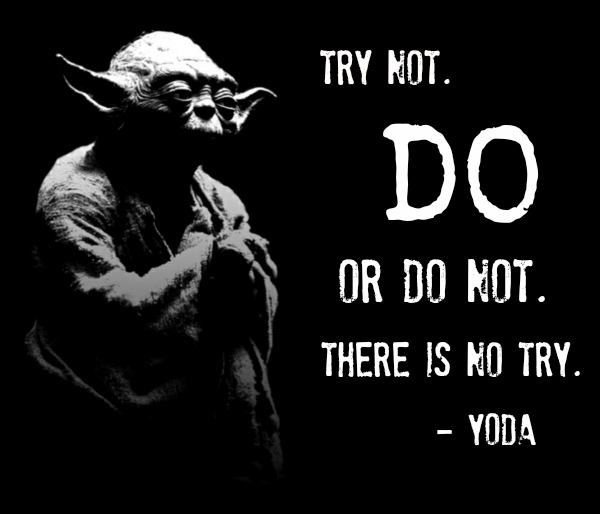
When I was giving a lecture on the “failure” schema, an improvised quote came to mind from Master Yoda, known from Star Wars: “Do or do not. There is no try.”
This piece of advice nicely illustrates how this schema operates.
But what’s wrong with trying?
One might think that the real problem is precisely the lack of trying.
Isn’t the definition of low frustration tolerance that I simply do nothing?
Isn’t it avoidance of failure if I only engage in things I already know I can accomplish?
Does Yoda really think that even this much risk doesn’t fit into life?
Well, anyone who has seen the film might, based on certain scenes, even believe that.
But anyone who truly understood the film knows that Yoda actually wants to push the hero toward the exact opposite.
He sees a difference between the expressions “I will do it” and “I will try.”
If the student says, “I will do it,” he declares that he identifies with the goal, believes he is capable of achieving it, and behaves accordingly.
But if he says, “I will try,” then he commits only to the behavioral side of the system; the underlying attitudes are not in sync. Deep down, the student has already doomed the behavior to failure. Behind “I will try” lies avoidance of failure — because if the goal was impossible from the start, then the attempt cannot really be considered a failure.
This is what Yoda confronts his mentee with.
Perhaps he read Young’s book.
What is the failure schema?
According to the book, maladaptive schemas develop when one of a person’s basic emotional needs is overpowered by circumstances and remains unmet.
In this case, we are talking about the need to feel autonomous, competent, and secure in one’s identity.
Even in adulthood, it can be painful when this need is suppressed. But in childhood, such experiences cause particularly deep harm, because the child learns from them that they are incapable of independently solving what they would like to solve — and therefore that independent striving and goal-setting are pointless.
Most often, it is the family that provides these lessons by not allowing the child to become independent to an age-appropriate degree. This may mean overprotection, which logically leads to the conclusion that such protection is necessary because the person would otherwise be incapable of solving their own problems (at least those problems typically handled at their age).
But it can also mean the exact opposite: being left alone with difficulties they are not yet developmentally equipped to handle. The repeated experiences of failure in such situations will later serve as “concrete proof” that the individual is incapable of meeting challenges.
Armed with these beliefs, it seems wiser not to take risks — otherwise one might just end up making a fool of oneself.
This cluster of beliefs is called the Impaired Autonomy and Performance schema domain.
From this domain we derive the failure schema, which convinces the individual that in any performance-related situation, failure is inevitable. This prediction is typically accompanied by the explanation that, compared to peers, the person has far more modest abilities — they are less intelligent, less skillful, less talented, less prepared.
The next question is: what does our hero do with this schema?
Basically, we tend to produce three instinctive coping responses: overcompensate, avoid, or surrender to the verdict.
According to the book, the failure schema can manifest in three versions depending on the coping style:
· Schema surrender: the person performs tasks half-heartedly, without real commitment.
· Schema avoidance: the person avoids challenges and procrastinates.
· Schema overcompensation: the person overperforms and relentlessly drives themselves.
The “I’ll try” attitude sounds suspiciously similar to what we read about in schema surrender.
Perhaps this is why Yoda finds it important to close this line of thought in such a black-and-white manner.
So does Luke Skywalker have a failure schema?
No. Anyone who has seen Star Wars can sense that someone who, without any formal training, volunteers to fly through and shoot up the Death Star from the inside and the outside is unlikely to be driven by a failure schema.
We could only speak of such a schema if, from childhood onward, he had carried a self-image of “I can’t do it.” But in the films—at least up to this point—we have seen quite the opposite.
In one respect, however, the idea can still be useful. For that, we need the full scene in which he must lift his spaceship out of the swamp.
Here, the student’s task is not to accomplish something that would be considered “realistic for his age,” as the schema domain description might put it. His task is precisely to step beyond what is “realistic for his age” and to take as his reference point the potential slumbering within him — a spiritual power that transcends the limits of ordinary material reality.
There is a slight tone of failure-schema thinking in the way he contemplates crossing that boundary.
But who could blame him? The very nature of the task contradicts everything he has learned so far about the world and about himself.
Yoda knows that this self-knowledge must be deconstructed for the student to move forward on his path.
Just as a schema therapist knows that the knowledge we hold about ourselves and the world — when it is based on maladaptive schemas — must be deconstructed.
Not only because these schemas cause suffering, but because they hinder self-actualization in the same way they temporarily hinder the hero of Star Wars.
You were the Chosen One
It is worth briefly wandering in the symbolic direction suggested by this scene.
Among fans, it is almost a cliché that Star Wars intentionally follows Jungian principles of storytelling — specifically those described in The Hero with a Thousand Faces by Joseph Campbell.
According to the process often referred to as the “Hero’s Journey,” every Hero at some point leaves ordinary material reality and descends into the underworld to obtain some kind of spiritual power. This usually happens through a confrontation with their shadow personality — or, less dramatically put, with a repressed part of themselves.
Yoda actually stages such a confrontation quite literally for his student in the film. Yet the present scene is just as much a part of this process: Luke Skywalker comes face to face with the realization that this time it is not an external obstacle blocking him, but his own beliefs.
Although we tend to look for the Hero’s Journey in stories, psychologists influenced by Carl Jung argue that it does not truly reside there. These cultural products are, rather, projections of the individuation process — the unfolding of the dormant potential within the personality.
The scenes between Yoda and Luke do not, of course, suggest that we must learn to levitate spaceships with our minds.
They suggest that there will be challenges in life that we experience as just as impossible as Luke experiences lifting the X-wing.
And just as in the film it was not the size of the ship or the swamp that posed the real obstacle, but Luke’s lack of faith, it may be that in our own lives the true obstacle is not the parameters of the task, but our mindset. Only by transcending that mindset can we access those ego strengths that at this moment may seem almost supernatural.
The failure schema, then, does not merely prevent us from applying for a more demanding job.
It can halt the entire individuation process — because we cannot become the person we might have become through that very challenge.
At this point, it may become clearer what it means to say that this schema is connected not only to autonomy and competence, but also to identity.
Young wrote in more tangible, external reference terms — “compared to one’s peers” — probably because he was primarily thinking about childhood. But we also evaluate success and failure from another perspective: one aligned with an individual’s abilities, potential, and calling.
From this viewpoint, it is worth asking not only, “Will I succeed at what I want to do?”
It also involves the question: “Will I succeed in becoming who I want to be?”
If we are to believe Yoda, the perpetually self-searching answer — “At least I’ll try” — does not lead to growth here either.