


Why Do I Care So Much?
Understanding empathy, people-pleasing, emotional boundaries, and why caring can quietly become carrying.
If you’ve ended up here, there’s a good chance you’ve asked Google a question that was surprisingly difficult to put into words.
Maybe it was, “Why do I care so much about everyone?”
Or, “Why do I absorb other people’s emotions?”
Perhaps it was, “Why do I replay conversations in my head?” or “Why do I feel guilty saying no?”
They sound like different questions.
Most of the time...
they’re really the same one.
If you’re anything like me, you notice things other people don’t. Someone says they’re “fine” and you immediately suspect they’re about as fine as a British summer barbecue. A friend goes quiet and you spend the rest of the day wondering if you’ve upset them. Somewhere along the way, you’ve become the person everyone comes to when life starts falling apart.
Congratulations.
You’ve accidentally been promoted to Head of the Unofficial Emotional Support Department.
For years, I assumed there was a simple explanation.
I was just empathetic.
As it turns out, psychology has been quietly sitting in the corner muttering, “Well... it’s a bit more complicated than that.”
It turns out we use the word empathy to describe all sorts of different experiences. Sometimes it’s kindness. Sometimes it’s compassion. Sometimes it’s anxiety wearing empathy’s coat and hoping nobody notices.
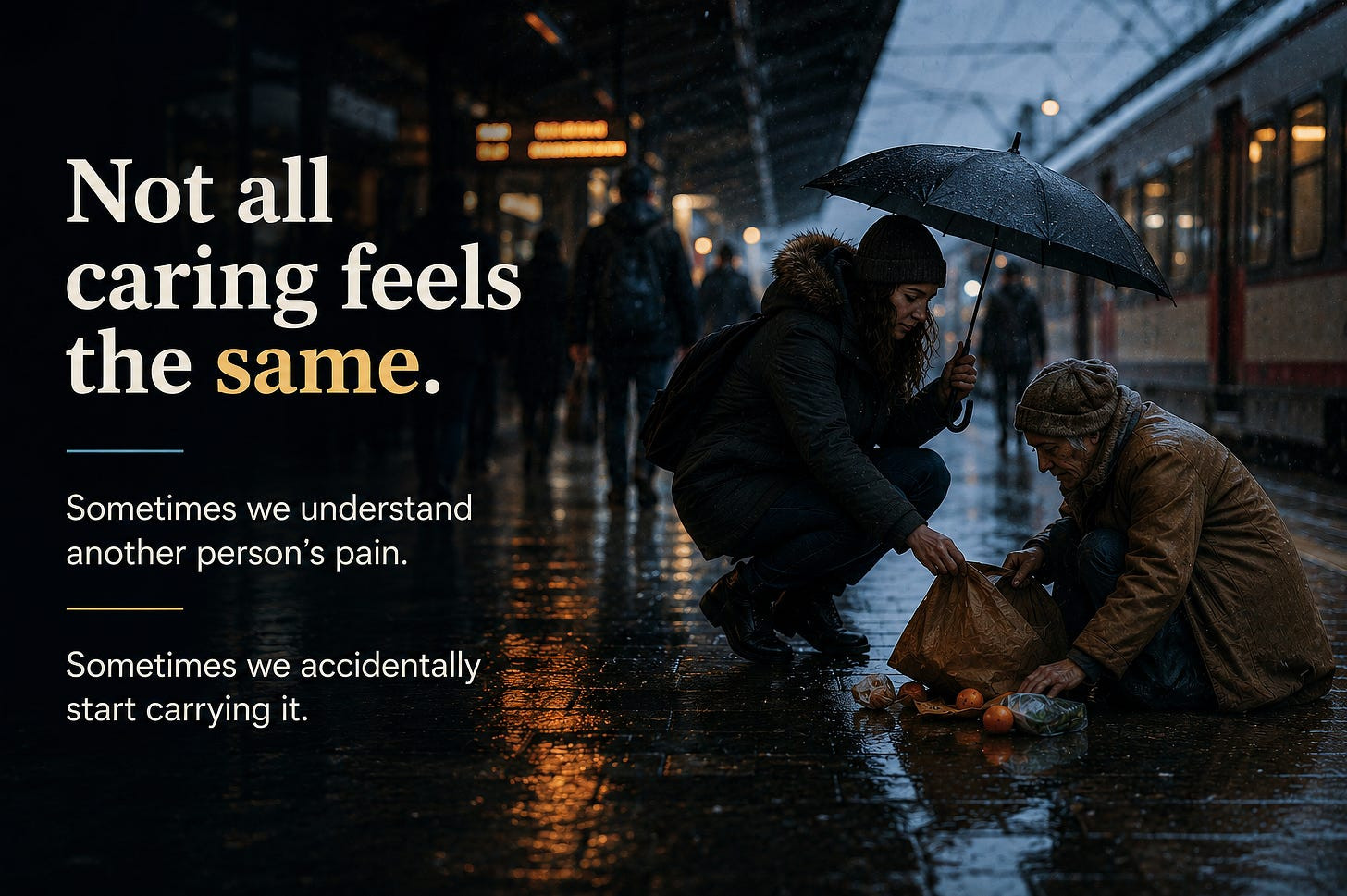
And sometimes, without ever meaning to, caring slowly turns into carrying.
That’s what this article is really about.
Not how to care less.
The world has enough people who don’t notice when someone is struggling.
This is about understanding why caring can become so emotionally expensive, and how to keep your kindness without feeling responsible for carrying every storm that passes through someone else’s life.
What Do We Actually Mean by “Empathy”?
Empathy gets blamed for almost everything.
Can’t stop worrying about people? Empathy.
Cried because somebody else’s dog died in a film? Empathy.
Spent three days wondering whether your colleague’s “See you tomorrow” sounded a bit... off? Well... not necessarily.
The funny thing is that we use the word empathy as though it explains everything, when it’s actually covering several very different experiences.
That’s important because some of those experiences help us build close relationships.
Others leave us completely exhausted.
Let’s start with empathy itself.
At its simplest, empathy is your ability to understand or share somebody else’s emotional experience. If a friend tells you they’ve lost their job, empathy helps you recognize why they’re upset.
But even here, psychology refuses to keep things simple.
There are two main types.
The first is cognitive empathy, which is really just a fancy way of saying “I understand why you feel like that.” You can put yourself in somebody else’s shoes without actually climbing inside them.
The second is affective empathy. This is where you don’t just understand somebody’s feelings, you begin to feel a little of them yourself. Their excitement lifts your mood. Their sadness sits in your chest. Their anxiety somehow ends up in your stomach before you’ve even realized what’s happened.
Neither of those is good or bad. They’re simply different ways our brains connect with other people.
Then there’s compassion, and I think this one deserves a better reputation.
Compassion doesn’t just notice suffering. It asks, “What would actually help here?”
It’s empathy that’s rolled its sleeves up.
The trouble starts when another process quietly joins the party.
Psychologists call it emotional contagion, which sounds like something you should catch on public transport, but thankfully isn’t.
It’s simply the way emotions spread between people. Sit with someone who’s laughing and you’ll probably smile. Spend enough time with someone who’s anxious and you might notice your own body becoming tense too. Humans are remarkably good at tuning into one another, often without even realizing it.
Most of the time, that’s perfectly normal.
The difficulty comes when somebody else’s emotions stop feeling like theirs and start feeling like yours.
That’s where we meet something called personal distress, and if you only remember one idea from this section, make it this one.
Personal distress doesn’t say,
“I can see you’re struggling.”
It says,
“Now I’m struggling too.”
From the outside, those two responses can look almost identical. Both come from caring.
Inside your brain, though, they’re very different experiences.
And that difference might explain why some people can support others without burning out...
...while others slowly find themselves carrying emotional weight they were never meant to carry.

When Caring Becomes Carrying
Nobody wakes up one morning and decides they’re going to spend the rest of their life worrying about everyone else.
It happens gradually, almost without noticing. What begins as kindness quietly gathers a few extra jobs along the way until, one day, you’re not just caring about people anymore, you somehow feel responsible for them.
Part of that story probably begins with personality. Some people seem to arrive in the world with their emotional volume turned up a little higher than everyone else’s. They notice changes in tone, awkward silences, tired eyes, forced smiles and the tiny shifts in atmosphere that other people walk straight past. Research suggests that sensitivity varies from person to person, and there’s nothing unhealthy about that. In many ways, it’s a gift. The world needs people who notice when somebody isn’t okay.
The trouble starts when noticing slowly becomes responsibility.
For some people, that shift begins in childhood, although not always for the reasons we tend to imagine. I think psychology sometimes gives the impression that there has to be one dramatic event explaining everything, when real life is usually far less tidy than that. Maybe somebody at home was ill. Maybe money was tight. Maybe there was constant tension that nobody talked about, or perhaps you simply grew up in a family where everyone looked after everyone else.
Children don’t sit around analyzing their childhood. They’re far too busy asking whether they can stay up another ten minutes or sneak another biscuit before dinner. What they are brilliant at, though, is adapting.
If home feels unpredictable, children adapt.
If keeping the peace seems important, children adapt.
If being helpful earns praise or prevents arguments, children adapt.
The remarkable thing about the brain is that it doesn’t stop to ask whether these strategies will still be useful thirty years later. It simply learns what appears to work and quietly files it away under Important. Keep doing this.
Before long, paying attention to everybody else’s emotions no longer feels like something you’re doing. It feels like who you are.
The child who instinctively watched people’s moods often becomes the adult who can sense tension the moment they walk into a room. The child who learned to smooth things over becomes the adult who apologizes for things that were never really their fault. The child who discovered that being useful felt safe may grow into the adult who feels strangely guilty the moment they stop helping.
Psychologists have a name for part of this process: hyper-vigilance. It sounds rather dramatic, but all it really means is that your brain has become exceptionally good at scanning for possible problems. Imagine a smoke alarm that’s become so sensitive it goes off every time somebody burns the toast. It’s trying to protect you; it’s just become a little overenthusiastic.
That doesn’t mean everyone who cares deeply has experienced trauma, and it certainly doesn’t mean every difficult childhood produces an overly caring adult. Human beings are far too complicated for neat little stories like that. Most of us are shaped by a mixture of personality, life experiences, relationships and the countless small lessons we never even realized we were learning.
What matters is recognizing the pattern.
Somewhere along the way, many caring people stop asking, “How is everyone else?” and quietly start believing, “How everyone else feels is my responsibility.”
They sound almost identical.
They aren’t.
That’s the moment caring quietly becomes carrying.
And carrying was never the job in the first place.

Putting the Bags Down
One thing that really started to annoy me while researching this article was the advice.
No matter where I looked, somebody was confidently telling people to “set better boundaries.”
Which sounds wonderfully sensible until you realize almost nobody explains what that actually means. It’s a bit like telling someone to “be more confident” or “stress less.” Thanks. I’ll get right on that.
The problem isn’t that caring people don’t want boundaries. Most of us desperately do. The problem is that we’ve quietly convinced ourselves boundaries and kindness can’t exist in the same room. Somewhere along the way, many of us started believing that saying no, taking a break or not immediately fixing somebody else’s problem was the same thing as not caring.
It isn’t.
I think the confusion starts because caring and carrying feel almost identical at first. If somebody you love is struggling, of course you’re going to feel something. You’d be worried if you didn’t. The mistake is believing your job is to remove their pain instead of simply walking beside them while they carry it.
That’s a much heavier job.
And, if I’m honest, it’s one none of us are actually qualified for.
Take grief as an example. If somebody loses a parent, a partner or a close friend, there isn’t a combination of perfect words that makes it hurt less. We still try, because that’s what caring people do, but most of us have probably had that moment where we’ve lain awake afterwards wondering whether we said enough, whether we should have done more, or whether we ought to check in again tomorrow.
There’s nothing wrong with checking in.
The problem is believing that if they’re still hurting, you’ve somehow failed.
I wonder how many of us have spent years carrying responsibility that nobody ever asked us to carry.
Maybe that’s the question worth asking instead.
Not, “How do I stop caring?”
But, “Which parts of this were actually mine in the first place?”
Because they’re very different questions.
One of the biggest changes I ever made was realizing I could support somebody without taking ownership of what they were going through. It sounds obvious written down, but it certainly didn’t feel obvious at the time. I honestly thought worrying proved I cared. If I wasn’t thinking about people after work, or replaying conversations on the drive home, was I really doing enough?
The answer, rather inconveniently, was yes.
Worry and compassion aren’t the same thing.
Neither are guilt and kindness.
That’s where boundaries finally started making sense to me. They weren’t walls to keep people out; they were simply a way of remembering where somebody else’s life ended and mine began. They allowed me to listen without feeling responsible for fixing everything, to care without assuming every problem belonged in my backpack.
I still care.
Probably more than is sensible some days.
I still notice when people aren’t themselves. I still worry occasionally. I suspect I always will.
The difference is that I no longer believe every storm I notice is mine to stand in.
And, strangely enough, that hasn’t made me less compassionate.
It’s made me far more useful.