

 Who supports the families navigating mental health difficulties, ADHD and autism, before and after diagnosis?
“Have you got family who can help?”
It sounds like a practical question. Sometimes it is. Someone is finding life difficult, and a professional wants to understand who is around them.
But there is quite a distance between having a family and having a family who knows what to do, has the time to do it and can keep doing it without becoming unwell themselves.
Somewhere in that distance, a relative can become the appointment organizer, the prescription chaser, the person researching school support at midnight and the person who notices that something has changed.
No interview. No induction. Apparently you start immediately.
You may not even call yourself a carer. You are their parent. Their partner. Their daughter. Their friend. You love them, and something needs doing, so you do it.
But who is helping you understand what that involves?
Love can be a reason to offer support. It cannot be the whole plan for making that support possible.
Before we go any further, nobody is the household’s problem
If you are the person receiving support, this is for you too. Needing help does not mean you have failed, and it does not make you a burden.
You might also be reading because your mum is depressed while managing depression yourself. Or supporting your child while trying to understand your own needs. Real life does not divide everyone into people who struggle and people who have unlimited capacity to help.
There can be several people having a hard time in the same house.
The question is how to make room for all of them, with the right support around them. The person needing care deserves dignity, choice and a say in their life. The people beside them need information, rest, safety and somewhere to turn too.
One person’s needs do not cancel out another’s.
 An assessment may be months away. Everyday life still needs support.
Waiting for an answer while life carries on
Imagine you are waiting for your child to be assessed for ADHD or autism.
You are hoping for an explanation. Meanwhile, mornings are still happening. School is still happening. Your employer still expects you at work, and the other children still need your attention.
Perhaps getting dressed is distressing. Perhaps your child manages at school and comes home completely depleted. Perhaps you and your partner disagree about what is happening, because neither of you has been given enough help to understand it.
An assessment may clarify things later. You still need help with tomorrow.
ADHD means attention deficit hyperactivity disorder. It can affect how someone manages attention, activity and impulses. Autism is a developmental difference that can affect communication, sensory experiences and how a person experiences change. They are different, and someone can have both. Autism is not an illness to cure. [1, 2]
Sensory experiences simply means things such as how sound, light, touch and movement feel. If a clothing seam is painfully uncomfortable, “just put your socks on” has missed an important part of the situation.
Families need ways to notice those needs without deciding every difficult moment has the same cause. Pain, bullying, poor sleep and other health concerns still deserve attention.
There are supports families can ask about before diagnosis. NICE guidance, for example, says ADHD-focused parent support should not have to wait for a formal diagnosis in relevant circumstances. Local availability varies, but being on a waiting list should not mean nobody discusses current needs. [1]
In England, a starting point for education support is the school’s SENCO, the special educational needs coordinator. That is the member of staff coordinating additional learning support. Ask what can be tried now, who will arrange it and when it will be reviewed. Other UK nations have different education systems and advice routes. [3]
Parents also deserve support in their own right. Asking about a parent carer’s needs assessment is not a declaration that you do not love your child. It is a way to explain what the family needs. [4]
 A diagnosis does not send home a different child.
A diagnosis does not send home a different child
Your child is still the child who loves that particular joke, notices that particular detail and wants you to understand something important about their world.
A diagnosis offers information. What happens next should involve listening to them, understanding their individual needs and making support more useful.
An ADHD diagnosis can open a discussion about medication alongside other support. It does not mean medication is automatic. Autism itself is not treated with medication, although separate health difficulties may need treatment. Those decisions belong in a conversation with the relevant clinician and the person involved. [1, 2]
And the household still needs practical answers. How do we explain this without making our child feel defective? What do siblings need? How do we agree on approaches when we are both exhausted?
If distress includes hitting or other unsafe behavior, everyone needs protection and appropriate professional guidance. We can discuss that honestly without suggesting autism or ADHD automatically means violence.
Understanding why something happens and keeping people safe belong together.
Supporting a child includes supporting the people around them. It also includes listening to the child.
 Love doesn’t automatically give us the words. Guidance can help.
What do I say when someone is struggling?
The same uncertainty turns up in families navigating mental health difficulties.
Someone withdraws. They stop enjoying things. They seem frightened, or sleep very differently, or say something you do not know how to respond to.
You do not need a diagnostic label to describe a change or ask for advice. And you do not need to become their therapist to be someone who cares.
Sometimes a useful opening is small: “I have noticed you seem exhausted. How have things been for you?”
Or: “Would you like me to listen, help with something practical, or give you some space and check in later?”
Those are invitations, rather than clever little phrases designed to make another person behave differently.
But communication also needs to fit the situation. Responding to depression is not identical to responding to psychosis. Psychosis can involve experiences such as hearing things others do not or strongly held beliefs others do not share. New symptoms need prompt medical advice. [5]
If someone feels threatened by something you cannot perceive, you can acknowledge that they are frightened without agreeing with the explanation: “That sounds frightening. I am not experiencing it the same way. Can we contact someone who can help?”
For someone with OCD, obsessive compulsive disorder, repeated reassurance or checking may need discussion as part of a treatment plan. A family should not be handed “stop reassuring them” as a universal instruction and left to work out the consequences alone. [6]
And someone with EUPD, emotionally unstable personality disorder, also called borderline personality disorder, deserves to be heard without assumptions about manipulation or difficult character. The person should have a say in family involvement; family help should not replace their access to services. [7]
The principle is consistent: understand the person, take distress seriously and ask for guidance specific to what is happening.
“Family will help” needs a second sentence
Which family member? With what? At what time? Do they know how? Have they agreed?
“Family can help with appointments” might mean somebody can occasionally drive. It does not necessarily mean they can leave work at any hour, safely transfer someone into a car or provide supervision all day.
If a person cannot attend an appointment, the barrier needs explaining clearly. “They cannot safely transfer into our car, and I cannot lift them” gives a service something concrete to address.
A housebound person can ask for consideration of a GP home visit or another suitable assessment arrangement. A clinician decides what is appropriate. For hospital appointments, some people qualify for non-emergency patient transport; it has eligibility rules and is not the normal arrangement for routine GP visits. [8, 9]
These are different routes, and families need somebody to help them work out which applies.
The answer cannot end with a letter asking someone to attend a place they cannot reach.
 An assessment may be months away. Everyday life still needs support.
Then the working day ends
You finish your paid job. The prescription still needs chasing. Someone needs food. There is a school email, a form and an appointment to rearrange.
People call the remembering and organizing the mental load. It means the work of keeping track of everything, including when you appear to be sitting still.
There is an important benefits distinction here. Working full time does not itself rule out Carer’s Allowance. Earnings and other eligibility conditions matter, and many working carers earn too much to qualify despite providing substantial support. Scotland uses Carer Support Payment instead. Get an individual benefits check before assuming nothing is available or changing a claim. [10]
In Great Britain, eligible employees can take up to one working week of unpaid carer’s leave per twelve months. Employees can also request flexible working from day one, although that does not guarantee their preferred arrangement. Northern Ireland has different employment rules. Employers may offer more. [11, 12]
Those provisions can help. They do not make care disappear at five o’clock, and unpaid leave does not pay the bills.

The working day ends. The remembering, organizing and caring carry on.
“Look after yourself” needs someone to cover the care
We're constantly telling carers to look after themselves, take time out and make space for their own wellbeing.
But how exactly are they supposed to do that when the person they're caring for cannot safely be left alone?
You can recommend rest, relaxation and self-care until you're blue in the face, but unless someone is available to take over the caring responsibilities, those suggestions are little more than words.
You cannot give someone permission to take a break without giving them a practical way to take one.
Self-care advice is not a substitute for actual support.
In England, an adult supporting another adult can ask adult social care for a carer’s assessment. It considers their own needs and the effects on health, work and relationships. Parent carers use children’s services. An assessment is separate from a benefits claim and does not guarantee a particular package. [4, 13]
Other UK nations have their own routes, which the workbooks signpost.
You can say: “I want to keep supporting them, but I cannot safely provide all of this. We need a plan for the parts I cannot do.”
That conversation should include the person receiving care, wherever possible. Support should respect their wishes and privacy, rather than reorganizing their life around them without asking.
Someone needing rest is not evidence that someone else needs to apologize for existing.
Something practical for the conversation afterwards
I wanted to create resources that go beyond simply recognising a problem.
Because recognising that your family is struggling is one thing. Knowing what to do about it, where to turn, what questions to ask and how to explain what's happening to someone who might be able to help is something else entirely.
Awareness is important, but people need practical tools to turn that awareness into action.
That's what I wanted these workbooks to offer. Not another person telling families what they should be doing, but something they can actually sit down with and use.
The collection includes seven focused workbooks, with fictional examples, plain explanations, flowcharts and printable pages. You can use one page, take it to an appointment or write “I don’t know”. Nobody is grading your emotional stationery.
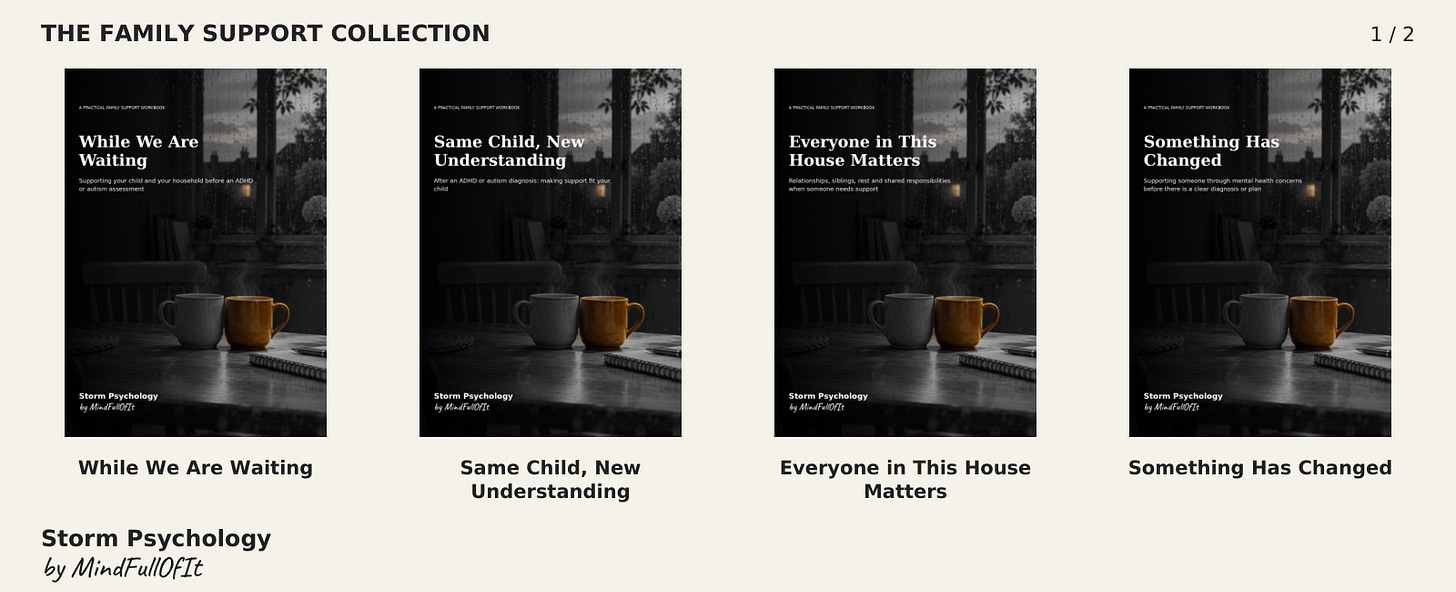
While We Are Waiting helps parents describe current needs, prepare for assessment and ask about support before a diagnosis.
Same Child, New Understanding focuses on what follows a child’s ADHD or autism diagnosis, including school, home, treatment questions and growing up.
Everyone in This House Matters makes room for siblings, relationships, shared responsibilities, safety and genuine rest.
Something Has Changed helps with concerns before there is a clear mental health diagnosis or plan.
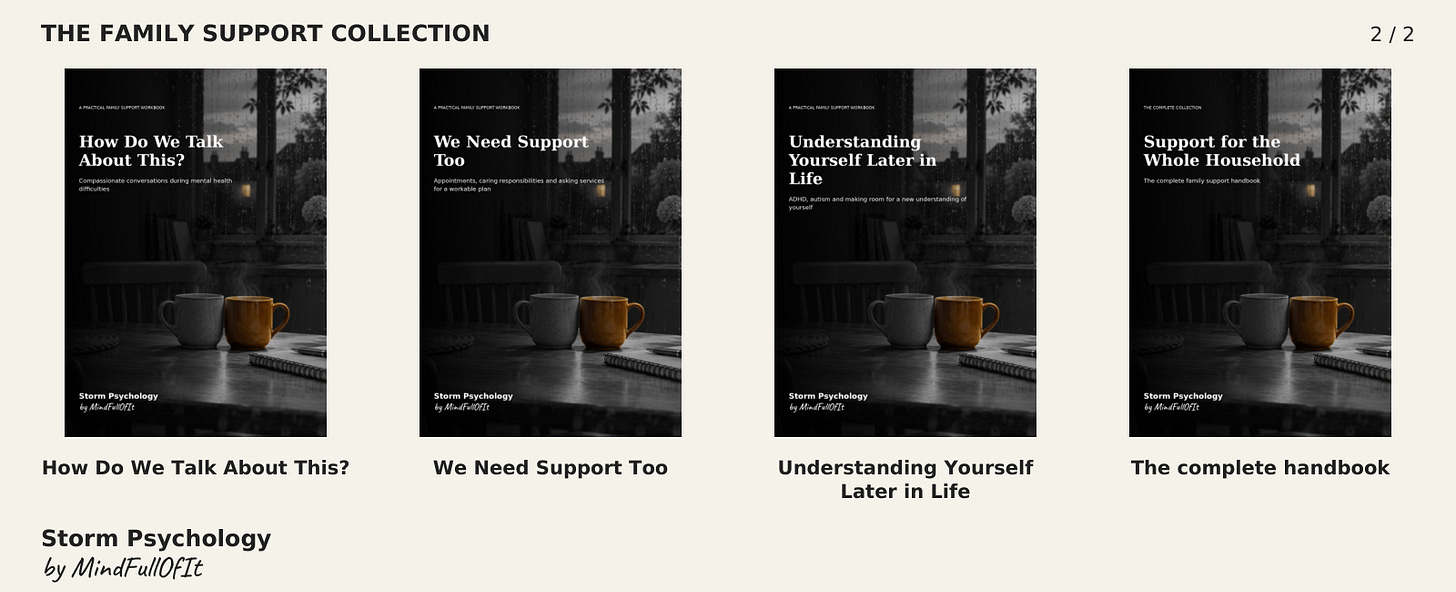
How Do We Talk About This? explores communication, with distinct sections for different experiences rather than one script for everybody.
We Need Support Too helps families prepare requests, explain caring responsibilities and tackle appointment and service barriers.
Understanding Yourself Later in Life gives adults space to consider a new understanding of themselves, privacy, relationships and support.
There is also Support for the Whole Household, the complete handbook bringing all seven together with navigation between them. The individual books are included in it, so you do not need both formats to get the content.
These are gifts for paid members in the Perks tab.
They will also be available individually and as a complete collection on Buy Me a Coffee. My main writing stays free; paid membership supports the work.
Room for everybody
Families are not all alike. Some people live alone. Some have unsafe relatives. Some have chosen family, distant family or nobody who can take over.
Even where love is plentiful, time, money, sleep and practical knowledge may not be.
So when we ask “Have you got family who can help?”, we need to keep listening after the answer.
Who has agreed to do what? What does the person receiving support want? What help do the supporters need? What happens when they cannot do it?
“Family can help” should be the start of a conversation, not the end of a service’s responsibility.

An assessment may be months away. Tomorrow morning still needs a plan.
These are educational planning resources, not individual treatment or crisis assessment. If someone’s life is at risk or you cannot keep yourself or someone else safe, call 999 or attend A&E if you can do so safely. For urgent mental health concerns, use your existing team’s urgent route or the appropriate service in your UK nation. Guidance checked 4 November 2026.
Helping this work reach the people who need it
This is what I want to keep building with Storm Psychology: clear explanations, useful resources and somewhere to start when you’re thinking, “Right, but what do we actually do now?”
You can find the individual workbooks and complete handbook in my shop here on Buy Me a Coffee. Choose the resource that fits your situation, without needing to subscribe.
If you already support me through paid membership on Substack, these are included as gifts in the Perks tab, so you don’t need to buy them again.
If this piece made you think of someone, please share it with them. You can also follow my writing on Substack or buy me a coffee here to help keep the writing and resources coming. My main articles stay free.
And whether you’re the person needing help, the person offering it, or both: there should be support for you too.
Sources and useful starting points
1. NICE: ADHD guidance
2. NHS: what is autism?
3. GOV.UK: education support in England
4. Contact: parent carer assessments
5. NHS: psychosis
6. NHS: OCD treatment
7. NICE: borderline personality disorder
8. NHS-hosted guide: home visits (older guide; confirm current arrangements locally)
9. NHS: hospital transport
10. GOV.UK: Carer’s Allowance eligibility
11. GOV.UK: unpaid carer’s leave
12. GOV.UK: flexible working
13. NHS: carer’s assessments