


Why humans are so bad at recognizing their own inner storms
A few weeks ago, I found myself sitting in a Teams meeting trying very hard to look interested and professional while secretly fighting for my life.
Not because the meeting was boring.
Not because I didn’t want to be there.
Because I was exhausted.
The kind of exhausted where your eyes feel like they’ve been lightly sandpapered. The kind where every yawn feels like a betrayal because you’re supposed to be paying attention, contributing, and showing up for the people who need you.
So there I was, flicking my camera on and off and hoping nobody noticed.
The strange thing is that if you’d asked me how I was doing, I probably would’ve said I was fine.
Not because I was trying to lie.
Because that’s what most of us say.
Fine.
Busy.
Getting there.
Can’t complain.
Living the dream.
The funny thing is that everybody knows these phrases aren’t always true. We hear them every day. We say them every day. They’re less answers and more social agreements. A way of saying, “I don’t really have time to explain everything that’s happened since Tuesday.”
The more I think about it, the more I realize that exhaustion has a public relations problem.
Most people imagine it as something obvious. They picture somebody lying in bed unable to move. They imagine tears, breakdowns, panic attacks, dramatic moments where a person finally reaches their limit.
Sometimes exhaustion looks like that.
Most of the time it doesn’t.
Most of the time it looks like somebody showing up.
Most of the time it looks like school runs, supermarket queues, packed lunches, spreadsheets, appointments, unpaid bills, overflowing inboxes, and trying to remember why you walked into the kitchen in the first place.
Most of the time it looks remarkably normal.
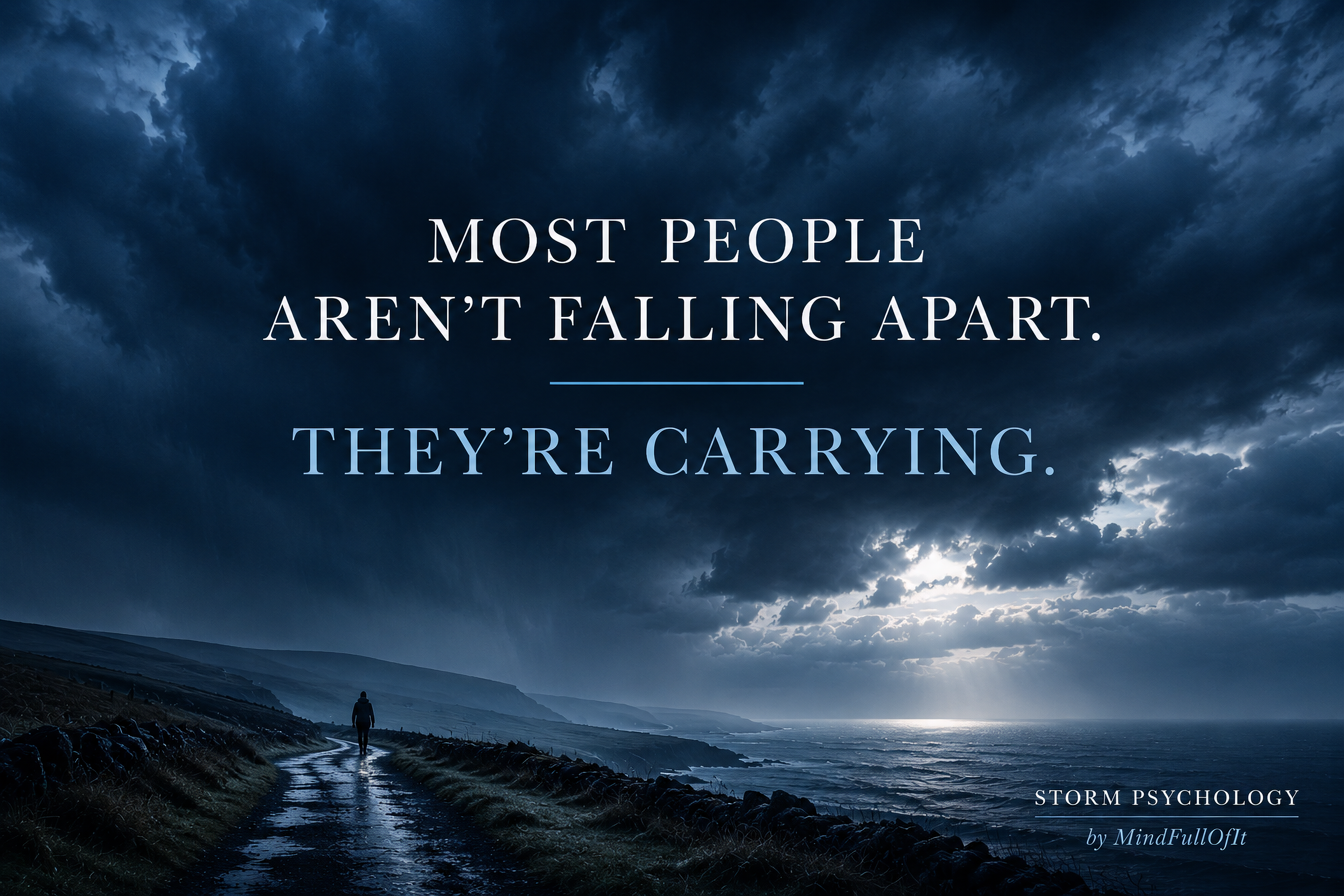
Most people aren’t falling apart.
They’re carrying.
Which raises an interesting question.
If exhaustion is so common, and if so many people are carrying more than they admit, why are we so bad at recognizing it in ourselves?
Why Are Humans So Bad At Reading Their Own Weather?
One of the strangest things about exhaustion is that most people can recognize it almost instantly in somebody else.
We notice when a friend becomes quieter than usual, when a colleague seems distracted, or when somebody who normally replies within minutes suddenly takes days to answer a message. We notice when somebody who usually laughs easily seems distant and preoccupied. From the outside, the signs are often surprisingly obvious.
Yet when exactly the same things happen to us, we come to completely different conclusions.
Instead of thinking, “I might be exhausted,” we think, “I need to get organised.”
Instead of thinking, “I’m carrying too much,” we think, “I need to try harder.”
Instead of thinking, “Maybe I need a break,” we think, “Maybe I need to stop being lazy.”
I’ve always found that fascinating because if your best friend phoned you and described exactly the same symptoms, you’d probably be kind. You’d reassure them, remind them that life has been busy, and tell them they’re doing the best they can with what they’ve got.
Meanwhile, you’re standing in your kitchen trying to put the butter lid on the milk tub and wondering whether you’ve somehow become incompetent.
Yes, that actually happened.
The milk survived.
My dignity took slightly longer to recover.
Most people don’t see moments like that and think, “Perhaps I’m carrying too much.”
They think:
“What is wrong with me?”
The forgotten appointment becomes proof they’re disorganized. The unanswered message becomes proof they’re unreliable. The neglected garden becomes proof they’re failing at adulthood.
Psychologically, human beings tend to judge themselves differently than they judge other people. We know our intentions, the jobs we haven’t finished, the emails we haven’t answered, and the promises we’ve quietly postponed. When somebody else struggles, we see context. We see pressure, responsibility, and difficult circumstances.
When we struggle, we often skip straight past context and head directly for self-criticism.
That’s where exhaustion becomes sneaky.
It doesn’t just make us tired.
It changes the stories we tell ourselves.
The behavior stays the same.
The explanation changes.
And once that happens, exhaustion becomes much harder to recognize, not because the signs aren’t there, but because we’ve convinced ourselves they mean something else.
Sometimes the problem isn’t the exhaustion.
It’s the story we tell ourselves about it.
The “One More Week” Trap
If exhaustion has a catchphrase, it’s probably this:
“Things will calm down after this week.”
We’ve all said it.
After this shift.
After this deadline.
After this appointment.
After this bill.
After this one thing.
The problem is that life has a remarkable ability to replace one responsibility with another. You finish the paperwork and the car starts making a noise. You survive a busy month at work and somebody gets ill. You finally get a free weekend and remember the garden now looks like it belongs in a wildlife documentary.
Life doesn’t really calm down.
It changes shape.
Psychologists sometimes refer to this as optimism bias. Human beings naturally assume that future circumstances will be easier to manage than current ones. We imagine we’ll have more time next month, more energy next week, and fewer responsibilities once we get through whatever is in front of us right now.
The trouble is that next week eventually becomes this week.
And somehow we’re still saying the same thing.
One more week.
One more push.
One more thing.
Sometimes that’s perseverance.
Sometimes it’s resilience.
And sometimes it’s self-neglect wearing a respectable outfit.
The difficult part is that nobody notices when that line gets crossed because, from the outside, you’re still functioning. You’re still showing up, paying bills, helping people, and keeping everything moving.
And functioning can hide a lot.
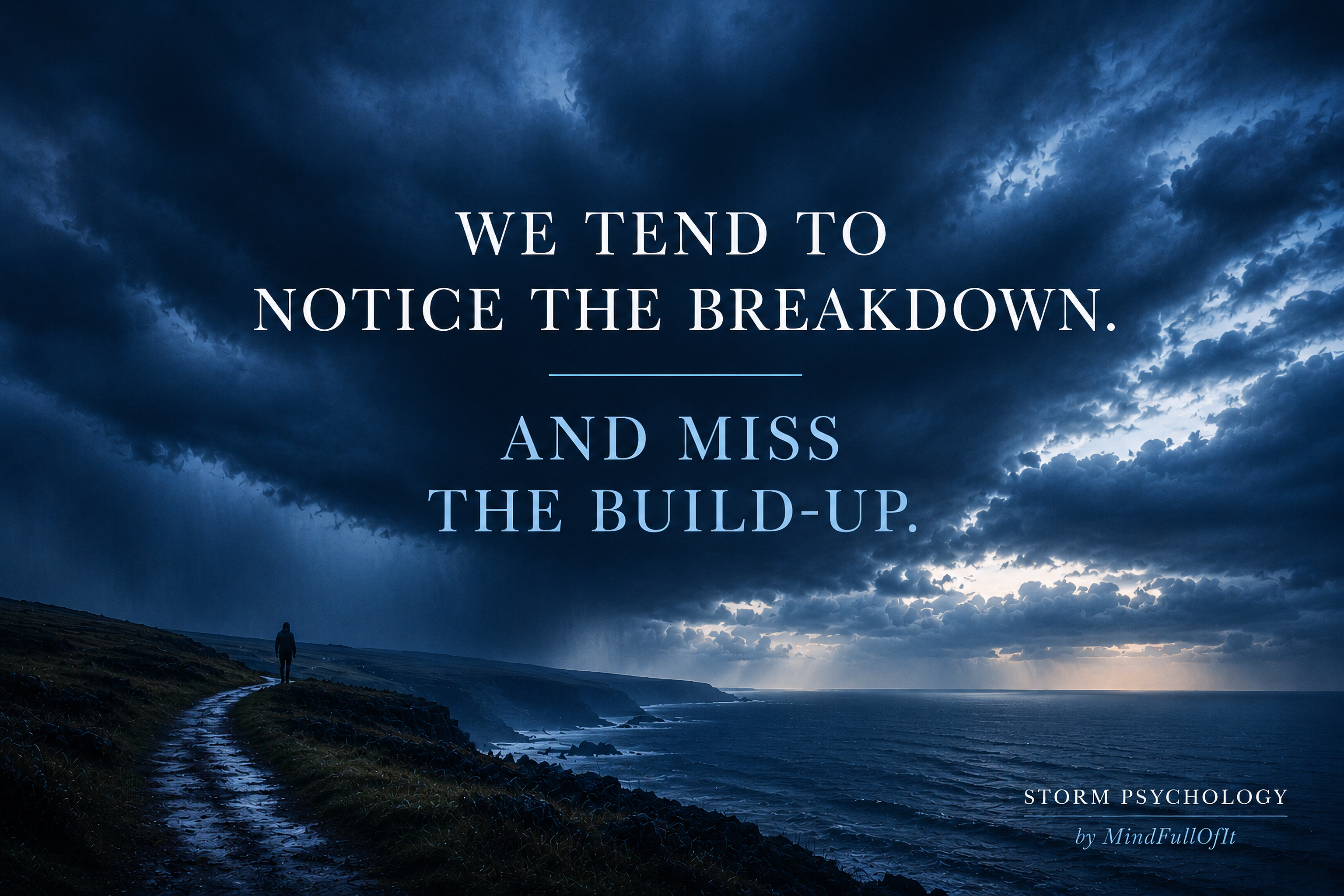
We tend to notice the breakdown and miss the build-up.
Why Small Things Start Feeling Big
One of the strangest things about exhaustion is that it rarely attacks the big tasks first.
Most people can still get up, go to work, care for their families, and do the things that absolutely have to be done. Instead, exhaustion tends to show up in smaller places. The unanswered text message. The phone call you’ve been meaning to make. The email that somehow feels more complicated than it should.
People often find this confusing. If you’re capable of holding down a job, paying bills, and navigating everyday life, why does replying to a message suddenly feel impossible?
The answer lies in how the brain manages energy.
When we’re under prolonged pressure, attention, decision-making, and emotional energy become valuable resources. The brain starts looking for shortcuts, not because it’s lazy, but because it’s efficient.
That’s why somebody can spend an entire day functioning at work and then stare at a simple message from a friend feeling completely overwhelmed by the thought of replying.
From the outside it makes no sense.
From the inside it often makes perfect sense.
Have you ever stood in a supermarket staring at a shelf of options and felt irrationally annoyed that food requires choosing? Or found yourself opening the fridge repeatedly despite knowing there is nothing new inside?
These aren’t character flaws.
They’re clues.
Clues that your mental battery may be running lower than you realize.
When Carrying Becomes Normal
Human beings are remarkably adaptable.
It’s one of our greatest strengths.
It’s also one of our biggest weaknesses.
Think about something that once felt overwhelming. A new job. Caring for somebody you love. A health problem. A financial worry. A responsibility you never expected to have.
When it first arrived, it probably occupied a huge amount of space in your mind. Then something strange happened.
You got used to it.
Not because it became easier.
Because human beings adapt.
That’s how parents keep parenting through sleepless nights. It’s how carers keep caring. It’s how people survive grief, illness, financial hardship, and all the other storms life occasionally throws at them.
The problem is that adaptation can make unhealthy situations feel normal.
A few months ago something felt overwhelming.
Today it feels routine.
Not because the pressure disappeared.
Because you’ve been carrying it for so long that it no longer feels unusual.
Eventually we stop asking:
“Is this healthy?”
and start asking:
“Is this normal?”
Those are very different questions.
One of the saddest phrases I hear is:
“Everyone’s tired.”
They’re usually right.
But if everyone in a room has a headache, it doesn’t suddenly become healthy. It simply means lots of people are struggling.
The same thing applies to exhaustion.
Just because something is common doesn’t mean it’s harmless.
Why Are So Many People Exhausted Right Now?
The more people I speak to, the more I hear the same story told in different ways.
What strikes me isn’t that people are failing.
It’s that they’re trying.
They’re trying to earn enough money to live, support their families, care for ageing parents, raise children, maintain relationships, stay healthy, stay informed, and somehow keep everything moving forward at the same time.
And they’re doing all of this in a world that constantly seems to ask for more. More time, more attention, more patience, more flexibility, more money, more energy. Sometimes it feels as though life has quietly become a subscription service where the price keeps increasing and nobody remembers signing up.
What I’ve noticed is that exhaustion isn’t always about doing too much. Sometimes it’s about giving too much. Giving energy, care, emotional support, patience, and time until, little by little, there’s less left in the tank than we realize.
The strange thing is that most people don’t notice it happening. Nobody wakes up one morning and decides to empty themselves out. It happens gradually, one favor, one responsibility, one act of kindness at a time. A lift here. A phone call there. A problem solved. A worry absorbed. A promise made.
Then one day you realize you’ve become the person everybody turns to, while quietly wondering who you’re supposed to turn to.
That’s why so many people describe a kind of tiredness that sleep doesn’t seem to fix. It’s not always physical exhaustion. Sometimes it’s the exhaustion of responsibility, emotional labor, and carrying worries that never quite leave your mind, even when you’re supposed to be resting.
I think that’s why so many people feel stuck. They’re waiting for a moment when life finally eases off, but life rarely works like that. Responsibilities don’t line up neatly and take turns. They arrive all at once, competing for the same time, energy, and attention.
Maybe the real question isn’t:
Why are people so exhausted?
Maybe it’s:
How could they not be?
People aren’t weak.
They’re carrying more than most people realize.
What Actually Helps?
One of the things that frustrates me about modern advice is that it often assumes people can simply stop.
Stop working.
Stop caring.
Stop carrying.
Stop doing.
As though exhaustion is always the result of poor choices rather than the reality of modern life.
For many people, stopping isn’t realistic. The bills still need paying, the children still need collecting, the shift still needs covering, and the dog still needs walking. Life rarely pauses long enough for recovery to happen neatly, which is why so much advice can feel disconnected from reality.
The people reading articles about exhaustion are often the same people holding everything together. They’re not looking for a three-week retreat in the mountains or a wellness guru telling them to wake up at 5am and meditate beside a waterfall. They’re trying to work out how to get through Thursday without accidentally putting the butter lid on the milk again.
That’s why I don’t think the answer is always to stop all the plates spinning.
For many people, that’s impossible.
I think the better question is:
Which plates actually need spinning?
Exhaustion has a habit of convincing us that everything is urgent. Every email feels important. Every task feels essential. Every responsibility demands attention right now. When we’re overwhelmed, the brain becomes remarkably bad at telling the difference between what genuinely matters and what is simply making the most noise.
Maybe the garden can wait another week.
Maybe the perfectly organised house isn’t the emergency your brain is insisting it is.
Maybe the pressure you’re putting on yourself is heavier than the pressure anybody else is placing on you.
If you can’t stop all the plates spinning, perhaps the goal isn’t to keep adding more.
Perhaps it’s to gently place one or two down for a while.
Not forever.
Just long enough to catch your breath.
Because that’s not failure.
That’s maintenance.
The same principle applies when somebody we care about is struggling.
A few years ago, I probably would’ve told you that the best way to help somebody was to have the right advice, the right words, or the perfect solution.
I don’t think that anymore.
Life has a habit of teaching us that most people already know what they’re supposed to be doing. They know they should rest. They know they should ask for help. They know they should be kinder to themselves.
The problem usually isn’t a lack of information.
It’s a lack of space.
That’s why one of the kindest things another human being can do is simply notice.
A simple:
“You seem like you’ve got a lot on your plate lately.”
can carry far more weight than people realize.
Not because it solves anything.
Because it tells somebody they’ve been seen.
Most exhausted people become experts at looking fine. They go to work. They reply to messages. They make jokes. They ask other people how they’re doing. From the outside, everything appears normal, which means that when somebody notices the effort underneath all of that, it matters.
And perhaps that’s where active listening becomes so important.
People often confuse hearing with listening. We nod at the right moments, wait for pauses in conversation, and think about what we’re going to say next. On the surface it looks like listening, but often we’re only hearing enough to prepare our response.
Real listening means becoming genuinely interested in what life feels like from the other person’s perspective. It means asking questions because you want to understand, not because you’re steering the conversation towards a solution. It means allowing somebody to explain what they’re carrying without immediately comparing it to your own experiences or searching for ways to fix it.
That can be difficult because most of us want to help.
The intention is kind.
The problem is that not every difficult situation has a quick solution.
Sometimes the bills still need paying.
Sometimes the health problem is still there.
Sometimes life is simply hard.
In those moments, what people often need most isn’t fixing.
It’s understanding.
Being heard is one of the most underrated forms of support we can offer another human being.
Sometimes people don’t need somebody to remove the storm.
They just need somebody willing to sit beside them while it rains.
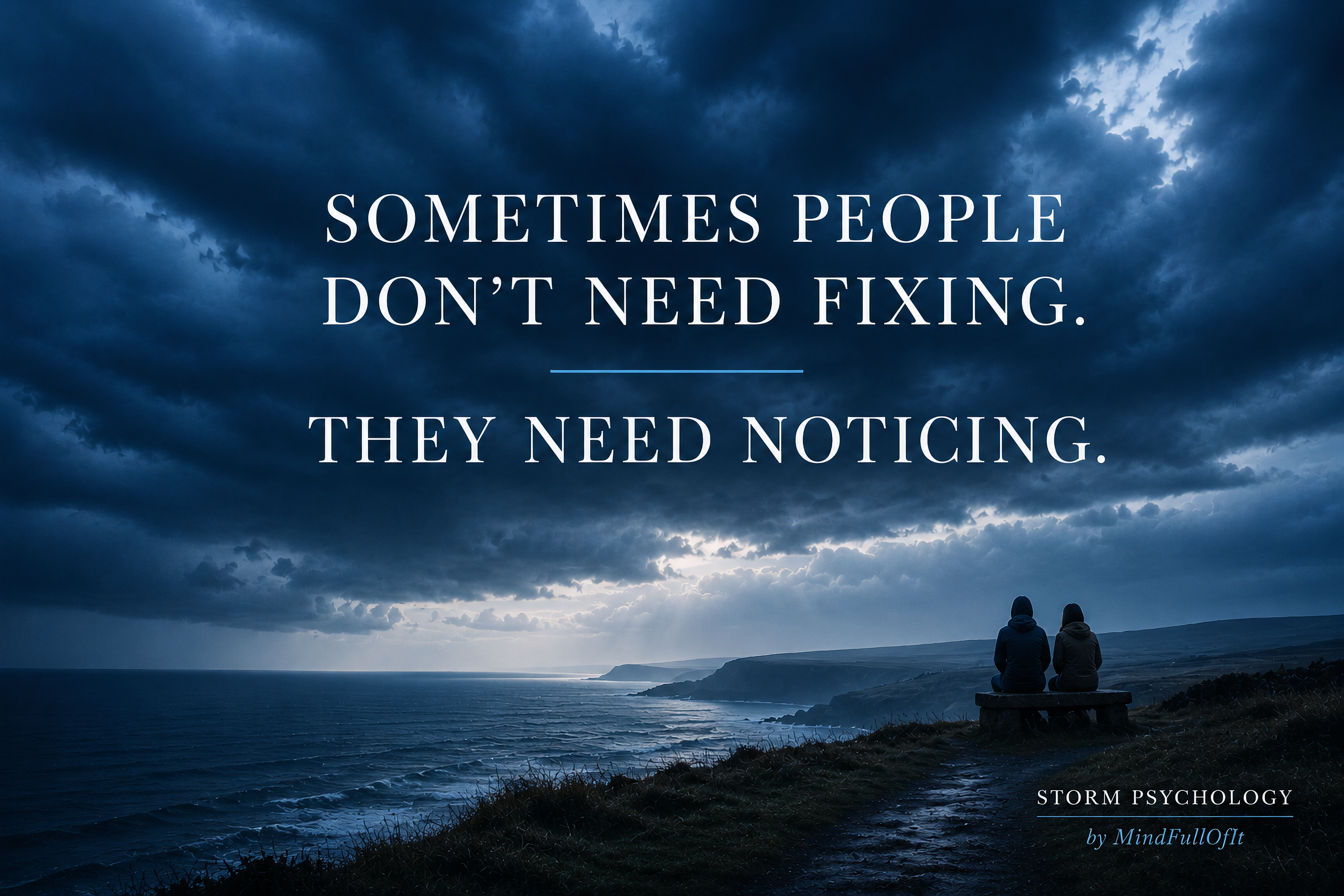
Sometimes people don’t need fixing.
They need noticing.
The Weather Can Change
If you’ve recognized yourself anywhere in this article, I want to leave you with one final thought.
Throughout this piece, we’ve talked about exhaustion as though it’s a storm. Not because storms are dramatic, but because they often arrive so gradually that we don’t fully notice what’s happening until we’re already standing in the middle of them.
Most people don’t wake up one morning and suddenly become exhausted.
A difficult week becomes a difficult month. A temporary problem becomes a permanent feature of everyday life. Responsibilities accumulate. Pressures overlap. Things that once felt unusual slowly become normal.
That’s one of the reasons exhaustion can be so difficult to recognize.
By the time many people notice it, they’ve already adapted to it.
They’ve become used to functioning while tired.
Used to pushing through.
Used to telling themselves they’ll rest when things calm down.
And perhaps that’s the real reason recognizing exhaustion matters.
Not because you’re weak.
Not because you’re failing.
Not because you’ve done anything wrong.
But because it’s difficult to navigate the weather when you’ve convinced yourself the storm isn’t there.
You don’t get extra points for pretending the rain isn’t falling. You don’t win a medal for struggling in silence. And carrying everything by yourself isn’t proof of strength.
More often than not, it’s simply proof that you’ve been carrying everything by yourself.
If there is one thing I’d like people to take away from this article, it’s that exhaustion isn’t always a sign that you’re doing something wrong.
Sometimes it’s a sign that you’ve been doing too much, for too long, without enough opportunities to put any of it down.
So if life feels heavy right now, perhaps this is your reminder to give yourself the same understanding you’d offer somebody else.
The same patience.
The same compassion.
The same grace.
Because storms pass.
Weather changes.
And no matter how normal carrying everything has become, you were never supposed to carry it all alone.