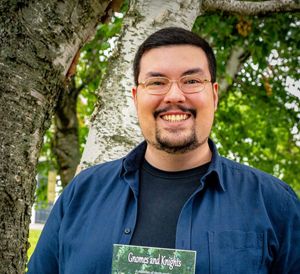

Introduce yourself; who are you and what types of books do you write?
My name is Ken Wilson. I’m the author of two books of creative nonfiction: Walking the Bypass: Notes on Place from the Side of the Road (University of Regina Press, 2025), and the forthcoming Walking Well: Trails, Paths, Pilgrimages (Wolsak and Wynn, 2026).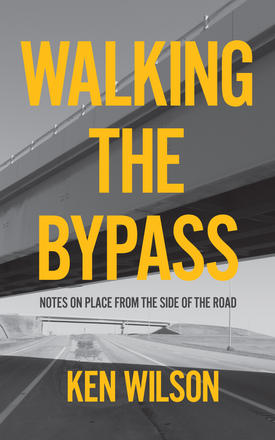 What are your books about?
Both of my books think about the ways that walking can enable us to connect to the world around us. Walking the Bypass studies a specific location: the Regina Bypass, a new highway around Saskatchewan’s capital. It asks whether it’s possible to feel connected to a place most people move through as fast as they can without stopping. Walking Well is a collection of essays that takes the notion of connection more broadly. It also asks how walking can help us connect to the places where we find ourselves, but it thinks about the ways that walking enables us to relate to other people and to understand our own experiences.
What was the inspiration behind writing your first book?
I was curious about the Regina Bypass. I didn’t understand its purpose. I didn’t understand why the province spent $2 billion building it. I decided to study it by walking, following the examples set by Iain Sinclair in London Orbital: A Walk Around the M25 and John Davies in Walking the M62. The difference between my book and those precursors is that I was able to walk on the highway itself. Roads in North America have shoulders, unlike those in the UK, and it would’ve been suicidal for Sinclair or Davies to try walking on the highways they write about.
What did you learn while writing your second book?
I’ve been working on the essays included in Walking Well for more than a decade, so one of the things I learned was how long it can take to write a book, and how a collection of essays develops slowly over time. I also learned how difficult it is to write about my personal life—to reveal things I’ve kept to myself for a long time. I don’t know what will happen when those stories find their way into the world, which makes me a little anxious.
In addition, I’ve learned something about assembling a collection of different texts—how to think about the order in which they should be presented, about how the different parts of a collection resonate with each other.
What is the most rewarding part of being an author?
The most rewarding part of being an author is hearing from readers who have found something worthwhile in what you’ve written. And holding your book in your hand for the first time.
What elements do you think make for a good story?
There has to be conflict. Readers need to care about what happens to the characters, to be invested in the story. The characters need to be vivid and they must have a life of their own, rather than being tightly controlled by their author. Writers need to allow their characters to surprise them.
What is the hardest part of being an author for you?
Finding time to write! I teach full time, and everything associated with my job tends to push longer writing projects to the side. It’s a little easier to work on shorter things. Perhaps that’s why my second book is a collection of essays.
What is your current writing project?
I’m at the beginning of a book about people who are trying to preserve and even restore grassland in western Canada. Temperate grasslands are the world’s most threatened ecosystem, and almost 90 percent of the grassland that once covered southern Saskatchewan has been turned into the fields of wheat and canola that define this province in the popular imagination. However, many people are trying to hold onto what’s left, and I want to tell their stories. Why do they care? What makes them feel so strongly, so passionately, about that ecosystem?
Because grassland in Canada continues to be destroyed at an alarming rate, I feel some urgency to write this book.
What is the best writing advice you’ve ever received?
I think the best writing advice I’ve run across is in the late Steven Heighton’s Workbook: write everything you can in the first draft, and then, as you revise your work in subsequent drafts, cut ruthlessly. That process creates subtext, Heighton argues, and I think he’s right.
Also, it’s essential to remember that writing is a practice. It’s something you do. And any practice requires practice: when we take up the piano, for instance, we need to run scales to develop and maintain strength and flexibility in our hands and fingers. I think that writing is like that. To become a better writer, the best thing to do is to write, even if you’ve only got a few minutes, even if what you’re writing has nothing to do with the project you’re supposed to be working on.
But, at the same time, writers need to read. Mary Oliver argued that to write poetry well, you need to read “widely and deeply” in the form, and the same is true about any kind of writing.
Where can readers discover more about you and your books?
I have a website and a blog. The website can be found at https://kenwilsonwriter.ca, and the blog at https://readingandwalking.ca. I’m also on social media: on Facebook at https://www.facebook.com/ken.wilson.955882/, on Instagram at https://www.instagram.com/kenwilsonwriter/, and on Bluesky at https://bsky.app/profile/therealkenwilson.bsky.social.