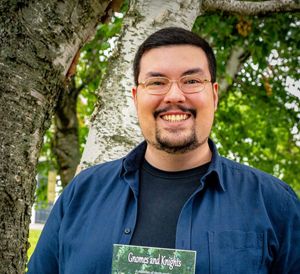

Introduce yourself; who are you and what types of books do you write?
Hello! Joseph Carrabis here.
Who am I? Great question. Depends on who you ask. The official (LinkedIn) bio reads “Joseph Carrabis is a master storyteller with a sharp sense of humor and linguistic expertise. Hailing from New Hampshire, USA, his passion for writing began at the tender age of seven while washing dishes with his older sister, Sandra. She’d read ‘Mission to the Heart Stars’ for a book report and shared her fascination and excitement over the story. Joseph, a plate in one hand and a dish towel in the other decided, “I want to give that to people.” With a career deeply embedded in evolving technologies, Joseph served as Chief Research Officer, Chief Neuroscience Officer, and Senior Research Fellow at several institutions and agencies while earning numerous awards for his journalism and trade technical writing. Joseph refers to himself as boring – something loudly debunked by his readers and peers – and weaves wildly imaginative stories that dance on the boundary of the known and unknown sciences where natural, preternatural and supernatural intersect. Fans’ comments regularly mention Carrabis’ ability to bring together advanced mathematics, quantum physics, cybernetics, and neuroscience with believable multi-dimensional characters and spellbinding future technology. Joseph has been nominated for the Pushcart Prize, recommended for a Nebula Award, and received an honorable mention in ‘Writers of the Future’. Outside of writing, Joseph spends his time with his wife, Susan, reading, talking around campfires, flying kites, and befriending wildlife. He thinks of music as a language of sound and movement and enjoys listening and playing the piano, clarinet, saxophone, and guitar. A facilitator for open-minded conversations, Joseph runs a monthly forum, Roundtable 360º, where creatives from a range of fields discuss what drives their souls to create.
What are your books about?
My long-time editor and several regular readers tell others “The two things you’ll always find in Joseph’s writing are a deep understanding of human psychology and love.”
Love, I agree, is a constant in my work. Doesn’t matter if I’m writing horror, science-fiction, fantasy, poetry, humor, children’s lit, whatever, and even non-fiction, there’ll always be something about relationships, and specifically relationships healing and individuals healing.
The Augmented Man is about a massively traumatized supersoldier - so modified he’s barely human anymore - he is willing to die because he falls in love and fears what he is will harm the person who loves him, thus love and sacrifice.
Empty Sky is about a child’s love for his parents and his dog, different individuals love for themselves and others, and the sacrifices people make to demonstrate that love when there’s a world dangering crisis.
The Inheritors is about a genius boy so wanting to be accepted and be with people who understand him he forsakes his family, who do love him, for what he believes will be a better place. He discovers it isn’t what he hoped, and he decides to change that place into a place people like him will be loved and accepted.
You’ll definitely find love at the core of The Shaman, and Search deals exclusively with the decisions people make about what’s best for themselves and others when they’re in love.
I could continue and you get the idea. And in my work, to understand the energies of love is to understand what makes us human (even when the characters aren’t human), to understand the psychological drives and motivations which give history and hope to our thoughts and actions.
What was the inspiration behind writing your first book?
I was a brutally abused child (sexual, physical, psychological, emotional, you name it, my family of origin were masters of it) who became a self-abusing adult. I placed myself in dangerous situations and was recruited for specialized training.
Then I met Susan (wife/partner/Princess) who loved me unconditionally but who also said she couldn’t help me unless she helped herself.
This staggered me. I never heard such a thing. At about the same time I had a road rage incident which could have landed me in jail except something inside me stopped. I realized I wasn’t supposed to live that way, and sought help.
I worked with two incredibly gifted gentlemen who worked with me for years. We made progress and it was so slight as to be disheartening. One thing which we all realized was there were no models (at the time) for traumatized children who become traumatized adults.
I’ve always been a researcher/student, and I turned that skill towards building a model for my experiences. I found similarities between childhood trauma, combat trauma, spousal abuse, job-related trauma, survivor guilt, quite a range of things, and began building a model which addressed all these situations and allowed for modifications as client and practionist needed.
At the time, I had no credentials or degrees in these fields and couldn’t find any journal willing to publish my findings, so I wrote The Augmented Man to both demonstrate and share what I learned.
I’ve had therapists tell me The Augmented Man’s “Through” section is a guidebook for dealing with trauma survivors, and people approach me at signings, often in tears, and tell me how much the book helped them understand fathers, mothers, uncles, aunts, brothers, and other family members.
PS: I’ve taught my therapeutic models worldwide and they’re now part of the canon.
What did you learn while writing your second book?
My own limits. I released the first edition and knew it had weaknesses. No readers ever commented such, and I knew those weaknesses existed. Six years later I had fixed those holes, strengthened the story greatly, and published the new edition. Readers of both editions prefer the second, still like the first, and liken the two versions to the same story told by two different people.
Basically, I matured as an author and it took my honesty with my second book, Empty Sky, to do it.
What is the most rewarding part of being an author?
Meeting people no one’s ever met, going places no one’s ever been, seeing things no one’s ever seen, and never having to leave my desk to do it.
What elements do you think make for a good story?
Easy - give me an interesting person in an interesting place doing something interesting and I’m locked. You have me. Give me two, make them strong, and you have me. You can give me any one and it has to be over-the-top amazing/engaging to hold me. Example: The Haunting of Hill House starts with an extremely interesting place. Most of Katherine Mansfield’s work starts with
extremely interesting places in which extremely interesting characters are introduced. Fritz Leiber’s A Pail of Air starts with all three and keeps that up throughout the story. Murray Leinster’s Exploration Team has all three and is brilliant.
What happens when all three occur is you entertain the reader. Entertain your audience and you can do anything you want with them; preach, propagandize, market, whatever, and do note that preaching, propagandizing, and marketing are all the same thing with different names.
But first you must entertain them. Keep them entertained and you have them engaged. They stick with your work until they finish, and better, they’ll want more.
What is the hardest part of being an author for you?
ROFL - getting people to read my work.
What is your current writing project?
ROFL^2 - this interview. My current pen-to-paper project is “How Jerry and Betty Became the Least Entertaining Couple in the Neighborhood,” a story about the need for art in our lives to make us whole. I usually have several projects going simultaneously and shift between them as plot points come and go.
What is the best writing advice you’ve ever received?
That’s a tough one because you specify “received.” I received lots of advice, most of it was opinion and told me more about the person offering the advice than it helped me improve my craft.
Received…hmm…Okay, the best advice I ever received was to quit writing because my writing sucked.
Where can readers discover more about you and your books?
About me - https://josephcarrabis.com
My work - http://nlb.pub/amazon
Twitter/X - http://nlb.pub/Twitter
Facebook - http://nlb.pub/Facebook
LinkedIn - http://nlb.pub/LinkedIn
Goodreads - http://nlb.pub/Goodreads
Pinterest - http://nlb.pub/Pinterest
Instagram - http://nlb.pub/Instagram
BookBub - http://nlb.pub/BookBub
YouTube - http://nlb.pub/YouTube
Substack - http://nlb.pub/Substack