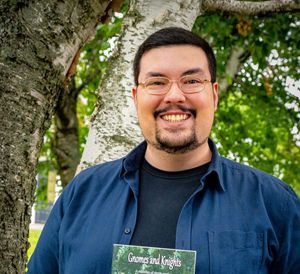

Introduce yourself; who are you and what types of books do you write?
I teach Canadian and American literature and creative writing at the University of Windsor. Formerly, I was a marine engineer on the Great Lakes and the Eastern Seaboard. I worked on bulk carriers, tankers, hydrographic and fishery patrol vessels before studying English. It’s not really a contradiction in careers: English and engineering. Both are about systems of thought, especially steamship engineering. I write novels, short stories, and poetry. I figure when I write a play I’ll have hit for the cycle. My genres range from historical fiction to Gothicism to sentimental realism. Within those genres, my fiction is character-based. I try to write protagonists who are palpably real. The situations they find themselves in, their conflicts and ambitions, differ with the genres. What are your books about?
My books are shaped by my experience, including living in Northern Ontario. From the age of 11 to 16 I lived in a mining town 50 miles down a dirt road from Ear Falls. High school was a 90-mile bus ride to Red Lake, itself a mining centre north of Kenora. Many of my stories are set up north or at sea. My first novel, Lucien & Olivia, is a romance about a sailor and a philosophy student. Set in the 80s, at a time of slow communication, particularly between the sea and the shore, the story follows two people, who we come to understand by the way they imagine each other.
What was the inspiration behind writing your first book?
My first book was a long time coming, a series of linked stories entitled Twelve Miles to Midnight, which follows the lives of two sailors, whose experiences on board the same ship are vastly different. I wanted to write about my time at sea, and I wanted to “get it right.” There have been many, many, many sailing stories, but far fewer in the modern age. All the world is mapped. Where is the adventure? A ship is essentially a floating workplace. Where is the personal growth? At sea as anywhere else. And I wanted to record that peculiar life for my generation. I wrote a series of discreet narratives. The work took shape over a period of over twenty years during which time I entered the stories into contests (winning the Atlantic Writing Contest, coming second in the Prairie Fire Short Fiction Contest) and published most of them in North American journals (one of them being included in Best Canadian Stories). During that time, I wrote many other things, including a PhD dissertation but, scholarship aside, this was the first book I completed. When I had enough stories to show what I wanted to show, I sent the manuscript to Black Moss Press who, happily for me, published it.
What did you learn while writing your second book?
How to map a novel. Stories tend to be about their themes, novels about time. The first lesson I had to learn was how not to write a very, very long short story and call that a novel.
What is the most rewarding part of being an author?
There is always a warm spot in my mind when I’m writing something I like. I want to be there. In that room or place I’m constructing. Afterwards, I get to say that I’ve succeeded at doing exactly what I wanted to do when I was in Grade 3. I don’t boast, but if I did, I would boast about being a novelist. I didn’t feel that way about engineering, although I respect the work.
What elements do you think make for a good story?
Stories are about characters in conflict. Good stories are about conflicted characters in conflict.
What is the hardest part of being an author for you?
Rejection is hard. My first novel was longlisted for the Scotiabank Giller Prize, but that doesn’t seem to have changed the odds. When I was twenty-one and working at sea, I rented an apartment in Halifax that had a crack in the wall. It shouldn’t have had a crack. It wasn’t an old building. But it did, and rather than complain to my landlord, I partially covered it with a rejection I’d received by mail. More rejections came, until the crack was completely covered and the wall was papered with “Thank you for sending…sorry it doesn’t fit our current vision…” When I threw parties, the wall was a conversation piece: “They rejected you, too?” “That’s a great rejection.” Still, it hurt. Rejection still hurts today.
What is your current writing project?
A selected criticism of Archibald MacMechan, an early 20th-C Dalhousie professor who was L. Maud Montgomery’s professor and who is credited with starting the Melville revival.
What is the best writing advice you’ve ever received?
Save your first draft. If you get lost in edits, the first draft knows what you were trying to say.
Where can readers discover more about you and your books?
Wikipedia page: https://en.wikipedia.org/wiki/Andr%C3%A9_Narbonne
Writers Union page: https://writersunion.ca/member/andre-narbonne
Interview: https://www.youtube.com/watch?v=ipTTRiv_P8Y
Books:
Those Are Pearls: https://www.indigo.ca/en-ca/those-are-pearls/9781997508175.html
The Poet’s Cookbook: https://49thshelf.com/Books/T/The-Poet-s-Cookbook