

Forget Donald Trump, this is about a decade of ash, evacuations, and billions in charred infrastructure that somehow failed to register as a wake-up call. Ottawa didn't need a nudge from Washington; it needed a foreign president to treat wildfire smoke like a trade dispute before anyone in the capital starts treating wildfire prevention as a national priority.
Prime Minister Carney,
Donald Trump is now threatening to make Canada pay for wildfire smoke drifting into the United States by adding what he calls its "incalculable cost" to tariffs on Canadian goods.
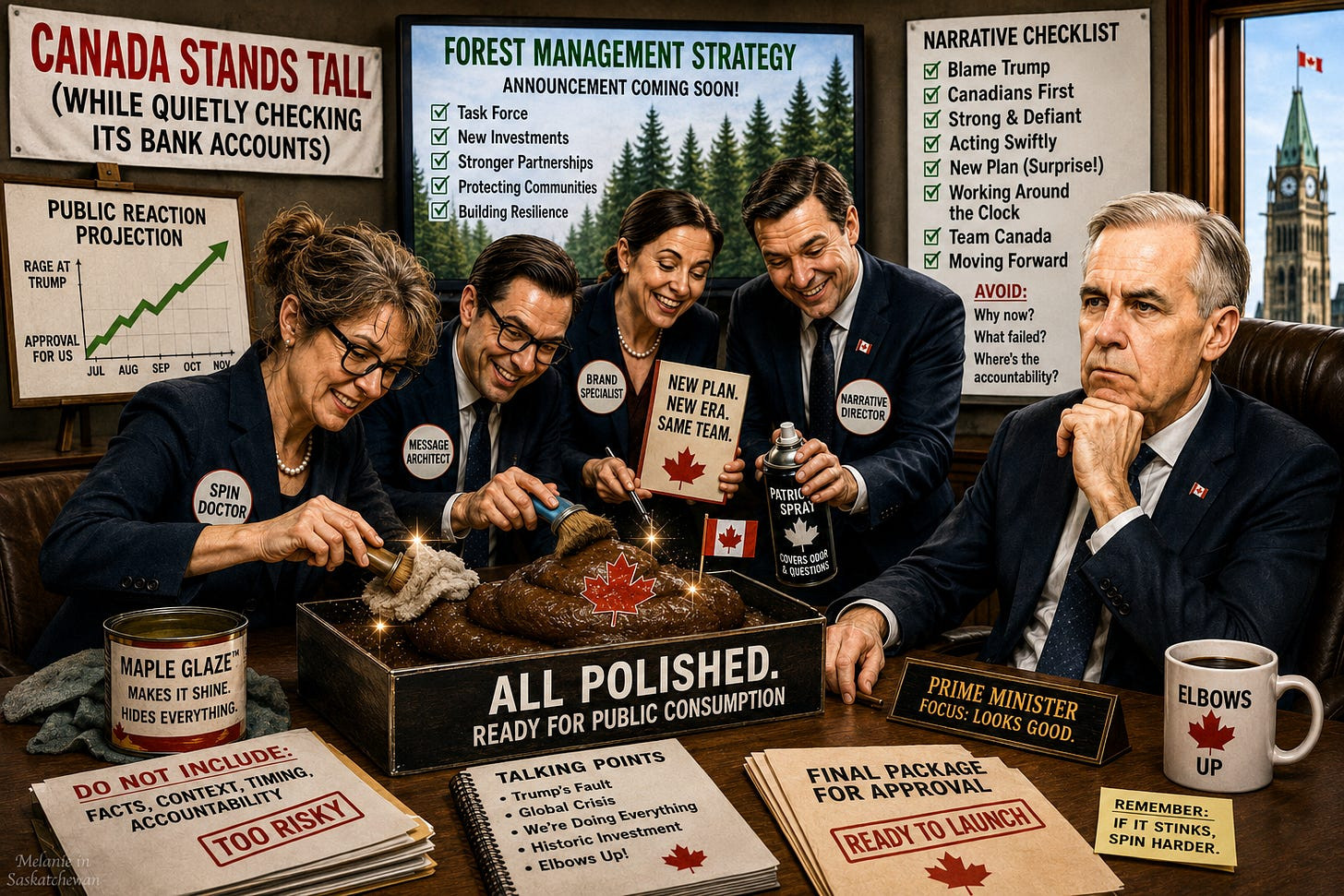
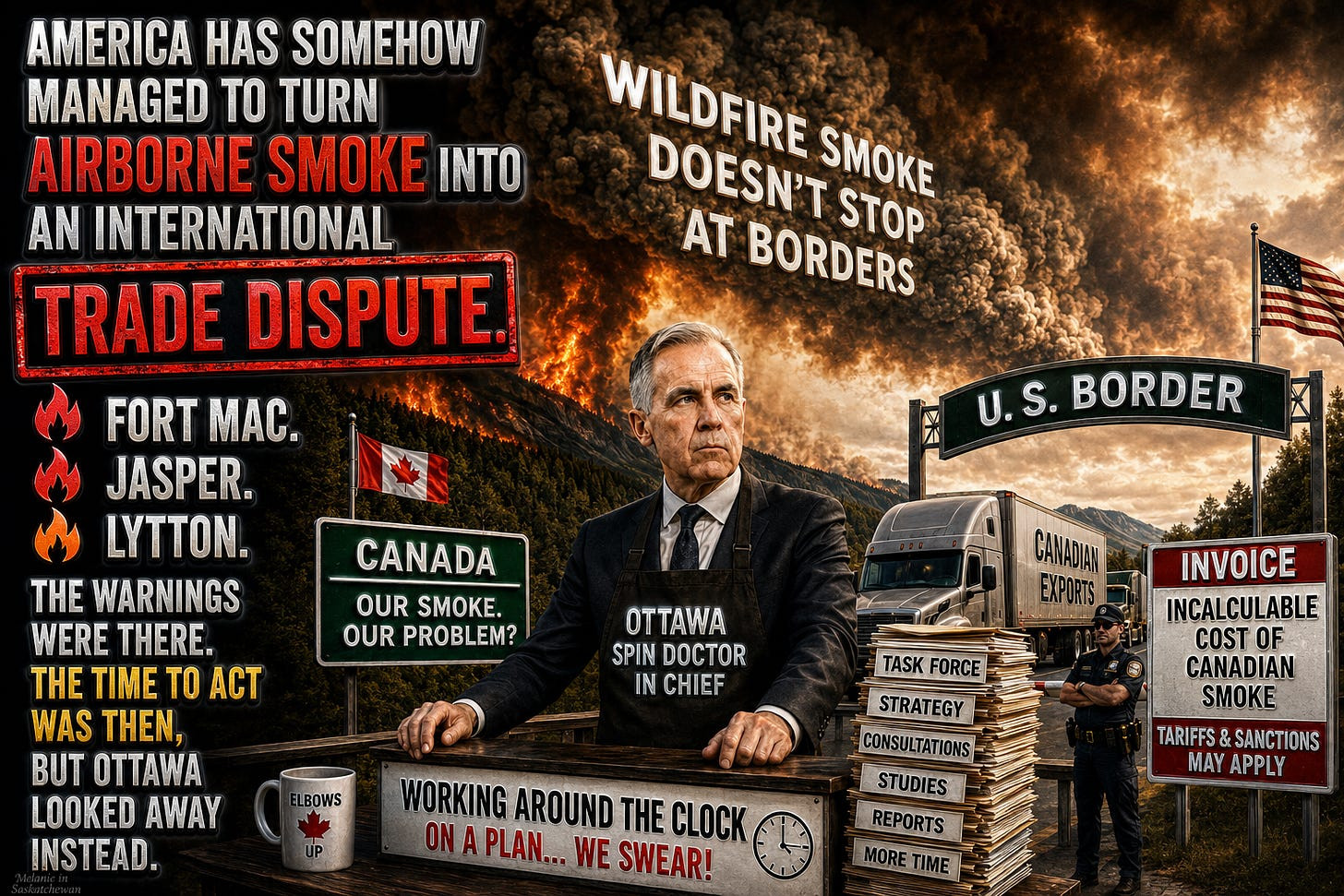 Meanwhile, Republican Senator Bernie Moreno is proposing sanctions against Canadian officials over the same issue. Those sanctions have not been enacted, and the available reporting does not establish that your personal assets are specifically being targeted. But proposed sanctions can involve frozen American assets, visa restrictions and other penalties against whichever officials are eventually named. That rather important distinction should be made before Ottawa’s communications department turns this into another travelling production of ‘Canada Stands Tall While Quietly Checking Its Bank Accounts.’
So let me make a prediction:
Any day now, your government will solemnly discover the importance of proper forest management.
There could be a task force, or a federal strategy, a minister standing solemnly in front of some trees. Perhaps an announcement that Ottawa has been "working around the clock" on a comprehensive plan that, by a miraculous coincidence, became urgent only after the American president threatened tariffs and a U.S. senator started talking about sanctions.
Should that happen, Canadians will be entitled to ask a very simple question: What finally changed Ottawa’s mind?
Was it concern for Canadians living through evacuations, destroyed communities and weeks of choking smoke? Was it the economic damage caused by recurring fire seasons? Was it pleas from provinces, northern communities and forestry workers for better prevention, mitigation and emergency capacity?
Or did the urgency arrive only when Washington threatened to slap another charge on Canadian exports and Senators possibly sanctioning Canadian officials like yourself? You personally have A LOT at stake if you are sanctioned since the majority of your wealth investment portfolio is in America.
The timing on this matters a great deal. It matters whenever a government suddenly treats a long-standing domestic problem like a national emergency only after somebody powerful outside the country attaches a financial consequence to it.
Trump has accused Canada of "wilful negligence" in maintaining its forests and says he intends to ask you what Canada plans to do. Your emergency management minister responded that governments have invested billions in fire prevention and forest sustainability since 2020. That defence deserves to be examined very closely and very carefully, because Canadians can reasonably ask what those billions purchased, where they went and why so many communities remain frighteningly vulnerable. To say it plainly... Canadians simply do not see any value for the dollars spent.
You announced spending of $317 million to lease 10 water bombers and heavy helicopters for rapid deployment to provinces because the wait time for them to be built is too long. So, here's a fun little arithmetic exercise for Ottawa: water bombers are built right here in Canada - jobs, sovereignty, the whole patriotic package you’ve been selling - yet the federal shopping list remains stubbornly empty.
With $317 million, you could buy three heavy scoopers and have pocket change left for spotter planes or a helicopter, or - and this is where it gets embarrassing - you could roll out 45 to 55 single-engine Fire Boss aircraft, scattering an actual national fleet across every province that needs one. But apparently the government prefers its firefighting budgets theoretical. It is here that I will remind you, Fort Mac, Jasper and Lytton should have already provoked this response to act years ago.
The United States is hardly in a position to lecture anyone without hypocrisy. It is enduring its own brutal wildfire season, and fires do not stop at customs booths to declare their country of origin. Climate, drought, lightning, forestry practices and emergency capacity all play a role. There is plenty of responsibility, contradiction and political theatre to go around here. America has somehow managed to turn airborne smoke into an international trade dispute, because apparently even oxygen now requires a customs declaration. But that doesn't absolve Ottawa. Again… Fort Mac. Jasper. Lytton. The warnings were already there. The time to act was then, but Ottawa chose navel gazing instead. In my books, that means today’s consequences lie with the governing Liberals.
This government has spent years announcing strategies, funds and climate initiatives while treating questions about measurable results as though Canadians were being rude at a dinner party, all while sending billions of tax dollars out for ridiculous foreign spending programs like gender sensitive farming practices for LGB Africans in Uganda and Congo, or The Senior Sex-Life Theatre Production, or The "Gender-Responsive" Bicycle Project to fund "gender-equity bicycles" in specific regions of Peru. That money should be here, in Canada, saving our communities and wildlife.
And so now, finally, these new threats from America may be the first genuine incentive that catapults Ottawa to finally act. And this is where the Canadian Liberal political machinery becomes predictable.
Your strategists will see this as an opportunity.
They will frame every new forestry announcement as part of another grand "elbows up" confrontation with Donald Trump. They will present overdue domestic policy as patriotic defiance. They will redirect public anger toward Washington, wrap routine government responsibilities in the flag and invite Canadians to applaud while avoiding the less flattering question:
Why did it apparently take an American threat to make this urgent?
And that, my friends, is the turd Carney’s Liberal spin doctors will be polishing right now.
 Not because Trump’s conduct is reasonable. Tariffs imposed over drifting wildfire smoke would be an extraordinary and potentially abusive response. Threatening sanctions against Canadian officials over a cross-border environmental crisis is equally serious and risks turning a shared emergency into a political spectacle.
But Trump’s behaviour does not automatically make your government competent, and it certainly does not erase years of what we can now clearly see as failed Liberal policy choices. Moreover, it does not transform any upcoming, hastily announced forest-management plan into evidence of heroic Liberal leadership. A government doesn't deserve applause for finally taking wildfire management seriously only after another country threatens to make it expensive not to.
Canadians should expect a serious response that includes transparent spending, measurable prevention targets, cooperation with provinces and Indigenous communities, modern firefighting capacity, fuel reduction where appropriate, forestry expertise and clear reporting on results. What they should not receive is another branding exercise.
No cinematic speech or carefully choreographed "Team Canada" backdrop.
No insinuation that asking why this was not done sooner is somehow a Maple MAGA conservative tactic designed to help Trump. And certainly no attempt to use this dispute as campaign fuel, with Trump cast as the designated villain and every domestic failure quietly swept behind him.
You have spent considerable political energy presenting yourself as the indispensable adult capable of dealing with international disorder. This would be the opportunity for you and your band of Liberal misfits to prove it. Release the facts and explain what Canada has spent. Show us what worked and identify what failed. Tell Canadians what will change and why.
And if your government suddenly unveils a sweeping new forest-management strategy, spare us the performance because Canadians will still wonder whether Ottawa finally acted to protect the country... or whether the threat only became real because it can reach the Prime Minister’s portfolio.
Melanie
(This article is reader-supported. To receive new posts and support my work, consider becoming a free or paid subscriber and share Melanie in Saskatchewan with your friends.🤗)
Who is Melanie in Saskatchewan
Melanie in Saskatchewan is an independent Canadian writer and political commentator whose work blends sharp analysis, dry wit, and an unapologetically populist perspective. Writing from rural Saskatchewan, she examines politics through the eyes of an ordinary Canadian trying to navigate an increasingly extraordinary world.
Widowed in late 2025, Melanie is raising her young autistic daughter while confronting the challenges of grief, parenthood, and an uncertain future. That deeply personal responsibility shapes her writing, driving a relentless focus on the Canada today’s leaders are leaving to the next generation.
After spending over two decades in construction and renewable energy projects, Melanie returned to a passion first discovered while studying communications. Today, she channels that foundation into opinion pieces that challenge political narratives, demand accountability from those in power, and question the direction she believes Canada is taking. Her work frequently explores government spending, economic policy, civil liberties, and what she views as the growing influence of ESG-driven governance and activist ideology over traditional democratic institutions.
Known for her incisive commentary, rhetorical storytelling, and willingness to ask uncomfortable questions, Melanie has built a loyal readership drawn to a simple belief: governments work for the people, not the other way around.