

A Prime Minister's first responsibility isn't to redesign the world. It's to strengthen the country that entrusted him to lead it.
Sometimes the biggest political stories aren’t the ones making the evening news. Sometimes they’re the ones that quietly change how you see a politician. That happened to me again this week.
Like most Canadians, I’ve been looking at Mark Carney through the lens of everyday life. Is the economy improving? Is housing becoming any more affordable? Are families getting ahead, or just falling behind more slowly? Throw in tariffs, government spending and the never-ending Trump drama, and you’ve pretty much covered the conversations happening around kitchen tables across the country.
Then I read an article in the Wall Street Journal that made me stop. Not because it exposed a scandal, those are predictably becoming routine. It made me stop because it exposed something far more revealing: Mark Carney’s priorities. The WSJ article describes Mark Carney as someone working secretly to force Europe to rethink its dependence on the United States and move to different pastures. Not just militarily, but economically, technologically and strategically. He even kept his British phone number to conduct these secret ambitions.
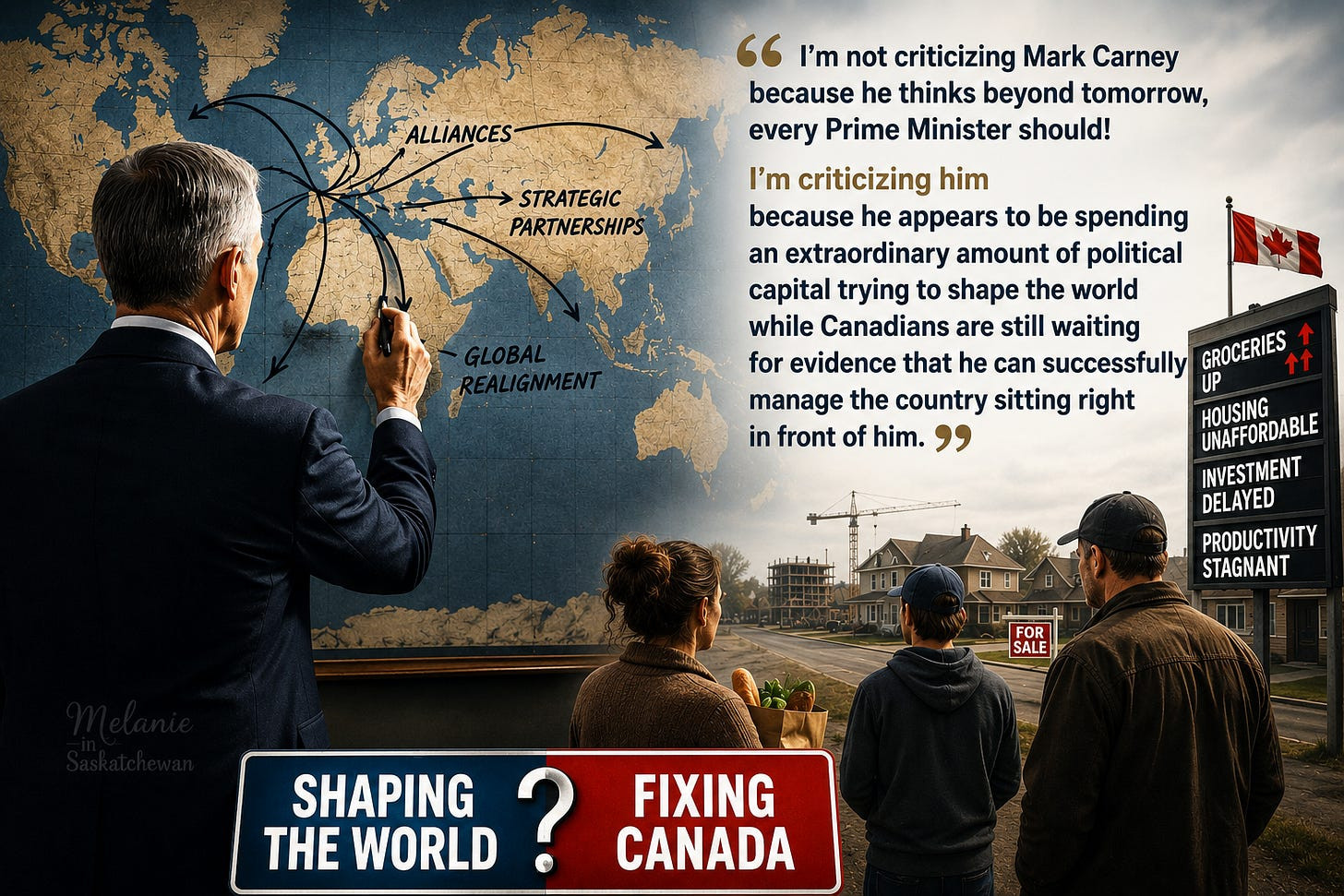 Take a second and let that sink in. This isn’t about Donald Trump. It isn’t even about tariffs. It’s about deliberately, and without being asked, to shape a world where America’s role is fundamentally different than it has been for the better part of a century. Whether you think that’s brilliant or breathtakingly naïve isn’t even the first question. The first question is...
When exactly did Canadians have that conversation?
Because I honestly don’t remember that being on the ballot. I remember a campaign built around competence. We were told Mark Carney was the experienced economist, the crisis manager, the steady hand uniquely qualified to fix Canada’s economy. That’s what Canadians were buying. If the real ambition was to help reshape the geopolitical balance of the Western world, I think most Canadians would agree that deserved a little more discussion during the election.
But here’s what really bothers me.
Mark Carney seems completely at home discussing Europe’s future, global alliances, strategic independence, artificial intelligence, international finance and the architecture of tomorrow’s world. Meanwhile, back here in Canada, families are still wondering why groceries cost what they do, young people are questioning whether home ownership will ever be within reach, businesses are delaying investment, productivity remains stagnant and entire industries are pleading with Ottawa to stop making it harder to build, invest and compete.
It’s as though he’s busy planning the next century while Canadians are still trying to make it to next Friday.
Countries don’t become influential because their leaders are popular at international summits or quoted in prestigious newspapers. They become influential because they’ve built something others want to emulate: a strong economy, productive industries, competitive businesses and a standard of living worth envying. That’s how real influence works. You earn it at home first and the world notices afterwards.
Then there’s the hypocrisy. That part never seems to go out of style. For years, Liberals wrapped major policy debates in the language of morality. They questioned close relationships with business, criticized international partnerships they found politically inconvenient and rarely missed an opportunity to remind Canadians they occupied the moral high ground. Now we’re told global realignment is simply the practical thing to do, strategic partnerships are essential and international capital is something to be welcomed. Principles, it seems, become remarkably flexible once they’re Liberal priorities.
I’m not criticizing Mark Carney because he thinks beyond tomorrow, every Prime Minister should! I’m criticizing him because he appears to be spending an extraordinary amount of political capital trying to shape the world while Canadians are still waiting for evidence that he can successfully manage the country sitting right in front of him. I don’t care what anyone thinks, the order matters.
Countries don’t build international influence by neglecting the fundamentals at home. They earn it by building a strong economy, encouraging investment, creating competitive industries and giving their own citizens reasons to believe tomorrow will be better than today. Get those things right and the rest of the world usually notices without needing to be reminded.
That’s what stayed with me after reading the Wall Street Journal piece, and not because Mark Carney is thinking globally. It’s because it confirmed a suspicion that’s been growing in the back of my mind for months. It increasingly feels as though he doesn’t see himself primarily as the Prime Minister of Canada. Instead, he seems to see himself as a global statesman who happens to be governing Canada, and those aren’t the same thing. One begins with the people who elected you. The other begins with the role you hope to play on the world stage.
Maybe history will prove Mark Carney right, but I doubt it. Maybe this grand strategy will someday be celebrated as visionary but I just can’t see it. But before any prime minister sets out to reposition Canada’s place in the world, I have one rather old-fashioned expectation: show Canadians you can reposition Canada itself.
Restore affordability. Reverse our productivity decline. Make Canada a place where businesses want to invest, build and compete again. Right now, four in ten manufacturing companies are planning to relocate to the U.S. Those aren’t distractions from Canada’s role in the world. They’re the very things that determine whether Canada has a meaningful role in the world at all.
Canadians didn’t elect a curator for the next global order. Liberal Canadians hired Mark Carney to rebuild Canada. Instead, he seems determined to use the country as a platform for rebuilding the world in his own image, and is deeply afflicted with a messianic complex. Before Mark Carney redraws the world, he might want to prove he can still find Canada on the map. Judging by the events of this week, I’m still not convinced he is the best choice for Canada or that he even has Canada as his main priority.
Melanie In Saskatchewan