

Dear Prime Minister Carney, Minister Miller, and the Liberal Architects of Selective Law,
Just stop. Please. Stop pretending this is complicated.
Bill C 15, buried inside a 600 page Budget Implementation Act, contains a clause that would allow a federal minister to temporarily exempt specific entities from federal laws or regulations within that minister’s portfolio. Not amend them through Parliament. Not repeal them after debate. Not challenge them in court. Simply exempt a chosen entity because the minister says so.
 That is the issue.
You call it a useful tool. A sandbox. A mechanism for urgent innovation. Guardrails. Transparency. Public interest. Lovely words. Decorative even. In reality, this provision hands a single political office holder the power to suspend rules for a specific company while every other Canadian must comply. It centralizes discretion in individuals who are, by definition, subject to lobbying, persuasion, pressure, and political incentives.
And let us be candid for a moment. Have you seen the current cabinet roster?
This is not a monastery of regulatory sages. Gary Anandasangaree and Lena Metlege Diab spring to mind instantly. These are not individuals who inspire confidence in unilateral discretion without rigorous oversight. Yet under this provision, they could be empowered to grant exemptions to companies seeking regulatory relief while positioning themselves for federal contracts. We are told to trust ministerial judgment. Judgment requires expertise, discipline, and insulation from lobbying pressure. Instead, Canadians are being asked to accept that political appointees, some of whom struggle to answer direct questions in committee, should be able to selectively suspend federal rules for chosen entities.
Perhaps someone should also check whether GC Strategies has quietly rebranded, just to ensure history is not preparing an encore.
Because when discretion expands and oversight shrinks, the well connected do not hesitate.
And you are proposing this in a country where CSIS has warned that at least eleven parliamentarians have been wittingly or unwittingly compromised by foreign interference. Eleven federal lawmakers. Not hypotheticals. Not speculation.
There is still no fully operational foreign agent registry in place. We have interference warnings, public reports, and committee testimony. What we do not have is a functioning, enforced registry to track foreign influence actors. Yet we do have a mechanism to let ministers waive laws.
In a country that has dealt with allegations of foreign police stations operating on Canadian soil. In a country that endured the Winnipeg lab scandal, where sensitive materials were transferred and foreign linked researchers were escorted out only after serious damage to public trust. In a country where Beijing has been explicitly identified as a serious national security concern.
You, Prime Minister, have described China as our greatest national security threat. You have also described China as a stable and necessary trading partner. You signed cooperation arrangements that deepen institutional ties, including collaboration in areas of public security and law enforcement training.
So let us play this forward. A Beijing connected firm establishes operations in Canada. It hires lobbyists. It meets with the appropriate minister. It argues that certain federal regulations are barriers to innovation or economic growth. Under Bill C 15, that minister could grant a temporary exemption. The company does not need to change Canadian law. It does not need to persuade Parliament. It only needs to persuade the right minister.
That is what should alarm Canadians.
When laws become selectively waivable by political discretion, they cease to be stable guardrails and become negotiable privileges. And power, once granted, is never granted because someone intends to leave it unused.
You tell us this is about economic growth amid trade tensions. Yet Canadians were told you were elected to steady the ship on trade and tariffs, to negotiate strength abroad, to stabilize economic uncertainty. Instead, trade tensions persist, tariffs remain contentious, and what advances efficiently is domestic policy architecture that conveniently aligns with the climate finance world you know so well.
Brookfield’s climate investment arm stands to benefit enormously from aggressive climate frameworks. You remain heavily invested. The potential for substantial personal financial gain is not speculation. It is disclosed reality.
You were not elected to refashion Canada into a climate investment thesis calibrated to suit global asset management portfolios. You were elected to manage trade pressures and protect Canadian economic interests.
This exemption clause is not a minor technical detail. It is a structural shift in how power is exercised. If it is so defensible, extract it from the omnibus bill and introduce it as standalone legislation. Let it be debated openly. Let Canadians see it clearly.
Implement a robust foreign agent registry immediately. Answer why a government that acknowledges compromised parliamentarians believes this is the moment to expand ministerial discretion over who must follow federal law.
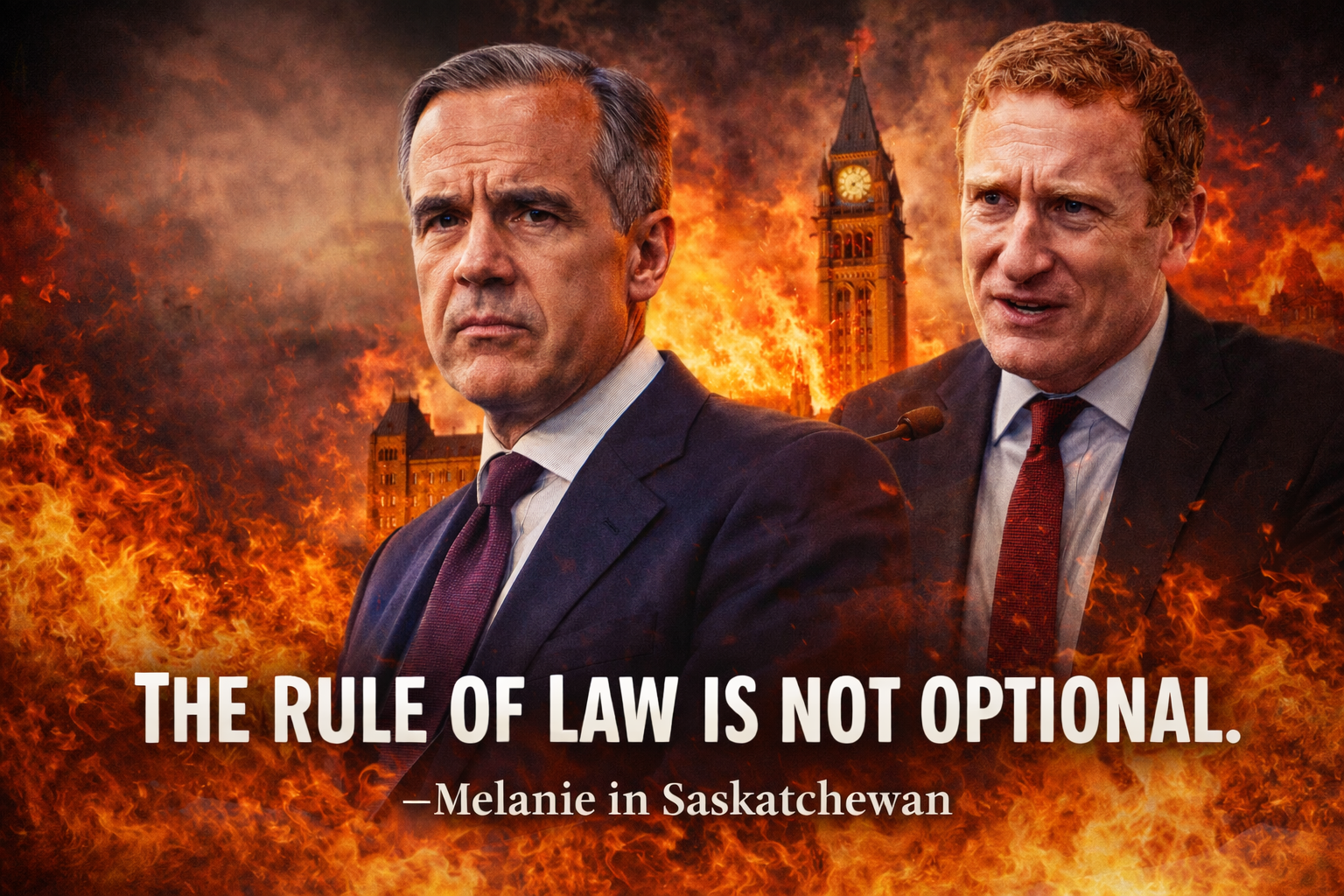
The rule of law is not optional.
And Canadians did not vote for a system where compliance is mandatory for citizens but negotiable for the well connected.
Melanie in Saskatchewan