

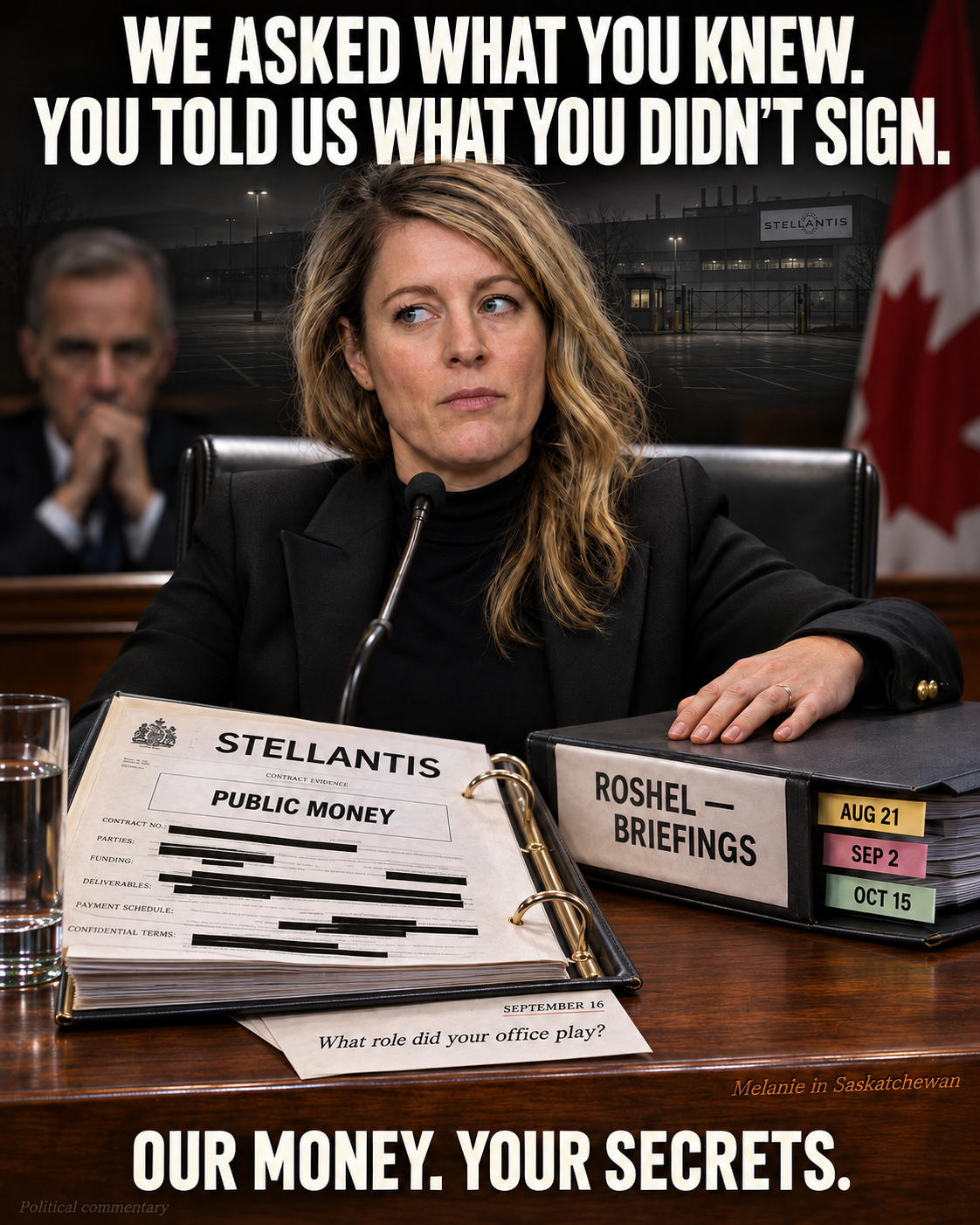
Her senior staff met Roshel repeatedly. We asked what she knew. Her office told us what she didn’t sign. Nobody asked rhat question.
 Just so I understand what Canadians are supposed to accept and believe here, indulge me a few moments to cover what we’ve been told.
Mélanie Joly’s senior staff had repeated contacts with Roshel before the announced purchase of Stellantis’s Brampton plant. Carney acknowledged he had advance knowledge of aspects of the proposed sale. Then Joly’s office said she hadn’t negotiated the deal. Well, isn’t that wonderful! Now, how about answering the question that was asked: what did she KNOW?
Her spokesperson said: “The minister had no part in negotiating with Stellantis or Roshel on the deal.” That only tells us what she didn’t do at the negotiating table. It does not tell us what reached her desk. If I ask whether you knew the roof was leaking, telling me you didn’t install the shingles doesn’t answer the question. That denial took some work! Imagine putting that much effort into answering taxpayers instead of insulting their intelligence.
This wasn’t just one staffer having one passing conversation either! The federal lobbying registry records an August 21 meeting involving Roshel’s representative and four people in Joly’s office: then-chief of staff Paul Moen, policy director David McFarlane, senior policy adviser Yasmin Atassi and investment adviser Rene Sylvestre.
On September 2, Moen, McFarlane and Atassi appear again, alongside Brian Botting, responsible for defence industrial strategy. Moen and McFarlane appear in another recorded communication on October 15.
Multiple contacts. Multiple senior staff. Over several months. The registry doesn’t give us the full conversation. That is precisely why Canadians need the meeting notes and briefing records.
But there is another document that makes the question much harder for the Liberals to dodge.
On September 16, Unifor president Lana Payne wrote directly to Joly about the proposed Stellantis–Roshel sale. She asked what role Ottawa had played, whether Roshel’s meetings with ministry staff included discussion of buying the plant, and whether government representatives had supported the proposal. That question about Ottawa’s role niggled away at me at the time. Why was the union asking that? It didn’t quite fit the story Canadians were hearing.
Now, we know senior staff in Joly’s office had met with Roshel repeatedly, and Carney has acknowledged prior knowledge about aspects of the proposed sale. Suddenly, the union’s question about government involvement makes a lot more sense. What had they picked up on that the rest of us hadn’t?
That was September. The sale announcement came in November. The union had already put the questions in writing. Joly’s office can’t just brush them aside as something an irritating opposition dreamed up afterward. And yes, the timing makes me wonder about the by-elections.
Imagine the sales pitch: workers face losing their jobs, the government announces it has helped secure a future for the plant, and Liberal candidates head out knocking on doors. “We’ve got your backs.” Convenient backdrop for a campaign, isn’t it? That is a scenario I’d like to see investigated.
Though it’s not evidence that Carney and Joly timed the sale around the US midterms, I wouldn’t be surprised in the least if their offices discussed using a possible deal as a by-election announcement. Its easy to prove me wrong. Publish the timeline and the communications. If workers’ livelihoods became campaign material, Canadians deserve to know. Anyway, back to the questions the union actually put in writing.
So when was Joly briefed? What was she told? What did her office do with that letter? Where is the response? If her staff briefed her, publish the timeline and explain her instructions. If they failed to brief her, identify where that failure happened and who is being held accountable. Either way, “she didn’t negotiate it” is not the answer.
A minister doesn’t need to sign a company’s sale agreement to be responsible for managing the government’s response. Otherwise, ministerial accountability would consist of keeping your pen in your handbag.
Carney’s confirmation of some prior knowledge makes the briefing question more pressing. What did his office know? What did hers know? What was shared between them? A government can know about a proposal without approving it, but that still leaves its conduct to be examined.
Before the sale announcement, what specific action did Ottawa take to preserve vehicle production and secure enforceable protections for the existing workforce? Not the promises in the original funding announcement. What did officials do after receiving warnings about THIS proposed sale? Written objections? Enforcement notices? Deadlines? Negotiated job guarantees? Show the dates and the results, because standing at a podium looking furious afterward is not credible evidence of diligence beforehand.
This is where I keep thinking about something I learned studying Law and Security: write everything down. Dates. Times. A record someone can check. We put body cameras on police for accountability. Maybe ministers should wear them while conducting government business. Government cams. Surely accountability can survive the trip up Parliament Hill. Footage could upload automatically to a secure cloud system ministers and their staff cannot access, edit or delete. Leave access restricted to CSIS under a new law. We’re supposed to trust them with national security. Perhaps they could help preserve the national memory too. It seems to fail whenever somebody asks a minister a question.
A running record of public business, with private lives kept out of it: who attended, what was discussed, what advice was given and what decision followed. Then Canadians could ask for a timeline built from records instead of whatever survived the minister’s recollection:
• Aug. 21: meeting held. What was discussed?
• Sept. 2: another meeting. What was discussed this time?
• Sept. 16: union warning received. Who acted on it?
• Minister briefed: when?
• Instructions issued: what were they?
These are basic questions. They shouldn’t require an archaeological dig. A timeline with no interpretive dance required. Truth matters if the government expects trust. A record written at the time is worth rather more than a polished recollection delivered once the questions become uncomfortable.
Then there’s the whole saga of Joly’s account of reading the contract. This isn’t the first time Canadians have had to ask how familiar Joly was with the agreements she was defending. After her deputy’s November 25, 2025 committee testimony, Blacklock’s Reporter ran the headline “Minister Never Read Contract.”
Joly disputed the claim and later told a committee she read the contract around the October warning that Jeep Compass production was moving to the United States. So... when did she first examine the job protections she was responsible for enforcing? Before the warning, or because of it?
Now, Joly says Stellantis could owe hundreds of millions of dollars. Stellantis has offered to return $24 million connected to Brampton’s retooling. “Documents are clear, contracts also are clear,” Joly says.
Excellent! Then show Canadians the clauses and the calculation supporting the government’s figure. One side says $24 million. The other points to hundreds of millions. At that distance, “clear” needs to show its sums.
During last year’s parliamentary fight over the agreement, officials cited commercial confidentiality. The committee eventually obtained the unredacted document under safeguards. But that did not give the Canadians who paid for everything unrestricted access to the complete deal.
Departmental briefing material also acknowledged that officials initially hadn’t asked Stellantis whether it would agree to provide an unredacted version. They blacked things out before asking whether the company would agree to show the whole document. Yet for some irresponsible reason, our money required considerably less privacy on its way out.
If the contract supports Joly’s position, explaining the relevant terms publicly would help Canadians hold Stellantis accountable too. Plus it would lend cover to her evaporated credibility. Show the employment promises. Show the exceptions. Show the repayment rules. Explain which obligations were broken and how the amount owing is calculated. Protect a genuine manufacturing secret where necessary, but don’t make Canadians guess what protection their money bought, if any.
“Trust us, the contract is strong” has reached the end of its useful life. Whatever strength it has should be visible in the results and explainable in plain English.
And a threat to recover funding does not answer what happens to the workers.
Does someone hired by Roshel keep their seniority? Their wage? Their benefits? What happens to pension arrangements? Are people approaching retirement expected to apply as new employees?
Those are the livelihoods the minister says she is protecting. Recovering money for taxpayers and restoring jobs are separate outcomes. A lawsuit might recover money, but has anyone asked it to cover a shift?
As of November 14, the evidence Canadians have is: repeated senior-staff contacts, a September letter warning Joly directly about the proposed sale, Carney’s acknowledgment of some advance knowledge, a denial about Joly negotiating the transaction, and competing repayment claims. What is missing is a complete public account connecting those pieces.
Who briefed whom? What did the minister know? What action followed? What did it achieve? Which promises to workers and taxpayers can actually be enforced? The record may yet establish who made a false or misleading statement. Right now, it establishes why the government owes Canadians considerably more than the denial it supplied.
And that brings us to a rule Parliament should legislate...
Any corporation accepting a major taxpayer-funded bailout or subsidy should have to accept publication of the financial terms, promised public benefits, exceptions and repayment rules. Any narrow exception should require a specific, public justification.
If a company wants taxpayers to share its risk, taxpayers get to inspect the bargain. Our wallets are not commercially confidential. Somehow, Ottawa always manages to find them. And a minister responsible for that bargain should not get to hide behind an answer to a different question.
Joly’s job is to understand the file, act on warnings, protect the public interest and give Canadians an account they can check.
To date we have multiple meetings... Joly’s senior staff... a written warning from the union... public funding at stake... Taxpayers deserve something better than an answer to a different question no one asked. Canadians still struggle to extract a clear account of her handling of it, which makes her public image the epitome of incompetence. That is the ministerial performance I am judging, and it falls way short.
Joly should resign as industry minister. If she won’t, Carney should remove her from cabinet. There are seats on the back benches in need of warming. Let someone competent handle the contracts. Taxpayers should be outraged.
Melanie in Saskatchewan