

When Ancestry Enters the Courtroom, Equality Leaves Through the Side Door
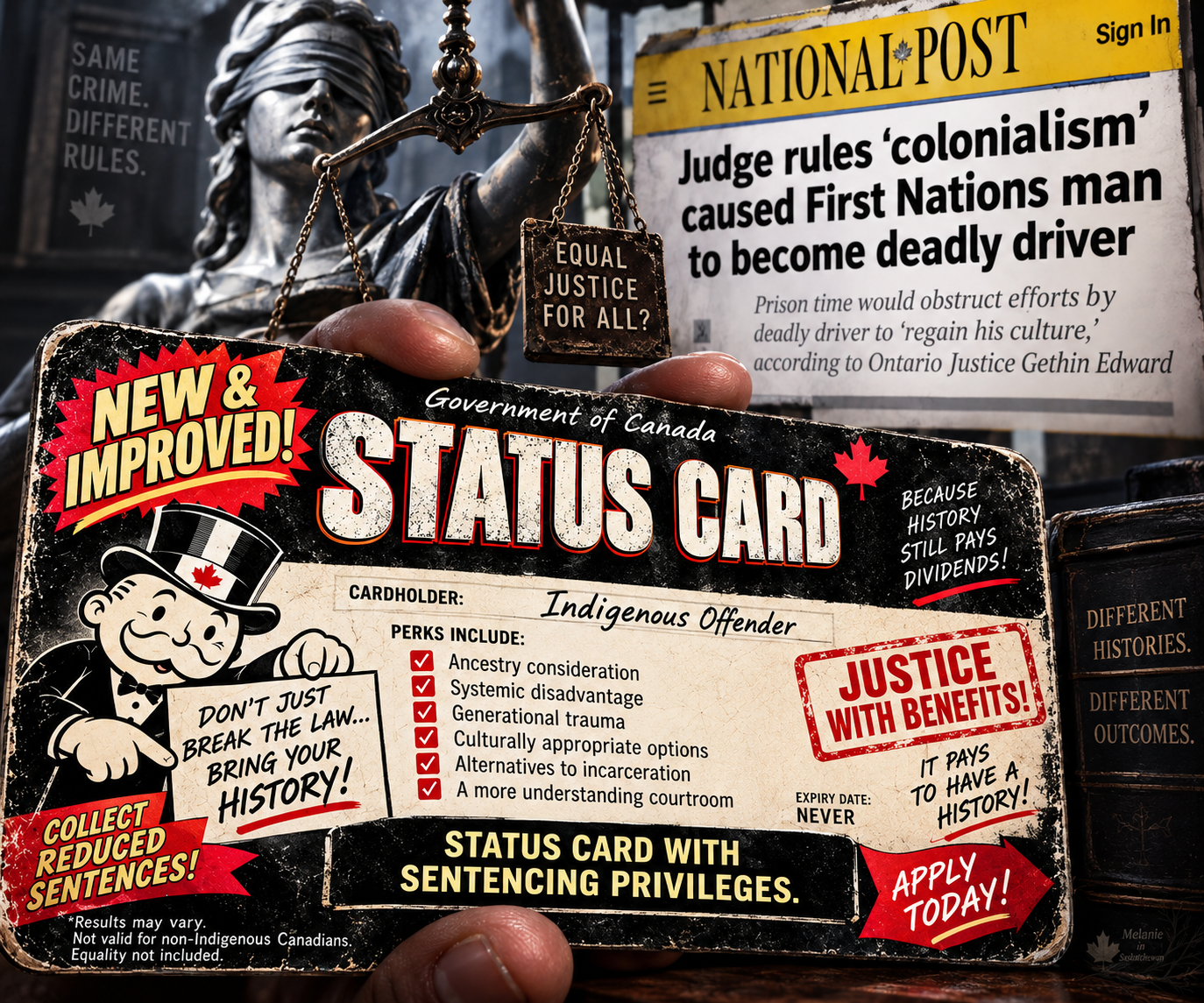 A twelve-year-old girl is dead. Her mother survived with a catastrophic brain injury that will affect her for the rest of her life. The Crown wanted the man responsible sent to prison for four years.
He got house arrest.
Welcome to Canadian justice, where apparently even killing a child now requires us to check the offender's ancestry before deciding exactly how responsible he ought to be.
Sierra Beverly was twelve years old when she and her mother Naomi were hit by Darris James Wilson on February 11, 2022. Wilson crossed the centre line and slammed into their vehicle. Sierra died. Naomi survived, but with a catastrophic brain injury requiring continuing care.
Wilson was 27 at the time. Police originally charged him with five offences, including impaired operation, operating with a blood-alcohol concentration over 80, dangerous operation causing death and dangerous operation causing bodily harm.
This wasn't somebody accidentally rolling through a stop sign.
Evidence described at sentencing had Wilson travelling roughly 90 km/h in a 50 zone. Beer cans were found in his truck. There was apparently no evidence he even braked before impact.
So, naturally, we need to talk about colonialism. I really do wish I were being facetious.
Can trauma affect later generations? It can, but let's be precise about what that means. Children can grow up with the consequences of a parent's trauma. Abuse can be repeated. Addiction can wreck families. Poverty and dysfunction can persist. Stories and grievances can certainly be passed down too. But none of that establishes that something experienced by an ancestor materially affected the choices made by a particular adult decades later.
And there's another problem. Addiction, abuse, poverty and dysfunctional families aren't Indigenous phenomena. Human misery has always been stubbornly multicultural. Canadians of every race and ancestry can grow up surrounded by alcoholism, violence, poverty, neglect and generational dysfunction.
So if those circumstances diminish individual responsibility, consider them wherever they actually exist. But then why should ancestry determine who gets a specialized sentencing framework for them?
If Wilson's parents or grandparents attended residential school, that fact alone still doesn't tell me how their experience caused or contributed to Wilson's decisions on February 11, 2022. There is a human being and a chain of individual choices between those two things.
Show me the chain.
Because “this happened to you” and “this happened to somebody before you were born” are not the same thing, not even close!
So here is where I part company with the Supreme Court:
In Ipeelee, the Court expressly rejected the idea that an Indigenous offender should have to establish a direct causal connection between those historical factors and the offence.
Read that again, because it's doing an astonishing amount of work...
We're saying colonialism and residential schools can matter enough to affect an individual's sentence, but asking how they actually affected that individual or contributed to the crime is apparently a bridge too far.
Why?
If Wilson's childhood, poverty, addiction, abuse or some identifiable consequence of intergenerational trauma affected his judgment or degree of responsibility, put it before the court. That's evidence about Wilson. But if you don't have to establish the connection, what exactly are we measuring?
At some point, we've stopped assessing the circumstances of the person standing in the courtroom and started assigning legal significance to the history attached to his ancestry. That's not a minor distinction. It's the entire bloody argument.
If history is going to help reduce the punishment imposed on one person for killing another, show how that history materially affected him. Otherwise, we're not individualizing justice, we're categorizing it.
And then... I looked at the judge as more information came out causing me to have to redraft this piece just to be current.
Judge Edward isn't simply a judge who happened to hear Wilson's case. He is himself a Mohawk member of Six Nations of the Grand River.
Yes. The same First Nation.
I checked for evidence that Judge Edward and Wilson are related or personally connected. I couldn't find any. So I'm not going to pretend there is, and I'm moving on, because what we do know is interesting enough.
Wilson's colonial history, intergenerational trauma and cultural disconnection become important considerations at sentencing. The Crown asks for four years in prison. Judge Edward gives him two years of house arrest. He can leave for work, school, medical appointments and other approved activities like funerals.
And to be curious about this entire scene is now prejudicial. Because there's something else bothering me about this case.
Wilson was originally charged with impaired operation and operating with a blood-alcohol concentration over 80. Yet those aren't the offences we're now talking about at sentencing. Where did they go? Maybe there's a perfectly legitimate explanation. If so, let's have it then.
Because none of the historical explanations being discussed put alcohol in Wilson's truck. None put his keys in the ignition. None pressed the accelerator to roughly 90 km/h in a 50 zone or carried his truck across the centre line.
Darris Wilson made choices.
And somewhere between those choices and the final sentence, the original alcohol charges disappeared from the convictions we're now seeing reported. There may be a perfectly legitimate legal explanation for that. I haven't found one reported.
That's all that needs saying about it for now.
What bothers me more is the bizarre imbalance in curiosity. We're apparently prepared to reach back generations to explain Wilson's behaviour, but finding out what happened to charges arising directly from the crash that killed Sierra seems considerably less urgent. Then we discover that the judge who gave Wilson house arrest is himself from Six Nations.
Does any of that prove favouritism or a conflict? No. Does it raise questions that should have been asked before everyone packed up the courtroom and congratulated themselves on nuanced justice?
Hell yes.
Maybe every piece of this has a perfectly ordinary explanation. Wonderful! Then explaining it shouldn't be terribly difficult.
And this is where the whole thing starts to stink.
We have become so accustomed to explaining unequal treatment with compassionate language that we've apparently forgotten to ask the embarrassingly basic question underneath it: would another Canadian standing in that courtroom with the same conduct, the same victim and the same consequences be entitled to have their ancestry weighed the same way?
If the answer is no, then stop telling me everyone is equal before the law and call it what it really is.
Canada has deliberately created a sentencing system in which ancestry can change what a judge is required to consider. We can decorate that distinction with legal terminology, historical context and several hundred pages of Supreme Court reasoning, but the distinction remains.
And that's where the hypocrisy becomes impossible to ignore.
We're repeatedly told that judging Canadians differently because of their ancestry is wrong. Fair enough. That's a principle I can get behind without needing a government pamphlet and a commemorative land acknowledgement.
Then we walk into a courtroom and suddenly ancestry is not only relevant, it's something Parliament specifically instructed judges to give particular attention to. Apparently discrimination becomes enlightened once you put it in the Criminal Code.
I don't want harsher justice for Indigenous Canadians... I want the same justice for every Canadian!
If poverty matters, consider poverty. If abuse matters, consider abuse. If addiction matters, consider addiction. If childhood trauma materially affected someone's culpability, put it before the court.
For everyone.
Because justice isn't equal when one person's circumstances have to stand on their own evidence while another person's circumstances arrive with an ancestral footnote supplied by statute. That's not equality with nuance. That's two-tiered justice insisting the tiers are a feature.
And after all the legal language, historical analysis and carefully upholstered explanations, we're still left with one brutally simple fact...
Sierra Beverly was twelve years old.
Whatever history Wilson "inherited," Sierra didn't create it. She didn't run a residential school. She didn't design colonial policy. She didn't disconnect Wilson from his culture. She didn’t make him drink and drive either. She was a child riding in a vehicle with her mother when Wilson crossed the centre line.
Naomi Beverly didn't experience her injuries as a systemic issue either. She lives with them every day. And there doesn't appear to be any end in sight for her.
That's the part that gets buried when justice becomes preoccupied with explaining the offender. We can spend pages examining everything that may have happened to Wilson, his family, his community and generations before he was born, while the people who absorbed the actual consequences of his choices become supporting characters in their own tragedy.
And somehow, we're supposed to call that compassion?! Oh please! That's quite the moral achievement. Centre the man who caused the devastation, push the people living with it toward the margins, then congratulate ourselves for being enlightened.
No. Compassion that requires us to squint past the victim isn't compassion. It's selective vision dressed up as virtue, a classic new-age liberal trait to be sure. Maybe that's what bothers me most about this entire case.
I don't object to understanding why people do terrible things. I object when understanding quietly begins replacing accountability.
Wilson deserved to have his individual circumstances considered. So does every Canadian who stands before a court. Poverty, abuse, addiction, disability, childhood trauma, coercion, cognitive impairment... whatever genuinely affected the person and genuinely bears on their responsibility, consider it.
But prove the relevance, don't hand me somebody's ancestry and expect me to fill in the causal blanks myself.
And don't tell me justice is colour-blind while maintaining a sentencing framework that specifically instructs judges to look at ancestry. That's not merely contradictory. That's institutional hypocrisy delivered with a perfectly straight face.
A twelve-year-old girl is dead. Her mother is permanently injured. The original alcohol charges still deserve an explanation. The judge who imposed house arrest is from the same First Nation as the offender. None of that proves corruption or favouritism, but every bit of it deserves scrutiny.
Instead, we're being asked to admire the nuance. I don't. Justice shouldn't need an ancestry chart to decide how much a dead child weighs.
And if two Canadians can arrive before the same court for the same conduct, but the law requires the judge to consider one differently because of ancestry, spare me the lecture about equality.
That's not equal justice. That's a status card with sentencing privileges. Where is Sierra's reconciliation?
Melanie in Saskatchewan