

Carney’s agenda predates Trump. The crisis gave him the cover he needed to put it into motion.
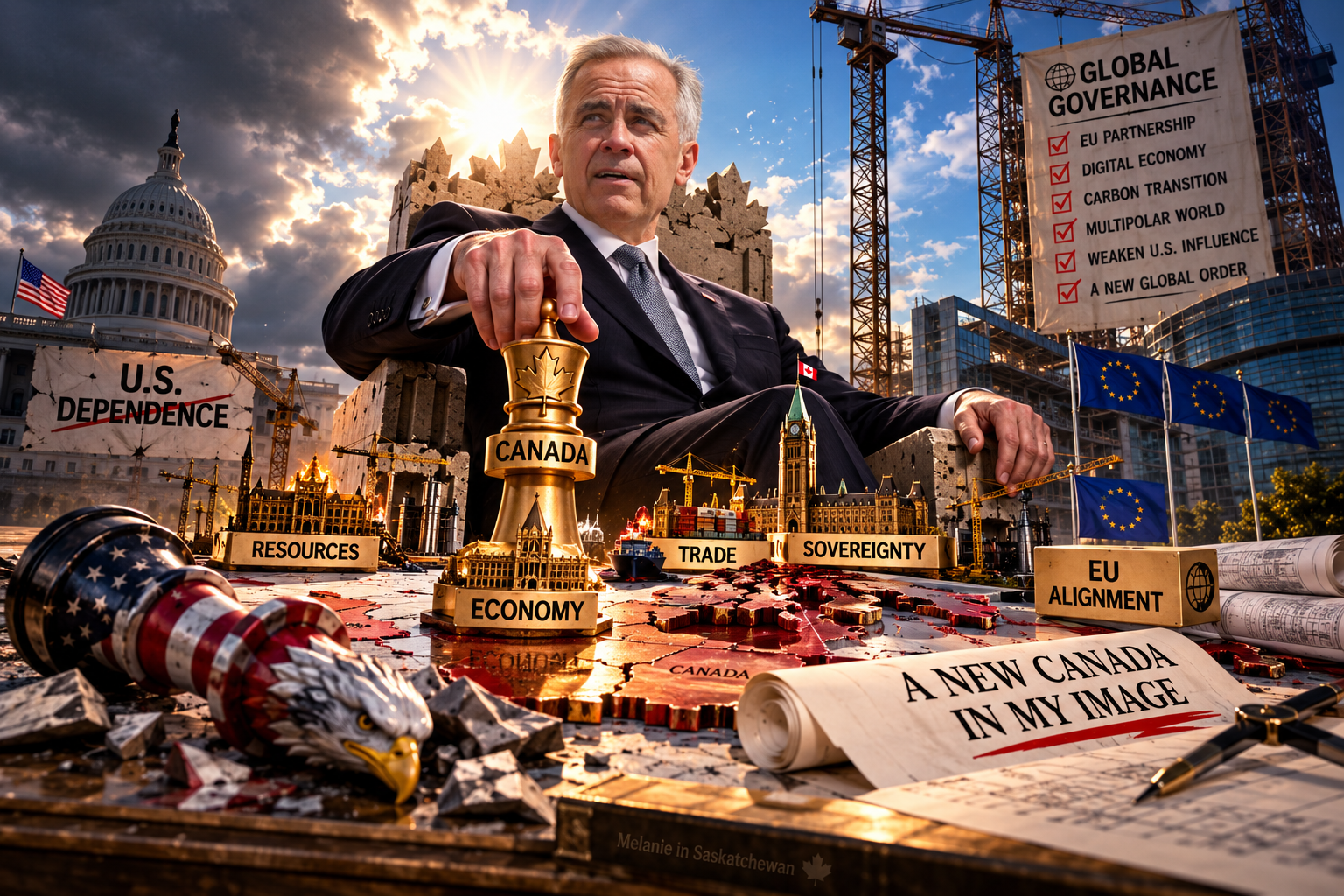 I’m starting to think Mark Carney has a passionate, personal hatred of America.
And I don’t mean Donald Trump. Plenty of people hate Donald Trump. I mean America itself, or at least the enormous role America has played in Canada’s economy for generations. Because the longer I listen to Carney talk about where he wants Canada to go, the more I wonder whether Trump caused this economic divorce at all... or whether he was simply the spectacular act of infidelity Carney needed to finally file the papers.
Maybe hate is too strong. Maybe geopolitical jealousy has stages too: irritation, resentment, righteous indignation and finally whatever stage comes after, “I’d love to go out sometime, but unfortunately I’ll be washing my hair indefinitely.” Whatever stage Carney has reached, I’m increasingly convinced this is about considerably more than Donald Trump.
Because we can document Carney publicly talking about a changing world order more than fifteen years ago. How long he had been developing those ideas before putting them into speeches, I have no idea. We don’t need to invent an origin story. The public record is interesting enough.
I can’t prove Carney hates America. Maybe he loves it. Maybe there’s a Louisville Slugger sticking out of a Davos swag bag somewhere between six conference lanyards, a King Charles commemorative tea towel and a couple of those luxury Normandy butter cups that apparently require their own travel arrangements. But if Mark Carney loves America, somebody should probably tell America the relationship is still on.
He certainly never seemed troubled by American money. His disclosed investments included hundreds of companies, many of them American. And I don’t begrudge him that. If American companies offered a good return, invest away. What makes it interesting is that while his money was quite comfortable in America, Carney had already spent years publicly describing a world becoming considerably less centred on American economic power. Donald Trump didn’t inspire that. He came crashing through the front door years later, apparently oblivious to the fact that Carney had already furnished the room.
Canadians have since been handed a wonderfully tidy explanation for everything happening now. Trump returned. Trump threatened tariffs. Trump called Canada the 51st state. Trump made governor jokes. CBC, our publicly funded national broadcaster, and a Canadian media industry operating alongside various government support programs amplified every provocation until everybody knew exactly which Trumpism could send Canada through the ceiling.
He said “51st state.” Canada erupted, so he said it again. Trump noticed. The media noticed. And I have a very hard time believing Liberal strategists somehow failed to notice the political value of an issue resonating that powerfully with Canadians.
But heaven forbid an opposition MP or ordinary Canadian asks to see where our money went. Suddenly negotiations, contracts and records disappear behind confidentiality, redactions and “national security.” Apparently telling Canadians what our own government is doing requires security clearance, but advertising precisely which Trump taunts are working required something closer to a neon sign: YES, DONALD. RIGHT THERE. THAT BUTTON!
Why not circle the red button, write DO NOT PRESS across it and explain exactly what happens when he does? Because if humanity has established anything about a big red button labelled DO NOT PRESS, it’s that nobody has ever wanted to press that bastard more.
There’s something particularly rich about watching the same political culture that normally preaches restraint, diplomacy and refusing to take the bait suddenly marching around with its elbows in the air and staging what amounts to a self-imposed prohibition against American booze. Only Canada could revive Prohibition in the 21st century and somehow convince ourselves the Americans were the ones being punished.
In 2011, as governor of the Bank of Canada, Carney delivered a speech called Canada in a Multi-Polar World. He described the shift toward that multipolar world as “fundamentally positive,” while acknowledging it would also be disruptive. Then in 2019, running the Bank of England, he went further. Carney questioned the international system’s dependence on the U.S. dollar and proposed considering a “Synthetic Hegemonic Currency” that could reduce the dollar’s influence over global trade and potentially displace some of its dominance in credit markets.
Because simply saying “something that makes everybody less dependent on the American dollar” was evidently rejected for insufficient syllables, but I digress. Just remember the dates: 2011. 2019.
No 51st-state taunts. No elbows-up campaign. No current Canadian tariff war forcing Mark Carney to suddenly discover the virtues of a world less centred on American economic power. He was already talking about it. And very publicly. Hell, the guy wrote a book.
By 2020, Carney was advising Trudeau on Canada’s economic recovery while moving into Brookfield to lead ESG and impact investing. He was also the UN Special Envoy for Climate Action and Finance. By 2024, Trudeau had made him chair of the Liberal Task Force on Economic Growth.
Central banking, climate finance, ESG investing, and Liberal economic policy. Different institutions, remarkably familiar ideas. People tend to build careers around the things they believe in, and Carney repeatedly chose positions that put him closer to the institutions, money and policy machinery capable of advancing his.
He wasn’t exactly a stranger to the international networking circuit either. Carney was sitting on the World Economic Forum’s Board of Trustees alongside Klaus Schwab by 2015. Two years later, Schwab rather infamously boasted at Harvard that the WEF had “penetrated the cabinets,” specifically pointing to Trudeau’s government and its Young Global Leaders.
Does that prove Klaus Schwab drew Mark Carney’s master plan on the back of a cocktail napkin in Davos? No. But at some point I’m allowed to notice who keeps showing up in the room.
Then came 2025. Trump was back, tariffs and sovereignty threats dominated Canadian politics, and the former central banker who had spent years discussing global economic rebalancing suddenly had a résumé almost custom-built for the moment. Once Carney became prime minister, those ideas acquired something they had never possessed before: the machinery of the federal government to manifest his fever dream and birth it into the reality we are living now.
To be fair, Carney campaigned on diversifying trade away from the United States. His campaign promised $5 billion for a Trade Diversification Corridor Fund and explicitly talked about building a “new Canadian economy.”
But diversification means finding more customers. What we’re watching now looks considerably larger: changing who Canada trades with, where our money goes, which industries government chooses to build, and how dependent Canada should be on the United States in the first place. That’s not a side project. That’s rewiring the damn house while 41 million people are still living in it.
Carney is perfectly entitled to have a personal economic philosophy. What I don’t remember is Canadians agreeing that his particular philosophy would simply become Canada’s destination. Diversify trade? Absolutely. But fundamentally remake our economic relationship with the country beside us while rebuilding enormous pieces of our own economy around that change at an enormously steep expense that is not even close to sustainable? I feel like that deserved considerably more than the brochure.
These aren’t academic questions for a graduate seminar where everyone gets a nice folder and somebody orders sandwiches at noon. This is jobs, factories, investment, pensions, housing, tax revenue and whether our kids can build successful lives here. If we’re pulling at that foundation, “trust me, I’m Mark Carney” isn’t enough. I feel like there should at least be a pamphlet. Not the little one-page kind either. One of those tri-fold bastards you have to open twice and turn over.
There is, however, one Carney word capable of making everything sound considerably more sophisticated: catalyze... sometimes with a capital "C."
Investment gets catalyzed. Capital gets catalyzed. Projects get catalyzed. Canada apparently spent 159 years suffering from an undiagnosed catalytic deficiency until Dr. Carney finally delivered the grim news: “I’m sorry, Canada. The tests are back. You’re dangerously under-catalyzed. Fortunately, I specialize in this. Thankfully I caught it just in time!"
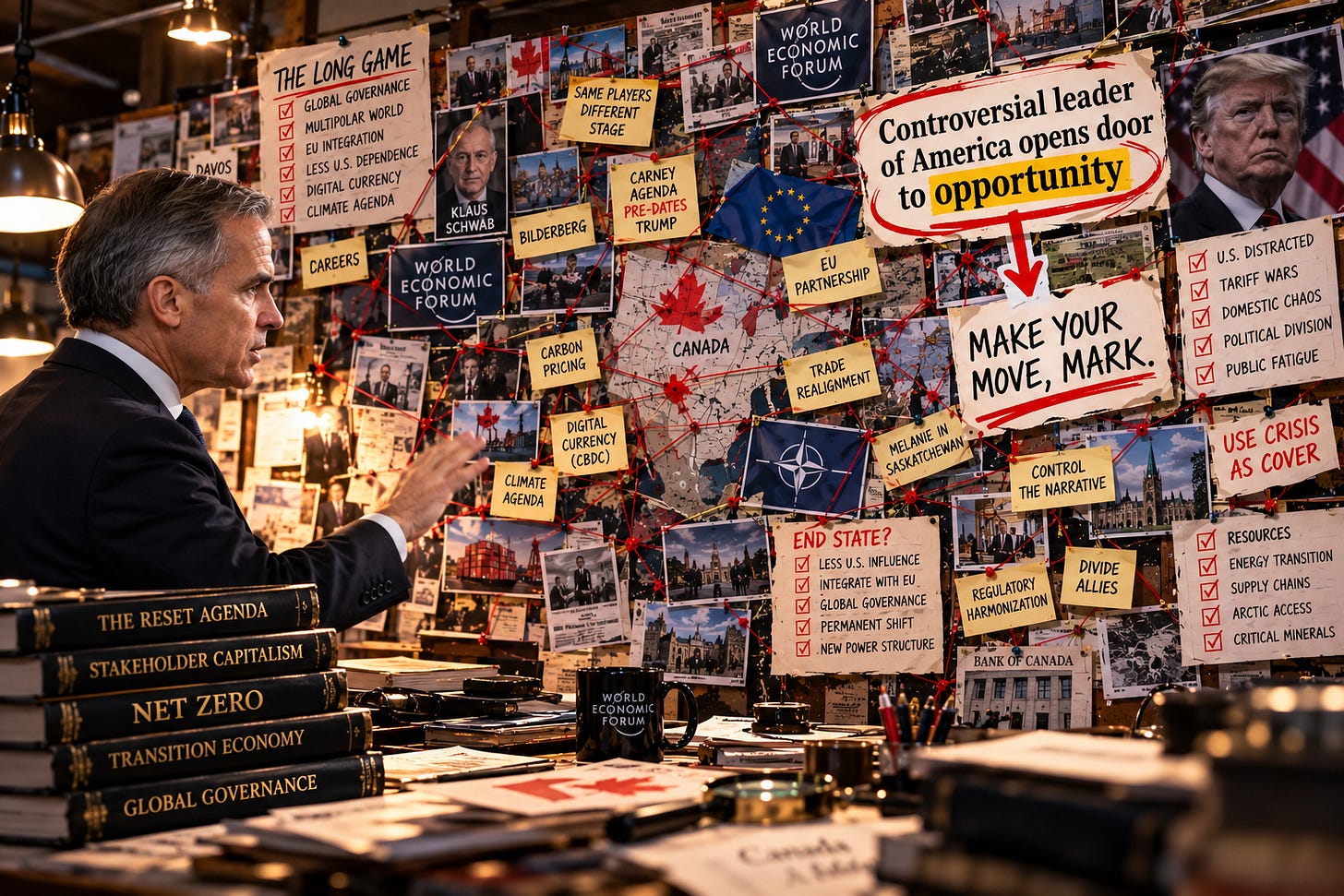 And then along came perhaps the greatest catalyst Mark Carney could have asked for: Donald Trump. Not because Trump knowingly handed him anything. Quite the opposite. Trump bulldozed into Canada with tariffs, threats and 51st-state taunts, apparently oblivious to the fact that he was creating precisely the kind of crisis capable of catalyzing ideas Carney had been publicly discussing for years.
Carney’s government now uses that very word while promising to “catalyse” $1 trillion in new investment. I’m not even stealing his material anymore. He’s leaving it unattended.
Trump is temporary. America isn’t.
The border isn’t moving when he leaves. Neither are the pipelines, railways, factories, supply chains or hundreds of millions of customers living beside us. You can stop speaking to your neighbour and build the tallest fence Canadian Tire sells, but when you take the garbage out Tuesday morning, there he bloody well is.
And this is where diversification and transformation become two very different things. Finding additional customers while protecting the biggest customer you already have is diversification. Burning the bridge behind you is something else entirely, particularly when the economic wreckage from burning it starts taking out the suppliers, workers, investment and businesses you’re going to need to build whatever comes next. It’s rather difficult to build a replacement bridge after you’ve accidentally set fire to the lumberyard.
I don’t merely suspect Carney thinks a less American-centred economic world is coming. He was publicly describing that shift as “fundamentally positive” fifteen years ago. What I increasingly suspect is that he wants Canada helping push that shift along, and now occupies the one office capable of moving an entire country in that direction.
None of this proves some grand secret plan, but Carney has accumulated enough remarkably convenient intersections between his ideas, his career and the circumstances that eventually put him in power that the vast space I had already allotted specifically for coincidences is officially full.
Unfortunately, storage units are at a premium, so we’re going to have to start stacking the coincidence bastards in the hallway. You don’t need to prove a conspiracy to notice a pattern. The public record establishes something considerably more important anyway: Trump didn’t create Carney’s destination, Trump became the catalyst.
I don’t believe Carney anticipated this particular crisis. What bothers me is how extraordinarily well his career appears to have prepared him for a moment remarkably like it, almost down to the damn specifications. The speeches were there. The philosophy was there. The international relationships were there. Then came a crisis capable of making a dramatic Canadian economic realignment politically saleable, and Carney arrived astonishingly prepared for it.
That’s why I have never regarded what we’re watching as Mark Carney simply improvising an emergency response to Donald Trump. The chronology runs the wrong way. Carney’s direction came first. The crisis came later... Chicken, meet egg.
Before becoming prime minister, he could advocate, advise, invest and influence. Now he possesses something fundamentally different: the authority of the federal government to actually execute it.
Trump will leave. America won’t. What concerns me is what remains after he’s gone. Because beneath the tariffs, elbows-up nationalism and endless warnings about Donald Trump, Canada appears to be undergoing something considerably larger than trade diversification. We get one announcement, one fund and one project at a time, but rarely the whole plan laid out in front of Canadians at once. Maybe Canadians would choose it. Maybe they wouldn’t. Hard to tell when nobody bothers to ask us.
And if the grand project is really this brilliant, why the hell are we seeing it in pieces? Show us where Canada is supposed to end up. Show us what it costs. Show us what gets sacrificed along the way. Lay out the steps beforehand, so when something painful happens Canadians aren’t handed another slogan and expected to figure out later how it fit into the plan.
Instead, we’re going to Build Canada Strong, become our own best customer, catalyze a trillion dollars and build big, build fast, build bold, all at the promised scale and speed of the new Carney era.
There certainly seems to be one hell of a hurry to build Mark Carney’s new Canada. You’d think before running up the tab, somebody might show the people paying the bill what the hell they ordered.
Melanie in Saskatchewan