

Before Prime Minister Carney, There Was Chairman Carney. Now a $50-Billion Maple Fund Born on His Watch at Brookfield Has Just Resurfaced in Canada.
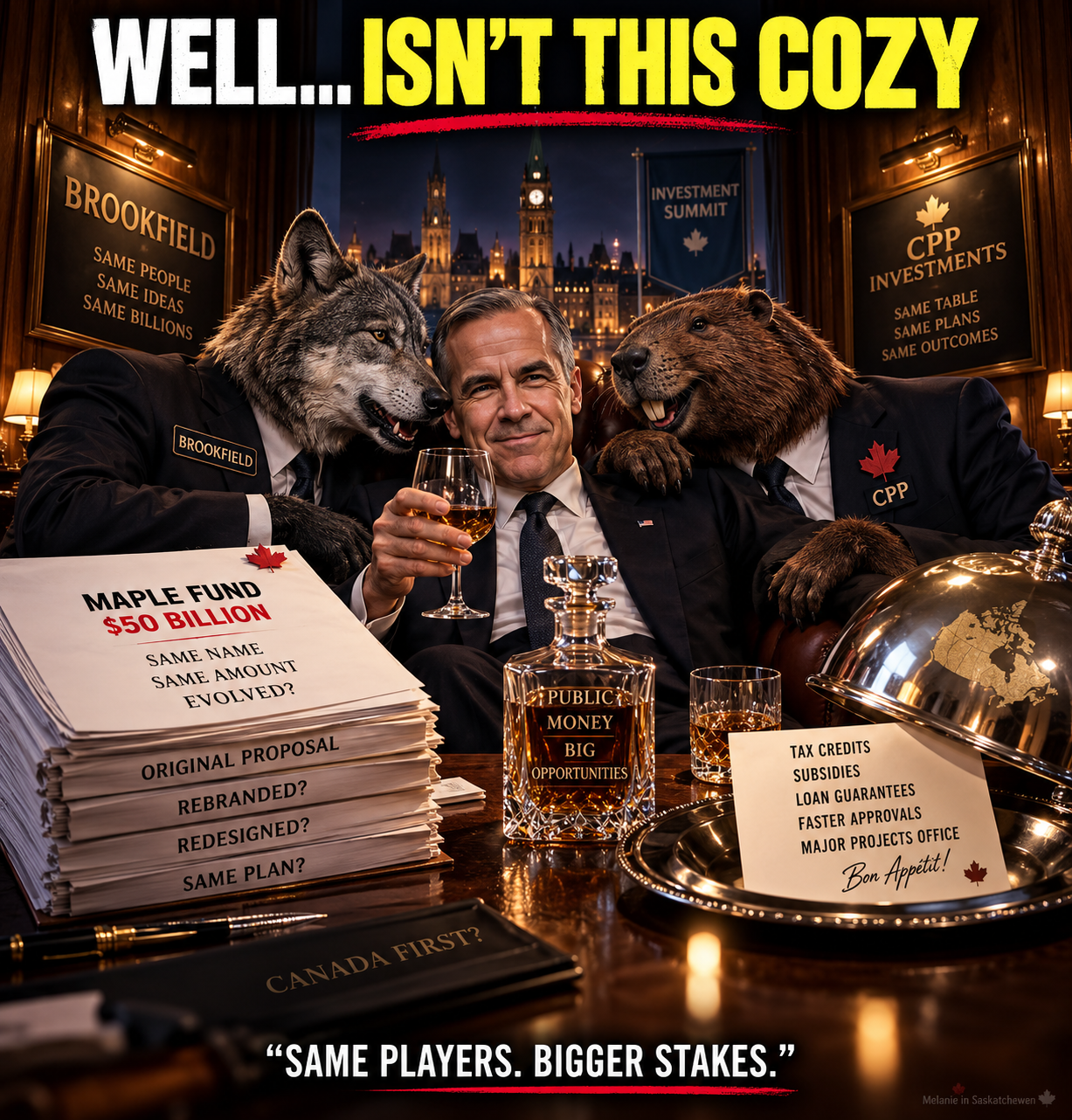 Brookfield and CPP Investments have just announced a $50-billion 'Maple Fund' to invest in major Canadian infrastructure and industries Ottawa considers strategically important. On its face, to the general public devoid of information, that’s terrific news. Canada desperately needs investment.
There is just one rather inconvenient detail. Brookfield already came up with a $50-billion Maple Fund two years ago, while Mark Carney was chairman of Brookfield.
👉🏻 Same name.
👉🏻 Same $50-billion price tag.
👉🏻 Same basic purpose of pouring huge amounts of institutional pension money into Canadian assets and infrastructure.
What an extraordinary coincidence... NOT! Apparently even investment funds experience reincarnation... who knew! 😮
The original 2024 Brookfield proposal was fairly straightforward. Brookfield would put in about $4 billion, Canadian pension funds would be asked for roughly $36 billion, and Ottawa would contribute another $10 billion. Brookfield would administer the fund. The money could go into everything from housing and data centres to nuclear energy and telecommunications.
At the time, this was already politically awkward.
Carney was still chairman of Brookfield and had also become an economic adviser to Justin Trudeau's Liberals. Contemporary reporting specifically raised concerns about the optics and possible conflict surrounding Brookfield's proposal.
The proposal didn't happen then. But don't worry. Apparently good ideas at Brookfield have excellent shelf lives.
Fast-forward to September 2026. Mark Carney is no longer advising the government from somewhere conveniently adjacent to Brookfield. He is the government.
He's Prime Minister, and his government is holding the Canada Investment Summit in Toronto, bringing together hundreds of executives and investors to pour money into Canadian energy, mining, technology and infrastructure projects. Carney wants to attract $1 trillion in investment over five years.
The Canada Investment Summit isn't some unrelated conference Carney happens to be wandering around with a name tag and a canapé. CPP Investments and PSP Investments are helping the federal government host the thing. CPP Investments is therefore sitting right beside Carney's government at the centre of this enormous exercise in attracting capital to Canadian projects.
And CPP Investments has just partnered with... Brookfield. Naturally. Because apparently this story was suffering from an unacceptable shortage of Brookfield. Better still, their shiny new investment vehicle is called the Maple Fund. Not Maple Fund 2.0. Not New Maple Fund. Not Definitely Not That Other Maple Fund. Just the Maple Fund.
And its value? $50 billion. Exactly the same headline number as the Maple Fund Brookfield was developing while Carney was its chairman. At this point, calling these things coincidences is beginning to place an unreasonable workload on the word coincidence.
At this point, “coincidence” is doing so much heavy lifting it should probably be eligible for a federal infrastructure grant:
• Same name
• Same $50 billion
• Same Brookfield
• Different chair for Carney
The new arrangement is not identical to the 2024 proposal, and that matters. This time, Brookfield and CPP Investments reportedly intend to commit up to $25 billion each over five years. Individual investments are expected to be enormous, at least $5 billion, with the two organizations generally taking equal stakes.
The original proposal for Ottawa to put $10 billion directly into the fund appears to be gone. Good. But changing the financing doesn't erase the rather inconvenient history.
Brookfield was developing a $50-billion Maple Fund while Carney was chairman. Now it's launching another $50-billion Maple Fund while Carney is Prime Minister. So how much actually changed? Was it rebuilt, or did somebody rearrange the financing, move a few commas around and call it new? Put the two proposals side by side and let Canadians decide.
That's not some wild-eyed conspiracy theory. The reporting itself describes today's agreement as following a two-year evolution of Brookfield's earlier proposal.
Well, then let's see the evolution.
Was Mark Carney involved in developing the original Maple Fund while he chaired Brookfield? Did it cross his desk? Did he discuss it, shape it or approve it? What exactly was his role? We don't know, which is rather remarkable considering the man who chaired the company developing it now runs the country where it has suddenly reappeared.
Perhaps somebody could clear that up. Preferably with documents instead of another reassuring speech about transparency. Since he was chairman of the company developing the thing, asking seems reasonably less insane than simply pretending the history doesn't exist.
Canadians also deserve to know what actually changed between Brookfield's original Maple Fund and this conveniently resurrected version. Was the investment strategy different? The governance? The industries it targets? Who redesigned it, when, and how much of Brookfield's original work was simply carried forward
Same name. Same $50 billion. Same Brookfield. "Trust us, it's different" isn't quite the detailed accounting Canadians should be getting.
Because if today's Maple Fund grew directly out of the one developed while Carney chaired Brookfield, that is rather important context when the former Brookfield chairman is now Prime Minister of Canada.
This becomes even more interesting because Carney has a formal conflict screen involving Brookfield.
That exists for a reason.
Carney didn't arrive in politics having once wandered past a Brookfield office and admired the shrubbery. He was its chairman. He had Brookfield-related compensation and financial interests. He spent years at the top of the organization.
A blind trust can separate Carney from the management of his financial assets. It cannot give him selective amnesia about the company he chaired. And that is precisely why the Brookfield conflict screen matters.
So here's a question the government should be able to answer without breaking into a nervous sweat:
Was the Maple Fund caught by Carney’s Brookfield conflict screen? If it was, show us how the screen worked. Who handled the matter instead of Carney? What information was kept from him? Which meetings did he leave? Which decisions did he stay out of? That's what a firewall is supposed to do. If you've actually built one, showing where the bricks are shouldn't cause a constitutional crisis.
Then we arrive at this week's investment summit. Carney is personally meeting major investors. Reuters reports that he's already held bilateral meetings with people including BlackRock CEO Larry Fink and Blackstone president Jon Gray. The entire purpose of this summit is to connect enormous pools of capital with Canadian projects.
Which leaves another remarkably simple question: Was Brookfield there? Was Brookfield Asset Management, Brookfield Corporation or any related entity represented at the summit, gala, receptions, meetings or associated events? And if so, did Carney meet with them, participate in discussions involving Brookfield, or hear anything about the Maple Fund?
If the answer is no, splendid. Publish the guest list and meeting records and kill the question. Nobody expects Carney to dive behind a potted fern whenever a Brookfield executive enters the country. But this isn't a wedding reception. It's his government's investment summit, and his former company just happens to be launching a $50-billion investment fund with one of its hosts.
It's an investment summit organized by his government, specifically designed to connect investors with Canadian projects. And one of its co-hosts has just partnered with Carney's former company to launch a $50-billion investment fund descended from a proposal developed while Carney chaired that company. Forgive me if "nothing to see here" doesn't quite satisfy the curiosity.
But the bigger issue isn't whether Ottawa writes the Maple Fund a cheque directly. It's what happens after the fund starts investing. If Brookfield and CPP Investments put billions into a Canadian mine, energy project, data centre or major infrastructure development, could that investment then benefit from federal tax credits, financing, loan guarantees, subsidies, grants, expedited approvals or support through the Major Projects Office
Because government doesn't have to hand Brookfield a giant cheque labelled “PLEASE ENJOY THIS MONEY" for government decisions to improve the value of a Brookfield investment that Carney will benefit from. That's exactly why conflict rules exist.
The problem isn't merely whether Carney personally makes money tomorrow afternoon. The question is whether someone who formerly chaired Brookfield is now in a position where federal policy, approvals, incentives and public money could benefit investments made by Brookfield, especially when Brookfield shows up waving the Maple Fund Carney oversaw in his Brookfield days.
Maybe Carney's firewall prevents every one of these conflicts. Excellent. Prove it. Publish the relevant conflict screen, Carney's recusals, his summit meetings and the complete guest list. Tell Canadians whether the Maple Fund was kept away from him and who handled it instead.
If the firewall is as sturdy as we're repeatedly assured, Ottawa shouldn't be treating the blueprints like nuclear launch codes.
And when the fund begins announcing investments, disclose every federal subsidy, incentive, guarantee, tax benefit and expedited approval attached to those projects.
Maybe everything here is perfectly legitimate. Maybe Carney had nothing to do with Brookfield's original Maple Fund, the new version was substantially rebuilt, his conflict screen worked flawlessly, and Brookfield was kept safely on the other side of it throughout the process.
Fantastic! Then Ottawa should be able to answer these questions before lunch without consulting seventeen lawyers and a communications strategist.
Brookfield developed a $50-billion Maple Fund while Mark Carney was its chairman. Two years later, Carney is Prime Minister, his government is hosting a massive investment summit with CPP Investments, and CPP Investments has partnered with Brookfield to launch a $50-billion Maple Fund described in reporting as an evolution of Brookfield's original proposal.
Apparently coincidence has now graduated from doing heavy lifting to managing the entire fricking project.
That isn't proof of corruption. It's something Ottawa should find considerably less comforting: a giant flashing sign screaming ASK SOME F♧CKING QUESTIONS. Because after all the convenient timing, recycled names, identical billions and Brookfield-shaped coincidences, one question refuses to go away: How much of Prime Minister Carney's Maple Fund is actually Chairman Carney's Maple Fund? And if the answer is none of it, wonderful.
Open the books and prove it.
- Melanie in Saskatchewan