

Mark Carney sat down with POLITICO and explained how well everything is coming along. It was all bullspit.
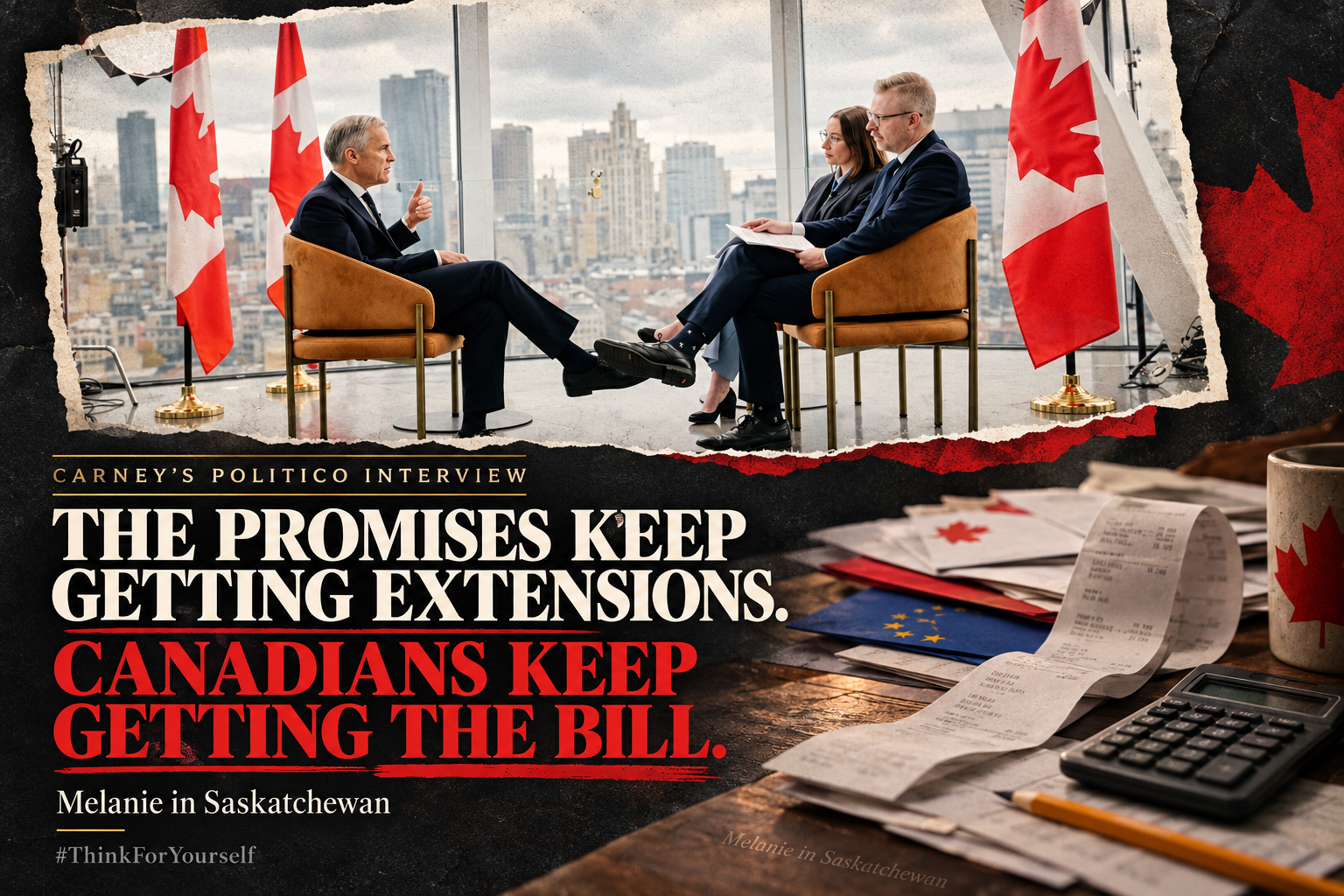 Mark Carney claims Canada gets stronger every month. Europe offers opportunity, affordability and greater sovereignty. Our trade options are expanding. And if necessary, we can just wait for another American president.
Oh really?
Before anyone mistakes a confident delivery for a successful government, let’s put his interview beside his previous promises and the figures Canadians actually have to live with. Because somewhere between what he promises, what he means and what eventually happens, Canadians keep getting handed another explanation or excuse instead of the result.
1. THE CLAIM: Canada’s trade access will double in six months.
Six months away. Somehow, it's always six months away.
Carney told POLITICO that Canada’s free-trade access covers approximately 1.5 billion consumers and is likely to double within six months. Except by August, he was already promising to double that same figure over the following six months. By the end of October, it was six months again. Math is a universal language. Six minus two is four. Unless you’re Carney. Then it’s six again. It’s always six.
His original deadline hasn’t arrived yet. But why does the clock keep restarting when he describes the promise? Which agreements are signed? Which are operating? Which are still being negotiated
And millions of potential consumers are not millions of actual customers. Canadian businesses still need competitive prices, transportation and buyers. Potential is not the same as actual. Prove me wrong, because I can wait. You simply cannot pay employees with the promise of the population of India as a potential market.
2. THE CLAIM: Canada gets stronger every month
The employment report missed the memo.
Stronger every month? September’s employment figures showed 68,000 fewer jobs. The economy was flat in August, and the preliminary September estimate pointed to a contraction. Yes, a partnership might help later. A proposed project might eventually employ people.
But if your household income drops, you don’t tell the bank you’re financially stronger because you’ve made some interesting new friends who might buy your crafting table products.
What does he mean by stronger? More jobs? More production? More money left after groceries? Because Canadians losing work are entitled to something more useful than another description of how impressive the future will be.
3. THE PRINCIPLE: Powerful industries cannot police themselves
A fascinating principle. Try it at the Prime Minister’s Office.
Carney explained why powerful industries need outside oversight. Their own interests make effective self-regulation difficult. Well then. Let’s apply that understanding to him.
His conflict-of-interest screen is administered by his chief of staff and the Clerk of the Privy Council. An independent Ethics Commissioner is involved, but the everyday job of identifying and handling those matters happens inside his governing machinery and relies on his own ability to recognize conflicts of interest.
Parliamentary scrutiny produced recommendations for stronger safeguards, including auditable records, public reporting and administration by non-partisan public servants. So clearly he understands why powerful people require scrutiny.
Excellent. He should have absolutely no difficulty explaining why his political chief of staff helps administer his own safeguards, and how Canadians can independently verify that the arrangement works, because so far it isn't working at all. Surely the principle applies when the powerful person is him.
4. THE PITCH: Europe means opportunity, affordability and greater sovereignty
Buy Canadian. Unless our new partners object.
Carney says closer European ties will give us more choices, lower costs and greater independence. But his government’s own summit backgrounder identifies unresolved European barriers involving carbon border charges, deforestation rules and pesticide measures. It also records European objections to Buy Canadian policy.
Hang on...
Buying Canadian helps make us stronger and more independent. That is part of his sales pitch here at home. Now he’s pursuing a deeper arrangement with a bloc that has identified that policy as a trade concern. So, what gives? Which promise gets negotiated down? Those other barriers matter too.
☆ CBAM: European carbon-accounting requirements and potential carbon charges on covered imports, including steel, aluminum, cement and fertilizers.
☆ Deforestation rules: Proof of where covered products came from and whether their production involved deforestation. Canada has challenged the tracing requirements and administrative burdens affecting exports such as forest products, hides and soy.
☆ Pesticide measures: A crop meeting Canadian requirements does not automatically meet European import requirements. Canada has challenged aspects of Europe’s approach to pesticide residues.
These are costs and conditions Canadian businesses have to deal with. A warmer diplomatic relationship does not automatically remove them. And Carney has had his finger in the carbon-border pie for years. In November 2021, British MP Jerome Mayhew explicitly cited Carney’s suggestions for starting a CBAM with internationally traded products such as steel, cement and aluminum, then expanding it. That documents an actual contribution to the policy discussion. He was not simply watching from the sidelines. He later promised a Canadian version himself.
Here is my prediction. Mark my words: Carney will sell Liberal voting Canadians on his own Canadian carbon border tax as the solution to Europe’s carbon border tax. He’ll tell Canadians we need our own CBAM to protect our exports from theirs, to balance things out with the result that Canadian importers and exporters will have some magic exemption. And how many people will swallow that without asking how it actually works? Our CBAM would charge imports coming into Canada. Theirs charges covered goods going into Europe. Introducing ours does not automatically exempt us from theirs.
And if securing relief means bringing Canadian policies into line with Europe’s, explain the sovereignty sales pitch. We’re supposed to become more independent by changing our rules to satisfy Brussels? Canadians deserve to know what we would have to change, what it would cost and which choices we would be giving up. Calling it “protecting sovereignty” doesn’t answer those questions. If he sells policy concessions as greater independence without explaining the trade-offs, that’s a crock of shite.
If that becomes the argument, remember that he was promoting the approach years before he became the prime minister now responsible for defending Canadian exporters. So listen carefully to his wording. If he packages those different things as one simple solution, ask him to show the actual agreement.
5. THE DODGE: The terminology dispute is Europe’s business
We’re expected to celebrate while they finish defining it.
Carney brushed questions about European objections to the relationship’s terminology toward Europe’s internal politics. Yet the joint statement says they will work to define the concept of the closer association by the 2027 summit.
So what exactly are Canadians being asked to applaud? What will it cost? What obligations would we accept? Who makes which decisions? What requires parliamentary approval? Closer cooperation can give Canada more options apparently. It can also involve compromises. Calling the result “more sovereignty” does not explain which decisions remain ours and which commitments constrain them.
He won an election. That gives him authority to govern. It does not turn every broadly worded campaign promise or idea that pops into his skull into a blank cheque for whatever arrangement he develops afterward. This is where the language matters. Canadians hear “opportunity,” “independence” and “affordability.” The obligations arrive later. Tell us what comes with the words.
6. THE POSITION: We can wait for another American president
His job can survive the waiting. Can yours?
Carney said he would wait for another president rather than accept an unacceptable agreement. Doesn't that make his whole presence as PM a moot point now? His entire campaign was about reaching deals with Trump, not keeping a seat warm until a new American president is elected before acting. And what if they elect another Republican? What if Vance runs and wins? What then? That's a lot years wasted and Canadian lives negatively impacted.
Nobody needs him to sign a rotten deal. But the next American presidential election is November 7, 2028. The next president takes office January 20, 2029. That is roughly two years and three months from today just to reach inauguration day. And then what?
A new president has appointments to make, priorities to establish and a lineup of governments wanting something. There is no guarantee the next administration will offer Canada better terms. January 2029 is a change of administration. It is not a delivery date for a Canadian trade agreement.
How many manufacturers, farmers and workers can afford that uncertainty? What is his plan for them in the meantime? He can keep collecting a prime minister’s salary while negotiations drag on. Their situation may be somewhat less accommodating.
7. THE BOOKKEEPING: Fiscal discipline, with a rather expensive definition
The borrowing survives the new labels.
The Parliamentary Budget Officer projects approximately $732.9 billion in federal borrowing over five years, compared with $333.3 billion in cumulative deficits. Those are different measures. Borrowing also finances loans, investments and other financial assets.
But the PBO’s conclusion remains damning: the government’s fiscal anchors have imposed limited discipline on spending and borrowing. Its operating target excludes debt-financed capital spending. The PBO also found some classifications of operating versus capital items appeared contradictory.
In household terms, you can separate the furnace loan from the grocery bill, but you still owe the furnace money. Carney needs to explain the total borrowing and what Canadians receive for it. Meeting a target that leaves substantial borrowing outside the calculation does not make that borrowing disappear. Look, none of this requires a banking career to understand.
When somebody promises six months, ask why it’s still six months later. Why it's ALWAYS six months later. When somebody promises sovereignty, ask which decisions remain yours. When somebody promises discipline, count the borrowing. And when somebody says we can wait, ask who is paying for the privilege.
Canadians voted for promises about improving their lives. That does not require them to applaud every international arrangement, accounting definition or expensive experiment presented afterward. We are allowed to check. And the more confidently Carney sells it, the more carefully we should scrutinize and question.
Melanie in Saskatchewan
♡ Canada’s future deserves more than a sales pitch. Sign petition e-7823: disclose the terms and obligations of closer EU ties, and let Canadians decide in a national referendum. 👇🏻
https://www.ourcommons.ca/petitions/en/Petition/Sign/e-7823
Article Sources
☆ POLITICO interview: full video
☆ POLITICO: Carney interview and trade-deal reporting, October 30, 2026
☆ Prime Minister’s Office: August 22, 2026 trade speech and six-month market-access promise
☆ Statistics Canada: September 2026 employment figures
☆ Statistics Canada: August 2026 GDP and preliminary September estimate
☆ Carney’s published conflict-of-interest screen
☆ House of Commons ethics committee report: conflict screens and recommended safeguards
☆ Canada–EU summit backgrounder: CBAM, deforestation, pesticides and Buy Canadian concerns
☆ UK Hansard, November 1, 2021: MP credits Carney’s CBAM suggestions
☆ Carney’s 2021 British parliamentary testimony on carbon border measures
☆ The Canadian Press: Carney promises a Canadian carbon border mechanism, January 31, 2025
☆ EU CBAM legislation: carbon-price deductions and linked-system exemptions
☆ Canada–EU agriculture dialogue: deforestation tracing concerns
☆ Canada–EU committee report: pesticide regulations and import tolerances
☆ Canada–EU joint statement: closer association to be defined by the 2027 summit
☆ U.S. government: next presidential election and next inauguration
☆ PBO: October 2026 economic and fiscal outlook
☆ PBO: assessment of the government’s operating-budget fiscal anchor