

Canadians did not elect Mark Carney to run a climate conversion clinic.
They elected him to confront Donald Trump, stabilize Canada’s trading position, and defend Canadian workers from tariffs, retaliation, and economic whiplash.
That was the pitch.
That was the poster.
That was the applause line in every city.
What they received instead is a Prime Minister who treats trade urgency like a background app while sprinting toward a climate-first project that voters were never honestly asked to approve.
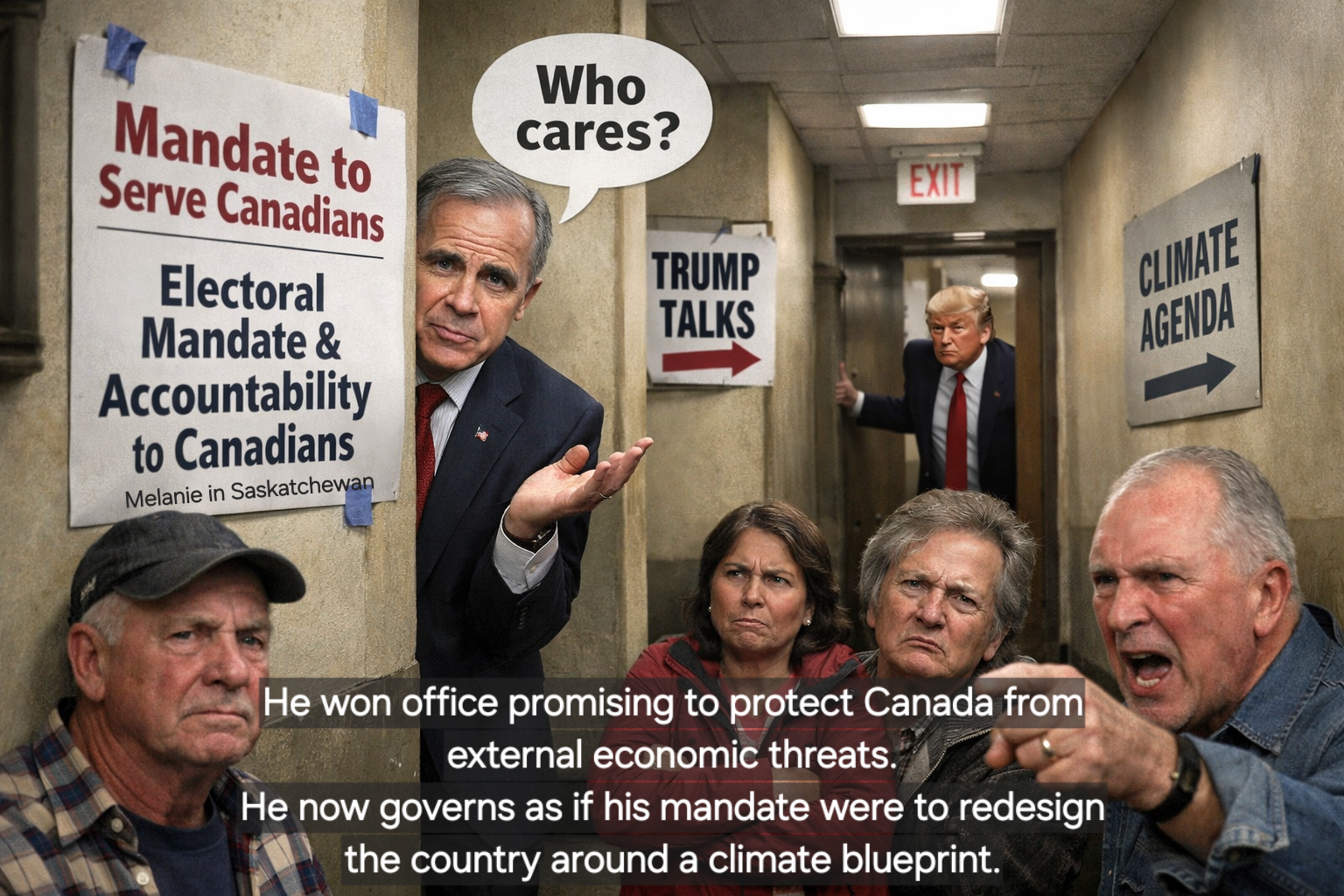 This is not a disagreement over policy.
It is a case study in truth in political advertising.
The Campaign Carney Ran
Carney’s campaign was built on three obsessive themes: trade, Trump, and speed.
He was “laser-focused.”
He would move at speeds “never before seen.”
He would be the steady hand protecting Canada from external shocks.
Those were not footnotes. They were the foundation of his candidacy.
They are also the promises most conspicuously missing in action.
Yes, his government eventually produced domestic items: a middle-class tax cut, GST relief for first-time homebuyers, and internal trade legislation. Useful. Technical. Entirely beside the emotional point.
And not coincidentally, most of those “accomplishments” were Pierre Poilievre’s campaign promises first.
The language, the policy framing, even the sequencing were lifted almost verbatim from Pierre. Internal free trade. Labour mobility. Housing supply acceleration. Middle-class tax relief. These were not the signature pillars of Carney’s campaign. They were the backbone of Poilievre’s.
Carney did not introduce a bold new domestic vision.
He inherited the opposition’s.
And the tax cut itself? A masterpiece of political minimalism.
One percentage point shaved off the lowest federal bracket on the first slice of income, rolled out mid-year, delivering savings that for many households lands somewhere between “nice” and “did that cover the cost of one grocery bag yet?”
A policy so small it required a press conference, just to make sure Canadians noticed it happened.
The Part They Forgot to Mention
Here is the part voters were not asked to look squarely at during the campaign.
Before the Prime Minister’s Office, Carney’s day job was not “defend Canada from Trump.”
It was building the world of transition investing.
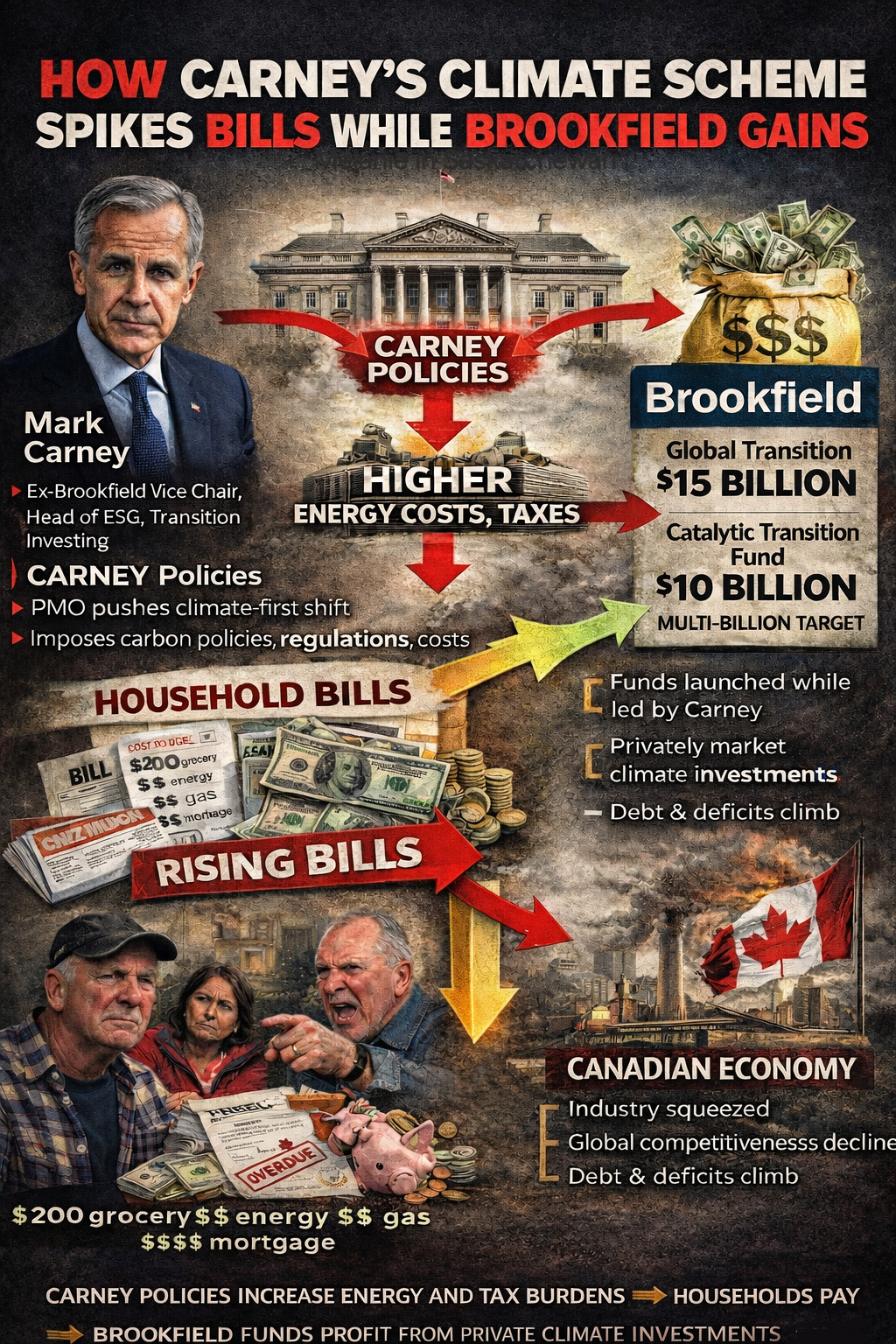 Brookfield did not hire Carney to cut ribbon at a local chamber of commerce lunch. It brought him in as Vice Chair and head of ESG and impact fund investing, later positioning him as a leader in its transition investing platform. That platform is built on the idea that the global economy must be pushed, steered, and rewired into net-zero alignment, and that the people who finance that shift should earn attractive returns for doing it.
Brookfield’s flagship vehicle for that project was the Brookfield Global Transition Fund, co-headed by Carney, closing at a reported 15 billion dollars. Then came BGTF II, with a first close of 10 billion dollars and later fundraising reported significantly higher. Then the Catalytic Transition Fund, backed by billions more and explicitly structured to scale climate finance globally.
Which is why today’s governing architecture looks suspiciously familiar.
Accelerate the transition.
Restructure incentives.
Expand the climate investment pipeline.
Call it public good.
When Canadians are told the pain is necessary and the cost is worth it, they might ask the obvious question.
Worth it for whom?
Carney governs like a man who believes net-zero is not a policy choice but an inevitability. Which is a remarkably convenient worldview for someone who helped build the world’s largest private transition fund series designed to profit from that inevitability.
That does not prove misconduct.
It does something more politically dangerous.
It makes his motives look obvious.
What Voters Actually Got
Meanwhile, the promised trade offensive against American pressure has drifted along on calendars and communiqués.
Talks paused.
Talks resumed.
Talks stalled. TV ads aired.
Tariffs flared and settled into limbo.
The legendary “laser focus” now resembles a low wattage desk lamp running on dead and dying batteries.
What has not stalled is Carney’s climate drive. Regulatory push. Transition financing language. International climate positioning. Acceleration. The full portfolio.
He is tone deaf to the obvious reality that average households do not experience policy as theory. They experience it as bills, rent, groceries, interest rates, and a cost of living that keeps climbing while government assures them it is all under control.
The national version of that story is no prettier.
A country trying to compete, build, export, and negotiate from strength does not do it by burying industry under a layer cake of climate compliance while the trade file sits in the waiting room.
The Undisclosed Mandate Problem
Voters were not told that trade urgency would become optional.
They were not told that the economy would be reorganized around emissions modeling.
They were not told that manufacturers, exporters, and energy producers would be placed in extended uncertainty while competitors move.
They were told Carney would defend Canada’s economic flank.
Instead, they received a leader governing like he has a majority mandate for an agenda that was never the centrepiece of his campaign, never fully disclosed, and never clearly approved.
If you tell people you are running into the fire to deal with Trump, then once elected you pivot to building your climate legacy, do not act surprised when Canadians feel played.
Especially when your climate legacy aligns perfectly with the investment world you came from.
Why This Matters
Democracy does not demand that politicians keep every promise.
It demands that they tell voters which promises matter most.
Carney’s climate project may deserve debate.
What it does not deserve is installation by omission.
When the central justification for your election is trade defense, and the central output of your government is climate restructuring, that is not evolution.
That is misrepresentation.
Canadians did not reject the trade candidate they were offered.
They were never shown the climate-first governor they now have.
Conclusion
Mark Carney did not simply adjust priorities.
He replaced the mission.
He won office promising to protect Canada from external economic threats.
He now governs as if his mandate were to redesign the country around a climate blueprint, with the confidence of someone who never needed permission in the first place.
That is not leadership.
That is a bait-and-switch.
And Canadians are paying the price for the campaign he ran, not the government he formed.
Melanie in Saskatchewan
👇🏻Appendix: Key Sources for Fact-Checking
• Brookfield Asset Management – Aug 26, 2020👇🏻
“Brookfield Announces Appointment of Mark Carney as Vice Chair and Head of ESG and Impact Fund Investing”
• Brookfield Asset Management – Jun 22, 2022👇🏻
“Brookfield Raises Record 15 Billion Dollars for Inaugural Global Transition Fund”
• Reuters – Jun 22, 2022👇🏻
“Brookfield raises 15 bln for climate-focused fund”
• Brookfield Asset Management – Feb 5, 2024👇🏻
“Brookfield Announces 10 Billion Dollar First Closing for Second Global Transition Fund”
• Reuters – Feb 5, 2024👇🏻
“Canada’s Brookfield raises 10 bln for second global transition fund”
• Brookfield Asset Management – Jun 13, 2024👇🏻
“Brookfield Opens Fundraising for Catalytic Transition Fund with Anchor Commitment from ALTÉRRA”
• Financial Times – Oct 6, 2025👇🏻
“Brookfield raises 20bn in second energy transition investment fund”