

Canada Strong? Then Let Canadians Decide.
 Before you sign a contract, you read the conditions, unless of course you're Melanie Joly. Before you commit an entire country, you show the conditions to the people who will have to live with them. This is something Mark Carney must learn now.
After eleven years of Liberal government, I am fresh out of confidence in the Liberal government's sales pitch. "Trust us" is not an explanation. It is precisely what makes me want to read the fine print.
Canadians are struggling to keep their homes, pay their bills and give their children a decent start. We cannot afford to discover the catch after Ottawa has congratulated itself and signed the paperwork on behalf of 41+ million Canadians.
Carney's government is proposing a deeper, more integrated relationship with the EU, including financial services and opportunities for young people to live, work and study on either side of the Atlantic.
Lovely... so where are the conditions? And what, exactly, are the requirements of an associate membership?
Canada already trades with Europe. CETA made 98% of EU tariff lines duty-free for Canadian goods when it took provisional effect in 2017. We also already have trade agreements across the Asia-Pacific region. Carney did not discover overseas commerce.
Meanwhile, the United States still received 71.7% of Canada's merchandise exports in 2025. Every other market combined accounted for the remaining 28.3%. Diversification matters, but replacing the scale of our American market requires considerably more than an enthusiastic speech in Europe.
If better trade is the justification, show us what this arrangement would deliver beyond our existing agreements. Show us the expected gains, the costs and the conditions. What additional access are we buying, and what authority might we give up to obtain it?
For comparison, existing full EU members have the following obligations. They would not automatically apply to Canada, but they show why demanding the details matters:
- Contribute Money: The largest funding source is based on gross national income, or GNI, rather than simply GDP. Calculating from the Commission's 2025 figures, national contributions averaged approximately €4.9 billion PER COUNTRY, excluding customs revenue and before EU funding received back. That is not Canada's prospective bill. What would ours be? What would we receive? Which priorities at home would wait?
- Adopt and Implement EU Rule: Which Canadian laws and standards would have to change? Who has asked our small businesses, manufacturers, farmers and employers what compliance would cost them? They deserve an answer before being handed another expensive obligation dressed up as an opportunity, and before government starts dangling outrageous "we've got your back" loans to help them survive the expense.
- Accept the Precedence of Applicable EU Law: Within areas of authority assigned to the EU, EU law takes precedence over conflicting national law. This reaches beyond trade promotion into who has the final legal say. Would Canada accept anything comparable? Could Parliament reject a requirement? What happens if we refuse?
- Participate in Free Movement of Goods, Services, Capital and People Including their Immigrants and Refugees: What new rights would Canada grant, to whom, and with what limits? What would that mean for housing, employment and public services?
- Commit to Adopting the Euro Once Conditions Are Met: (excluding Denmark, which has an exeption) An associate arrangement would not automatically require Canada to adopt the euro, nor would Denmark's exemption automatically become ours. Would the agreement explicitly protect our dollar and monetary authority? Carney's documented 2019 proposal explored a potential digital international reserve currency to reduce dependence on the US dollar and that conversation reared its ugly head recently.
And I want the net-zero questions answered just as plainly.
When Carney left Brookfield's chairmanship, the company credited him with helping establish its position in energy-transition investment. Ottawa's new nature-financing taskforce is examining private investment and financial mechanisms, explicitly linked in its announcement to a net-zero economy.
Would this EU arrangement bind Canada to climate targets, carbon-pricing requirements, investment rules or nature-financing commitments? Which businesses could benefit, including Brookfield? What disclosures and safeguards would apply? What are the exit clauses?
Could Canadians elect a government to reverse those policies, only to discover that Ottawa had already committed us to keeping them by entrenching irreversible laws preventing future governments from repealing them? I want to know what the next government could change, what it could cancel and what getting out would cost.
Which brings us to the sovereignty sermon. When Washington makes demands during trade talks, Canadian sovereignty apparently requires every elbow in the country to immediately rise in an upwards motion as a sign of national fealty. But when Brussels offers deeper integration, potentially involving binding rules and shared authority, those same elbows are suddenly rushing to hold the signing pen, so it seems.
Does sovereignty have a preferred flag? Is outside influence an outrage until it arrives with a European accent? If Carney says this strengthens our independence, he can explain exactly how, in ordinary language.
Which decisions remain ours? Which become shared? Which require somebody else's approval? Spare us the vocabulary that requires a translator at the kitchen table. An impressive résumé does not answer a question, and fluent delivery does not fill in missing conditions and limitations.
I want Canadians listening for what is absent: the price, the limits, the enforcement and the exit. Until those are explained, "Canada Strong" remains a Liberal government slogan.
And before anyone signs, show us how we leave should we need to! If the arrangement fails Canada, could a future government withdraw? How much notice would be required? What payments or obligations would survive? Could Parliament restore Canadian rules without compensation claims or other penalties?
An associate arrangement would not automatically mean joining the European Parliament. The question is whether Canada would accept rules made through EU institutions, and what power Canadians would have to challenge or change them. The government can negotiate international agreements, however that does not settle whether Canadians should consent to this one before it becomes binding.
Show us the conditions. Explain the consequences. Let Canadians decide.
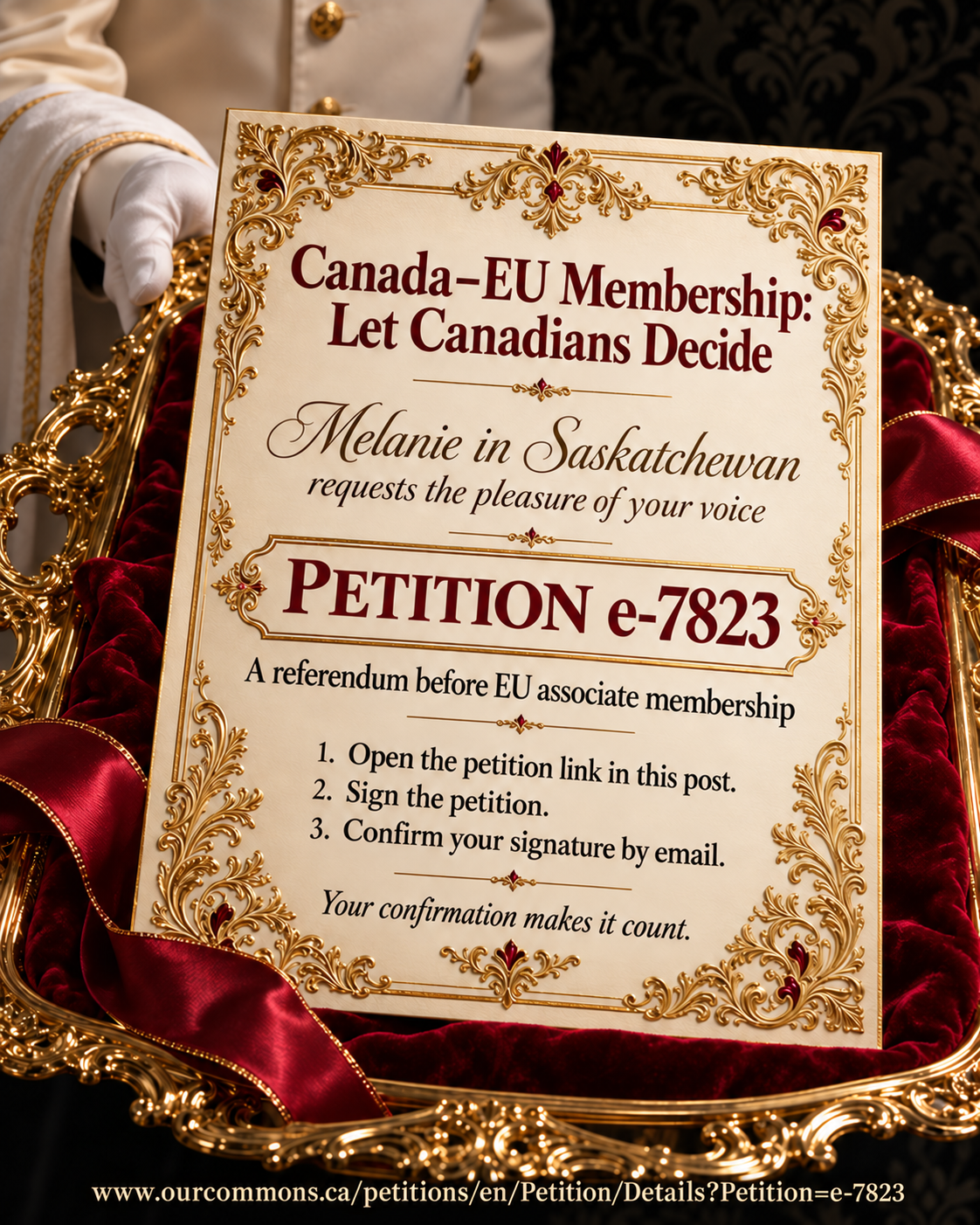
THAT IS WHY I CREATED PETITION e-7823.
It calls for:
- Public disclosure of the complete proposed terms and obligations before any agreement is signed.
- Preservation of Canada's sovereignty of legislative, judicial, fiscal and regulatory authority.
- A national referendum before entering any form of EU associate membership.
Whether you're a Liberal, Conservative or purple-spotted Martian, you deserve enough information to decide for yourself. I have no faith in a government sales pitch. I want disclosure, scrutiny and a vote.
PLEASE SIGN & SHARE PETITION e-7823
https://www.ourcommons.ca/petitions/en/Petition/Details?Petition=e-7823
After signing, you must check your email and follow the confirmation link so your signature counts.
If the deal is good enough for Canadians, then it should survive Canadians reading it and voting on it, wouldn't you agree?
Melanie in Saskatchewan 💙