
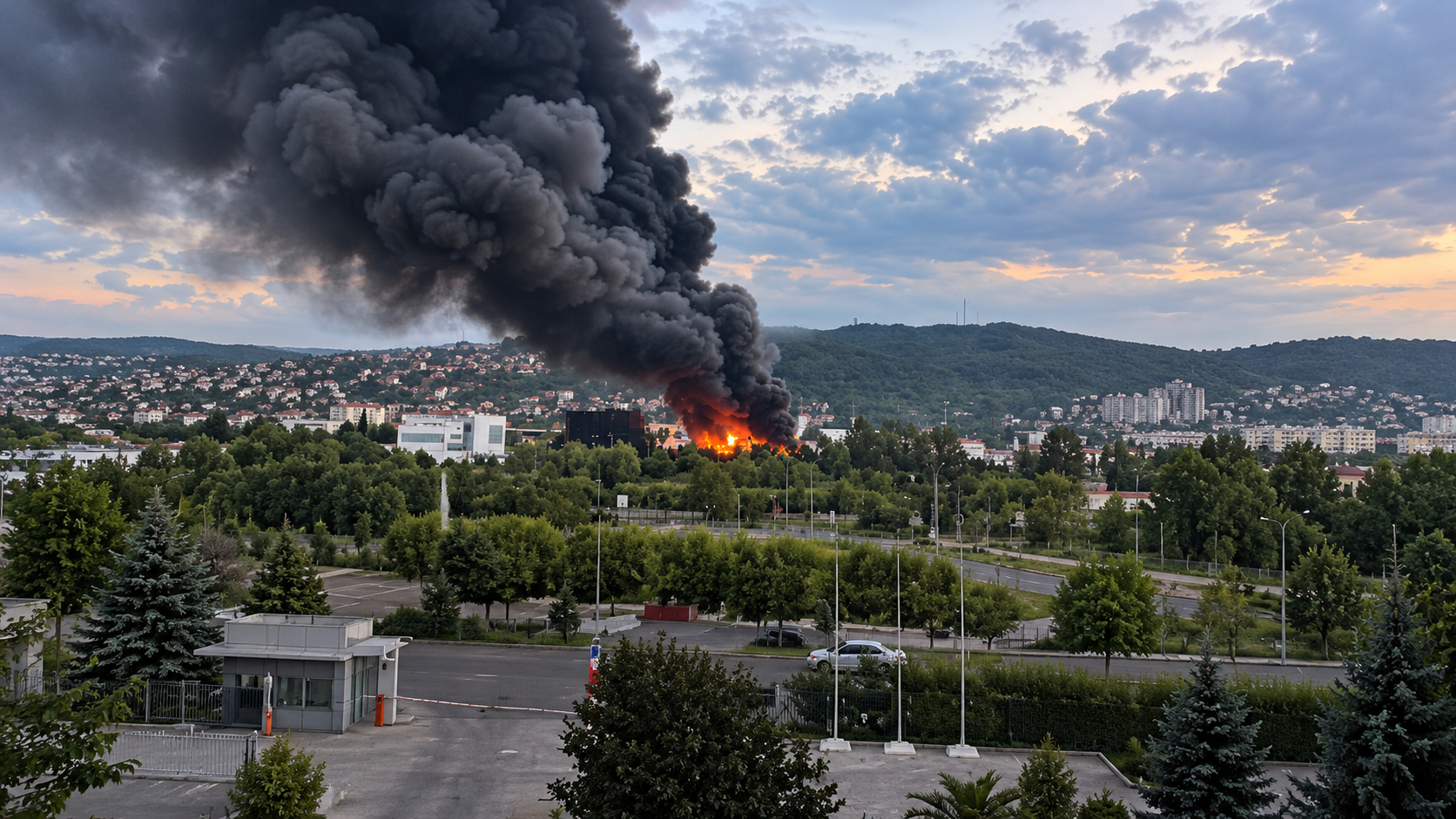
Ukrainian strikes hit fuel and air-defense targets around Sochi and industrial facilities in Sterlitamak, where the petrochemical plant stopped operating after the attack. Russia, meanwhile, struck the SBU headquarters in central Kyiv and residential areas in Odesa, while Ukraine reported a critical shortage of Patriot interceptors. President Trump also sent Steve Witkoff and Jared Kushner on a diplomatic mission involving Moscow and Kyiv.
🇺🇦 Ukraine’s Defense & Military Developments
• Ukraine’s Defense Forces used FP-1 drones to strike three Russian targets around Sochi overnight: a Lukoil oil depot with 12 tanks and listed capacity of more than 8,400 cubic meters, the Adler airport fuel storage facility, and an S-400 air-defense position. Large fires broke out at two fuel sites, while the same attack also targeted a radar position preliminarily identified as an ORL-A air traffic surveillance radar.
• Ukrainian drones struck two industrial facilities in Sterlitamak, Bashkortostan. The Avangard plant produces explosives, ammunition, solid rocket fuel and pyroxylin powder. At the Sterlitamak petrochemical plant, which produces synthetic rubber, aviation gasoline and other petrochemicals, the Agidol production shop, an overpass at the isoprene workshop and isopentane dehydrogenation units were damaged, and the plant stopped operating.
• The 23rd Assault Regiment “R.U.H.” of the National Guard’s 2nd Khartiia Corps retook another 4 square kilometers between Dvorichna and Zapadne in the Kupiansk district of Kharkiv region. On one section, its troops fought alongside the 35th Marine Brigade, cleared a forest near Zapadne and continued advancing.
• Ukraine’s General Staff said the Defense Forces struck a storage, preparation and launch site for attack drones near Donetsk on September 3 and overnight into September 4, as well as command posts in Fedorivka and Petrivka. Other targets included a radar in Bryansk region, two Grenadier technical-intelligence posts in occupied Crimea, a mesh-network relay in Kursk region and a fuel depot in occupied Luhansk.
• Ukraine’s Defense Intelligence said operators from the Group 13 special unit struck a Russian Bastion coastal missile system in occupied Crimea during August. The system can launch Zircon and Oniks missiles, while the same operation destroyed or damaged two fuel trucks and a command-and-staff vehicle.
• Ukrainian air defenses shot down or suppressed 103 of 121 Russian drones launched overnight, including Shaheds, Gerberas, S8000 Banderol drones and decoys. Russia also launched a Kh-31P missile from the Black Sea, with strikes recorded at 15 locations and falling debris at six.
• Ukraine is entering winter with a critical shortage of Patriot interceptor missiles as Russia increases production of ballistic missiles and jet-powered Shaheds. President Volodymyr Zelensky put the requirement at about 300 Patriot missiles, while the United States has roughly 800 newer PAC-3 interceptors and several hundred PAC-2s; European allies are also seeking stocks from Spain and Greece, but licensed production in Ukraine would not solve the shortage in the coming months.
• Ukrainian forces have pushed the interception rate for Russian sea-launched Kalibr cruise missiles to nearly 100 percent while continuing systematic attacks on the Black Sea Fleet. Russian ships have been pushed from occupied Sevastopol toward Novorossiysk, while Ukrainian unmanned surface vessels and integrated FPV-drone launchers are also being used against ships, air defenses and port infrastructure.
• In August, Ukraine’s Defense Forces reported destroying 3,336 Shahed drones and 101 S8000 Banderol drones, along with 1,031 reconnaissance UAVs and 820 Lancets. They also reported neutralizing more than 50,000 tactical drones, while Ukrainian Air Force aircraft carried out more than 1,900 sorties during the month.
• Ukraine’s General Staff said two major Russian oil facilities stopped operating after earlier Ukrainian strikes: the Lukoil refinery in Kstovo, hit on August 26, and the Novatek complex in Ust-Luga, attacked on September 1. At Ust-Luga, pipelines, a primary gas-condensate processing unit and two hydrocracking columns were hit, with petroleum spills covering about 200 and 250 square meters.
• Ukraine’s 426th Separate Unmanned Systems Regiment struck several Russian air-defense and radar assets in occupied Crimea. The targets included a ZU-23-2 anti-aircraft gun, two MT-LB-based air-defense systems, an antenna and a coastal radar station.
• President Zelensky warned foreign carriers and insurers on September 1 about growing risks in Russian airspace and said Ukraine intended to increase daily drone use against Russia from about 300 to 1,000. After the warning, Pegasus flights to Moscow turned back, Flydubai changed flight plans, and Russian authorities temporarily restricted nighttime traffic at Domodedovo, Vnukovo and Sheremetyevo.
• Commander-in-Chief of the Armed Forces of Ukraine Mykhailo Drapatyi named stabilization of the front and preparation for future challenges as immediate priorities. His priorities also include a stable personnel-management system covering recruitment, training, service, rotations and retention, more freedom for lower-level commanders, and coordination across land, air, sea, cyber and cognitive domains.
🇷🇺 Russia & the Warfront
• President Zelensky said a Russian Shahed directly struck the office of acting SBU head Oleksandr Poklad inside the Security Service’s central building near Volodymyrska Street and Zoloti Vorota in Kyiv, causing a fire. The wider attack injured 12 people in the Shevchenkivskyi district, nine were hospitalized and two were in serious condition; the 18th-century Consistory building at the St. Sophia reserve also had windows blown out and its glass entrance destroyed.
• Russian forces struck residential areas in Odesa and the surrounding region during a mass morning attack, killing one person and injuring at least five, including a child. Apartments, facades and windows were damaged in two high-rise buildings, two private houses were destroyed, and additional buildings and vehicles were hit.
• Ukrainian monitoring project DeepState recorded Russian advances near three settlements in Zaporizhzhia region: Mali Shcherbaky, Huliaipilske and Varvarivka. Mali Shcherbaky is in the Stepnohirsk community of Vasylivka district, while Huliaipilske and Varvarivka are in Polohy district.
• Ukrainian war veteran, former Aidar company commander and analyst Yevhen Dykyi assessed that Russia lacks the resources to sustain major offensives on several fronts simultaneously. He said Russian forces can maintain slow advances mainly in Donetsk region, where he estimates they are present across about 70 percent of Kostiantynivka, and that Moscow has been unable to open a new front section in Chernihiv region.
• Presidential defense-technology adviser Serhii Beskrestnov said Russia is scaling electronic-warfare systems such as Peresvet-M to suppress the uplink channel used by Starlink terminals. He said one system costs about $1 million to $1.2 million and covers roughly 20 square kilometers, with deployments expanding in occupied Crimea and around warehouses, naval bases, ships, military units, radars and air-defense positions.
• Russian special services have intensified sabotage operations in Europe and increasingly recruit remote operatives for individual tasks paid in cryptocurrency. Over the past month, a drone carrying explosives was found near a Ukrainian cargo aircraft at Leipzig airport, while suspicious sabotage incidents occurred in Poland. Explosions and fires were also recorded at European defense facilities supplying Ukraine, and Polish Foreign Minister Radoslaw Sikorski called for making such operations costly for the Kremlin.
• Russia is increasingly using jet-powered Shaheds in daytime attacks, a tactic that Ukrainian presidential adviser Serhii Beskrestnov said reduces the effectiveness of mobile fire groups because the drones fly higher and faster. Beskrestnov said Ukraine is intercepting about 80 percent of them and that at least four Ukrainian jet-powered interceptor designs are in final testing and combat trials. Analyst Franz-Stefan Gady said about 1,500 Russian jet drones were detected in July and 3,000 in August.
• Two Russian Black Sea Fleet submarines capable of carrying cruise missiles have not been observed on combat patrol this year, according to Ukrainian Navy spokesman Dmytro Pletenchuk, who linked their absence from the sea to possible maintenance and operational problems. The submarines are currently at their base in a semi-submerged position for protection from air strikes, while metal structures have also been installed over their bridges.
• Kremlin spokesman Dmitry Peskov said Russia is checking reports that Germany, Britain and France may establish long-range ballistic missile production in Ukraine. He said any such production site would be treated by Russia as a legitimate target.
• Chechen leader Ramzan Kadyrov said Russian forces could seize Poland and then advance toward France and Germany. In July, he had already called for a Russian military operation against NATO countries supporting Ukraine and said Chechen units were ready to operate in any direction ordered by Vladimir Putin.
• Ukraine’s General Staff reported in its September 3 update that Russian forces had lost an additional 1,440 personnel, along with one tank, eight armored combat vehicles, 77 artillery systems, three multiple-launch rocket systems, four air-defense systems and 13 ground robotic systems.
🇺🇸 United States
• President Trump sent Steve Witkoff and Jared Kushner to Moscow with a proposal aimed at ending the war in Ukraine and said the mission is intended to determine whether an agreement can be reached. President Zelensky said the two U.S. representatives would then visit Kyiv on Sunday, adding that Ukraine would refrain from airstrikes while they were in Moscow and urging Russia to do the same during their stay in Kyiv.
• A U.S. sanctions bill backed by the Senate in an 86-11 vote may remain blocked in the House of Representatives until at least the November 3 midterm elections. The legislation would allow President Trump to impose tariffs of up to 100 percent on imports from the five largest buyers of Russian oil and the five countries most involved in helping evade sanctions, while lawmakers have raised concerns about oil prices and expanded presidential authority.
• President Trump said he does not believe Vladimir Putin intends to attack NATO territory, citing his own conversations with the Russian leader. He also attributed the lack of a settlement in Ukraine partly to what he described as intense hostility between Putin and President Zelensky.
• President Trump intends to demand compensation from European countries for weapons and other assistance that the United States provided to Ukraine and NATO under the Biden administration. No exact amount, list of countries or legal and financial mechanism has been defined, and the European Commission said it had received no official U.S. request for repayment.
🇪🇺 Europe & World
• Germany is deploying about 5,000 military personnel and civilian staff and roughly 2,000 pieces of military equipment to Lithuania, with Rukla and Pabrade among the main locations. The brigade will be based about 30 kilometers from the border and will bring German technical intelligence capabilities, along with intelligence personnel, for rapid response in the event of a Russian attack.
• Britain’s Ministry of Defence has suspended part of its combat training program to save about £30 million, with full training expected to resume only in summer 2027. British military expert Hamish de Bretton-Gordon warned that the pause threatens the army’s combat readiness because tanks, drones, missiles, communications, sensors, electronic warfare and precision weapons require regular joint training.
• Air Tanzania suspended its Dar es Salaam-Moscow service from September 4 after reassessing operational security risks. The airline said passengers would receive refunds or free rebooking and that flights would resume only after another security review.
⚡ Geopolitics & Economy
• Slovakia rejected an EU plan to extend individual sanctions against Russia for 12 months instead of six. The current restrictions expire on September 15, and any change requires unanimous approval from all 27 EU member states.
• Ukraine faces a $32.6 billion financing gap, with Finance Minister Serhii Marchenko describing the budget situation as the most difficult since the full-scale invasion began in 2022. Without additional assistance, nonmilitary payments could be delayed as defense spending remains the priority, while local shelter and infrastructure projects could also be affected; the new budget is being prepared on the assumption that the war continues into 2027.
• Vice Prime Minister for European and Euro-Atlantic Integration Vsevolod Chentsov is working with European partners on ways to cover Ukraine’s defense and civilian budget gaps, including early access to part of the EU’s €90 billion loan and the use of frozen Russian assets. More than €200 billion in Russian central bank assets are frozen in the EU, most of them held at Belgium’s Euroclear, while Ukraine is seeking partial access and wider guarantees after Belgium’s earlier veto.
• Global food prices rose 1.9 percent in August to their highest level since late 2022. Sugar prices increased 11.9 percent, wheat rose 2.6 percent and was 15 percent above a year earlier, while the 2026 global grain production forecast was reduced to 2.98 billion tons, marking the largest annual decline since 2018. Fighting in the Black Sea has also complicated Ukrainian grain exports, while poor harvests in Europe are increasing the risk of greater import dependence.
• Ukrmetalurgprom President Oleksandr Kalenkov and Ukrainian Agribusiness Club CEO Oleh Khomenko urged the government to restore full maritime shipping because Danube routes and western border crossings cannot replace Black Sea ports in either volume or cost. Ukraine traditionally exports about 80 percent of its steel products and 50 to 60 percent of its iron ore, while alternative ports add roughly €50 to €90 per ton to agricultural logistics.
• The Dutch central bank reduced its gold holdings in New York by more than 78 tons as part of a broader redistribution of about 86 tons of reserves held in the United States and Canada. Most of that amount was replaced by gold held in London to reduce geopolitical risk and improve access, while about 27 tons were physically moved from North America to Europe.
🛑 Society & Policy in Ukraine
• Ukraine’s National Anti-Corruption Bureau and Specialized Anti-Corruption Prosecutor’s Office are conducting an operation against an alleged criminal organization led by an official of the Prosecutor General’s Office. The head of a cyber department, Serhii Kropyva, was detained, and the group is suspected of protecting fraudulent call centers and laundering assets.
• Head of the Presidential Office Kyrylo Budanov advised President Zelensky not to agree to transfer Donbas to Russia as part of a peace settlement, arguing that this would give Moscow territory its forces had failed to capture militarily. Budanov, who headed Ukraine’s negotiating team in previous talks with Russia and the United States, expects negotiations could resume near the end of September.
• An occupation court in the temporarily occupied part of Zaporizhzhia region sentenced 64-year-old Melitopol journalist and National Union of Journalists member Iryna Levchenko to 15 years in prison on accusations of spying for Ukraine. Russian forces seized Levchenko and her husband from a street in Melitopol on May 6, 2023, and she has remained in Russian captivity for more than three years.
• Prime Minister Serhii Koretskyi initiated development of a separate air-raid alert application based on the Diia state platform that would display current threats and the movement of Shaheds, other drones and missiles in one state information system. No launch date or technical specifications have been announced, while the government introduced yellow and red alert levels on September 3 for drone attacks and higher missile or combined-attack threats.
• Denys Marchuk, deputy head of the All-Ukrainian Agrarian Council, expects prices for dairy and frozen products to rise by 15 to 20 percent, potentially more, over the next three months because Russian strikes have damaged retail warehouses and reduced refrigerated storage capacity. He said meat could rise by about 10 percent, cereals by around 15 percent, and greenhouse tomatoes and cucumbers by 20 to 30 percent or more later in the autumn.
• The Cabinet approved Ivan Fedorov’s dismissal as head of the Zaporizhzhia Regional Military Administration and his appointment as head of Ukraine’s State Agency for Restoration and Infrastructure Development. Serhii Sukhomlyn was dismissed from the agency, President Zelensky formally ended Fedorov’s regional powers, and Mykhailo Semikin was appointed acting head of the region.
• Restricted grain exports after Russian attacks have created a large wheat surplus in Ukraine, with prices in some areas falling from around 11,000 hryvnias to 5,000 hryvnias per ton. The decline exceeds 30 percent in central regions and reaches 50 percent in northern areas; Denys Marchuk, deputy head of the All-Ukrainian Agrarian Council, estimates that grain accounts for no more than about 12 percent of bread production costs and said bread prices could rise by 1.5 to 2 percent per month because of logistics, energy, imported components and labor.
September 4 showed simultaneous pressure on Russia’s strategic rear and Ukraine’s urban centers, with Ukrainian forces reporting strikes on fuel, industrial and air-defense targets while Russian attacks hit Kyiv and Odesa. Air defense remains one of the central military constraints: Ukraine reported strong interception results against Russian aerial threats but also a critical Patriot missile shortage and a growing challenge from jet-powered Shaheds. Diplomatically, the Witkoff-Kushner mission is set to involve both Moscow and Kyiv while major U.S. sanctions legislation remains stalled. Financial pressure is also widening, from Ukraine’s $32.6 billion budget gap to efforts to access frozen Russian assets and the growing costs of disrupted Black Sea trade.
🤝 SUPPORT US 💙
We continue to work only because you read and support us. If you appreciate what we do, please become our sponsor or donate here👇
☑️ patreon.com/meanwhileinukraine
or
☕️ buymeacoffee.com/meaninuak
or
☕️ ko-fi.com/meaninua
or
💳 paypal.me/meaninua
Your support helps us continue delivering timely and accurate updates. Stay informed and stand with Ukraine! 🇺🇦
Together we are stronger! 🇺🇦
3