

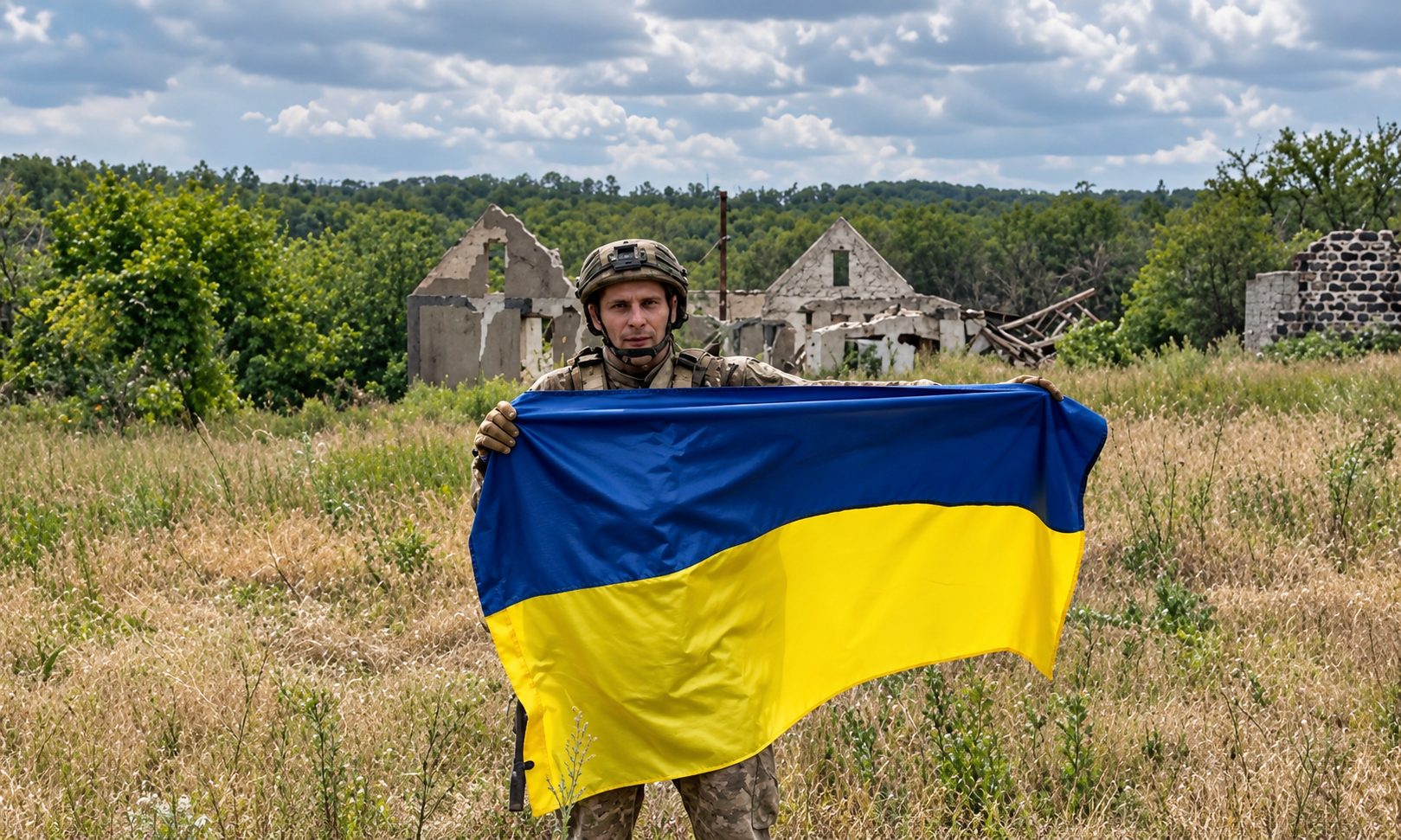
Ukraine’s Third Army Corps said the third phase of Operation Vivaldi liberated three settlements and restored control over two more, adding 51 square kilometers to a 176-square-kilometer advance. Russia, meanwhile, launched large drone attacks and carried out strikes that killed nine people and injured more than 80 across Ukraine, while Kyiv reported new deep strikes on Russian defense and fuel infrastructure. The day also brought new Ukrainian interceptor and long-range weapons developments alongside European moves on air defense and hybrid-threat response.
🇺🇦 Ukraine’s Defense & Military Developments
• Ukrainian forces liberated Ridkodub, Nove and Katerynivka on the Lyman axis during the third phase of Operation Vivaldi and fully restored control over Karpivka and Novomykhailivka, according to the Third Army Corps. The phase recovered another 51 square kilometers, bringing the total advance to 176 square kilometers, while the corps said Russian losses across all three phases reached about 5,000 troops and more than 250 soldiers surrendered. Ukrainian forces also used converted BTR-60 vehicles as ground kamikaze systems while destroying launch sites used by Russia’s Rubikon drone unit.
• Ukrainian forces carried out an overnight series of deep strikes against Russian defense and fuel infrastructure. President Volodymyr Zelensky said two defense plants in the Tula and Voronezh regions were hit, while SBU Alpha Center drones struck four fuel facilities in Russia’s Krasnodar region, including Edelweiss-95, Din-Yug-Oil, Lukoil-Yugnefteprodukt and Angelinska, with fires reported at the sites.
• Ukraine’s HUR said its Ghosts special unit struck a railway bridge across the North Crimean Canal and a broad network of Russian communications, electronic warfare, electronic intelligence and radar assets in occupied territory. The targets included nine such systems, a Nebo-U radar, a P-18 Terek command post and two Kasta-2E radars, while the operation also hit an L-39 Albatros aircraft and three high-speed boats, including a BK-10, a BK-16 and a Mangust patrol boat.
• The Ukrainian General Staff reported a separate series of strikes on Russian command, drone, ammunition, repair and logistics infrastructure on September 27 and 28. Targets included a Pantsir-S2 air-defense system near Seltsy in Russia’s Bryansk region, command and drone deployment sites in occupied Vynohradivka, a strike-drone storage and launch site in occupied Donetsk, a repair unit in Mariupol, ammunition depots in Makiivka and Ustynivka, and a logistics warehouse in Nikolske.
• Ukraine’s Navy said a Neptune missile struck the Azov Optical-Mechanical Plant near Rostov, while Dallas Analytics said internal documents obtained before the September 26 strike linked the facility to at least seven Russian missile programs. The documents cited components associated with the Kh-101 cruise missile, the R-37M long-range air-to-air missile and Oreshnik, including a planned delivery of 510 K-7751 Krechet-M units between 2023 and 2027.
• A Ukrainian air-defense crew reported the first successful combat use of a new jet-powered interceptor against a Geran-5 drone. The Yastrub crew of the 1020th Anti-Aircraft Missile and Artillery Regiment destroyed the target at 425 km/h and above 3 kilometers altitude, while Commander of the Unmanned Systems Forces Robert Brovdi said Ukraine had already moved its first jet anti-Shahed systems from development into practical interception.
• Fire Point unveiled an expanded Ukrainian weapons family spanning long-range drones, ballistic systems and an anti-ballistic interceptor. The FP-1, FP-2 and Flamingo are listed with ranges of up to 3,400, 700 and 3,000 kilometers respectively; the FP-7 and FP-9 ballistic systems are rated at up to 250 and 850 kilometers, while FREYJA is designed to reach speeds of 1,500 to 2,000 meters per second.
• Ukrainian drones reportedly struck railway infrastructure in Russia’s Bryansk region, where part of a bridge collapsed on the Dyatkovo-Lyudinovo section and 10 railcars derailed. Another 18 empty railcars derailed in the Unetsky district.
• Ukrainian Defense Forces struck the cargo vessel Aroyat on September 27 while it was heading toward a Russian port, causing a fire in the stern. The vessel carried seven Egyptian, six Syrian and three Turkish crew members, with injuries reported among them; Aroyat had previously used Ukraine’s maritime grain corridor in 2023.
• Ukrainian forces continue to hold small areas of Russia’s Kursk region around Novyi Put and Politotdelskyi, along with nearby forested terrain, according to 8th Air Assault Corps commander General Dmytro Voloshyn. He said Russian forces had previously tried to push the Ukrainian units out but abandoned the effort after suffering heavy losses and are now seeking weak points while attempting to create a buffer zone on Ukrainian territory.
• Ukrainian active-protection systems for armored vehicles intercepted between 60% and 80% of FPV drones during testing, Oleksandr Syrskyi reported. The systems are designed to detect incoming threats automatically and destroy or deflect them before impact, while developers are also testing counter-drone systems using computer vision and Edge AI.
• Vyriy Industries presented Slavic, a new Ukrainian tactical reconnaissance drone designed to let crews operate farther from the front line. The aircraft has a range of up to 30 kilometers, 90 minutes of endurance, GPS-independent optical navigation and a 2K camera with 10x optical and 30x hybrid zoom; it has already undergone initial combat testing in seven Ukrainian Defense Forces units.
🇷🇺 Russia & the Warfront
• Russia launched two major drone waves against Ukraine on September 28. Overnight, 165 drones were launched, including 79 jet-powered Shaheds, with 112 intercepted or suppressed and impacts recorded at 14 locations. From 06:30 to 18:30, another 124 drones were launched, including 86 jet-powered systems, with 86 intercepted or suppressed and impacts recorded at 26 locations. President Zelensky said Russian strikes across Ukraine killed nine people and injured more than 80 during the day.
• President Zelensky said Russia has effectively begun additional mobilization by expanding recruitment and plans to bring in more foreign personnel. Ukrainian intelligence estimates that about 8,000 North Korean troops are already in Russia and another 10,000 are being prepared, while Unmanned Systems Forces commander Robert Brovdi expects roughly 300,000 additional Russian personnel to reach the front in the coming months.
• President Vladimir Putin signed a decree setting the authorized size of Russia’s Armed Forces at 2,441,630 personnel, including 1,550,500 servicemembers. The September 28 decree replaced a June order and took effect immediately, making it the fourth increase in the authorized size of Russia’s military within a year.
• Ukrainian military intelligence says Russia plans to increase ballistic-missile production by the end of 2026 and test a new missile type with a range of up to 800 kilometers. HUR also reported continued modernization of the 9M723 missile family and said the Iskander-1000 has a range of about 550 kilometers that could reach roughly 700 kilometers with a lighter warhead.
• The Ukrainian General Staff reported Russian losses for September 28 of 2,090 personnel, one tank, eight armored combat vehicles, 49 artillery systems, two multiple-launch rocket systems and two air-defense systems. It also reported losses of 1,382 drones and 12 cruise missiles.
• A Russian drone strike on an office building in central Dnipro killed three people and injured at least 12. Firefighters rescued 47 people from the burning business center, including residents evacuated from upper floors by aerial ladder, while the building sustained major damage.
• A Russian jet-powered drone struck the National Academy of Sciences of Ukraine on Volodymyrska Street in Kyiv, causing a fire on the roof and upper floor. One woman was killed and six people were injured, including three children, while former National Security and Defense Council secretary Volodymyr Horbulin sustained minor injuries from the blast wave and broken glass.
• Russian guided aerial bombs struck the Kyivskyi and Saltivskyi districts of Kharkiv, with one bomb hitting the second floor of an apartment building and destroying the second and third floors. The number of injured rose to 25, including at least nine children, three of whom were hospitalized.
• A Russian jet-powered drone struck near the Yahodyn international border crossing in Starovoitove, Volyn region, close to Poland. The shock wave damaged the checkpoint building but caused no reported casualties, while Poland scrambled combat aircraft as the Russian attack continued in western Ukraine.
• A separate Russian strike hit a seven-story administrative building in Kyiv’s Shevchenkivskyi district that houses the Dobrobut medical center. Seven people were injured, including six Dobrobut employees, while fire and blast damage affected upper floors, windows and medical equipment, forcing the center to suspend operations for several days.
• A Russian jet-powered drone damaged a 21-story residential building in Odesa’s Moldavanka district, destroying an apartment on the 12th floor and damaging the facade, balconies and windows across multiple floors. Four people were injured, including girls aged 17 and 18.
• Russian forces in the sector monitored by Ukraine’s 93rd Mechanized Brigade amount to roughly eight regiments, according to Black Raven drone battalion commander Volodymyr Demchenko. He said the 102nd Motor Rifle Regiment is running down its strength, reserves are being transferred from the Pokrovsk sector, Russian troops are using two-man infiltration teams around Kostiantynivka and Druzhkivka, and Russian FPV activity has roughly tripled over six months.
• Ukrainian serviceman Muchnoi reported Russian advances east of Hoptivka in the Kharkiv region, including movement near a tree line along the road toward Kharkiv and repeated infiltration by small groups on the flanks. He identified the Buhaiivka and Tokarivka areas as particularly vulnerable to attempts to bypass Ukrainian positions.
• Ukraine’s Khartia Corps reported that Russian troops withdrawing or operating around the Kupiansk community used civilians as cover near the Shebelinka-Ostrogozhsk gas pipeline. Reconnaissance drones recorded a group of nine civilians, including children, elderly people and a person on crutches; Ukrainian troops withheld fire and documented the incident for investigation as a possible war crime.
• Russia restricted airspace over the Kapustin Yar missile test range from September 28 through October 3, with closures scheduled daily from 09:00 to 19:00. Similar restrictions were imposed before earlier Oreshnik launches, although Russian authorities currently describe the activity only as ballistic-missile testing.
• Russian forces have begun using a reported Geran-5 K5 modification with a changed fuselage and a possible DSMAC-class optical navigation system. The system can compare reference imagery with the drone’s onboard camera and operate without satellite navigation, although the K5 designation and use of DSMAC have not been officially confirmed and the system has daylight and accuracy limitations.
• A previously unidentified MANPADS displayed by a mobile Russian air-defense group in the Rostov region has been described as the “Iva” system. Its design does not match known Russian MANPADS and resembles Iran’s Misagh-3 and China’s QW-18A/QW-19, with analysts identifying stronger visual similarities to the Chinese systems while the weapon’s origin remains unconfirmed.
• A new technical assessment of Russia’s September 23 strike on Kyiv says a Geran-5 was used together with a jet-powered Shahed that circled the attack area at an altitude of roughly 3 kilometers. Presidential defense-technology adviser Serhii Beskrestnov said the second drone acted as a radio relay and filmed the strike before leaving Kyiv and hitting a McDonald’s warehouse.
🇺🇸 United States
• President Trump said he asked President Volodymyr Zelensky to show restraint in striking Russian oil refineries because of concerns about diesel supplies and prices. Trump said Zelensky responded that Ukraine would “possibly” reduce such attacks, while Zelensky had earlier rejected a unilateral end to strikes on Russian refineries.
• A report that President Trump proposed selling American weapons to Chinese leader Xi Jinping was disputed by U.S. administration officials, who said no such deal is planned and pointed to U.S. legal restrictions on arms sales to China. Taiwan, meanwhile, is awaiting approval of a new U.S. weapons package valued at about $14 billion after a decision on the package was deferred during Trump’s May meeting with Xi.
🇪🇺 Europe & World
• European capitals are developing a collective mechanism for responding to Russian sabotage, arson, cyberattacks and other hostile actions below the threshold of an armed attack. EU defense ministers are expected to consider a proposed Emergency Security Protocol designed to coordinate responses through a mechanism described as similar in logic to NATO Article 4.
• Latvia is building an automated anti-drone wall along its entire eastern border with Russia, with completion planned by the end of September. The system is intended to detect and track targets and launch interceptors automatically while leaving the final decision to a servicemember, with NATO fighters acting as the last defensive layer if the barrier is penetrated.
• British authorities declared a serious incident near the Fairford air base in Gloucestershire after several men were detained on suspicion of offenses under the Explosives Act. Homes in Welford were evacuated, explosive-ordnance specialists began checking several vehicles, and armed police secured the area, while the cause of the incident remained officially undetermined.
• The European Union is preparing detailed accession roadmaps for Montenegro, Ukraine, Moldova and Albania. The plans are intended to identify required reforms, clarify expectations for each candidate and establish specific timelines for opening and closing individual negotiating clusters.
• Kaja Kallas called on EU countries to transfer Patriot interceptor missiles from their existing stocks to Ukraine. Her proposal would allow governments to provide available missiles immediately and replenish their own inventories later.
• Norway is preparing for possible Russian hybrid provocations around Svalbard, according to Defense Minister Tore Sandvik. Russian vessels have reportedly tested a device capable of cutting underwater cables near the archipelago; local authorities are investing in critical infrastructure and have prepared an evacuation plan, while Norway is procuring frigates and submarines and adding three surveillance satellites.
• South Korea summoned Ukraine’s acting chargé d’affaires and demanded an official explanation and apology over the public disclosure that two North Korean prisoners of war had been transferred to Seoul. South Korean officials say the disclosure violated a confidentiality agreement intended to protect the soldiers and damaged trust between the two governments.
• Britain is using lessons from the war in Ukraine to further develop the Challenger 3 main battle tank, including measures addressing the growing role of drones. The program includes an adaptable targeting system, additional protection, a NATO-standard 120 mm L55A1 smoothbore gun and other modular upgrades; seven prototypes exist, an eighth is being built, and the first crewed live-fire tests have been completed.
• A Finnish Army delegation led by Lieutenant General Pasi Välimäki visited Ukraine and met Ukrainian Ground Forces commander Brigadier General Sviatoslav Zaiets. The delegation visited training centers and participated in joint activities, with future cooperation expected to include new training formats, joint courses and instructor exchanges.
• Four unnamed NATO members are privately developing their own unmanned-systems force structures based on Ukraine’s model, according to Ukrainian Unmanned Systems Forces commander Robert Brovdi. Britain also created a task force in July to accelerate military-drone adoption, although Brovdi said the process there slowed after a leadership change.
• Latvia amended its weapons law so citizens who also hold Russian or Belarusian citizenship will no longer be allowed to buy, store or carry firearms or pneumatic weapons. Existing possession is permitted only until December 1, 2026, while the law also changes rules for competitive shooters and convertible signal and gas weapons.
⚡ Geopolitics & Economy
• President Putin issued a decree restricting access to a broad range of Russian fuel and energy-sector data. The restrictions cover export volumes and values, buyers and sellers, payment mechanisms, transport routes and terminals, customs statistics, refinery processing and production figures, and planned domestic sales of some gasoline and diesel products.
• Russia’s proposed 2027 budget combines higher taxes and levies with a lower indicative oil-price assumption, according to financial analyst Vitaliy Shapran. The measures include higher excise duties, VAT on some rapid-payment and cross-border transactions, progressive taxation of passive income, a technology levy on imported equipment and an additional 20% tax on specified mining, metals and fertilizer companies, while the oil-price assumption is being lowered from $59 per barrel in the 2026 budget to $53 in 2027. The Russian stock market fell after publication of the government’s budget release.
• Ukrainian metallurgical companies have been struck by ballistic missiles at least nine times since August, with potential combined losses approaching $100 million. The attacks on blast furnaces and energy infrastructure forced Metinvest, Interpipe and ArcelorMittal Kryvyi Rih to suspend steel production, while rerouting some cargo through Poland and Romania has increased transport costs by 50% to 60%.
• A European requirement limiting Chinese components to 35% of the value of Ukrainian weapons bought with European funding could sharply increase production costs, according to defense-industry executive and reserve Air Force officer Anatolii Khrapchynskyi. He estimates European engines could cost five to eight times more, optics five to seven times more and Western electronic-warfare components nearly 10 times more; he said fully shifting components to European alternatives could raise costs at least threefold and potentially fourfold for FPV drones, interceptors and electronic-warfare systems.
• Lithuania imposed national sanctions on Russian billionaires Alisher Usmanov and Mikhail Fridman after the EU removed them from its sanctions lists. Both were declared personae non gratae and barred from entering Lithuania for five years, while Latvia and Estonia are also considering national measures against them.
• Hungary’s largest bank, OTP Bank, is considering a complete withdrawal from Russia as it expands in the Baltic region. Its Russian operations now account for about 0.4% of the country’s banking assets, while OTP has stopped lending to Russian companies, restricted some cross-border payments, cut staff by 25%, reduced its branch network by 40% and repatriated about $880 million in dividends.
• Ireland’s Aughinish Alumina plant continues supplying alumina to Russian industrial customers even though the facility itself is not under EU sanctions. Some EU countries want the plant included in a new sanctions package in October; European aluminum smelters are operating at roughly 30% of capacity, while Aughinish has supplied about 0.3 million tonnes of alumina to EU smelters since the start of the year.
• Ukraine sees little prospect of a Black Sea grain ceasefire or full restoration of the grain corridor in the coming months because Russia rejected proposals delivered by Kyiv’s partners, Agriculture Minister Taras Vysotskyi said. Alternative routes currently carry about 45% of normal export volumes, with their estimated practical limit at roughly 50%.
🛑 Society & Policy in Ukraine
• Ukraine estimates that financing the war in 2027 will require about $175 billion, compared with $155 billion in 2026. Around $100 billion is currently included in the budget framework, while the additional requirement is estimated at roughly $70 billion; the government has increased the hryvnia resource for the security and defense sector to 4.9 trillion UAH and raised the Finance Ministry reserve fund to 200 billion UAH.
• The Ukrainian government says financing for military pay, payments to families of fallen servicemembers and other defense support is fully secured through the end of the year after $7 billion was found through spending optimization and reallocations. Authorities are also discussing advance financing with manufacturers of drones and deep- and mid-strike systems, followed by government purchases in January and February and possible guarantees from European partners.
• Ukraine’s draft 2027 state budget proposes raising VAT from 20% to 21%, with Prime Minister Serhii Koretskyi linking the additional revenue to a rapid compensation fund for businesses suffering wartime damage. The government plans to contribute about $1 billion and build a fund of roughly $5 billion with international partners, although the VAT increase still requires approval by the Verkhovna Rada.
• The Ukrainian government is prioritizing defense, pensions, social benefits and salaries for teachers, doctors and other public-sector workers as some planned international financing remains delayed. New construction, reconstruction, noncritical capital repairs and spending on parks, squares and fountains are being postponed, while local governments have also been advised to limit nonessential expenditure.
• Ukraine extended the public-service obligation regime on the natural-gas market through March 31, 2027. Household gas prices will remain at 7.96 UAH per cubic meter through the autumn-winter period, while preferential conditions are also preserved for heating companies, gas-distribution operators and cogeneration facilities in frontline areas.
• The government is developing a layered approach to protecting Ukrainian data centers and communications infrastructure, including underground facilities, cloud services, foreign hosting and combinations of those options. An attack on September 23 caused internet problems for about 100,000 households in Kyiv and the surrounding region.
• Prime Minister Serhii Koretskyi advised people with limited mobility and people with disabilities who live on upper floors in large cities to consider alternative accommodation for the winter under a pessimistic heating-season scenario. He said the issue had been discussed with Kyiv Mayor Vitali Klitschko and framed the recommendation as a way to reduce the burden on emergency services during possible prolonged power cuts and attacks.
• Russian-installed official Vladimir Saldo said occupation authorities do not plan mandatory evacuation from Oleshky, while Ukraine says roads around the occupied city are mined and civilians effectively lack a safe route out. Kyiv requested a humanitarian corridor, but the Russian side did not agree to open one.
Ukraine’s territorial gain in Operation Vivaldi came alongside deep strikes on Russian defense, fuel and logistics infrastructure and new developments in interceptor, long-range weapons and armored-vehicle protection systems. Russia paired large-scale attacks across Ukraine with further manpower expansion, a larger authorized force and plans to increase ballistic-missile production. European governments advanced a mix of air-defense, anti-drone and hybrid-threat initiatives, including calls for Patriot interceptor transfers, Latvia’s anti-drone wall and a proposed EU response mechanism. Fiscal and industrial pressure was also visible in Ukraine’s projected $175 billion war requirement for 2027 and potential metallurgical losses approaching $100 million from repeated Russian strikes.
🤝 SUPPORT US 💙
We continue to work only because you read and support us. If you appreciate what we do, please become our sponsor or donate here👇
☑️ patreon.com/meanwhileinukraine
or
☕️ buymeacoffee.com/meaninuak
or
☕️ ko-fi.com/meaninua
or
💳 paypal.me/meaninua
Your support helps us continue delivering timely and accurate updates. Stay informed and stand with Ukraine! 🇺🇦