

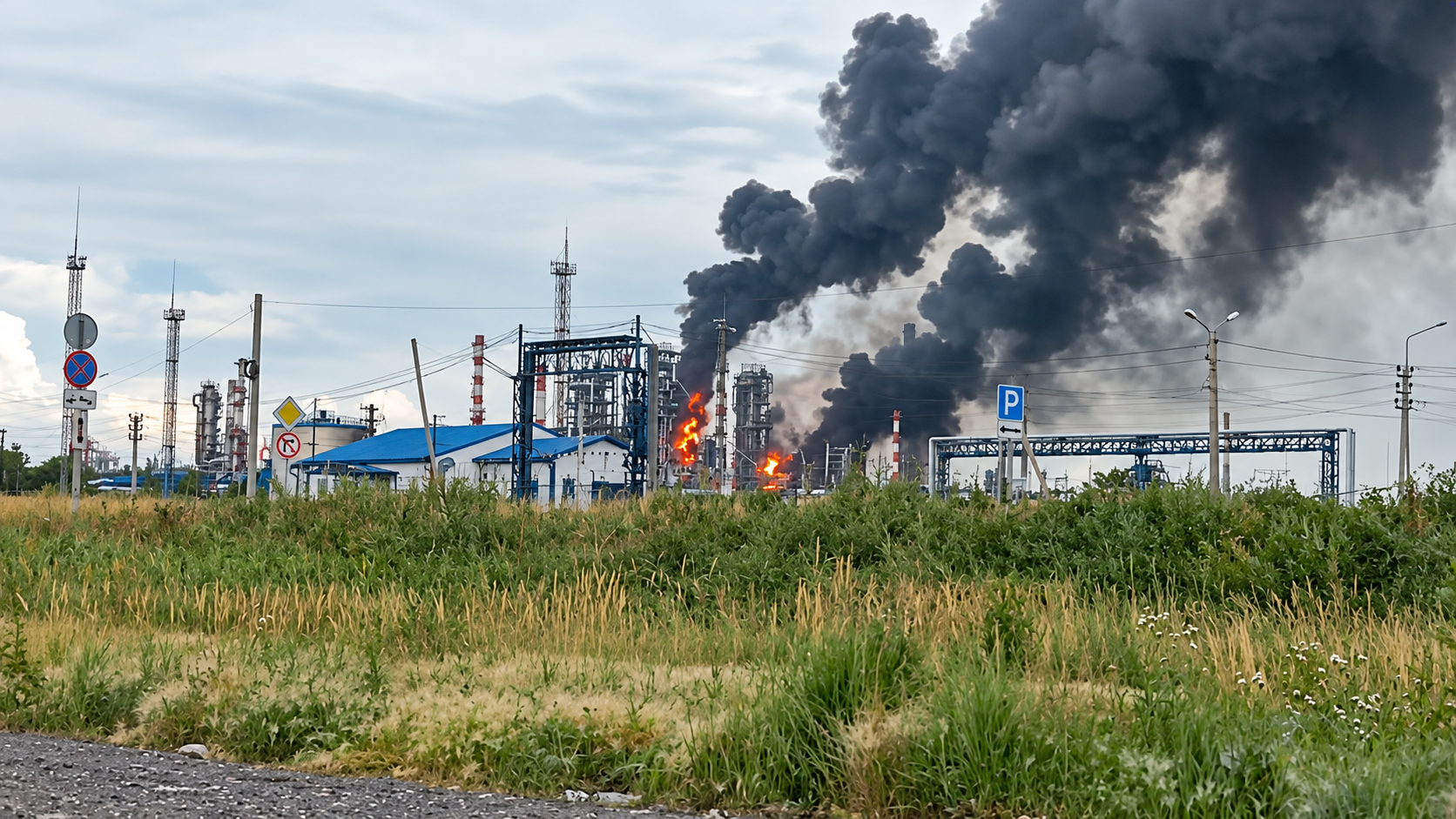
Ukraine carried out a confirmed FP-1 strike on the Omsk refinery more than 2,500 km from Ukraine, while other attacks hit industrial facilities in Sasovo and the refining complex in Salavat. Russia's attacks killed dozens in Kramatorsk and Pryluky and damaged Kyiv's energy network, causing major power and transport disruptions. U.S.-Ukraine talks were set for Miami on a proposed framework for ending the war, security guarantees and postwar reconstruction.
🇺🇦 Ukraine’s Defense & Military Developments
• Ukrainian Defense Forces struck the Omsk refinery with FP-1 drones at a distance of more than 2,500 km from Ukraine, the General Staff confirmed. A fire broke out at the facility, which can process about 22.23 million tonnes of oil annually, and one of its primary refining units was reported hit after an attack lasting roughly four hours.
• In Sasovo, Ryazan Oblast, a Ukrainian attack hit the Sasta machine-tool plant and the co-located Yandex data center. Sasta produces CNC machinery for Russia's defense, aerospace, transport and heavy industries, while Yandex confirmed that its data center stopped operating after infrastructure damage and power problems disrupted multiple services.
• The General Staff confirmed that Ukrainian forces hit the Gazprom Neftekhim Salavat refining and petrochemical complex in Bashkortostan, where a fire broke out. The facility can process up to 10 million tonnes of hydrocarbon feedstock annually and produces fuels and petrochemicals. The General Staff said the complex also helps meet the needs of Russian forces.
• Ukrainian forces also carried out a coordinated strike package against Russian military infrastructure. The General Staff listed a drone storage, preparation and launch site near Donetsk, command posts near Prydorozhne and Ocheretyne, a Mesh-network repeater in the Black Sea, a logistics warehouse and a field artillery depot among the targets.
• Staffing in some Ukrainian frontline units has fallen to about 50 percent, leaving available personnel and weapons sufficient mainly for holding positions rather than advancing without higher losses. Shortages of reserves and less frequent rotations are also contributing to exhaustion in those units.
• Ukraine's 156th Anti-Aircraft Missile Regiment has paired a Buk fire-control unit with a Kub launcher armed with 3M9 missiles. The combined system has already destroyed about 20 aerial targets, most of them Russian jet-powered attack drones, while allowing the Kub to use the Buk for detection, tracking and target illumination.
• The Ukrainian Navy used a Sargan-3000 unmanned surface vessel to shoot down a Russian Shahed operating through a mesh network. The drone was destroyed with fire from a 12.7 mm RWS Protector turret mounted on the boat.
• The 1030th Anti-Aircraft Regiment Aquila is operating the British RapidRanger air-defense system in Kharkiv Oblast against Russian jet-powered Shaheds and Banderol drones. The mobile system detects targets at roughly 15 km and engages them at up to 6 km, with the crew able to guide a missile manually by laser after launch.
• The 23rd National Guard Brigade Khortytsia destroyed Russian K-8 Dvushka drones on the Zaporizhzhia front using General Chereshnya AIR interceptors. The K-8 can reach about 150 km/h, carries 5 kg of explosives and is used for both strikes and logistics.
• Pilots from the Wormbusters unit of the 414th Brigade shot down a Russian Knyaz Vladimir Svyatoslavich attack drone. The ring-wing aircraft is designed for vertical takeoff and more efficient horizontal flight, with a range of about 50 km and a warhead of up to 3 kg.
• SIGNUM drone operators struck Russian logistics vehicles and mobile fire groups in the Donbas, with up to 20 vehicles or pieces of equipment left burning in Luhansk Oblast. A Russian Osa air-defense system was also attacked twice.
🇷🇺 Russia & the Warfront
• A Russian UMPB D-30 SN aerial bomb struck a street in Kramatorsk where two scheduled buses were traveling, killing 33 people and wounding 18. Both buses and an apartment building were damaged, and regional authorities suspended public transport in Kramatorsk and Sloviansk because of the deteriorating security situation.
• Twenty-two people, including five children, were killed when a Russian strike destroyed a five-story residential building in Pryluky, Chernihiv Oblast. Another 54 people, including seven children, were injured, and rescuers worked through the night before the search and rescue operation was completed.
• Russian attacks damaged a major Kyiv energy facility and several elements of the electricity network, causing widespread outages and disruption to urban services. The damage forced emergency power cuts affecting as many as three outage groups at once, along with interruptions to metro and electric transport and water and sewage problems in parts of the capital.
• Russia launched 142 drones overnight, including 82 jet-powered Shaheds, while Ukraine reported that 126 were shot down or suppressed. Hits were recorded at seven locations, with debris from intercepted drones falling at four more.
• An intercepted Russian military document from August lists 60 key targets in Ukraine's energy system, including cross-border lines and substations, 10 major hydroelectric plants, three nuclear power plants, thermal facilities, pumping stations and water-treatment infrastructure. The plan envisages up to 770 drones, 170 glide bombs and 75 Kinzhal and Iskander-M missiles, with Kyiv, Kharkiv and Odesa identified as major urban targets.
• Russian drones also struck Kyiv directly during October 8. In Holosiivskyi district, one person was killed and 11 were injured, while a strike on a four-story commercial building in Solomianskyi district killed two people and injured two more.
• Another Russian strike hit a residential high-rise in Kyiv's Desnianskyi district, killing two people. Rescuers saved 22 residents, including eight children, while four people were injured and emergency psychologists assisted 12 residents.
• Russian forces are transferring drone units, separate regiments and GRU special forces from lower-priority sectors to the Kramatorsk direction. The reported purpose is to create conditions for further combined-arms advances and an attempt to capture the Sloviansk agglomeration, although a Ukrainian commander described the current situation there as relatively stable.
• Russian troops advanced near Tsvitkove and Hirke in the Polohy district of Zaporizhzhia Oblast while concentrating armored and other heavy equipment to support further offensive operations. Stepnohirsk remains the closest area of active fighting to Zaporizhzhia.
• The Ukrainian General Staff reported Russian losses as of October 8 at 1,830 personnel, three tanks, four armored vehicles, 47 artillery systems, two multiple-launch rocket systems, two air-defense systems, 1,702 drones and 12 cruise missiles.
• President Volodymyr Zelensky estimated Russian frontline losses in September at 42,000 to 43,000 personnel, compared with monthly figures above 30,000 at the beginning of 2026. He said Russia had still failed to achieve decisive battlefield success despite that level of losses.
• Russian media citing The Telegraph said President Vladimir Putin tasked General Sergei Surovikin with destroying bridges in Kyiv in an attempt to paralyze the capital during winter and sever connections between the two banks of the Dnipro.
• The Institute for the Study of War assessed that Russia is concentrating waves of jet-powered Geran drones together with cruise and ballistic missiles on a limited number of priority targets to overwhelm local Ukrainian air defenses. During the October 7 attack, 30 cruise missiles were directed at Kremenchuk, Oleksandriia and Svitlovodsk.
• Russian cyberespionage group UAC-0099 has intensified attacks on Ukrainian government bodies, financial institutions, media, transport, manufacturing and energy companies using the MATCHBOIL loader. The malware is delivered through targeted phishing and VBScript files, contacts its command infrastructure every two minutes and uses Cloudflare and BitLaunch infrastructure to conceal operations.
• Russia has begun factory testing of the DF-1 Roscherk interceptor drone, designed to counter jet-powered drones. The 15 kg system is listed with a maximum speed of 500 km/h, a range of up to 250 km and a warhead of up to 1.5 kg, with public tests planned for November.
• Russian developers are also working on a low-cost anti-drone missile based on an existing Alazan family unguided rocket and have already presented the concept to Vladimir Putin. The planned interceptor is estimated to cost about 1 million rubles, roughly $12,000 per missile.
• A Russian drone fell in the yard of a school near the Petrivskyi Kvartal residential complex in Sviatopetrivske, Bucha district, causing a fire. The attack damaged a combined school-kindergarten and a nearby children's playground.
🇺🇸 United States
• U.S. envoys Steve Witkoff and Jared Kushner are set to meet a Ukrainian delegation in Miami for two days of talks on a proposed framework for ending the war, security guarantees and postwar reconstruction. Air defense and possible sectoral ceasefires covering energy infrastructure and the Black Sea are also on the agenda, with European, NATO and EU representatives expected to participate.
• U.S. Secretary of State Marco Rubio described Russia's war against Ukraine as a strategic stalemate with no current path to a negotiated settlement. He said Moscow still defines full control of Donetsk Oblast as a condition for victory that Ukraine cannot accept, while Washington expects Russia to use winter attacks against Ukraine's remaining power infrastructure.
• President Trump's administration has until October 19 to determine the future of Temporary Protected Status for more than 100,000 Ukrainians in the United States. If no formal termination decision is issued, protection would automatically continue for another six months, while lawmakers from both parties are pressing for a broader extension and a separate bill proposes coverage through 2029.
• U.S. authorities introduced additional health controls for passengers arriving from Siberia amid concerns surrounding an unexplained illness linked to an Irkutsk research institute. A medical point was established at John F. Kennedy International Airport, while the CDC assessed the risk to the United States as extremely low and both the WHO and State Department sought further information from Russia.
🇪🇺 Europe & World
• Ukrainian pilots will begin training on Rafale fighters in France in November 2026, according to French Armed Forces Minister Catherine Vautrin. Ukraine has ordered its first 16 aircraft, the first four are expected in 2028 or 2029, and the package includes AASM bombs and MICA and Meteor missiles.
• German defense company Quantum Systems plans to supply Ukraine with tens of thousands of SPYS high-speed interceptor drones developed with Ukrainian company WIY. Several thousand could arrive in 2026, with production planned at several thousand units per month for countering Russian Geran-4 and Geran-5 jet drones.
• NATO selected the Czech MTS-40 drone as the winner of a competition for affordable strike systems capable of attacking airfields without GPS or communications in heavy electronic warfare. The system costs about $90,000, has a range of more than 290 km and uses AI-based optical navigation, with further trials planned in Eastern Europe.
• Denmark's PET intelligence service says Russia is shifting from broader hybrid operations toward sabotage against Danish defense companies that produce or supply weapons for Ukraine. PET assesses Moscow's operational boldness as increasing, with particular attention on companies directly connected to Ukrainian military support.
• A failed sabotage attempt at Leipzig airport involving an explosive drone found near a Ukrainian An-124 has been linked to Russian military intelligence and GRU Colonel Denis Smolyaninov. Several other named individuals were also linked to the operation, including one whose traces were found on equipment used to strengthen the drone's control signal.
• The Kremlin rejected an Indian peace proposal that called for ending strikes on energy and infrastructure, maintaining uninterrupted grain and energy shipments through Black Sea ports and stopping attacks on commercial vessels. Kremlin spokesman Dmitry Peskov dismissed the approach as "segmental" and said Moscow wanted a broader long-term settlement instead.
• Turkey and the United Nations have organized new October talks with Ukraine and Russia on a maritime ceasefire in the Black Sea. Ankara says the effort is intended to restore safe shipping and repeat the result of the 2022 arrangement that reopened maritime traffic.
• South Korea recalled its ambassador from Ukraine after Kyiv disclosed the transfer of two captured North Korean soldiers despite an agreement not to publicize the operation. Ukraine had summoned the South Korean ambassador earlier in the week, and both sides have continued consultations despite the dispute.
• Germany extended temporary protection for Ukrainians already in the country under Section 24 of the Residence Act until March 4, 2028. From October 9, the mechanism will not apply to military-age Ukrainian citizens entering Germany unless they can demonstrate compliance with military-duty requirements, show that they left Ukraine legally or prove that they are exempt from military service.
• Prosecutors in Lublin closed their investigation into the mass incursion of Russian drones into Polish airspace on September 10, 2025, after failing to establish an individual perpetrator. Polish SIM cards were found in some of the downed drones, while the military response was judged lawful and compliant with weapons-use procedures.
• Slovakia and Russia restored the exchange of military attachés for the first time since the full-scale invasion. Bratislava appointed Brigadier General Slavomir Staviarsky and Colonel Ivo Gahir to Moscow, while Russian naval officer Maxim Verezhan is expected to take up the corresponding post in Slovakia.
• Russia's Prosecutor General asked the Netherlands to arrest and extradite nine representatives of the International Criminal Court, including former ICC president Piotr Hofmański and former prosecutor Karim Khan. The request concerns officials linked to cases against Russian figures and the arrest warrant for Vladimir Putin.
• Germany's AfD and BSW plan to introduce a motion next week in the Saxony-Anhalt parliament calling for an end to military support for Ukraine and renewed ties with Russia. The regional parliament cannot directly change German foreign policy, which remains under federal authority.
• Algerian Air Force transport aircraft have been making repeated flights to Russia through European airspace. A C-130 flew from Boufarik to Moscow on October 6 through several EU states, while recent routes have also involved Il-76MD, C-130H/H-30 and LM-100J aircraft that could be used for military-technical cooperation and support for Russian-origin weapons systems in Algerian service.
⚡ Geopolitics & Economy
• The United Kingdom imposed sanctions on 38 individuals and entities linked to Russia, including another 12 oil tankers from the shadow fleet. The package also targets three cryptocurrency exchanges, two payment platforms and 17 suppliers of machine tools, electronics and materials used in Russian ballistic missiles and drones.
• Indian refiners cut purchases of Russian crude to an average of about 310,000 barrels per day in the four weeks to October 4, the lowest level since March 2022. Russia's share of Indian imports fell from 56 percent in July to about 35 percent in September as Urals crude traded at a premium of more than $10 per barrel to Dated Brent and buyers shifted back toward Gulf suppliers.
• Russia's seaborne exports of oil products rose to a three-month high of about 1.17 million barrels per day in September despite Ukrainian refinery strikes. Diesel and gasoil exports fell to 144,000 barrels per day, their lowest monthly level in more than a decade, while petrochemical feedstock and fuel-oil shipments increased.
• Lithuania ordered tighter checks on the origin of grain moving through the country after authorities uncovered a scheme involving Russian products routed through a company registered in Klaipėda. The government also wants an EU ban on such transit and sanctions against Russian agricultural oligarchs while investigators examine possible movement of stolen or mixed Ukrainian grain.
• The Federation of Employers of Ukraine estimates potential Ukrainian GDP losses of up to 4.8 percent from the EU's Carbon Border Adjustment Mechanism unless its financial component is delayed or revised. The federation says default EU emissions values for Ukrainian cement clinker are roughly twice actual levels, increasing pressure on production, exports and employment.
• Russia has asked Vietnam to provide passenger aircraft together with crews and maintenance. Of 673 aircraft operated by the 11 largest Russian airlines, 130 are currently out of service, while Vietnamese use of Airbus or Boeing aircraft for such an arrangement could create secondary-sanctions risks.
• Kremlin adviser Kirill Dmitriev and Jared Kushner have been involved in discussions about possible U.S. investment in the Nord Stream pipelines. The concept could allow American investors to profit from postwar Russian energy deliveries to Europe, while the White House has denied recent talks specifically about Nord Stream and Dmitriev has separately discussed energy initiatives with U.S. officials.
• South Korea rejected Ukrainian accusations that fuel loaded at its ports was helping Russia ease domestic shortages. Kyiv cited more than 176,000 tonnes loaded in July and August onto tankers bound for Russia, some under British or EU sanctions, while Seoul said the counterparties, origin of the products and final consumers had not been established.
🛑 Society & Policy in Ukraine
• Thousands of Ukrainian service members have used a simplified procedure to return after leaving their units without authorization, with the total number described as comparable to the manpower of two or three brigades. Many returned to combat positions, and their pay and other benefits were restored.
• Ukraine's Cabinet kept preferential household electricity tariffs in place for the entire 2026-2027 heating season, including for homes using electric heating. The government said it plans to move eventually toward more targeted support for households that need assistance.
• Ukraine and Romania opened the Bila Tserkva-Sighetu Marmației road crossing in Zakarpattia, the region's first new automobile crossing with Romania in almost 20 years. It can initially process up to 400 passenger cars per day, with future capacity planned for an additional 360 trucks and 50 buses daily.
• Ukraine's High Anti-Corruption Court refused to approve a plea agreement with lawmaker Oleksandr Kachnyi in an illicit-enrichment case because the proposed UAH 3 million payment would have gone through a private charitable foundation whose subsequent use of the money would not be controlled by the court or the parties to the agreement. The court said such a transfer could not automatically be treated as direct aid to the Armed Forces, and the ruling has entered into force and cannot be appealed.
• A Rating Group poll found that 56 percent of Ukrainians would accept territorial concessions to Russia to end the war if backed by real security guarantees from the United States and Europe, while another 3 percent would accept concessions under any conditions. Thirty-five percent opposed any territorial concessions.
Russian forces shifted drone units, separate regiments and GRU special forces toward Kramatorsk while advancing near Tsvitkove and Hirke, and an intercepted document listed 60 priority targets across Ukraine's energy system. Ukraine reported about 20 aerial targets destroyed by the Buk-Kub pairing and a Shahed downed by a Sargan-3000, while some frontline units reported staffing near 50 percent. Quantum Systems planned production of several thousand SPYS interceptors per month, NATO selected the MTS-40 for further trials in Eastern Europe, and Denmark warned that Russia was shifting toward sabotage against defense companies supplying Ukraine. Economically, Britain widened sanctions, Indian refiners cut Russian crude purchases to their lowest level since March 2022, and Lithuania moved to tighten controls on grain linked to Russia.
🤝 SUPPORT US 💙
We continue to work only because you read and support us. If you appreciate what we do, please become our sponsor or donate here👇
☑️ patreon.com/meanwhileinukraine
or
☕️ buymeacoffee.com/meaninuak
or
☕️ ko-fi.com/meaninua
or
💳 paypal.me/meaninua
Your support helps us continue delivering timely and accurate updates. Stay informed and stand with Ukraine! 🇺🇦