

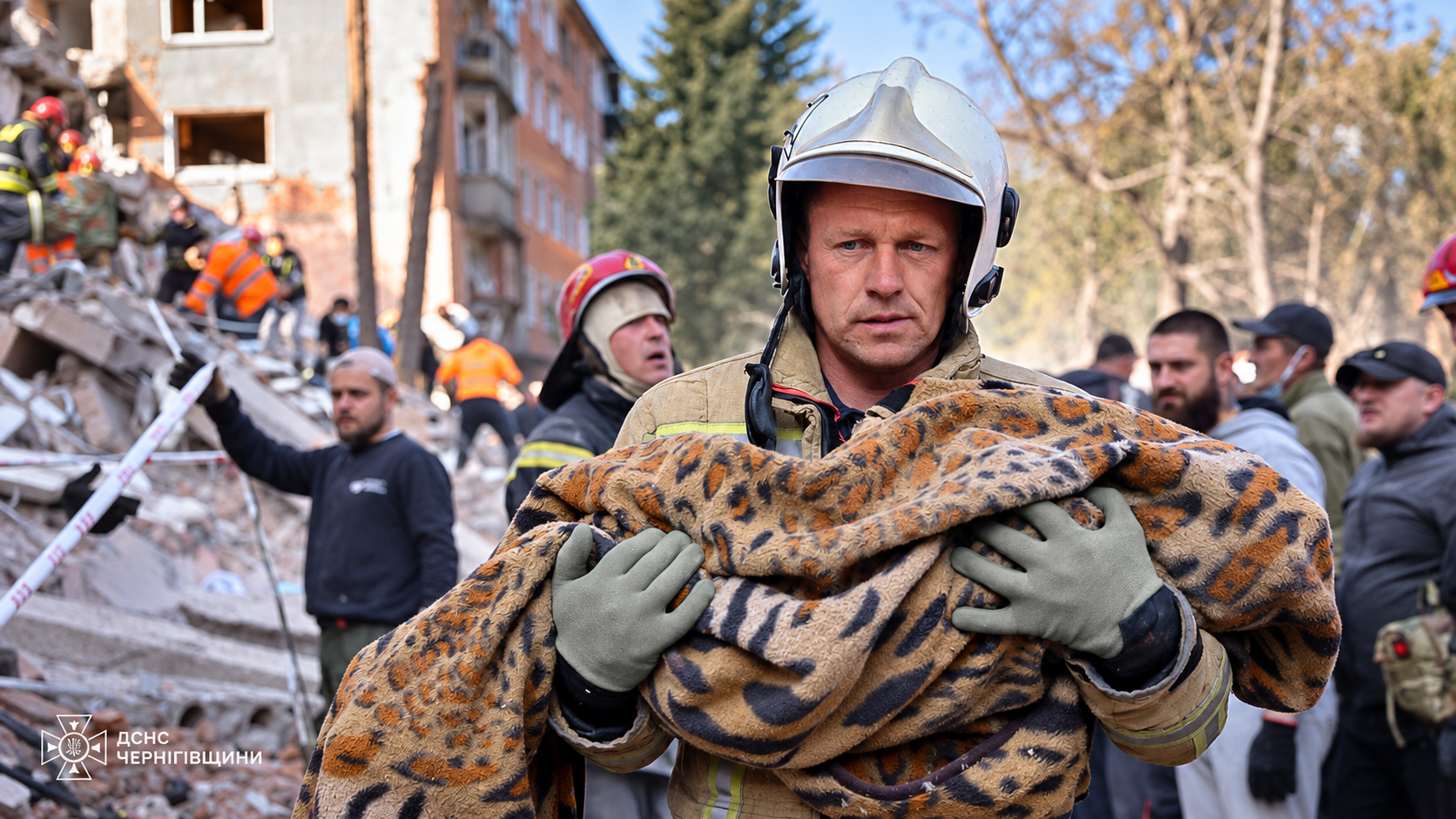
Russia launched a large coordinated missile-and-drone attack across Ukraine, killing 25 people and wounding 100, with energy infrastructure among the main targets. The strikes prompted emergency power restrictions in several regions. Ukraine simultaneously reported counteroffensive gains and sustained strikes on Russian military and energy infrastructure, while European governments advanced sanctions, air defense deployments, fighter-transfer talks and major new defense financing.
🇺🇦 Ukraine’s Defense & Military Developments
• Ukrainian forces are conducting counteroffensive operations in northern Kharkiv region, around Lyman and Kostiantynivka, and in western Zaporizhzhia region. Russian losses near Lyman exceeded 1,000 troops in a week after Operation Vivaldi, while Ukrainian units are trying to take Yampil and advancing along the Zherebets River; Black Bird Group assessed September as Russia’s worst month for net territorial gains since June 2023.
• Ukrainian forces struck the Seshcha airfield in Russia’s Bryansk region, an electronic-warfare station near Hryniove and a radar near Elionka during operations on October 6 and overnight into October 7. The same operation hit a drone storage, preparation and launch site near Donetsk, drone-control points in Zaporizhzhia region, command positions in Donetsk region, and logistics and fuel sites in occupied Luhansk region.
• Ukraine reported four strikes over the day against targets linked to Russia’s ability to finance and sustain the war, including two oil facilities and a training range across the Perm, Samara and Astrakhan regions, plus a target in the Black Sea. The Samara oil pumping station was hit again and burned at several locations. Earlier confirmed damage at the same site included 14 tanks, pipelines and an automated loading station; an October 4 strike on the Astrakhan gas plant damaged three processing units.
• Ukraine has established a persistent drone presence over occupied Crimea for the first time in 12 years of occupation. The 414th Brigade, known as the Birds of Magyar, conducted more than 7,000 sorties during the summer under the Unmanned Systems Forces’ Crimea operation, with drones regularly flying tens of kilometers over the peninsula toward targets.
• The Ukrainian Navy said its Sargan 3000 unmanned surface vessel destroyed a Russian Shahed with a gun turret mounted on the sea drone. The Shahed was operating within a mesh network when it was brought down by turret fire.
• The NC13 unit of Ukraine’s 3rd Assault Brigade has completed more than 100 operations using heavy bomber drones to deploy ground kamikaze robots 5 to 15 kilometers and deeper behind Russian lines. The systems have been used for reconnaissance, mining and attacks on personnel and logistics, and one operation caused Russian forces to cancel a planned mechanized assault after several soldiers were killed.
• Ukraine is deploying automated 12.7 mm machine-gun turrets as one layer of its air-defense network around Kyiv and in Kharkiv region. Air Force spokesman Yurii Ihnat said their effective range is roughly one kilometer and their current interception rate remains limited because deployment is still small, with tactical aviation, interceptor drones, short-range air defense and electronic warfare covering the same threat.
• Ukraine’s 40th Artillery Brigade reported hitting four Russian Giatsint-B guns, a Gvozdika self-propelled howitzer, a tank and an FPV-drone warehouse. The brigade also attacked shelters used by Russian troops.
🇷🇺 Russia & the Warfront
• Russia launched 130 drones and 48 cruise missiles alongside ballistic missiles in a coordinated attack on Kyiv and 12 regions. Ukraine reported intercepting or suppressing 117 drones, 39 cruise missiles and five ballistic missiles, while missile and drone impacts were recorded at 18 locations; President Volodymyr Zelensky said the combined attack killed 25 people and wounded 100 nationwide.
• A Russian strike on a residential building in Priluky killed 19 people, including five children, and wounded 55, including seven children. Ninety people received psychological assistance as rescuers continued clearing rubble and checking the destroyed building.
• Russia increased its use of jet-powered drones from about 1,500 in July to 2,850 in August and roughly 3,200 in September, with the Kyiv metropolitan area becoming a major target. The aircraft are more than twice as fast as earlier models, fly higher and use improved guidance, forcing Ukraine to rely heavily on fighter aircraft while roughly half of its F-16 fleet may be undergoing maintenance.
• Russia’s United Aircraft Corporation delivered another batch of Su-34 frontline bombers to the Defense Ministry after factory testing. Released material showed two aircraft, while Russia may have received at least four to six new Su-34s in 2026; the aircraft are major carriers of guided bombs, 8,766 of which Russia used against Ukraine in August alone, an average of about 283 a day.
• Ukrainian aviation expert Anatolii Khrapchynskyi assesses Russia’s Geran-5 modernization as an attempt to raise the jet-powered drone’s speed to about 800 to 900 km/h by moving the engine into the rear fuselage and increasing thrust. He said such speeds would move the threat beyond the effective range of cheaper interceptors and force greater reliance on systems such as NASAMS, IRIS-T and Mistral.
• Russia’s defense industry is upgrading T-72A tanks to the T-72B3M standard at a rate of about 360 vehicles per year. It is also assembling T-80UE-1 variants by fitting T-80UD turrets to T-80B or T-80U hulls, although current production numbers for that model remain unknown.
• Ukraine’s Sapsan missile program has effectively stopped after Russian strikes damaged key production infrastructure, according to aviation expert Valerii Romanenko. The affected facilities included a missile plant, a solid-fuel engine producer, a backup production site and two or three component suppliers.
• A Russian drone struck the grain carrier Royad Mammadov in the Black Sea near the Romanian coast, killing the captain and leaving another person missing. The vessel sank after the attack.
• Kremenchuk suffered a major combined Russian strike that caused some of the city’s most extensive residential damage since the full-scale invasion. Apartment buildings, private homes, facades, structural elements and vehicles were damaged, while an enterprise in the Kremenchuk district was also hit.
• The Kyiv Cardboard and Paper Mill was struck for the third time in six months, with serious damage to production and storage buildings, equipment and engineering systems. Fires broke out after the attack and production at the plant was suspended.
• A Russian strike on an industrial enterprise in Oleksandriia, Kirovohrad region, killed two people and wounded three. Another person was initially unaccounted for as emergency services worked at the site of a resulting fire.
• The central warehouse of ATL Autoservice in Kyiv was completely destroyed during the overnight attack. The facility handled the company’s main volumes of motor oils, batteries and other automotive goods; no employees were killed, while stores and service centers continued operating from reserves as logistics were rebuilt.
• A Russian strike hit the Borshchahivka chemical-pharmaceutical plant in Kyiv at about 5 p.m. The company ranks seventh among Ukraine’s pharmaceutical producers by revenue. The same attack damaged an Auchan fresh-food warehouse, where no employees were injured.
• Ukraine’s General Staff estimated cumulative Russian personnel losses since the start of the full-scale invasion at about 1,545,950, including 1,690 in the latest day. Its equipment estimate included 12,396 tanks, 25,498 armored vehicles, 50,836 artillery systems, 443 aircraft, 356 helicopters, 35 ships and boats, two submarines and 5,126 cruise missiles.
🇺🇸 United States
• The U.S. Army has begun developing PrSM Increment 4 for M142 HIMARS and M270 launchers, targeting a range of at least 1,000 kilometers and the ability to strike moving ground targets and ships. Prototype contracts went to Anduril, Castelion, Lockheed Martin, Mach Industries and RTX, with field testing planned for 2027.
• The Trump administration is considering arrangements with Moscow that could include sanctions relief in exchange for the release of some political prisoners and a potential multibillion-dollar oil agreement. The measures remain under consideration rather than announced policy.
• Two leading political advisers to President Trump, James Blair and Chris LaCivita, traveled to Republika Srpska to advise its government on election issues. They received hundreds of thousands of dollars through a Washington law firm, while Trump-linked lobbyists and political operatives have received more than $4 million from the Republika Srpska government since early 2025.
🇪🇺 Europe & World
• The European Commission paid Ukraine €1.24 billion through the defense component of the €90 billion Ukraine Support Loan. The money covers drones, interceptor drones, drone munitions and Ukrainian-made missiles, bringing defense financing under the program to nearly €13 billion.
• Norway’s government included 85 billion kroner, about $8.89 billion, for Ukraine in its draft 2027 defense budget through the Nansen Support Program. The commitment brings the program’s overall value to 344 billion kroner, about $36 billion, alongside a separate €90 million Norwegian contribution to the EU fund for Ukraine.
• Sweden will deploy Patriot air-defense systems and about 100 personnel to eastern Poland beginning in December to protect the NATO logistics hub used to supply weapons to Ukraine. Prime Minister Ulf Kristersson announced the mission without disclosing the number of Patriot systems involved.
• Poland has at least 29 F-16 fighters available for possible transfer to Ukraine, Foreign Minister Radoslaw Sikorski said. A transfer schedule had been agreed roughly six months earlier but later stalled, while negotiations continue and two Ukrainian technical delegations have visited Poland.
• Ambassadors from all 27 EU countries worked through a large-scale hybrid-attack scenario involving mass casualties after an explosives-carrying drone was discovered at Leipzig airport in August. Measures under consideration include emergency response teams, EU financial assistance to an affected state and coordinated crisis communication.
• According to former U.S. ambassador to NATO Julianne Smith, NATO has increased patrols, intelligence sharing, infrastructure protection and counter-drone measures as Russian hybrid activity in Europe has expanded from cyberattacks and disinformation toward sabotage, arson, drone incidents and airspace violations. Smith described this as an increasingly dangerous creeping escalation and said further responses could include tougher sanctions and stronger protection of undersea infrastructure.
• Latvian troops detained at least 20 migrants after armed masked men deliberately pushed the group from Belarus toward the Latvian border and threatened Latvian soldiers. Latvia’s armed forces described the episode as a demonstrative aggressive provocation and a hybrid threat.
• France carried out the first launch of its new M51.3 submarine-launched ballistic missile from Le Vigilant, the first M51-family launch from an operational submarine in three years. The test carried no nuclear warhead, and Russia confirmed receiving advance notification before Kremlin spokesman Dmitry Peskov criticized Europe’s military buildup.
• Turkish President Recep Tayyip Erdogan offered Ankara’s participation in arranging direct contacts between Ukraine and Russia during a telephone conversation with Vladimir Putin. The two also discussed security of navigation in the Black Sea.
• Ukraine says it is ready for five ceasefire formats: a full and unconditional ceasefire, Black Sea navigation security, Black Sea food security, an energy truce and a separate U.S.-linked energy arrangement. Turkey and Egypt are involved in the Black Sea tracks, India in the food-security initiative, while implementation requires Russian consent.
• India submitted a settlement proposal calling for an end to strikes on energy and other infrastructure, uninterrupted grain and energy shipments through Black Sea ports, and a halt to attacks on commercial shipping, according to Kremlin spokesman Dmitry Peskov.
• North Korean leader Kim Jong Un pledged continued support for Russia and further expansion of the countries’ strategic partnership. Their cooperation has included up to 15,000 North Korean troops sent in support of Russia since 2024 and transfers of ballistic missiles following the countries’ mutual-defense treaty.
• Russian authorities changed their explanation for the death of an employee at the Irkutsk anti-plague research institute after officials initially linked the case to plague and later described it as pneumonia of unknown origin. At least 200 possible contacts were quarantined, the U.S. Embassy advised Americans not to travel to Russia and urged those already there to leave, while President Trump planned a call with Putin and Washington offered assistance.
⚡ Geopolitics & Economy
• EU ambassadors approved a major expansion of sanctions against Russia covering 1,646 entries, including 743 individuals, 826 organizations and 77 State Duma deputies elected from occupied Ukrainian territories. The measures include entry bans, asset freezes and financing restrictions, while the sanctions list was extended for three years.
• Russian military spending in 2026 could reach almost 17 trillion rubles, about $199 billion, after planned expenditures rose by approximately $60 billion, around 40 percent above the original budget. The projected deficit increased from 3.8 trillion to more than 7 trillion rubles and is being financed through domestic borrowing and gold sales, while Moscow is already planning 17.1 trillion rubles in military spending for 2027.
• Residents of dozens of Russian cities across the Chelyabinsk, Perm and Nizhny Novgorod regions, Krasnoyarsk Krai and Omsk remained without heating after the start of the heating season. Heating was absent even in some kindergartens, while average wear across Russia’s utility networks exceeds 40 percent and reaches 70 to 80 percent in some regions.
• South Korea’s presidential office denied that the country is supplying oil products to Russia and opened a review after data indicated that more than 176,000 metric tons of fuel were loaded onto seven Russia-bound tankers in July and August. August alone accounted for 112,000 metric tons, equivalent to 31 percent of Russia’s seaborne petroleum-product imports, while Seoul said it complies with sanctions and export controls and will act if violations are found.
• Russia is redirecting part of its grain exports from the Black Sea toward Baltic routes through Lithuania, Latvia and Estonia. Lithuania remains the only one of the three that has not restricted Russian grain transit, while a Lithuanian lawmaker is calling for the route to be closed and for the Dolgov brothers to be added to EU sanctions lists.
• Critical Metals received Greenland government approval to move toward exploitation of the Tanbreez deposit in southern Greenland, one of the largest undeveloped heavy rare-earth projects outside China. Resources are estimated at about 45 million metric tons, the project has an after-tax net present value of at least $2.1 billion, and infrastructure work and a 10,000-meter drilling program are underway.
• The World Bank cut its forecast for Ukraine’s 2027 GDP growth from 4 percent to 1.5 percent, assuming active fighting continues throughout next year and Russian attacks on critical infrastructure persist. Growth in 2026 is projected at just 1.2 percent, with a possible recovery to 3 percent in 2028.
• Ukraine’s three largest steel plants, Zaporizhstal, Kametstal and ArcelorMittal Kryvyi Rih, which accounted for about 90 percent of steel production, are not operating. Steel exports fell 76 percent between June and August and seaborne shipments dropped 97 percent, while the industry links a 30 percent increase in rail freight tariffs to the possible loss of almost UAH 100 billion in GDP and $2.4 billion in foreign-exchange earnings. Metinvest chief executive Yuriy Ryzhenkov said the EU quota cut exceeds 50 percent and warned that restricted access to the EU market could undermine new investment in rebuilding production.
• Ukraine’s international reserves stood at $47.1 billion on October 1, down 3.2 percent in September, while the National Bank sold $5.4 billion on the foreign-exchange market. Government inflows included $890.4 million through the World Bank and $3.81 billion from the EU, and reserves cover roughly four months of future imports.
• Ukraine rejects a model of full EU membership accompanied by permanent restrictions on sales of particular Ukrainian agricultural products, Agriculture Minister Taras Vysotskyi said. Kyiv is prepared to accept temporary quotas and safeguards only if they have an end date, while the European Commission’s October 6 proposal would retain major restrictions for sensitive products.
• Smart Energy chief executive Oleksii Zaiets said Russian attacks, difficult geology and regulatory restrictions are constraining Ukrainian gas production. Naftogaz-group facilities have faced 293 attacks since the start of 2026, while blocked Smart Energy assets have cost Ukraine almost 300 million cubic meters of gas production.
🛑 Society & Policy in Ukraine
• Ukrenergo imposed emergency electricity restrictions in Kyiv and several regions after intensified Russian attacks on the power system, with new outages in Poltava, Chernihiv, Kharkiv, Vinnytsia and Kherson regions. Restrictions in some areas reached 0.5 to 1.5 outage groups, while power losses at pumping stations caused water-supply disruptions on Kyiv’s right bank.
• Energy expert Stanislav Ihnatiev said a new Russian tactic could leave parts of Kyiv without stable electricity for 15 to 16 hours, with drones fitted with devices designed to cut transmission lines and capable of circling damaged sites to delay repairs. He said the left bank is particularly vulnerable because only three major energy connectors link the two sides of the capital; under a winter scenario with an average daily temperature of minus 10°C and no new large-scale Russian strikes, Ukraine could still face at least six hours of daily power cuts. About 1,100 Kyiv apartment buildings depend on the damaged Darnytsia thermal power plant, while electricity imports of up to 2.3 GW are expected to cover part of the deficit.
• Ukraine’s protective construction program for major power transformers is about 90 percent complete, according to lawmaker Serhii Nahorniak. Reinforced-concrete shelters are being built around key transformers, although installation requires taking one of three units offline, while anti-drone metal nets remain unfinished and are expected to be completed within several weeks.
Russia’s October 7 attack combined missiles and drones on a national scale and produced heavy civilian losses. Russian strikes on energy infrastructure translated directly into emergency power restrictions and preparations for a difficult winter, while attacks also damaged industrial facilities across Ukraine. Ukraine continued counteroffensive operations and attacks on Russian airfields, oil infrastructure, command sites and logistics. Ukrainian forces also used robotic ground systems and maritime air defense and established a persistent drone presence over occupied Crimea. European states paired financial assistance with sanctions, Patriot deployments and renewed F-16 discussions, while EU and NATO actors also addressed hybrid threats through exercises, patrols, intelligence sharing and infrastructure protection. The economic strain is visible on both sides, from Russia’s rapidly expanding military budget to Ukraine’s weaker growth outlook, steel-industry shutdowns and pressure on domestic gas production.
🤝 SUPPORT US 💙
We continue to work only because you read and support us. If you appreciate what we do, please become our sponsor or donate here👇
☑️ patreon.com/meanwhileinukraine
or
☕️ buymeacoffee.com/meaninuak
or
☕️ ko-fi.com/meaninua
or
💳 paypal.me/meaninua
Your support helps us continue delivering timely and accurate updates. Stay informed and stand with Ukraine! 🇺🇦