

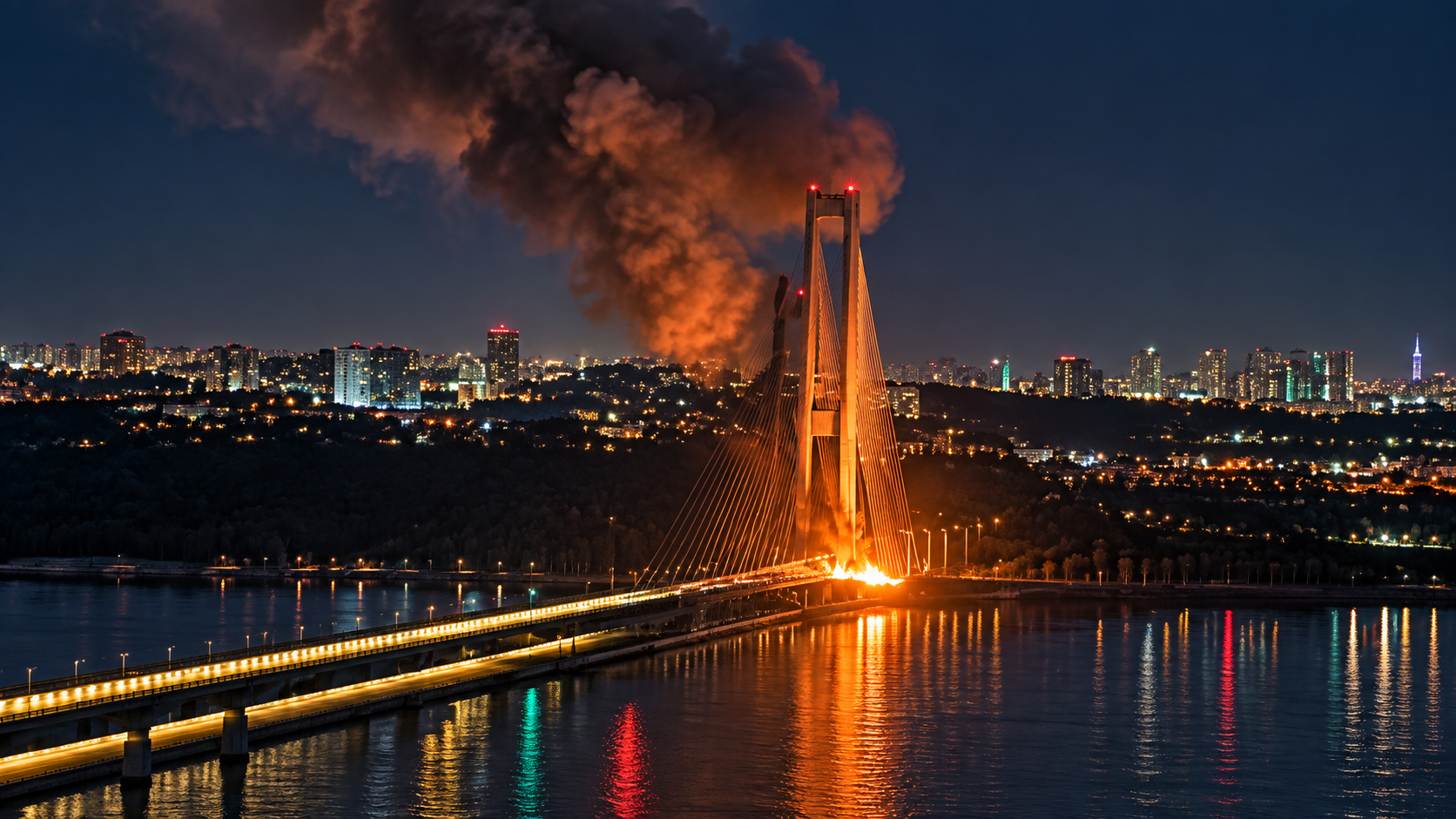
Russia’s 108-drone overnight attack was accompanied by renewed strikes on Kyiv’s bridges, while an intercepted plan calls for up to 1,000 weapons to destroy as much as 15 GW of Ukrainian energy capacity. Ukraine reported at least 147 square kilometers liberated during Operation Vivaldi while also striking major oil infrastructure in Samara and Volgograd. Ukrainian forces are testing five high-speed interceptor models, with one being prepared for production of about 400 units per month by the end of October.
🇺🇦 Ukraine’s Defense & Military Developments
• Ukrainian forces have liberated at least 147 square kilometers during Operation Vivaldi on the Lyman axis, forcing Russian troops to retreat and reducing pressure on the Sloviansk-Kramatorsk area, according to Joint Forces spokesperson Viktor Trehubov. Ukrainian units are also counterattacking around Ozerne, Dibrova, Yurkivka, Malynivka and Tykhonivka, while territorial assessments indicate Russia lost more ground than it gained between March and September.
• Ukrainian forces carried out a wider series of long-range operations against Russian military and industrial targets across several regions and in the Black Sea, President Volodymyr Zelensky said. The operations included airfields, an ammunition depot and a rocket-space center, although no damage assessment for those additional targets has been established.
• The Lukoil refinery in Volgograd, which can process about 15 million tons of oil a year, was struck by Ukrainian forces, with fires reported near its delayed-coking and ELOU-AVT units. The nearby Kaustik chemical plant also caught fire during the attack, while one person was injured in a residential building in Volgograd.
• Ukrainian long-range drones struck the Samara oil hub, where a large fire broke out at a facility used to receive, store and blend crude before feeding the Kuibyshev-Tikhoretsk and Druzhba pipelines. The site contains 71 tanks with total capacity above 1.6 million cubic meters; Ukrainian monitoring channels reported eight tanks burning and damage to pipelines and a pumping station, while losses from the tanks and stored oil were estimated at roughly $200 million.
• Ukraine has used its domestically produced FP-7 ballistic missile in combat for the first time. The Oct. 1 launch targeted a site in occupied Ukrainian territory, according to Fire Point CEO Iryna Terekh, but the strike result has not yet been established; the missile is reported to have a range of about 250 kilometers, a 200-kilogram warhead and a reported error of up to 15 meters.
• Five models of high-speed interceptor drones are being tested in Ukraine as jet-powered drones account for roughly half of Russian drone launches, according to Zelensky. Ukrainian forces currently destroy about 57% of those targets compared with 85% to 90% of conventional drones, while one interceptor design is being prepared for production of about 400 units per month by the end of October despite shortages of engines and funding.
• President Zelensky described Ukraine’s F-16s as highly effective against Russian jet-powered drones but said roughly half of the fleet is currently in Europe for maintenance. Former Deputy Defense Minister Kateryna Chornohorenko said some servicing could take up to 40 weeks, while Foreign Ministry spokesperson Heorhii Tykhyi disputed claims of catastrophic readiness problems and said turnaround times are improving.
• Ukrainian FP-2 strike drones destroyed a Russian Pantsir-S2 air-defense system that had been obstructing Ukrainian drones flying toward targets deeper in the Russian rear. A secondary detonation tore the system apart after the strike.
• The 413th RAID Regiment reported that its electronic-warfare operators protected Ukrainian military equipment worth more than ₴2.1 billion from Russian drone attacks over six months. The unit also said its systems protected more than 200 Ukrainian servicemembers targeted by Russian FPV and Molniya drones.
• The Alter Ego unit of Ukraine’s 93rd Mechanized Brigade has used an amphibious unmanned ground vehicle for a frontline logistics mission for the first time. After an unsuccessful initial attempt, the upgraded vehicle traveled about 70 kilometers in total carrying food and other supplies, survived Russian fire and completed the mission under manual operator control.
🇷🇺 Russia & the Warfront
• Russia attacked Ukraine overnight with 108 drones, including 47 jet-powered Shaheds as well as Gerbera and Parodiya UAVs. Ukrainian air defenses shot down or suppressed 88 drones, while impacts were recorded at 11 locations and debris fell at five more.
• An intercepted Russian plan presented by Ukrainian Energy Minister Denys Shmyhal calls for a winter campaign intended to destroy up to 15 GW of Ukrainian energy capacity with as many as 1,000 missiles, drones and bombs. The listed targets include substations, hydroelectric and thermal plants and boiler houses, while the plan also describes attempts to stop three operating nuclear plants by striking open distribution substations, some less than 1.6 kilometers from reactors.
• Russia has concentrated four armies along roughly 50 kilometers of the front for an offensive toward Dobropillia in Donetsk region, sending hundreds of troops into daily assaults supported by drones and guided bombs. Russian units have advanced south of the city and established positions north and west of Ukrainian defensive lines, while Ukrainian counterattacks have cleared parts of the areas penetrated by Russian forces.
• Three Russian guided aerial bombs struck Kharkiv’s Slobidskyi and Nemyshlianskyi districts, killing two people and injuring 28, including a child. One bomb completely destroyed a residential house, while homes, office buildings, an educational facility and vehicles were damaged across the two districts.
• Russia again struck Kyiv’s South Bridge at about 05:03 after earlier drone hits near the structure’s support section. The South Bridge was closed in both directions, traffic was restricted on the Paton and Metro bridges, several bus routes were redirected and Kyiv City Express restored cross-river rail service.
• President Zelensky said intercepted Ukrainian intelligence communications indicate that Vladimir Putin ordered Russian commanders in September to loosen restrictions on strikes against Ukraine. Zelensky said attacks subsequently intensified against Kyiv, including schools, hospitals, telecommunications infrastructure and data centers; dline halted operations and moved services to backup sites after strikes, while the Parkovyi data center sustained critical damage and Cosmonova was repeatedly hit.
• Russia plans to increase military spending next year by 40% compared with its planned current-year level, bringing expenditures to almost 380% above the prewar level. A substantial share of the additional money is intended for missiles, drones and other weapons, while deeper Ukrainian strikes are also forcing Moscow to spend more on defenses inside Russia.
• Defense Express director Serhii Zghurets estimates Russia can produce about 3,200 jet-powered Geran-4/5 drones and another 3,000 gasoline-powered Geran-2 drones each month. He said more than 2,000 jet-powered UAVs were used against Kyiv in a single month while Russia continues to preserve ballistic and cruise missiles for the winter period.
• Russian forces are accumulating armored and other heavy equipment on the Huliaipole axis and have already carried out a trial mechanized assault toward Zaliznychne and Hirske. Ukrainian units stopped the attack, while Russia lost more than 600 vehicles, around 50 armored vehicles and more than 3,000 personnel killed or wounded on the axis during September.
• Ukraine’s General Staff reported Russian losses for Oct. 2 at 1,520 personnel, seven armored vehicles, 37 artillery systems, one multiple-launch rocket system, 1,470 drones and seven cruise missiles.
• A Russian Mi-8 helicopter carrying three crew members was apparently shot down by a Russian Su-35 while being moved because of a Ukrainian drone threat. The preliminary account says the fighter crew mistook the helicopter for a hostile drone; Russia plans to manufacture 72 Mi-8 helicopters in 2026 and 2027, doubling the current production rate.
• Russia has displayed previously unknown jet-powered Garpiya kamikaze drones together with a mobile launcher mounted on a KamAZ-5350 military truck and capable of carrying several UAVs. Only the piston-powered Garpiya-A1 had previously been identified, while a Russian source suggested the new version may be produced by IEMZ Kupol.
🇺🇸 United States
• The U.S. Treasury’s Office of Foreign Assets Control sanctioned the Russia-linked A7 Network as a significant transnational criminal organization involved in money laundering and disguising illicit financial operations as legitimate trade. The network, led by sanctioned Moldovan businessman Ilan Shor, was conducting more than 2,000 transactions per day worth more than $91.5 billion as of January 2026, equivalent to roughly 13% of Russia’s 2025 foreign trade.
• According to Ukrainian lawmaker Oleksandr Merezhko, John Cole, President Trump’s envoy for Eastern Europe, is promoting a proposal to partially ease sanctions on Russia in exchange for a limited humanitarian step such as releasing some political prisoners. President Trump has not made a decision on the proposal.
• The Trump administration is redirecting $52 million in foreign assistance from Slovakia, North Macedonia, Tunisia and Iraq to Panama, Peru, Ecuador and Colombia. Some funding originally assigned to Slovakia and North Macedonia was part of a supplemental Ukraine-related package, while Sen. Jeanne Shaheen and Rep. Gregory Meeks objected before the administration decided to proceed.
• Russian businessman Umar Kremlev spent at least $170,000 on a private island and fireworks display for the wedding of Donald Trump Jr. and Bettina Anderson, prompting Rep. Robert Garcia to demand clarification about the gift. Trump Jr. offered to repay the money, while Kremlev, who heads the International Boxing Association, received Russia’s Order of Friendship from Vladimir Putin earlier this year.
🇪🇺 Europe & World
• Türkiye and the United Nations have organized new talks for early October with Ukraine and Russia on a Black Sea ceasefire and protection of grain shipping. Representatives of Switzerland’s Centre for Humanitarian Dialogue are expected to mediate the process.
• Ukrainian Foreign Minister Andrii Sybiha said Kyiv has four ceasefire proposals from India, Türkiye, Egypt and the United States. The Indian proposal covers energy and the Black Sea, the Turkish and Egyptian initiatives focus mainly on Black Sea security and grain exports, and Ukraine says a complete halt to attacks on energy facilities, including port infrastructure, must be linked to a Black Sea ceasefire.
• A likely aerial drone object fell near Plauru in Romania’s Tulcea County at about 05:00. Romania’s Defense Ministry said the object caused a fire but no casualties or material damage, while authorities cordoned off the area and opened an investigation; radar systems recorded no unauthorized intrusion into Romanian airspace.
• Ukraine’s military intelligence says Russian special services are preparing hybrid operations in EU and NATO countries aimed at military sites, critical infrastructure and communications systems, including Starlink receiving stations. Ukrainian intelligence said partner governments have been warned.
• German investigators are examining an attempted sabotage operation against a Ukrainian An-124 aircraft at Leipzig Airport involving a drone carrying 1.8 kilograms of explosives. Russian national Oleg Lyovushkin and Belarusian Andriy Karshakov are named as possible participants, and investigators found Karshakov’s DNA on a fragment of a glove attached to an antenna after the detonator failed.
• A reported Russia-Belarus scheme routes migrants from the Middle East and Africa through Moscow and Minsk toward the borders of Latvia, Lithuania and Poland. Latvia has denied entry to more than 11,000 people this year and reinforced its Belarusian border with fencing, cameras, drones, motion sensors and rapid-response patrols, while Latvian officials attribute the operation to an effort to create domestic pressure and divert security resources.
• Sixteen Dassault Rafale fighters for Ukraine could come from France’s fifth production batch or from aircraft already ordered by a foreign customer willing to postpone delivery. The production cycle is about 36 months and Paris has not announced a separate order for Ukraine; Ukrainian pilot and technician training is due to begin in 2026, while under the prospective schedule the first four aircraft could arrive in 2028 or 2029.
• Japanese lawmaker and former defense minister Itsunori Onodera raised the possibility of reopening domestic discussions on providing or selling weapons to Ukraine, including Patriot interceptors, during a visit to Kyiv. Japan has 24 Patriot batteries and produces PAC-3 interceptors under license, but legal and political restrictions remain and no transfer decision has been made.
• Some Western embassies have prepared contingency plans to move operations from Kyiv to Lviv or eastern Poland if diplomatic facilities come under direct attack.
• A leaked intelligence memo prepared for Five Eyes services says with “high confidence” that Russia may have used Western veterans to train Russian citizens and active servicemembers at the Alfa-Metal facility in northern Bulgaria. Alfa-Metal categorically denies the allegation, while Bulgaria’s Interior Ministry says 13 inspections conducted between February 2022 and Sept. 24, 2026 found no violations.
• Radio Free Europe editor Rikard Jozwiak identified Oct. 13 as a possible date for opening two EU accession negotiating clusters each for Ukraine and Moldova. Hungary currently blocks the opening of four Ukrainian clusters over disputes concerning the rights of the Hungarian minority in Zakarpattia.
• EU Enlargement Commissioner Marta Kos said Ukraine cannot join the European Union on Jan. 1, 2027 because accession remains based on meeting established criteria and provides no special exemptions. The EU is also preparing discussions on its own internal reforms, rule-of-law safeguards, gradual integration and the possible wider use of qualified-majority voting in security and defense.
• South Korean President Lee Jae Myung is demanding a public apology from Ukraine and recognition of a confidentiality agreement concerning two captured North Korean soldiers. Lee has indicated that additional measures could follow if the dispute continues, with humanitarian and financial assistance and reconstruction support among the areas that could be affected.
• Hungarian authorities are nearing the end of an investigation into the March detention of Ukrainian Oschadbank cash couriers carrying valuables worth €70 million. Former prosecutor Frucht alleges that former prime minister Viktor Orban personally ordered security services to seize their vehicle, and investigators may bring charges.
• Sixty-five percent of Estonians consider a Russian attack in the coming years unlikely, while 27% view it as likely. Estonian intelligence currently says it sees no signs that Russia is preparing an attack on Estonia or another NATO country.
• Chancellor Friedrich Merz linked the Alternative for Germany party with support for Russia and Russian efforts to destabilize German society, weaken aid to Ukraine and reduce investment in deterrence. Merz presented no concrete evidence that Moscow finances the party or directs its policies, while AfD supports ending German military assistance to Ukraine and restoring imports of Russian gas.
⚡ Geopolitics & Economy
• Russian attacks have already caused an estimated $10 billion in losses to Ukraine’s economy this autumn, according to financial analyst Andrii Shevchyshyn, with a pessimistic scenario of losses reaching $20 billion during the autumn and winter if the current intensity continues. Major industrial disruptions include halted or reduced steel production, a September week in which Ukraine produced no steel, and direct losses of €35 million reported by German businesses operating in the country.
• Ukraine has established four routes for importing U.S. liquefied natural gas after Russian attacks in 2025 destroyed up to 60% of domestic gas-production capacity. The routes run through Świnoujście in Poland, Klaipėda in Lithuania, Mukran in Germany and Revithoussa in Greece through the Vertical Corridor, while Ukraine’s underground storage system can hold more than 30 billion cubic meters and could serve wider Central and Eastern European distribution.
• Ukraine received €2.9 billion from the European Union under the Ukraine Facility after completing 10 reform indicators covering two quarters of 2026 and earlier periods, including three completed ahead of schedule. The reforms covered banking, energy, agriculture and transport, while the funding will support core state spending and allow more domestic resources to be directed toward defense.
• The United Kingdom added eight vessels to a new sanctions package targeting Russia’s shadow LNG fleet, including the newly commissioned Alexei Kosygin and Konstantin Posyet tankers and the Pyotr Stolypin. The two new LNG carriers are about 300 meters long and can operate through Arctic ice up to two meters thick.
• Global food prices rose 1.5% in September from the previous month and 5.8% from a year earlier, according to the UN Food and Agriculture Organization. Grain prices rose 5.1% in one month and 17.2% year over year, while disruptions in the Black Sea region constrained wheat and corn exports.
• The National Bank of Ukraine set the official exchange rate for Oct. 5 at ₴44.99 per U.S. dollar, 16 kopecks weaker and above the previous record of ₴44.98 set on June 11. The official euro rate was set at ₴50.53, while interbank dollar quotations reached ₴44.97 to ₴45.00.
🛑 Society & Policy in Ukraine
• Ukraine has received more than 26,000 bodies that Russia says are those of fallen Ukrainian servicemembers, according to Kyrylo Budanov. Kyiv is accelerating identification work, creating an interagency group and expanding access to international DNA-testing capabilities.
• Investigators have not identified anyone who commissioned the murder of Iryna Farion or any accomplices. A Lviv court on Oct. 1 sentenced Viacheslav Zinchenko to life imprisonment for the killing and illegal weapons possession and awarded Farion’s daughter ₴5 million in moral damages.
• Bill No. 16119, registered in the Verkhovna Rada, would keep Ukrainian as the main language of education while allowing official EU languages in classes and groups for national minorities. Schools where more than half of students study in a minority language could receive minority-school status, while two-thirds of parents in a class or group could request an increase in the number of subjects taught in Ukrainian.
• A new wave of relocations from Kyiv, Dnipro, Kharkiv, Odesa and other cities has sharply tightened the rental market in western Ukraine. Average rent in Uzhhorod has risen 50% in a year and is now about 80% above Kyiv levels, while one-bedroom apartments average about ₴22,500 in Ivano-Frankivsk and ₴24,800 in Lviv.
• Ukraine’s Bureau of Economic Security seized more than ₴630 million in cash in an investigation into illegal currency-exchange operations. The amount was described as a record seizure in the case.
Russia plans to raise military spending by 40% next year, while Defense Express director Serhii Zghurets estimates monthly production at about 3,200 jet-powered Geran-4/5 drones plus 3,000 Geran-2s. Ukraine has simultaneously recovered at least 147 square kilometers around Lyman, carried out a wider series of long-range operations and used the domestically produced FP-7 ballistic missile in combat for the first time. Financial analyst Andrii Shevchyshyn estimates that Russian attacks have already caused about $10 billion in economic losses this autumn, while Ukraine has received €2.9 billion from the EU and established four U.S. LNG import routes alongside underground storage capacity exceeding 30 billion cubic meters. Türkiye and the United Nations have organized Black Sea talks for early October, while Ukraine says it has four ceasefire proposals from India, Türkiye, Egypt and the United States.
🤝 SUPPORT US 💙
We continue to work only because you read and support us. If you appreciate what we do, please become our sponsor or donate here👇
☑️ patreon.com/meanwhileinukraine
or
☕️ buymeacoffee.com/meaninuak
or
☕️ ko-fi.com/meaninua
or
💳 paypal.me/meaninua
Your support helps us continue delivering timely and accurate updates. Stay informed and stand with Ukraine! 🇺🇦
Together we are stronger! 🇺🇦
BLURB - Facebook:
Russia launched 108 drones overnight as an intercepted plan called for up to 1,000 weapons to destroy as much as 15 GW of Ukrainian energy capacity. Ukraine reported new territorial gains around Lyman and struck major oil infrastructure in Samara and Volgograd.
BLURB - X (Twitter):
Russia launched 108 drones overnight, while an intercepted plan called for attacks intended to destroy up to 15 GW of Ukrainian energy capacity. Ukraine reported gains around Lyman and struck major oil infrastructure in Samara and Volgograd.
TOP NEWS TODAY 🔝 October 2, 2026
Russia’s 108-drone overnight attack was accompanied by renewed strikes on Kyiv’s bridges, while an intercepted plan calls for up to 1,000 weapons to destroy as much as 15 GW of Ukrainian energy capacity. Ukraine reported at least 147 square kilometers liberated during Operation Vivaldi while also striking major oil infrastructure in Samara and Volgograd. Ukrainian forces are testing five high-speed interceptor models, with one being prepared for production of about 400 units per month by the end of October.
🇺🇦 Ukraine’s Defense & Military Developments
• Ukrainian forces have liberated at least 147 square kilometers during Operation Vivaldi on the Lyman axis, forcing Russian troops to retreat and reducing pressure on the Sloviansk-Kramatorsk area, according to Joint Forces spokesperson Viktor Trehubov. Ukrainian units are also counterattacking around Ozerne, Dibrova, Yurkivka, Malynivka and Tykhonivka, while territorial assessments indicate Russia lost more ground than it gained between March and September.
• Ukrainian forces carried out a wider series of long-range operations against Russian military and industrial targets across several regions and in the Black Sea, President Volodymyr Zelensky said. The operations included airfields, an ammunition depot and a rocket-space center, although no damage assessment for those additional targets has been established.
• The Lukoil refinery in Volgograd, which can process about 15 million tons of oil a year, was struck by Ukrainian forces, with fires reported near its delayed-coking and ELOU-AVT units. The nearby Kaustik chemical plant also caught fire during the attack, while one person was injured in a residential building in Volgograd.
• Ukrainian long-range drones struck the Samara oil hub, where a large fire broke out at a facility used to receive, store and blend crude before feeding the Kuibyshev-Tikhoretsk and Druzhba pipelines. The site contains 71 tanks with total capacity above 1.6 million cubic meters; Ukrainian monitoring channels reported eight tanks burning and damage to pipelines and a pumping station, while losses from the tanks and stored oil were estimated at roughly $200 million.
• Ukraine has used its domestically produced FP-7 ballistic missile in combat for the first time. The Oct. 1 launch targeted a site in occupied Ukrainian territory, according to Fire Point CEO Iryna Terekh, but the strike result has not yet been established; the missile is reported to have a range of about 250 kilometers, a 200-kilogram warhead and a reported error of up to 15 meters.
• Five models of high-speed interceptor drones are being tested in Ukraine as jet-powered drones account for roughly half of Russian drone launches, according to Zelensky. Ukrainian forces currently destroy about 57% of those targets compared with 85% to 90% of conventional drones, while one interceptor design is being prepared for production of about 400 units per month by the end of October despite shortages of engines and funding.
• President Zelensky described Ukraine’s F-16s as highly effective against Russian jet-powered drones but said roughly half of the fleet is currently in Europe for maintenance. Former Deputy Defense Minister Kateryna Chornohorenko said some servicing could take up to 40 weeks, while Foreign Ministry spokesperson Heorhii Tykhyi disputed claims of catastrophic readiness problems and said turnaround times are improving.
• Ukrainian FP-2 strike drones destroyed a Russian Pantsir-S2 air-defense system that had been obstructing Ukrainian drones flying toward targets deeper in the Russian rear. A secondary detonation tore the system apart after the strike.
• The 413th RAID Regiment reported that its electronic-warfare operators protected Ukrainian military equipment worth more than ₴2.1 billion from Russian drone attacks over six months. The unit also said its systems protected more than 200 Ukrainian servicemembers targeted by Russian FPV and Molniya drones.
• The Alter Ego unit of Ukraine’s 93rd Mechanized Brigade has used an amphibious unmanned ground vehicle for a frontline logistics mission for the first time. After an unsuccessful initial attempt, the upgraded vehicle traveled about 70 kilometers in total carrying food and other supplies, survived Russian fire and completed the mission under manual operator control.
🇷🇺 Russia & the Warfront
• Russia attacked Ukraine overnight with 108 drones, including 47 jet-powered Shaheds as well as Gerbera and Parodiya UAVs. Ukrainian air defenses shot down or suppressed 88 drones, while impacts were recorded at 11 locations and debris fell at five more.
• An intercepted Russian plan presented by Ukrainian Energy Minister Denys Shmyhal calls for a winter campaign intended to destroy up to 15 GW of Ukrainian energy capacity with as many as 1,000 missiles, drones and bombs. The listed targets include substations, hydroelectric and thermal plants and boiler houses, while the plan also describes attempts to stop three operating nuclear plants by striking open distribution substations, some less than 1.6 kilometers from reactors.
• Russia has concentrated four armies along roughly 50 kilometers of the front for an offensive toward Dobropillia in Donetsk region, sending hundreds of troops into daily assaults supported by drones and guided bombs. Russian units have advanced south of the city and established positions north and west of Ukrainian defensive lines, while Ukrainian counterattacks have cleared parts of the areas penetrated by Russian forces.
• Three Russian guided aerial bombs struck Kharkiv’s Slobidskyi and Nemyshlianskyi districts, killing two people and injuring 28, including a child. One bomb completely destroyed a residential house, while homes, office buildings, an educational facility and vehicles were damaged across the two districts.
• Russia again struck Kyiv’s South Bridge at about 05:03 after earlier drone hits near the structure’s support section. The South Bridge was closed in both directions, traffic was restricted on the Paton and Metro bridges, several bus routes were redirected and Kyiv City Express restored cross-river rail service.
• President Zelensky said intercepted Ukrainian intelligence communications indicate that Vladimir Putin ordered Russian commanders in September to loosen restrictions on strikes against Ukraine. Zelensky said attacks subsequently intensified against Kyiv, including schools, hospitals, telecommunications infrastructure and data centers; dline halted operations and moved services to backup sites after strikes, while the Parkovyi data center sustained critical damage and Cosmonova was repeatedly hit.
• Russia plans to increase military spending next year by 40% compared with its planned current-year level, bringing expenditures to almost 380% above the prewar level. A substantial share of the additional money is intended for missiles, drones and other weapons, while deeper Ukrainian strikes are also forcing Moscow to spend more on defenses inside Russia.
• Defense Express director Serhii Zghurets estimates Russia can produce about 3,200 jet-powered Geran-4/5 drones and another 3,000 gasoline-powered Geran-2 drones each month. He said more than 2,000 jet-powered UAVs were used against Kyiv in a single month while Russia continues to preserve ballistic and cruise missiles for the winter period.
• Russian forces are accumulating armored and other heavy equipment on the Huliaipole axis and have already carried out a trial mechanized assault toward Zaliznychne and Hirske. Ukrainian units stopped the attack, while Russia lost more than 600 vehicles, around 50 armored vehicles and more than 3,000 personnel killed or wounded on the axis during September.
• Ukraine’s General Staff reported Russian losses for Oct. 2 at 1,520 personnel, seven armored vehicles, 37 artillery systems, one multiple-launch rocket system, 1,470 drones and seven cruise missiles.
• A Russian Mi-8 helicopter carrying three crew members was apparently shot down by a Russian Su-35 while being moved because of a Ukrainian drone threat. The preliminary account says the fighter crew mistook the helicopter for a hostile drone; Russia plans to manufacture 72 Mi-8 helicopters in 2026 and 2027, doubling the current production rate.
• Russia has displayed previously unknown jet-powered Garpiya kamikaze drones together with a mobile launcher mounted on a KamAZ-5350 military truck and capable of carrying several UAVs. Only the piston-powered Garpiya-A1 had previously been identified, while a Russian source suggested the new version may be produced by IEMZ Kupol.
🇺🇸 United States
• The U.S. Treasury’s Office of Foreign Assets Control sanctioned the Russia-linked A7 Network as a significant transnational criminal organization involved in money laundering and disguising illicit financial operations as legitimate trade. The network, led by sanctioned Moldovan businessman Ilan Shor, was conducting more than 2,000 transactions per day worth more than $91.5 billion as of January 2026, equivalent to roughly 13% of Russia’s 2025 foreign trade.
• According to Ukrainian lawmaker Oleksandr Merezhko, John Cole, President Trump’s envoy for Eastern Europe, is promoting a proposal to partially ease sanctions on Russia in exchange for a limited humanitarian step such as releasing some political prisoners. President Trump has not made a decision on the proposal.
• The Trump administration is redirecting $52 million in foreign assistance from Slovakia, North Macedonia, Tunisia and Iraq to Panama, Peru, Ecuador and Colombia. Some funding originally assigned to Slovakia and North Macedonia was part of a supplemental Ukraine-related package, while Sen. Jeanne Shaheen and Rep. Gregory Meeks objected before the administration decided to proceed.
• Russian businessman Umar Kremlev spent at least $170,000 on a private island and fireworks display for the wedding of Donald Trump Jr. and Bettina Anderson, prompting Rep. Robert Garcia to demand clarification about the gift. Trump Jr. offered to repay the money, while Kremlev, who heads the International Boxing Association, received Russia’s Order of Friendship from Vladimir Putin earlier this year.
🇪🇺 Europe & World
• Türkiye and the United Nations have organized new talks for early October with Ukraine and Russia on a Black Sea ceasefire and protection of grain shipping. Representatives of Switzerland’s Centre for Humanitarian Dialogue are expected to mediate the process.
• Ukrainian Foreign Minister Andrii Sybiha said Kyiv has four ceasefire proposals from India, Türkiye, Egypt and the United States. The Indian proposal covers energy and the Black Sea, the Turkish and Egyptian initiatives focus mainly on Black Sea security and grain exports, and Ukraine says a complete halt to attacks on energy facilities, including port infrastructure, must be linked to a Black Sea ceasefire.
• A likely aerial drone object fell near Plauru in Romania’s Tulcea County at about 05:00. Romania’s Defense Ministry said the object caused a fire but no casualties or material damage, while authorities cordoned off the area and opened an investigation; radar systems recorded no unauthorized intrusion into Romanian airspace.
• Ukraine’s military intelligence says Russian special services are preparing hybrid operations in EU and NATO countries aimed at military sites, critical infrastructure and communications systems, including Starlink receiving stations. Ukrainian intelligence said partner governments have been warned.
• German investigators are examining an attempted sabotage operation against a Ukrainian An-124 aircraft at Leipzig Airport involving a drone carrying 1.8 kilograms of explosives. Russian national Oleg Lyovushkin and Belarusian Andriy Karshakov are named as possible participants, and investigators found Karshakov’s DNA on a fragment of a glove attached to an antenna after the detonator failed.
• A reported Russia-Belarus scheme routes migrants from the Middle East and Africa through Moscow and Minsk toward the borders of Latvia, Lithuania and Poland. Latvia has denied entry to more than 11,000 people this year and reinforced its Belarusian border with fencing, cameras, drones, motion sensors and rapid-response patrols, while Latvian officials attribute the operation to an effort to create domestic pressure and divert security resources.
• Sixteen Dassault Rafale fighters for Ukraine could come from France’s fifth production batch or from aircraft already ordered by a foreign customer willing to postpone delivery. The production cycle is about 36 months and Paris has not announced a separate order for Ukraine; Ukrainian pilot and technician training is due to begin in 2026, while under the prospective schedule the first four aircraft could arrive in 2028 or 2029.
• Japanese lawmaker and former defense minister Itsunori Onodera raised the possibility of reopening domestic discussions on providing or selling weapons to Ukraine, including Patriot interceptors, during a visit to Kyiv. Japan has 24 Patriot batteries and produces PAC-3 interceptors under license, but legal and political restrictions remain and no transfer decision has been made.
• Some Western embassies have prepared contingency plans to move operations from Kyiv to Lviv or eastern Poland if diplomatic facilities come under direct attack.
• A leaked intelligence memo prepared for Five Eyes services says with “high confidence” that Russia may have used Western veterans to train Russian citizens and active servicemembers at the Alfa-Metal facility in northern Bulgaria. Alfa-Metal categorically denies the allegation, while Bulgaria’s Interior Ministry says 13 inspections conducted between February 2022 and Sept. 24, 2026 found no violations.
• Radio Free Europe editor Rikard Jozwiak identified Oct. 13 as a possible date for opening two EU accession negotiating clusters each for Ukraine and Moldova. Hungary currently blocks the opening of four Ukrainian clusters over disputes concerning the rights of the Hungarian minority in Zakarpattia.
• EU Enlargement Commissioner Marta Kos said Ukraine cannot join the European Union on Jan. 1, 2027 because accession remains based on meeting established criteria and provides no special exemptions. The EU is also preparing discussions on its own internal reforms, rule-of-law safeguards, gradual integration and the possible wider use of qualified-majority voting in security and defense.
• South Korean President Lee Jae Myung is demanding a public apology from Ukraine and recognition of a confidentiality agreement concerning two captured North Korean soldiers. Lee has indicated that additional measures could follow if the dispute continues, with humanitarian and financial assistance and reconstruction support among the areas that could be affected.
• Hungarian authorities are nearing the end of an investigation into the March detention of Ukrainian Oschadbank cash couriers carrying valuables worth €70 million. Former prosecutor Frucht alleges that former prime minister Viktor Orban personally ordered security services to seize their vehicle, and investigators may bring charges.
• Sixty-five percent of Estonians consider a Russian attack in the coming years unlikely, while 27% view it as likely. Estonian intelligence currently says it sees no signs that Russia is preparing an attack on Estonia or another NATO country.
• Chancellor Friedrich Merz linked the Alternative for Germany party with support for Russia and Russian efforts to destabilize German society, weaken aid to Ukraine and reduce investment in deterrence. Merz presented no concrete evidence that Moscow finances the party or directs its policies, while AfD supports ending German military assistance to Ukraine and restoring imports of Russian gas.
⚡ Geopolitics & Economy
• Russian attacks have already caused an estimated $10 billion in losses to Ukraine’s economy this autumn, according to financial analyst Andrii Shevchyshyn, with a pessimistic scenario of losses reaching $20 billion during the autumn and winter if the current intensity continues. Major industrial disruptions include halted or reduced steel production, a September week in which Ukraine produced no steel, and direct losses of €35 million reported by German businesses operating in the country.
• Ukraine has established four routes for importing U.S. liquefied natural gas after Russian attacks in 2025 destroyed up to 60% of domestic gas-production capacity. The routes run through Świnoujście in Poland, Klaipėda in Lithuania, Mukran in Germany and Revithoussa in Greece through the Vertical Corridor, while Ukraine’s underground storage system can hold more than 30 billion cubic meters and could serve wider Central and Eastern European distribution.
• Ukraine received €2.9 billion from the European Union under the Ukraine Facility after completing 10 reform indicators covering two quarters of 2026 and earlier periods, including three completed ahead of schedule. The reforms covered banking, energy, agriculture and transport, while the funding will support core state spending and allow more domestic resources to be directed toward defense.
• The United Kingdom added eight vessels to a new sanctions package targeting Russia’s shadow LNG fleet, including the newly commissioned Alexei Kosygin and Konstantin Posyet tankers and the Pyotr Stolypin. The two new LNG carriers are about 300 meters long and can operate through Arctic ice up to two meters thick.
• Global food prices rose 1.5% in September from the previous month and 5.8% from a year earlier, according to the UN Food and Agriculture Organization. Grain prices rose 5.1% in one month and 17.2% year over year, while disruptions in the Black Sea region constrained wheat and corn exports.
• The National Bank of Ukraine set the official exchange rate for Oct. 5 at ₴44.99 per U.S. dollar, 16 kopecks weaker and above the previous record of ₴44.98 set on June 11. The official euro rate was set at ₴50.53, while interbank dollar quotations reached ₴44.97 to ₴45.00.
🛑 Society & Policy in Ukraine
• Ukraine has received more than 26,000 bodies that Russia says are those of fallen Ukrainian servicemembers, according to Kyrylo Budanov. Kyiv is accelerating identification work, creating an interagency group and expanding access to international DNA-testing capabilities.
• Investigators have not identified anyone who commissioned the murder of Iryna Farion or any accomplices. A Lviv court on Oct. 1 sentenced Viacheslav Zinchenko to life imprisonment for the killing and illegal weapons possession and awarded Farion’s daughter ₴5 million in moral damages.
• Bill No. 16119, registered in the Verkhovna Rada, would keep Ukrainian as the main language of education while allowing official EU languages in classes and groups for national minorities. Schools where more than half of students study in a minority language could receive minority-school status, while two-thirds of parents in a class or group could request an increase in the number of subjects taught in Ukrainian.
• A new wave of relocations from Kyiv, Dnipro, Kharkiv, Odesa and other cities has sharply tightened the rental market in western Ukraine. Average rent in Uzhhorod has risen 50% in a year and is now about 80% above Kyiv levels, while one-bedroom apartments average about ₴22,500 in Ivano-Frankivsk and ₴24,800 in Lviv.
• Ukraine’s Bureau of Economic Security seized more than ₴630 million in cash in an investigation into illegal currency-exchange operations. The amount was described as a record seizure in the case.
Russia plans to raise military spending by 40% next year, while Defense Express director Serhii Zghurets estimates monthly production at about 3,200 jet-powered Geran-4/5 drones plus 3,000 Geran-2s. Ukraine has simultaneously recovered at least 147 square kilometers around Lyman, carried out a wider series of long-range operations and used the domestically produced FP-7 ballistic missile in combat for the first time. Financial analyst Andrii Shevchyshyn estimates that Russian attacks have already caused about $10 billion in economic losses this autumn, while Ukraine has received €2.9 billion from the EU and established four U.S. LNG import routes alongside underground storage capacity exceeding 30 billion cubic meters. Türkiye and the United Nations have organized Black Sea talks for early October, while Ukraine says it has four ceasefire proposals from India, Türkiye, Egypt and the United States.
🤝 SUPPORT US 💙
We continue to work only because you read and support us. If you appreciate what we do, please become our sponsor or donate here👇
☑️ patreon.com/meanwhileinukraine
or
☕️ buymeacoffee.com/meaninuak
or
☕️ ko-fi.com/meaninua
or
💳 paypal.me/meaninua
Your support helps us continue delivering timely and accurate updates. Stay informed and stand with Ukraine! 🇺🇦