

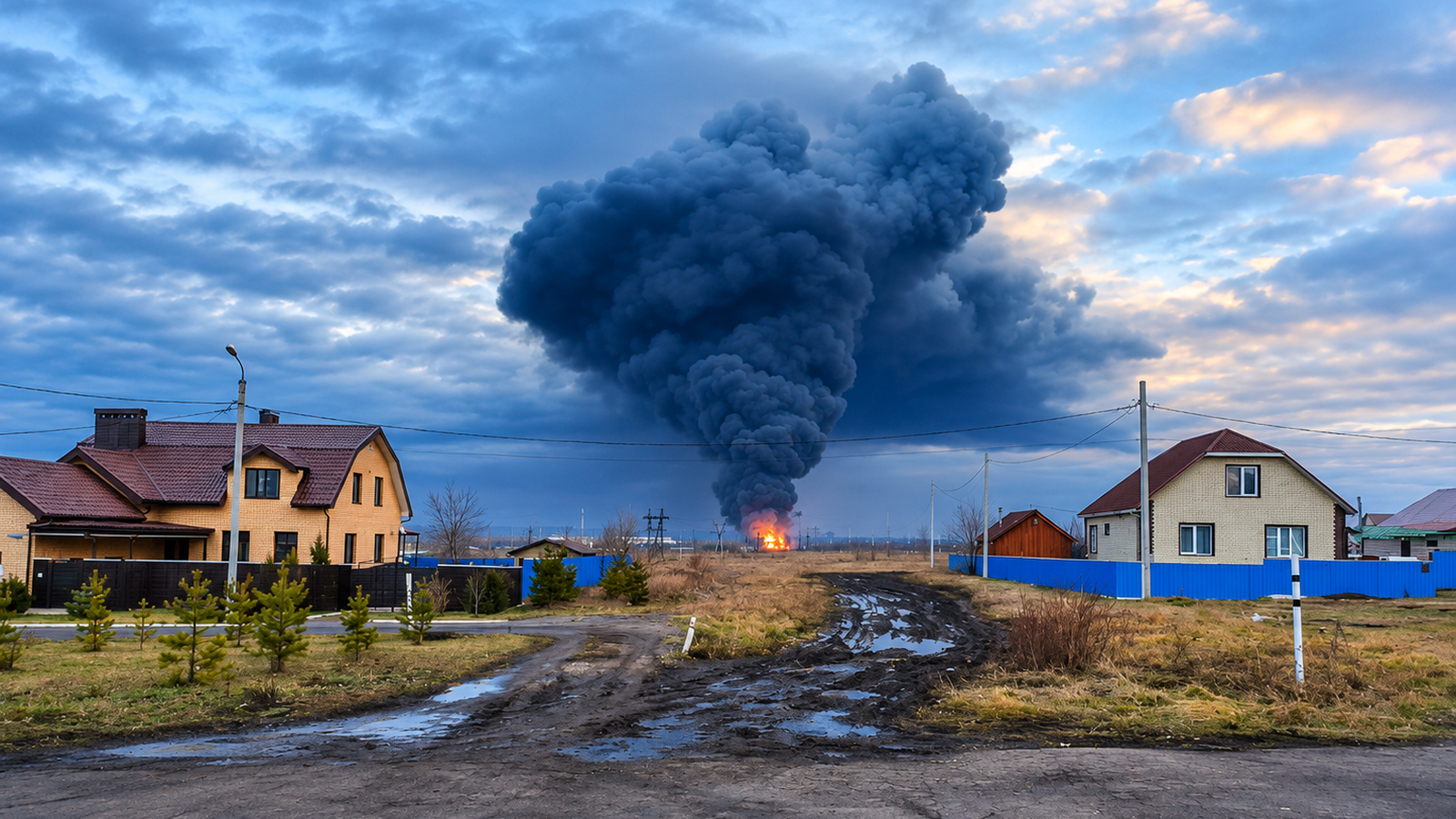
European Union leaders ended their Brussels summit without approving a €45 billion loan for Ukraine, despite support from 24 member states. Meanwhile, Ukraine is deploying new laser air defense systems against Russian drones but faces a critical shortage of interceptors needed to counter ballistic missiles. Germany has approved €11.6 billion in support for Ukraine as negotiations over additional EU assistance continue.
🇺🇦 Ukraine’s Defense & Military Developments
• St. Petersburg and its suburbs came under a large-scale Ukrainian long-range drone attack overnight, with explosions across eight districts and intense Russian air defense activity. Reports indicated that an electrical substation and a suspected drone storage facility were hit, while a Russian air defense missile struck an apartment building, damaging an upper floor. Leningrad region Governor Alexander Drozdenko claimed 44 drones had been intercepted after midnight. In a separate account, he reported 45 drones shot down over the region.
• Ukrainian strike drones hit the Yefremov synthetic rubber plant in Russia’s Tula region. The chemical facility supplies specialized materials used in solid rocket propellant for Iskander ballistic missiles and components for explosives manufacturing. Explosions and fires were also reported at the neighboring Yefremov thermal power plant.
• Ukraine faces a critical shortage of missile interceptors as Washington prioritizes the Middle East, President Volodymyr Zelensky told the BBC. Ukrainian air defenses intercept approximately 70% of Russia’s fastest attack drones, but ballistic missiles remain a major challenge.
• Ukraine’s Blysk laser air defense system destroyed a Russian jet-powered Geran attack drone while protecting critical infrastructure. The system was developed by Carmine Sky under Ukraine’s government-backed Private Air Defense program, with support from the Brave1 defense technology cluster.
• The first Ukrainian military unit has begun combat operations with the Tryzub-3000 laser air defense system, approved for operational use in September 2026. Designed to counter enemy drones, the system incorporates artificial intelligence-assisted targeting and demonstrated its ability to disable the optical equipment of attack drones during trials.
• Ukrainian defense manufacturer General Chereshnia estimates that its Bullet interceptor destroyed 1,200 Russian attack drones in a month. According to the company, Bullet’s share of drone purchases through the eBaly points-based procurement system within the Army of Drones Plus program rose from 14.65% in September to 36.75% in November.
• Ukraine could manufacture between eight and nine million first-person-view (FPV) drones for aerial operations in 2026, according to Ukrainian serviceman Yehor Firsov. The estimate excludes other types of strike drones, interceptors and heavy bomber drones. Firsov attributes the shrinking size of Russian assault groups to Ukraine’s widespread use of drones.
• Starlink and Starshield services have returned to normal in Ukrainian-controlled territory, Zelensky confirmed, although restrictions remain in Russian-occupied areas. Ukrainian military sources told the Kyiv Independent that Starshield speed restrictions introduced in October have caused substantial losses of medium-range strike drones and forced the cancellation of combat missions. Connectivity problems also complicate the interception of Russian jet-powered drones before they approach Ukrainian cities.
• Ukrainian forces destroyed an underground Russian fuel depot and its supporting logistics infrastructure in a forest in occupied Donetsk region during Operation Peklo-3. The operation involved the SxLüd unit of the National Guard’s 1st Azov Corps and the SIGNUM Battalion of the 59th Separate Assault Brigade. Russian camouflage, electronic warfare and mobile air defenses failed to protect the facility.
• Drone operators from Ukraine’s 413th RAID Unmanned Systems Regiment destroyed another Russian Pantsir-S1 short-range air defense system. Footage released by the regiment shows the multimillion-dollar missile and gun system attempting to repel the drone attack before its destruction.
• The crew of a German-made Leopard tank from Ukraine’s 155th Anne of Kyiv Separate Mechanized Brigade survived an attack by 26 Russian FPV drones, with the tank, nicknamed Rhino, remaining operational and the crew completing its combat mission. Ukrainian tank crews have praised the Leopard’s protective design and battlefield survivability.
• Ukraine held more than 80 bilateral defense meetings and two Ramstein-format meetings during Defense Minister Yevhen Khmara’s first 100 days in office, according to political commentator Kyrylo Sazonov. His assessment also cited a substantial increase in drone procurement contracts and a review of defense purchases intended to free up 15.6 billion Ukrainian hryvnias (UAH).
• Kyiv delivered another 1,500 FPV drones of various types to the Bureviy National Guard Brigade, part of the 1st Azov Corps. Since the beginning of 2026, the capital has supplied Ukrainian forces with more than 84,500 drones. Mayor Vitali Klitschko put Kyiv’s financial support for the defense forces this year at UAH 6 billion.
🇷🇺 Russia & the Warfront
• Russia launched 155 drones against Ukraine overnight, including 83 jet-powered Shaheds. By 8 a.m., Ukrainian air defenses had destroyed or suppressed 110 drones, including 51 jet-powered Shaheds. Impacts were recorded at 27 locations, with falling debris reported at four others.
• At least four people were killed in Russian attacks across Ukraine. A single strike in the Zhytomyr region left another 12 people injured.
• Continued Russian attacks on electricity substations and distribution networks caused new outages in the Dnipropetrovsk, Zaporizhzhia, Kirovohrad, Sumy, Kharkiv and Kherson regions. Dnipropetrovsk and Kherson were initially the hardest hit, with equipment damage forcing emergency outages in Dnipropetrovsk. Ukrenergo announced that one to three groups of consumers would face rolling power cuts of four to 12 hours in selected regions on November 28, alongside industrial electricity restrictions. Emergency outages remain in Zaporizhzhia and Dnipropetrovsk, while electricity supplies in Kherson have stabilized.
• Russia sustained another 2,262 personnel casualties, according to the Ukrainian General Staff’s November 27 update. Ukraine also reported Russian losses of two tanks, 11 armored fighting vehicles, 33 artillery systems, two multiple-launch rocket systems, one air defense system, 1,315 drones and 14 units of special equipment.
• Russia plans to build a military satellite communications infrastructure comprising more than 1,000 spacecraft, Ukrainian military intelligence reported. The Rassvet network is expected to include 924 satellites by 2035, while St. Petersburg-based Geoscan plans 240 satellites for its military Innoset network by 2036. Together, the systems could support approximately 22,000 terminals. Ukrainian intelligence deputy chief Vadym Skibitskyi warned that Rassvet could enable worldwide Russian aerial and maritime drone operations. Ukraine has asked the International Telecommunication Union not to allocate frequencies to the system.
• Western intelligence agencies believe Russia could launch a satellite carrying a nuclear warhead before the end of 2026. According to German journalists, the spacecraft was manufactured several years ago and is currently in the Moscow region. Experts warn that a nuclear explosion in low Earth orbit could damage numerous satellites and create lasting threats to space infrastructure.
• A temporary interruption in North Korean ammunition deliveries could affect the intensity of Russian offensive operations, according to aviation expert Bohdan Dolintse. Russia previously received approximately five to ten North Korean ballistic missiles monthly, and Dolintse estimates that disruptions to artillery ammunition supplies could be felt within weeks. South Korean experts also consider further restrictions on military cooperation between Moscow and Pyongyang possible.
• The Russian Navy has received the Perm nuclear-powered submarine, which is destined for the Pacific Fleet. It is the fifth Yasen-M-class submarine delivered to Russia’s navy in six years. Vladimir Putin announced plans to deliver another five missile-carrying submarines by 2030, including three of the same class.
• A Russian military convoy carrying equipment and escorted by the frigate Golovko changed course following Ukraine’s attack on Russian vessels in Benghazi. Reuters, citing three military and security sources, reported that the convoy abandoned its planned voyage to Libya. Its final destination remains unknown.
• Russian forces stationed near the Baltic states are fully organized and combat-ready, according to military expert Pavlo Lakiichuk. They include ground forces, missile units, military aviation and air defense systems. Lakiichuk considers another large-scale Russian military operation unlikely while Moscow continues its war against Ukraine, although the threat of hybrid aggression remains.
• Russian forces are actively using the Chinese Ascent digital communications system, according to Ukrainian presidential defense technology adviser Serhii Beskrestnov. The system transmits digital video through a closed, encrypted protocol. Beskrestnov also identified a gradual transition from analog to digital communications across Russian unmanned systems.
🇺🇸 United States
• Donald Trump reiterated his belief that Vladimir Putin wants to end the war in Ukraine and argued that both sides must participate in peace negotiations. He attributed his friendly rhetoric toward Putin to his pursuit of a peace agreement and identified the personal relationship between Putin and Zelensky as a major obstacle. Trump defended his sanctions policy toward Russia and expressed his desire to see Putin at December’s G20 summit in Florida. He also suggested that Russia’s exclusion from the G8 following the annexation of Crimea contributed to the conflict, arguing that continued membership might have prevented the war altogether.
• American senators attending the Halifax International Security Forum expressed intentions to strengthen Congress’s role in US foreign policy once the newly elected legislature convenes. Proposals under discussion include legislation requiring the administration to maintain support for Ukraine and Taiwan. European representatives urged US lawmakers to restore large-scale military assistance to Ukraine.
• Hackers penetrated Cloud One, one of the US Air Force’s largest cloud computing platforms, Reuters reported. The breach was discovered during a system modernization within the past month and caused service disruptions. Cloud One supports critical military command and weapons inventory systems across more than 200 US Air Force installations.
• Speaking at a Thanksgiving press conference at Mar-a-Lago in Florida, Donald Trump claimed that Russia and China were helping him reach an agreement with Iran. Responding to questions about Russian and Chinese intelligence assistance to Tehran, Trump downplayed the issue and said he had discussed Iran with Vladimir Putin and Xi Jinping, both of whom he believes want an agreement. He maintained that Washington was offering Iran an opportunity to negotiate but questioned whether Tehran would accept.
🇪🇺 Europe & World
• EU leaders concluded their summit early without agreeing on an additional €45 billion loan for Ukraine in 2027. European Council President António Costa confirmed that 24 member states supported the proposal, although Bulgaria would participate only in its nonmilitary component. Hungary, Slovakia and Czechia remain opposed. German Chancellor Friedrich Merz continues to push for approval, while Slovak Prime Minister Robert Fico described his pressure as blackmail. Hungarian Prime Minister Péter Magyar opposes mandatory participation by all EU member states in financing the loan. Negotiations resume December 17–18.
• Negotiations over the EU’s 2028–2034 budget ended without an agreement after representatives of Denmark, Sweden, Belgium and Austria walked out of the Brussels meeting. Costa canceled the summit’s second day, postponed further talks until December and proposed additional cuts of €220–230 billion, primarily affecting competitiveness and external assistance programs. France seeks another €35 billion in agricultural subsidies. Magyar criticized the proposed allocations, estimating Ukraine could receive €100 billion and Hungary €32–34 billion, or approximately €15 billion after Hungary’s own contributions.
• Germany’s Bundestag approved the 2027 federal budget, allocating €11.612 billion for Ukraine’s security, defense and stabilization. More than €9 billion will go directly toward supporting Ukraine through Germany’s Defense Ministry. The budget passed its third reading with 316 votes in favor and 260 against.
• France and Germany are developing legal mechanisms to prevent individual EU member states from blocking long-term assistance to Ukraine under the bloc’s next budget. Berlin proposes incorporating Ukraine’s funding directly into EU budget legislation so that a single government cannot veto subsequent increases in support.
• European governments are increasingly prepared to confront Donald Trump over Ukraine funding, defense procurement and digital taxation, POLITICO reported. Republican losses in the US midterm elections and persistent trade tensions have reduced European concerns about antagonizing Washington. Despite Trump’s criticism of spending on Ukraine, the EU is pursuing a €45 billion loan for 2027 and approximately €100 billion in its proposed long-term budget.
• Zelensky criticized Trump’s friendly rhetoric toward Vladimir Putin in an interview with the BBC, comparing it to calling Adolf Hitler a friend during World War II. The Ukrainian president argued that Washington is not applying sufficient pressure on Moscow to advance peace negotiations and that Ukraine does not need messages from the United States that it can already receive from Russia.
• The International Atomic Energy Agency is negotiating another localized ceasefire between Ukraine and Russia around the occupied Zaporizhzhia Nuclear Power Plant. The facility lost both external power lines and switched to emergency diesel generators. It is the 28th complete loss of external electricity supply since Russia launched its full-scale invasion.
• Latvia deployed NATO fighter jets and an interceptor drone after an unidentified unmanned aircraft violated its airspace. Authorities issued an alert in the eastern part of Ludza municipality and a lower-level warning in Balvi municipality. Both warnings were subsequently lifted.
• Russian sabotage operations in Europe are entering a more dangerous phase, according to the International Institute for Strategic Studies (IISS). Of the 25 incidents recorded in August and September 2026, 24% occurred in Poland, 20% in Germany and another 20% across the Baltic states. Seth Jones of the Center for Strategic and International Studies (CSIS) estimates that Russia has organized more than 100 attacks and sabotage operations in Europe since February 2022. Jones also estimates that approximately 60% of this year’s operations targeted facilities connected to assistance for Ukraine.
• Zelensky has clarified that Ukraine’s operation against Russian vessels near Libya took place without prior coordination with European allies. He had initially stated that Ukraine coordinated attacks on Russian military targets outside Russia with international partners. Italian Foreign Minister Antonio Tajani denied receiving advance notification of the attack. During a conversation with Italian Prime Minister Giorgia Meloni, Zelensky expressed readiness to establish regular information exchanges between the relevant authorities.
• Germany will begin manufacturing Ukrainian Babka reconnaissance drones for Ukraine’s defense forces, with Berlin allocating approximately €34 million to production facilities. German manufacturer Wingcopter and Ukraine’s Shadow Flytech have established a joint venture. The two countries are implementing six major joint defense manufacturing projects worth more than €1 billion.
• Rheinmetall CEO Armin Papperger no longer expects the company’s planned artillery ammunition factory in Ukraine to proceed after more than two years without production. The project was agreed upon in 2024, although no final cancellation decision has been made. Ukrainian manufacturers already supply more than half of the country’s annual military requirement of one to 1.3 million artillery shells.
• Ukraine has submitted a proposed Black Sea ceasefire to international partners and is awaiting Russia’s response. Foreign Minister Andrii Sybiha told the Grain from Ukraine conference that Kyiv’s priority is ensuring safe agricultural exports. Moscow wants oil exports included, which Ukraine is prepared to discuss as part of a broader energy ceasefire.
• Britain’s Ministry of Defense cannot establish the current whereabouts of approximately 45,000 former service members in its strategic reserve. Only about half of the reserve’s 95,000 regular-force veterans have received communications concerning potential mobilization. New legislation is intended to enable the government to mobilize former military personnel aged up to 65 during a national crisis.
• China is conducting large-scale amphibious military exercises in Fujian province near Taiwan. Satellite imagery examined by Reuters showed specialized vessels and floating structures intended to transport military equipment and supplies. Taiwan’s Ministry of National Defense is monitoring the Chinese military activity.
• German public support for continued military assistance to Ukraine has fallen from 59% to 46% over the past year, according to a Körber Foundation survey. The latest results show that 53% of respondents now oppose further military aid.
• French President Emmanuel Macron reaffirmed the need to continue financial assistance to Ukraine after the first day of the European Council summit. He stressed that Ukrainians are defending their country’s sovereignty and territorial integrity as well as Europe’s security. Macron warned that abandoning support for Kyiv would threaten European security in the short and medium term.
• Czech President Petr Pavel described open warfare and hybrid aggression as integral components of Russian foreign policy during Senate hearings. He identified espionage, sabotage, cyberattacks and information campaigns as instruments of Moscow’s continuing confrontation with the West. According to Pavel, Russia seeks to destabilize the European Union and NATO while intimidating countries that support Ukraine.
• Alternative for Germany co-leader Alice Weidel advocated the return of approximately 1.1 million Ukrainians living in Germany after the war. She also supported transferring occupied Ukrainian territories to Russia as a condition for a peace settlement and urged Chancellor Friedrich Merz to open direct negotiations with Russian leaders.
• Polish police detained six suspects accused of vandalizing three Warsaw monuments with inscriptions reading “Glory to the UPA,” a reference to the Ukrainian Insurgent Army. According to investigators, the perpetrators received 1,000 Polish zlotys, and the organizers may have acted in the interests of Russian intelligence. Two Ukrainian citizens among those detained were deported from Poland.
• Austrian Freedom Party leader Herbert Kickl proposed sending migrants who cannot be deported to their countries of origin to Ukraine after the war. His proposal specifically includes Syrian and Afghan nationals, whom he wants involved in Ukraine’s reconstruction. Kickl linked the initiative to European Union financial assistance for Kyiv.
• France has commissioned the De Grasse nuclear-powered attack submarine, the fourth of six Suffren-class vessels under its Barracuda program. The submarine began sea trials in February 2026. The remaining two vessels, Rubis and Casabianca, are scheduled for delivery to the French Navy by 2029.
• The British Army is revising its officer training program based on lessons from Ukraine’s battlefield experience. The Royal Military Academy Sandhurst is expanding instruction in trench warfare, protection against aerial threats and the rapid construction of defensive positions. Training also covers how military units operate under modern battlefield conditions.
• The question of continued support for Ukraine is becoming less prominent in France’s presidential election campaign, France 24 reported. Only 6% of respondents identified the war in Ukraine as one of their two most important concerns, compared with 47% who prioritized purchasing power. Domestic economic issues are increasingly shaping the political agenda of French parties.
• Polish Prosecutor General Waldemar Żurek explained that decisions to intercept Russian missiles entering Polish airspace depend on the potential danger to civilians. Military authorities track aerial targets while considering the risk posed by falling debris. Żurek said changes to Poland’s overall response to Russian missiles and drones require coordination within NATO.
• Latvian airline airBaltic has asked some pilots to consider transferring to Papua New Guinea’s Air Niugini or leaving the company. Under a cooperation agreement, the pilots could begin flying Airbus A220 aircraft from 2027. The restructuring also affects airBaltic’s training academy and is aimed at reducing operating costs.
⚡ Geopolitics & Economy
• The International Monetary Fund’s updated economic outlook projects a 0.5% contraction in Ukraine’s real GDP in 2026. The forecast anticipates a further decline of 1% in 2027.
• Ukraine’s mining and steel industries face higher transport costs as Ukrainian Railways plans a 15% freight tariff increase in January 2027, following a 30% increase in August. If implemented, the January increase would bring the cumulative rise in freight tariffs to nearly 50% in less than six months. Metinvest and the Ukrmetallurgprom industry association warn that higher tariffs could force industrial shutdowns, reduce rail freight volumes and hinder the sector’s recovery.
• Russian oil production is projected to fall to 494 million metric tons in 2026, down 3.4% from the previous year and potentially its lowest level since 2008. Output has declined by 66 million tons, approximately 12%, from its 2019 peak. The projected figure falls short of the Russian government’s revised forecast of 511 million tons.
• The Bloomberg Dollar Spot Index rose 1.9% in November, its third consecutive monthly increase. The US dollar strengthened against every G10 currency amid falling technology stocks and concerns about artificial intelligence investment. Financial markets anticipate a 25-basis-point Federal Reserve interest rate increase next month.
• Wholesale natural gas prices in Russia’s Moscow region have reached 8,500 rubles, approximately $103 per 1,000 cubic meters, compared with $80–95 for equivalent volumes supplied to US industrial consumers. Russian energy expert Alexey Gromov warned that further domestic price increases could complicate negotiations with China over the Power of Siberia 2 gas pipeline.
• Russia is using African energy projects to establish long-term political and economic influence, Ukrainian military intelligence warned. At the Egypt Energy 2026 exhibition, Rosatom signed an agreement with an Egyptian technology company to localize energy storage system production. Ukrainian intelligence believes Russian participation in African nuclear infrastructure could create lasting dependence on Russian technology and nuclear fuel.
• Guyana’s economy is projected to grow by 22.3% in 2026, according to the International Monetary Fund, driven by the expansion of offshore oil production. The country’s oil output could increase by approximately 25% compared with the previous year.
🛑 Society & Policy in Ukraine
• Ukraine’s Cabinet approved a revised 2027 draft budget allocating nearly UAH 5 trillion, equivalent to 43% of GDP, to security and defense. Prime Minister Serhii Koretskyi estimated that Ukraine still faces €70 billion in uncovered financing needs despite confirmed international assistance programs. The draft provides an additional UAH 20.4 billion for military pay, increases war-risk insurance funding to UAH 31 billion and removes proposed VAT and excise tax increases expected to generate UAH 67 billion in revenue. If adopted, it would also raise the subsistence minimum for people unable to work from UAH 2,595 to UAH 2,878. The maximum monthly pension supplement for each year of pensionable service beyond the statutory requirement would rise from UAH 25.95 to UAH 28.78. For someone with ten years of service above that requirement, the supplement could reach UAH 287.80 per month.
• Ukraine is bringing home another group of young Ukrainians from Russian-occupied territories and Russia, including nine children from occupied areas of Kherson, Zaporizhzhia and Crimea and Anastasiia, a young adult from the Oleshky residential care institution. President Volodymyr Zelensky thanked US First Lady Melania Trump for her mediation in securing their return. He also confirmed that a total of 2,875 Ukrainian children have now been returned.
• Ukraine’s government is considering increasing minimum military pay, a measure that Prime Minister Serhii Koretskyi estimates would require tens of billions of hryvnias in additional monthly expenditure. Defense Minister Yevhen Khmara has been tasked with preparing proposals that account for different service conditions and combat assignments.
• Ukraine’s government will present proposals for a new social contract on military mobilization in early December, aimed at balancing the armed forces’ manpower needs, troop rotations and the continued operation of businesses. Prime Minister Serhii Koretskyi explained that periodic changes to the rules governing mobilization deferments for employees reflect changing battlefield conditions and military manpower requirements.
• Ukraine’s Cabinet is examining several pension reform scenarios, with Prime Minister Koretskyi estimating that the baseline proposal would require approximately UAH 170 billion in additional annual government expenditure. The government is seeking a financially viable compromise that would allow pension payments to increase gradually.
• Kyiv is preparing guaranteed free bus services in case Russian attacks on critical infrastructure significantly worsen conditions in the capital, while national and municipal authorities are planning backup routes if other forms of public transportation cease operating. Zelensky held a meeting on protecting Kyiv’s infrastructure and developing alternative logistics. Speaking to the BBC, he stressed that Ukrainian cities, particularly Kyiv, must remain functional despite attacks on energy infrastructure, highlighting threats to bridges across the Dnipro River and the need to keep hospitals operational on both banks. He emphasized that relocation must remain a personal decision.
• Sixty-two apartment buildings in Ukrainka, Kyiv region, remain without central heating following the destruction of the Trypilska thermal power plant. Three modular gas-fired heating plants, each with a capacity of seven megawatts, have been delivered. Kyiv regional administration deputy head Andrii Stashkiv estimates installation could take up to six weeks.
• Ukrainian households’ outstanding utility debts have reached UAH 101.4 billion, according to the State Statistics Service. Heating and hot water account for the largest share at UAH 31.4 billion, followed by natural gas at UAH 27.6 billion and electricity at UAH 16.6 billion. Households paid UAH 51 billion for utility services during the third quarter of 2026.
• Ukraine has temporarily simplified the process of obtaining mobilization deferments for employees through its Diia digital services portal. The measure applies to businesses whose designation as critically important enterprises expired on or after October 27, 2026. Eligible employers can submit applications without the usual 72-hour wait for lists of employees subject to mobilization to be generated. Applications will be processed within 24 hours, and the temporary rules remain valid through December 20.
• Bread prices in Ukraine could rise by approximately 5%, according to Ukrainian Bakers Association President Oleksandr Taranenko. Industrial electricity prices increased from around UAH 6 per kilowatt-hour in September to UAH 10 in November, while natural gas rose from UAH 18 to UAH 26.30 per cubic meter. Rising energy and logistics expenses have partially offset lower flour prices.
• Ukrainian fuel retailers continue reducing prices, with the KLO gas station network in the Kyiv region cutting gasoline and diesel prices by UAH 7 per liter. Nationwide averages stand at UAH 81.52 for A-95 gasoline, UAH 96.14 for diesel and UAH 77.67 for A-92 gasoline. Automotive LPG has fallen to UAH 61.32 per liter.
• Kyiv’s Commercial Court rejected a request by Raiffeisen Bank International’s Ukrainian subsidiary to freeze Andrii Vadaturskyi’s ownership stake in agricultural company Nibulon. The bank also sought to freeze his personal assets and funds. Expert Oleksii Holobutskyi described the actions as a possible attempt to unlawfully seize control of the company, although the court made no such finding.
• Zelensky addressed questions from the BBC concerning an individual identified as “Vova” in audio recordings released in connection with the Dynasty investigation. He referred to anti-corruption authorities’ public position that they had no questions for him. Ukraine’s National Anti-Corruption Bureau director previously confirmed that Zelensky was not implicated in the investigation into financing the construction of the residence concerned.
• Political analysts Tetiana Lupova and Mykhailo Shnaider urged a temporary parliamentary investigative commission to examine the detention of complainants in an alleged bribery case involving the wife of Specialized Anti-Corruption Prosecutor’s Office chief Oleksandr Klymenko. Their request followed Security Service General Serhii Duka’s claim that one complainant was hospitalized after detention. The analysts proposed questioning the leadership of the anti-corruption prosecutor’s office and the State Bureau of Investigation. The causes of hospitalization and allegations of pressure remain independently unverified.
• Danylo Hetmantsev, chair of Ukraine’s parliamentary finance committee, alleged potentially improper payments by the Anti-Corruption Action Center to Anton Marchuk. He demanded an explanation from the organization’s head, Vitalii Shabunin, citing payments exceeding UAH 1.1 million from the first quarter of 2022 through the second quarter of 2023 and $586,900 in EU Anti-Corruption Initiative (EUACI) funding for affiliated entities between 2020 and 2025. Marchuk currently heads EUACI’s anti-corruption policy and European integration component. According to Spilno, Hetmantsev did not publish supporting documents or specify when Marchuk, a former Anti-Corruption Action Center expert, joined EUACI.
• Political analyst Artur Bilous called for an investigation into allegations concerning relatives of the wife of Oleksandr Abakumov, head of a detective division at Ukraine’s National Anti-Corruption Bureau (NABU). Security Service General Serhii Duka alleged that the relatives conducted business activities in occupied Luhansk. The call came after Ukrainska Pravda included Abakumov in its UP100 list, with his profile written by NABU communications chief Marharyta Zhyvaha. The allegations concerning the business activities require independent verification.
Ukraine is introducing domestically developed laser weapons into combat service and already using drone interceptors against Russian aerial attacks, but its ability to counter Russian ballistic missiles still depends on supplies from international partners. The scale of the financial challenge is evident in Kyiv’s proposed defense and security expenditure of 43% of GDP and €70 billion in uncovered financing needs. Germany’s commitment of €11.6 billion offers substantial national support, while France and Germany are pursuing mechanisms to protect future European assistance from individual member-state vetoes. As negotiations resume in December, the EU faces two distinct decisions: financing Ukraine’s immediate needs in 2027 and establishing a more durable framework for long-term assistance.
🤝 SUPPORT US 💙
We continue to work only because you read and support us. If you appreciate what we do, please become our sponsor or donate here👇
☑️ patreon.com/meanwhileinukraine
or
☕️ buymeacoffee.com/meaninuak
or
☕️ ko-fi.com/meaninua
or
💳 paypal.me/meaninua
Your support helps us continue delivering timely and accurate updates. Stay informed and stand with Ukraine! 🇺🇦