

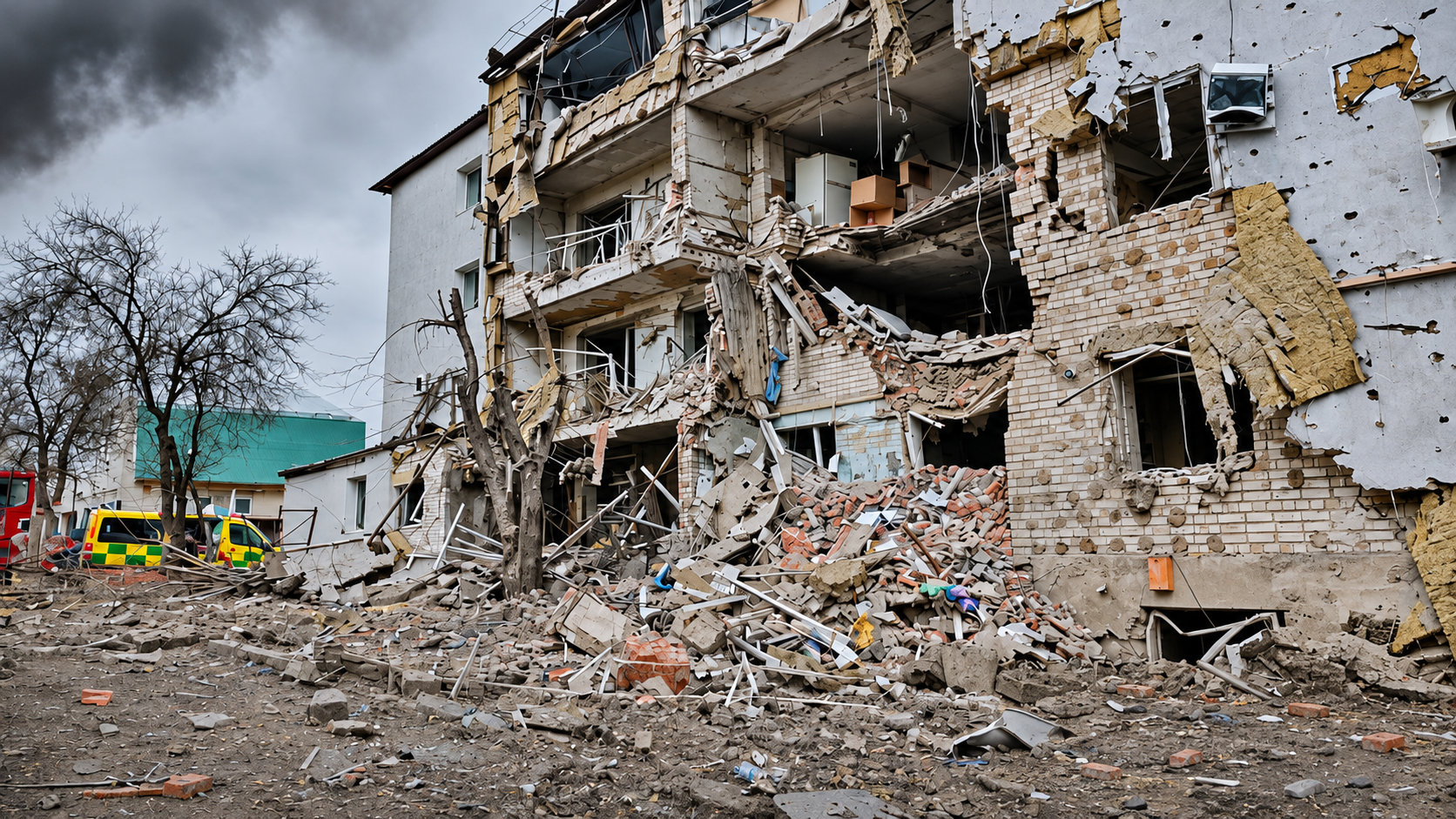
Russia launched another large drone-and-missile attack on Ukraine as Kyiv warned that Moscow may already be preparing a new strike focused on energy and logistics. Ukraine meanwhile continued long-range operations against Russian oil, military and communications infrastructure, while Kyiv faced severe power shortages and officials gave conflicting accounts of Russian activity during the Oleshky humanitarian pause.
🇺🇦 Ukraine’s Defense & Military Developments
• Ukraine offered a one-month pause in strikes on Russian refineries if Moscow stops attacking Ukrainian energy infrastructure for the same period. President Volodymyr Zelensky said another option would be to provide Ukraine with Patriot missiles and protection for that month, which Kyiv is ready to pay for. He argued that Ukrainian refinery strikes have little effect on global fuel prices because Russia accounts for about 2.2% of the global oil market, while developments in the Middle East have a much larger impact. Zelensky also said Donald Trump “should not help Putin.”
• Ukrainian long-range strikes hit at least 28 targets inside Russia between October 18 and November 1. They included 10 chemical-industry facilities, seven oil-sector sites, four defense-industry facilities, as well as logistics hubs, data centers, substations and a military airfield.
• Ukraine’s General Staff identified 10 major October strikes aimed at Russian missile, aviation and drone capabilities. The targets included the Energia battery plant, the Redkino fuel-component plant and Proton-Electrotex, along with several synthetic-rubber facilities, Roboavia drone production, Geran infrastructure near Navlia and the Kamensky rocket-fuel plant. Kyiv also reported six Su-34s hit at Borisoglebsk and two more destroyed at Marinovka.
• A Ukrainian long-range drone strike caused a major fire at the Samara oil-pumping and storage complex near Prosveshchenie. Preliminary assessments indicated that six fuel tanks could be burning at the strategic pipeline facility, while the full extent of the damage remained unclear.
• Ukrainian strikes hit two telecommunications facilities in occupied Luhansk, Lugacom and the Luhansk Telephone Company, which support mobile, internet and data services used by Russian occupation forces. The attack was the fifth recorded strike on occupation communications infrastructure since October 21.
• Ukraine expects to receive its first Swedish Gripen fighters in the first half of 2027. The initial deliveries are expected to involve C/D variants, while Kyiv is also discussing future Gripen E aircraft and Ukrainian pilots are already training.
• NATO and Ukraine signed a defense-innovation agreement that gives Ukrainian companies access to DIANA challenges, grants, more than 200 allied testing centers, investment networks and rapid-adoption programs.
• Ukraine deployed a large electronic-warfare network over Kyiv to disrupt MESH radio links used to control Russian Shahed drones. Hundreds of antenna and EW sites were installed across the capital, and the system reportedly forced Russia to modify its drones and seek alternative technical solutions.
• Ukraine’s Brave1 defense cluster launched Brave1 Invest to connect domestic defense manufacturers with vetted investors. Investors must pass security and compliance checks, including screening for Russian links.
• Ukraine has contracted more than 20,000 unmanned ground systems since the start of 2026. Their military use is expanding rapidly, although winter conditions such as mud, snow and ice will provide a major reliability test.
• Ukraine’s 125th Heavy Mechanized Brigade converted an old armored personnel carrier into a remote-controlled explosive ground vehicle and sent it toward Russian positions. The brigade says similar systems are increasingly used for strikes, logistics and evacuation.
• Ukraine’s Code 9.2 unit carried out its third evacuation of a wounded soldier with a SkyFall StarGate drone. The 54-year-old serviceman, Andrii “Donbas,” had lost a foot and waited 57 days for evacuation from a position about two kilometers from Russia.
• A Russian Su-57 fighter exploded at Akhtubinsk airfield on October 29 while its engines were being started, according to Ukrainian military intelligence. The aircraft was estimated to be worth about $150 million, and HUR said poor-quality fuel was among the possible causes of the engine failure.
🇷🇺 Russia & the Warfront
• Russia attacked Ukraine on November 2 with 171 drones, including 103 jet-powered UAVs, and 10 S8000 Banderol/Dan-T missiles. Ukraine said it shot down or suppressed 139 drones, including 78 jet-powered UAVs, and intercepted eight missiles, while about 20 drones remained airborne when the figures were reported.
• Ukraine warned that Russia may be preparing another large combined attack within 48 hours. Monitoring reports cited movements of Tu-95MS and Tu-160 bombers, including two Tu-160s that took off from Ukrainka airbase, and possible use of Kh-101, Kalibr, Iskander, S-400, Zircon and KN-23 missiles together with Geran drones. Zelensky said energy and logistics were expected to remain priority targets and called for stronger anti-ballistic defenses.
• A Russian guided-bomb attack on Komyshuvakha in Zaporizhzhia region left 24 people dead, five wounded and 27 missing. One bomb hit a school used as a humanitarian-aid point, and the surrounding shelter area was struck again. At least nine FAB-3000 guided bombs were used in the attack. A police officer and two emergency-service rescuers were among those reported dead.
• Russian forces advanced near Huliaipilske and Hirke in the Polohy district of Zaporizhzhia region, according to DeepState. The movement came after Russia’s earlier capture of Huliaipole and extended pressure westward on that sector.
• Ukraine’s General Staff reported 2,500 Russian personnel losses on November 1, its highest daily figure since the full-scale invasion began and above the previous record of 2,250 on October 21. The same daily report listed one tank, seven armored fighting vehicles, 46 artillery systems, two MLRS, one air-defense system, 936 UAVs and nine special vehicles lost. October personnel losses reached about 54,400, while ISW estimated that Russia gained roughly 139.85 square kilometers during the month but lost about 167.14 square kilometers, the second consecutive month in which losses exceeded gains.
• Russia used more than 4,000 jet-powered UAVs, about 150 ballistic missiles and 80 cruise or air-launched missiles against Ukraine in October. The Ukrainian Air Force also recorded about 360 Banderol and Dan-T systems and 4,740 conventional strike and decoy drones.
• Russia is expanding its network of fixed launch sites for jet-powered attack drones, including a new facility near Millerovo airfield in Rostov region. HUR estimates that the site could support up to 100 launches per day and supplement at least 12 existing fixed launch areas.
• Russia has begun using the Gerbera-2 drone, which can carry a warhead of up to 25 kilograms and fly as far as 1,200 kilometers. One such drone was found on Poland’s Baltic coast, while the platform itself is evolving from a decoy into a reconnaissance and strike system.
• Russia is increasing the number of electronic-warfare systems intended to counter Starlink at the front and in occupied Crimea. Some complexes are reportedly being disguised as civilian infrastructure.
• Russian Ka-52 attack helicopters have received S-8VC rockets adapted for use against drones. The weapon is intended as a cheaper alternative to conventional surface-to-air missiles and has also been developed for several other Russian helicopter types.
• Russia’s Defense Ministry plans to move part of its December payments to servicemembers into January because of a budget deficit. Bloomberg described the planned delay as unprecedented during the current war.
• A Russian drone attack on Odesa region wounded five women aged 29 to 86. Infrastructure, a bakery and a grain warehouse were damaged, while 12 settlements in the Kiliia and Vylkove communities lost electricity.
• Ukraine’s General Staff said Russian forces used the humanitarian pause around Oleshky to rotate units, strengthen positions, install anti-drone systems and replenish ammunition. Sky News material showed heavy equipment, weapons and ammunition moving into the area, but Ukrainian Ombudsman Dmytro Lubinets offered a different account. He said there had been no Russian military movements under cover of the truce and that some Russian equipment was used for humanitarian demining under Ukrainian control, carried Red Cross markings and was returned to Russia after the work. His explanation conflicted with the conclusions drawn from the other material.
🇺🇸 United States
• The U.S. administration is promoting the restoration of Russian gas transit to Europe through Ukraine as part of a possible energy truce. One proposal involves an American intermediary, but some European capitals oppose the idea and the Kremlin says current political and military conditions make it unrealistic.
• Ukraine has not yet received a formal invitation to the December G20 summit in Miami. Zelensky said Washington had signaled that Ukrainian participation was possible and that he would attend if President Donald Trump issued an official invitation.
• Donald Trump acknowledged that China and Russia conduct intelligence operations against the United States. He said Washington does the same against both countries and claimed that U.S. intelligence performs the work better.
• A private Learjet 60 crashed onto a multilane road in a residential area of Florida near Trump’s residence. All nine people aboard died. Air-defense systems had recently been deployed nearby, but no evidence linked them to the crash.
🇪🇺 Europe & World
• Poland launched a special security operation in the Warmian-Masurian and Podlaskie regions after intelligence and allied services warned of possible sabotage near the Kaliningrad border. Police, military personnel, border guards and security services were reinforced amid concerns that armed groups could attempt to cross into Poland.
• Zelensky rejected any attempt by Donald Trump, Vladimir Putin and Xi Jinping to decide Ukraine’s sovereignty or territorial future without Kyiv. He said any effective agreement to end the war must include Ukraine and argued that previous attempts to settle its fate without Ukrainian participation had failed.
• Italian Prime Minister Giorgia Meloni said support for Ukraine could cost her politically, including among some of her own voters, but she would not change course. She argued that an international order based only on military strength would also threaten Italy’s national interests.
• Iran has prepared pilots, personnel and infrastructure for Russian Su-35 fighters. Leaked documents indicate a possible order for 48 Su-35S aircraft with deliveries through 2028, while analysts said alternatives such as China’s J-10C may not have been available.
• Iliana Iotova won Bulgaria’s presidential election with 57.66% of the vote against 39.38% for Andrey Gyurov after 99.66% of ballots were counted. She became Bulgaria’s first woman president and is politically associated with Rumen Radev, who opposed some sanctions on Russia and favored reducing support for Ukraine.
• China is deepening cooperation with Russia in the Arctic and aims to establish itself as a “polar great power” by 2030. Beijing is investing in Russian Arctic projects as competition grows over missile routes, air defense, critical minerals and emerging transport corridors.
• The Kremlin is preparing a bilateral meeting between Vladimir Putin and Xi Jinping at the APEC summit in China. Moscow says there is no agreement for a trilateral Putin-Xi-Trump meeting, although a separate Putin-Trump meeting has not been ruled out.
• A cyberattack on supermarket refrigeration systems affected stores in Sweden, Belgium and Estonia. Temperatures in some freezers reportedly reached 50°C, and Belgian company Sabcobel confirmed that equipment had been remotely switched into defrost mode.
• Indonesia called on Russia to stop recruiting Indonesian citizens for the war against Ukraine following reports that an Indonesian citizen serving with Russian forces had become a casualty in the war. Authorities are seeking to block what they describe as dangerous foreign recruitment channels.
• French Rafale fighters gained a tactical advantage over Russian Su-35s during exercises in Egypt through the SPECTRA electronic-warfare system and networked airborne early-warning support. Analysts cautioned that Ukraine would not automatically reproduce the same result without Meteor missiles, data links and AWACS-type support.
• The Alternative for Germany party (AfD) has set out a foreign-policy concept calling for closer ties with the Trump administration, restored contacts with Russia and an end to military assistance for Ukraine. Such a policy would sharply depart from Berlin’s current approach to the war.
• Schengen countries issued 630,605 short-stay visas to Russian citizens in 2025, up 14.1% from the previous year. It was the second consecutive annual increase, with Italy, France and Spain among the most active issuers.
• Eastern Poland is testing warning sirens and expanding its shelter network in response to the threat of Russian missile and drone attacks. The measures are part of Poland’s broader rebuilding of civil defense alongside higher defense spending.
• China’s military is testing strikes against mock aircraft carriers in the desert. Analysts cautioned that stationary land targets cannot reproduce the maneuvering, air defenses, electronic warfare and missile defenses of a real carrier strike group.
⚡ Geopolitics & Economy
• Global oil prices fell more than 3% after three days of U.S.-Iran talks involving Qatar. Markets reacted to the prospect of lower geopolitical risk and improved energy-supply conditions.
• U.S. gasoline prices rose above about $3.46 per gallon while diesel prices increased almost 70% year on year as the Trump administration temporarily eased some sanctions affecting Russian fuel. One Russian diesel cargo reportedly failed to find U.S. buyers, and Yevhen Dykyi estimated that the shipment equaled roughly half a day of American diesel consumption and said buying Russian fuel remained politically toxic for U.S. companies.
🛑 Society & Policy in Ukraine
• Kyiv’s main thermal power plants, including CHP-5, CHP-6 and Darnytska CHP, have effectively stopped generating electricity after Russian strikes, while an expert also linked the crisis to damage at CHP-4. The capital now produces only about 5% of the power it needs and depends heavily on the national grid. Outages have reached 16–18 hours a day and disrupted water, communications, parts of the red and green metro lines, the funicular and light rail. Further attacks threaten heating and high-voltage infrastructure.
• Emergency power cuts were imposed in Kyiv, Kyiv region, Poltava, Zhytomyr and other parts of Ukraine after Russian attacks on the energy system. Previously published schedules stopped applying where emergency restrictions were introduced. Hourly restrictions were announced throughout November 3, ranging from half a group to four groups at a time depending on the region and grid conditions, while industrial consumers also faced power limits.
• The humanitarian pause around occupied Oleshky ran from October 27 to November 1 and ended after nearly six days. Lubinets said Ukraine and Russia fulfilled their obligations during the agreed period. Melania Trump said almost 800 people were evacuated and thanked both sides for observing the arrangements. A further 105 animals were removed, while the bodies of Ukrainian soldiers and civilians were recovered for return to Ukrainian-controlled territory. Ukraine and Russia also agreed on monthly humanitarian-aid deliveries to Oleshky and continued reconciling evacuation lists. Twenty-two ambulances were involved, and some evacuees, including people with limited mobility, were still traveling on November 2. Injured volunteer Alla Lykhman-Malysh remained behind after refusing to leave without 70 animals, including 30 cats and 40 dogs, while mined roads also prevented some residents of nearby villages from evacuating. The Kremlin said it currently had no plans for another operation of this kind.
• Ukraine and Russia agreed to create a joint center to help return civilians, while the Ukrainian Ombudsman’s Office is planning a permanent mechanism for people held in Russian prisons and occupied territories. Lubinets said the Oleshky operation could become a model for similar missions elsewhere, and Russia’s ombudsperson also proposed considering other locations.
• Unauthorized interference with Ukraine’s Air Alert app sent users false warnings about nuclear, radiological and chemical threats, an Oreshnik strike and street fighting. The civilian app was temporarily disabled for restoration, while the Air Force said military warning systems continued to operate normally.
• Officials in Ukraine’s Presidential Office discussed removing Kyiv Mayor Vitali Klitschko from his separate post as head of the Kyiv City State Administration. Two sources confirmed that the idea had been considered, but it reportedly lacked broad support inside Zelensky’s team.
• A company linked to the circle of Ivan Fedorov is seeking more than UAH 69 million from the state for work on an ice arena in occupied Melitopol. The original contract was worth UAH 92 million, another UAH 56 million was later added, and work-completion documents were dated in autumn 2022 after the city had already been occupied. A first-instance court had already rejected the claim because of insufficient evidence.
• An investigation into Ukraine’s gambling market assigned political responsibility for delayed systemic oversight to Mykhailo Fedorov, citing Cabinet Resolution No. 924. Full online monitoring only entered testing in April 2026, and 17 operators had connected by June.
• Yulia Tymoshenko accused parts of the Ukrainian government of shadow budget arrangements, outside influence and using NABU and SAPO to conceal corruption during debate on the state budget. The claims were political allegations rather than findings established by investigators.
• Since November 1, 37 categories of Ukrainian men have been legally permitted to cross the state border. For most categories, eligibility depends on health, family circumstances, profession and supporting documents, while men under 18 and over 60 and some citizens aged 18–22 may travel under separate rules.
• Ukraine’s acting prosecutor general said former Prosecutor General Ruslan Kravchenko signed the order authorizing his own foreign business trip. The formal basis was a request addressed to one of his deputies. The official also said a figure known as Kropyva in the “Carthage” case frequently traveled abroad with Kravchenko; the case concerns the Prosecutor General’s Office’s international operations, and the relevant structural post was later abolished.
• Ukraine’s State Bureau of Investigation closed the criminal proceeding involving NABU director Semen Kryvonos. Kryvonos was never formally served with a notice of suspicion, although a draft had been prepared under former Prosecutor General Ruslan Kravchenko.
• Ukrainian shopping malls lost an average of about 9.8 working days in October because of air-raid alerts. Since the full-scale invasion began, cumulative lost operating time in the sector has exceeded the equivalent of 186 days.
Russia’s air campaign is placing severe strain on Ukraine’s electricity system, while Moscow is also expanding drone launch infrastructure and adapting new weapons and counter-drone systems. Ukraine continues to respond with long-range strikes, electronic warfare, unmanned systems and defense cooperation with NATO partners. The Oleshky operation showed that limited humanitarian coordination remains possible, even as Ukrainian institutions presented conflicting accounts of Russian activity during the pause. Diplomatically, Kyiv continued to insist that no settlement involving its sovereignty or territory can be negotiated without Ukraine.
🤝 SUPPORT US 💙
We continue to work only because you read and support us. If you appreciate what we do, please become our sponsor or donate here👇
☑️ patreon.com/meanwhileinukraine
or
☕️ buymeacoffee.com/meaninuak
or
☕️ ko-fi.com/meaninua
or
💳 paypal.me/meaninua
Your support helps us continue delivering timely and accurate updates. Stay informed and stand with Ukraine! 🇺🇦