

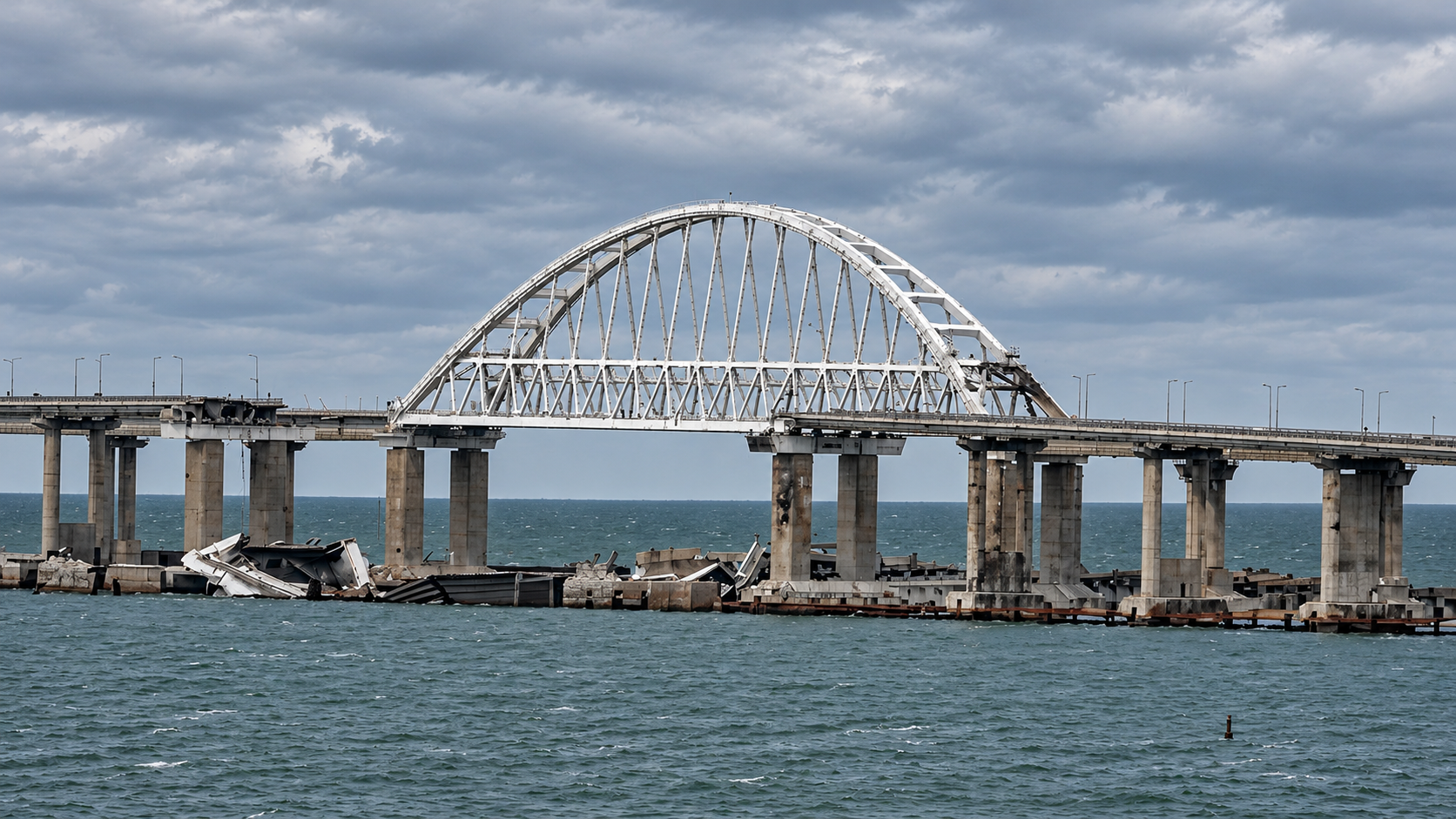
Ukraine's coordinated strikes brought down a major section of the Kerch Bridge, damaged its railway crossing and halted traffic, while Russian ballistic missiles struck two major bridges in Kyiv. The attacks disrupted transportation and critical infrastructure as Ukraine secured new air defense commitments from European partners and pushed for additional weapons at a defense meeting in Brussels.
🇺🇦 Ukraine’s Defense & Military Developments
• Ukraine's coordinated strikes on November 16–17 brought down the Kerch Bridge's road arch and more than 270 meters of roadway, damaged a second arch and railway structures, and halted both road and rail traffic. President Volodymyr Zelenskyy said the SBU and General Staff spent weeks preparing the operation, using Palianytsia missile-drones against the road section and Neptune missiles, RUTA drones and FP-5 Flamingo missiles against the railway section, with guided weapons maintaining communications until impact. The SBU's Alpha unit released footage of Palianytsia strikes near the steel arch supports, showing multiple impacts and explosions that destroyed metal arch connections and sent parts of the structure into the water; the service described the joint operation as its fourth successful strike against the bridge. Fire Point said two Flamingo missiles struck the crossing, one bringing down the road arch and deck and the other damaging the railway section, while co-founder Denys Shtilerman confirmed their nighttime use, released launch footage and reported that the navigational span's arch had collapsed into the water. Destinus separately reported RUTA strikes on consecutive days, including damage to the upper supporting structure on November 16 and seven hits on November 17 that it said caused a span to collapse; the company also reported using LORD/Da Vinci systems to suppress Russian air defenses. According to The Times, Ukraine's 7th Deep Strike Center, 1st Special Operations Brigade of the Unmanned Systems Forces, SBU, Navy and Special Operations Forces used a Ukrainian drone-to-missile video communications system instead of Starlink or Starshield, enabling Flamingo and Neptune missiles to penetrate Russian air defenses. Crimea's Russian-installed leader Sergei Aksyonov confirmed the renewed attack and traffic suspension, while Kremlin spokesman Dmitry Peskov promised reconstruction without announcing a timetable. Defense Express estimated that replacing the 227-meter steel arch, weighing more than 5,000 tons, could take two years or longer, noting that its original assembly and installation required more than 14 months; former SBU officer Ivan Stupak estimated at least several months because a new structure must be manufactured and installed, with winter weather and possible further Ukrainian strikes potentially delaying major repairs until March.
• Ukrainian forces struck the Gazprom Neftekhim Salavat refining and petrochemical complex in Bashkortostan overnight on November 17, according to Ukraine's General Staff. Explosions were reported at the facility, approximately 1,500 kilometers from Ukraine's border, followed by a fire visible from neighboring Sterlitamak, with reported impacts near catalytic cracking and hydrogenation units. The complex processes approximately 10 million metric tons of crude oil and gas condensate annually and produces petroleum products also used to supply Russian military equipment.
• At the Ramstein meeting in Brussels, President Volodymyr Zelenskyy sought additional Patriot and NASAMS interceptors, missiles for IRIS-T systems, another 40 F-16 fighter jets and more aviation munitions. He proposed that European partners transfer Patriot and IRIS-T missiles from their existing stocks for later replenishment through Ukrainian orders in the United States, citing the extensive maintenance time required by Ukraine's current F-16 fleet. With Russia continuing ballistic missile attacks, including the use of North Korean-supplied weapons, Zelenskyy also requested long-range missiles capable of striking Russian military production facilities and US technology for targeting ballistic missile launchers.
• Ukraine will respond to Russian attacks with strikes two or three times stronger, Defense Minister Yevhenii Khmara declared at the Ramstein meeting in Brussels, where he linked the Kerch Bridge operation to Russian attacks on civilian infrastructure in Kyiv. According to Khmara, Russia had attacked bridges across the Dnipro in the Ukrainian capital 12 times since October 1 without achieving its objective of disrupting logistics. He said Ukrainian forces had conducted reconnaissance and targeted Russian air defenses and electronic warfare systems before the main Kerch Bridge strike, identifying further development of Ukraine's Deep Strike capabilities as a priority.
• Ukrainian forces struck ten Russian radar and electronic warfare systems on November 16–17, Ukraine's General Staff reported. The targets included six radars and two electronic warfare stations in Russia's Bryansk region, another electronic warfare system near Yakovenkove in occupied Crimea, and a further station near Pryazovskoye in Krasnodar Krai.
• Ukraine's 413th Separate Unmanned Systems Regiment, known as Raid, reported striking Russia's Akhtubinsk military air base in Astrakhan Oblast on November 15. The unit reported secondary ammunition detonations inside aircraft hangars, although the precise types of munitions involved remain unconfirmed.
• An analytical review estimated Russian aircraft losses from Ukrainian airfield strikes in October, including attacks involving Su-34 aircraft at Borisoglebsk air base, at approximately $430 million at domestic Russian prices or as much as $700 million at market rates. Military analyst Oleh Katkov said new aircraft deliveries cannot resolve the problems of worn airframes and declining combat capability.
🇷🇺 Russia & the Warfront
• Russian ballistic missiles severely damaged Kyiv's Southern and Northern bridges overnight on November 17, initially closing both crossings in both directions. Zelenskyy said Russian forces fired four missiles at the Southern Bridge and three at the Northern Bridge, leaving engineers to assess structural damage before authorities could determine when traffic could safely resume.
• Russia launched a massive combined attack against Ukraine overnight on November 17, using 306 drones, including 92 jet-powered models, alongside ballistic and guided missiles. The attack involved Shahed, Gerbera and Parodiya drones, S8000 Banderol/Dan-T missiles, Kh-59/Kh-69 missiles and other missile types. Ukraine's Air Force reported intercepting 205 of the 306 drones, three S8000 missiles and three Kh-59/Kh-69 missiles, but no Iskander-M/S-400/Zircon ballistic or hypersonic missiles or Iskander-K cruise missiles; total launch figures for those missile categories were not provided. Impacts were recorded at 44 locations, while drones crossed Rivne, Volyn, Ternopil, Khmelnytskyi, Vinnytsia, Ivano-Frankivsk, Lviv and Zakarpattia oblasts. Russian strikes also damaged industrial infrastructure in Zaporizhzhia, disrupted electricity supplies in Chernivtsi and hit Cherkasy Oblast with cruise missiles, where local authorities reported injuries.
• A Russian strike caused a major fire at the Ukrainian vegetable oil producer Korolivskyi Smak, leaving one person dead and damaging production facilities beyond repair, according to the company. The manufacturer had already suspended operations and purchases of oilseed crops on November 13 because of electricity disruptions and wartime risks, before the latest attack destroyed its prospects of restarting the damaged production lines.
• Vladimir Putin arrived in Shenzhen, China, for the APEC summit, where a first trilateral meeting involving the leaders of Russia, the United States and China was listed on the agenda alongside bilateral discussions. Kremlin spokesman Dmitry Peskov insisted that Ukrainian strikes would not change the agenda of the planned talks with Donald Trump and Xi Jinping.
• Two people were killed and another person injured in Kyiv's Obolonskyi district during Russia's strikes on November 17. Emergency workers rescued a person from the rubble of a nonresidential building, while firefighters extinguished another blaze at a damaged nonresidential property in the Dniprovskyi district.
• Moscow has rejected a temporary ceasefire in Ukraine while repeating demands that foreign troops remain outside the country and that its conditions concerning Russian-speaking residents be addressed. Kremlin spokesman Dmitry Peskov opposed a temporary truce, while Foreign Minister Sergei Lavrov argued that Europe wanted a pause to allow Ukraine to regroup and accused European governments of undermining what he characterized as nearly completed US-Russian arrangements in Anchorage. Lavrov also rejected European Union participation in negotiations and warned that deploying European troops in Ukraine would constitute direct involvement in the war.
• Russian Foreign Minister Sergei Lavrov accused France of direct participation in the war because French military personnel are present in Ukraine. French authorities maintain that the personnel concerned are not engaged in combat operations, and Moscow's accusation does not establish that France has entered the war.
• Russia is developing a ground-based launch system for its S8000 Banderol, also known as Dan-T, a cruise missile previously launched from Mi-28NM helicopters. Aviation expert Bohdan Dolintse said ground launchers could make launches harder to detect and allow larger attacks, although the missile's range could decrease because more fuel would be needed for acceleration. He characterized Russian plans to manufacture up to 10,000 such missiles annually as ambitious.
• Russia's Defense Ministry confirmed 19 fatalities, accounting for everyone aboard a military An-12 transport aircraft that crashed near Yagunovo in Kemerovo Oblast, and cited a technical malfunction as the preliminary cause. The aircraft was flying from Novosibirsk to Kansk; local reports and eyewitness accounts described an onboard fire and an attempted emergency landing, but those circumstances have not been officially confirmed.
• Ukraine's General Staff reported Russian losses of another 1,620 personnel, two tanks, six armored combat vehicles, 52 artillery systems, four multiple-launch rocket systems, 1,494 drones and ten pieces of special equipment as of November 17. The General Staff's daily tally also listed one bridge among the losses.
🇺🇸 United States
• The Pentagon's Elbridge Colby publicly questioned the military value of some Ukrainian long-range strikes inside Russia during the Ramstein meeting, including attacks on civilian facilities such as Wildberries. He argued that such operations had neither accelerated peace nor halted Russian territorial advances and warned that they might strengthen Russian public support for escalation, while acknowledging Moscow's possible advantage in long-range strike capabilities. Colby urged Ukraine to prioritize frontline defense and medium-range operations, praised Ukrainian drone attacks against Russian logistics and stressed that the country should not be expected to fight with its hands tied.
• US representatives Steve Witkoff and Jared Kushner planned talks in Berlin with Ukrainian and European officials on security guarantees and postwar reconstruction, while Washington maintained separate contacts with Russia and Europe's role in direct negotiations remained unsettled. Following discussions involving Russian presidential aide Yuri Ushakov, Ukraine, five European countries, the EU and NATO, Kushner said a settlement required the consent of both Ukraine and Russia and outlined three US priorities: security guarantees for Ukraine, a path to EU membership and a comprehensive postwar economic reconstruction plan. NATO Secretary General Mark Rutte likewise linked future security guarantees to the Witkoff-Kushner talks and the involvement of European partners.
• The US National Security Agency lost access to NSA Net, its restricted internal network used for exchanging classified information, in a disruption whose cause remained unknown. Officials had found no evidence of a cyberattack, and backup communication systems continued to provide a means of delivering urgent intelligence to President Donald Trump ahead of his meetings in China.
• US intelligence obtained information suggesting Iran could be preparing a radiological or chemical attack against senior officials in President Trump's administration in Washington, CNN reported. The intelligence reportedly identified potential targets and locations, prompting American security services to strengthen emergency preparations. No decision by Tehran to carry out an attack had been established, and Iranian authorities rejected the accusations.
• President Donald Trump raised the possibility of meeting North Korean leader Kim Jong Un during his visit to China, where talks with Xi Jinping and Vladimir Putin were also planned. Pyongyang had not confirmed a meeting, and an earlier White House itinerary did not include one.
• Former President Joe Biden revealed in his memoirs that he feared major Ukrainian battlefield successes, substantial Russian military losses and the sinking of the cruiser Moskva could prompt Vladimir Putin to use tactical nuclear weapons. Biden described concern that such escalation might lead to a direct military confrontation between the United States and Russia.
• Biden also called NATO's 2008 Bucharest summit promise of eventual membership for Ukraine and Georgia premature. He argued that Ukraine could instead have received security guarantees through arrangements with the United States and the European Union outside NATO membership and rejected the idea that his administration had pushed for Ukraine's accession to the Alliance.
• In another account from his memoirs, Biden described warning Putin during a December 7, 2021, telephone conversation that a Russian invasion would trigger severe sanctions and additional American military assistance to Ukraine. He wrote that US intelligence already possessed information about plans to seize all of Ukraine and overthrow its government, but Washington struggled to convince both European allies and Kyiv that a full-scale invasion was imminent.
• Forensic expert Michael Freeman has challenged the official conclusion that Jeffrey Epstein died by suicide in a New York jail in 2019, suggesting that photographs of the autopsy could indicate strangulation. He cited hemorrhaging in the shoulder, facial injuries and marks on the neck, but had not personally examined the body and his analysis had not undergone peer review. The official finding remains unchanged.
🇪🇺 Europe & World
• Britain announced a £240 million winter air defense package for Ukraine at the Ramstein meeting in Brussels, including more than 1,000 short-range missiles, launchers and over a dozen radars. Defense Secretary Wes Streeting said deliveries would begin in mid-December, with the new weapons intended, among other purposes, to counter Russia's jet-powered Shahed drones. The announcement forms part of a broader £500 million British winter air defense commitment and follows the earlier delivery of 400 surface-to-air missiles.
• Germany and Norway will jointly finance purchases of American Patriot missiles for Ukraine through the PURL initiative. German Defense Minister Boris Pistorius announced a $300 million contribution from Berlin, with PAC-2 and PAC-3 interceptors identified as priorities for strengthening Ukrainian air defenses.
• Moldova temporarily closed its airspace after Russian Gerbera-2 drones entered the country during the overnight attack on Ukraine. Police received reports of fallen drones and explosions in Chișinău and the districts of Orhei and Florești, while President Maia Sandu condemned the incursions as violations of Moldova's sovereignty.
• Two Russian military aircraft violated Japanese airspace near Fukuoka Prefecture in southwestern Japan, prompting Japan's Self-Defense Forces to scramble fighter jets. The Japanese aircraft were deployed to intercept and warn the Russian planes after the incursion.
• Belarus launched a combat-readiness inspection of maneuver units belonging to its State Border Committee on the orders of Alexander Lukashenko. Security Council State Secretary Alexander Volfovich said maneuver groups across all border formations and detachments had been brought to full combat readiness.
• Hungary suspended rail services with Ukraine for November 17 and 18 after a Russian drone reportedly struck approximately 300 meters from the railway station in Mukachevo, western Ukraine. Hungarian Prime Minister Péter Magyar announced the incident, while Hungarian railway personnel were evacuated from an arriving train as Russian drones reached Zakarpattia and triggered air alerts and Ukrainian air defense operations.
• NATO Secretary General Mark Rutte said efforts were underway to urgently restore Starshield communications capabilities used by Ukrainian forces. Zelenskyy had reported serious restrictions on November 13, and the reduced satellite connection speeds were affecting communications important to Ukrainian troops on the front line.
• Ukraine has the right to strike Russian military logistics, Mark Rutte said after the attack on the Kerch Bridge. The NATO chief said the available evidence suggested a successful Ukrainian operation but declined to predict whether the damage would affect negotiations.
• Russia is unwilling to accept a separate temporary Black Sea ceasefire unless it forms part of a permanent peace agreement with Ukraine, Turkish Foreign Minister Hakan Fidan said. He identified Moscow's demands concerning Donbas and Kyiv's refusal to surrender territory as the central obstacle to negotiations. Fidan added that even after an agreed ceasefire line, the parties would still need to settle security guarantees, sanctions and the future European security framework.
• Finnish President Alexander Stubb called for direct European dialogue with Russia about the continent's security arrangements, but only after Russia's war against Ukraine ends. He said eventual discussions could cover Russia's relations with NATO and the EU, arms control and nuclear competition, while ruling out any revision of national sovereignty, territorial integrity or countries' right to choose their alliances. Moscow welcomed his call for renewed dialogue.
• EU Ambassador to Ukraine Katarína Mathernová identified Björn Seibert, chief of staff to the European Commission president, and Anna-Maria Bura, a foreign policy adviser to the European Council president, as possible members of a European negotiating team. Support for Ukraine and future security guarantees are also scheduled for discussion at a Coalition of the Willing meeting in Berlin on November 19.
• French far-right leader Marine Le Pen promised to maintain existing material and humanitarian support for Ukraine if elected president, following a meeting with Ukrainian Ambassador Vadym Omelchenko. She said France would honor current commitments, including participation in the EU's €90 billion loan program, but opposed increasing assistance beyond those commitments because of French budget constraints. Le Pen also expressed willingness to meet Zelenskyy in Paris or Brussels.
• Austria is considering stripping former Foreign Minister Karin Kneissl of her citizenship following her relocation to Russia. The potential legal grounds under examination concern activities benefiting a foreign state and conduct that could cause substantial harm to Austria's national interests or reputation; no final decision has been reported.
• Ukraine must accelerate anti-corruption reforms to reduce its lag behind Moldova in the European Union accession process, EU Ambassador Katarína Mathernová said. She identified outstanding reform benchmarks as a priority but also argued that the public exposure of corruption cases showed Ukraine's anti-corruption institutions could continue functioning despite political pressure.
• Dozens of passengers were injured, including Ukrainian citizens, when two passenger trains collided on a railway overpass in Prague's Prague 3 district near the city's main station. Czech rail operator České dráhy reported disruption to at least six railway lines, while injured passengers were taken to hospitals.
• Sweden and its European partners are developing a ballistic missile defense system known as Freya to strengthen Ukraine's protection against Russian attacks, Sweden's defense minister said. The project remains in development and will not be available for the coming winter, when Ukraine must continue relying on existing defenses while Russia expands production of ballistic missiles and drones.
⚡ Geopolitics & Economy
• The collapse of the Kerch Bridge's road arch blocked the Kerch-Yenikale shipping channel between the Sea of Azov and the Black Sea, disrupting a maritime route used by Russian commercial shipping. Analysts warned of potential consequences for grain and petroleum exports from ports connected to the Don, Volga, Kama and Caspian waterways, where river-sea vessels cannot be fully replaced by rail transportation. The Institute for the Study of War also identified the risk of increased congestion along Russia's alternative overland supply corridor through occupied Ukrainian territory.
• The International Monetary Fund sharply downgraded its economic outlook for Ukraine, forecasting GDP contractions of 0.5% in 2026 and 1% in 2027. The previous projections had anticipated growth of 1% and 3.5%, respectively, but the IMF revised its estimates amid intensified Russian attacks on economic infrastructure, worsening security conditions and an assumption that the war will continue throughout 2027.
• Ukraine and the International Monetary Fund made progress in negotiations over the second and third reviews of an $8.1 billion financing program, potentially opening the way for another $1.6 billion disbursement. IMF mission chief Gavin Gray indicated that the payment still depends on a staff-level agreement, financing assurances and approval by the Fund's Executive Board. Outstanding conditions include changes to tax policy and safeguards for the independence of Ukraine's energy regulator.
• Russian attacks and electricity disruptions have halted approximately half of Ukraine's oilseed processing capacity, including all eight Kernel plants and major facilities belonging to Korolivskyi Smak and Delta Wilmar. KSE Agrocenter expert Pavlo Martyshev said the shutdowns had cost Ukraine its leading position in the global sunflower oil market, while shortages of rail tank cars and congested railway routes were complicating exports. He warned that Russia and Argentina could capture part of Ukraine's former market share, although smaller and medium-sized Ukrainian processors might replace some production lost at the largest plants.
• A Ukrainian lawmaker proposed treating Ukrzaliznytsia and Ukrenergo primarily as critical infrastructure requiring dedicated state and international financing during the war, rather than relying on continued tariff increases. Ukrzaliznytsia's freight rates have already risen by 30%, a further 15% increase is under consideration, and industry estimates warn that the resulting costs could remove at least 27 million metric tons from the railway's freight base.
• The European Union will support Ukraine's transition to European customs information systems through the EU4PFM program, with implementation targeted for October 2029. Development work planned for 2027 will focus on export, import and entry controls and a customs declaration portal, supporting Ukraine's preparations for EU membership.
• Ukrainian logistics group Nova has completed its acquisition of BTA Bank as it prepares to establish NovaBank and expand its financial services beyond the existing NovaPay platform. The acquisition previously received approval from Ukraine's Antimonopoly Committee, followed by authorization from the National Bank of Ukraine.
🛑 Society & Policy in Ukraine
• Ukraine is preparing another prisoner-of-war exchange following trilateral negotiations in Abu Dhabi, with results expected in the coming weeks, President Volodymyr Zelenskyy said. Kyiv will submit its proposals to Washington, while discussions with American mediators also cover the return of Ukrainian civilians held by Russia and proposed humanitarian missions in ten occupied settlements in Kherson and Zaporizhzhia oblasts, modeled on the operation in Oleshky. Zelenskyy said the United States and Russia had agreed to expand the negotiating format to include European partners.
• Russian ballistic strikes damaged aboveground infrastructure on Kyiv's green metro line on the morning of November 17, interrupting service between Osokorky and Chervonyi Khutir while trains continued operating between Syrets and Vydubychi. Service on the Osokorky–Chervonyi Khutir section was subsequently restored, but the line continued operating as two disconnected segments without direct passenger service across the Dnipro.
• Only Kyiv's Obolon district has sufficient backup power to maintain its full water supply during prolonged blackouts, according to Deputy Mayor Petro Panteleiev. The district's system can serve approximately 300,000 residents, while generators elsewhere in the capital cannot meet the electricity demands of major pumping stations. Kyiv's water utilities have 104 generators with a combined capacity of 16 MW, and the government has promised ten more for the city and another 21 for twelve other communities. Water supply expert Dmytro Novytskyi warned that Russian attacks on the power grid and inadequate backup generation could force scheduled water supply in Kyiv, Dnipro, Nikopol, Marhanets and parts of Kryvyi Rih, with severe infrastructure damage potentially delaying restoration for days or weeks.
• Emergency electricity restrictions were introduced in Kirovohrad, Poltava and Sumy oblasts following Russian attacks on Ukraine's energy infrastructure, while consumers in nine additional regions also experienced outages. Ukrenergo applied between one and three groups of scheduled residential power cuts alongside industrial consumption limits. Further hourly restrictions were planned for November 18, including all-day schedules in Kharkiv Oblast that could leave households without electricity for approximately 8–16 hours depending on their assigned subgroup.
• A Ukrainian investigative report questioned the government's continued financing of major road projects during wartime budget restrictions and delayed Treasury payments to local communities. The expansion of the N-31 Dnipro–Tsarychanka–Kobeliaky–Reshetylivka highway and the northern bypass of Zhytomyr have a combined estimated cost of approximately 12 billion hryvnias, with another 5.5 billion hryvnias allocated to road projects in 2027. In Lviv alone, 4,231 Treasury payments totaling 901.7 million hryvnias remained unprocessed as of October 28.
• Kyiv partially reopened its damaged Southern and Northern bridges while expanding rail services to ease travel between the banks of the Dnipro. The Southern Bridge reopened from the left bank toward the right for vehicles weighing up to 10 metric tons and public transportation up to 18 tons, while traffic in the opposite direction remained prohibited; the Northern Bridge permitted public and emergency vehicles to use the far-right lane in both directions. Other traffic was diverted across remaining bridges, with restrictions on the Podilskyi crossing during air alerts, as disruption to the green metro line caused severe congestion and forced some passengers near Chernihivska station to abandon vehicles and continue on foot. Kyiv City Express added eight evening services on November 17 and scheduled 16 additional daily services for November 18–20, while Ukrzaliznytsia introduced two extra trains along the Pochaina–Darnytsia–Vydubychi route.
• Russian strikes on Kyiv's Northern and Southern bridges also damaged district heating pipelines, disrupting hot water and heating supplies in the Darnytskyi, Obolonskyi and Podilskyi districts. Kyivteploenergo began transferring some consumers to backup heating arrangements while repairs continued in areas including Kurenivka, Obolon, Osokorky and Pozniaky.
• The civilian population of Kramatorsk has fallen to approximately 28,000, while about 20,000 people remain in Sloviansk, according to estimates attributed to Ukrainian military intelligence and cited by CEPA. Between 200 and 300 residents are officially leaving Sloviansk each week, as Russian attacks on electricity, heating and water infrastructure worsen living conditions in the two Ukrainian-controlled Donetsk Oblast cities that Moscow continues to demand in negotiations.
• Temporary bridges across the Dnipro in Kyiv could cost approximately 3 billion hryvnias each, according to an engineering assessment by Anna Miniukova. The proposed crossings would provide one traffic lane in each direction, primarily for public transportation, emergency services and military vehicles, but their construction would require further technical calculations and financing, with no approved construction decision reported.
• Ukraine has begun preliminary planning for a transportation tunnel beneath the Dnipro in Kyiv as a possible alternative to vulnerable surface bridges. American company Robbins has expressed readiness to supply specialized tunneling equipment, training and technical assistance, although the project still requires a route selection, geological surveys, a feasibility study and financing before construction could proceed.
• Ukrainian company Nibulon has proposed restoring passenger transportation along the Dnipro River to connect Kyiv's two banks after Russian attacks damaged major bridges. The proposal involves high-speed river vessels, including hydrofoils, as an alternative means of crossing the river; no passenger service has yet been established under the plan.
• Ukrainian lawmakers have called on the government to preserve local communities' entitlement to 64% of personal income tax revenues and reverse equalization grants in the 2027 state budget. The Association of Ukrainian Cities supported the appeal, arguing that retaining these resources is necessary to finance local public services and maintain municipal operations during the war.
• Former Prosecutor General Ruslan Kravchenko made new corruption allegations against people associated with Oleksandr Klymenko, head of Ukraine's Specialized Anti-Corruption Prosecutor's Office, including Klymenko's wife. Kravchenko alleged systematic bribery of High Anti-Corruption Court judges and arrangements with SAPO prosecutors to secure favorable decisions for law firm clients; he said newly released recordings concerned an alleged attempt to influence judges of the court's Appeals Chamber in the interests of a mayor from western Ukraine. Kravchenko called for Klymenko's resignation, but the allegations have not been independently established through judicial proceedings.
• Kyiv's Shevchenkivskyi District Court again refused to transport businessman Ihor Kolomoisky to a hearing concerning his alleged involvement in a 2003 attempted murder, citing threats to his life. Defense lawyer Oleh Pushkar challenged the justification, pointing to an earlier appellate decision that had found insufficient grounds for restricting his transfer. A separate hearing involving Kolomoisky was scheduled for November 18 at the High Anti-Corruption Court.
The Kerch Bridge operation has left Russia facing both damaged transport infrastructure and an obstructed shipping channel, with competing expert assessments indicating that reconstruction could take months or even years. In Kyiv, Russian attacks have disrupted road and metro connections, damaged heating systems and forced authorities to introduce emergency transportation arrangements. New British and German air defense commitments offer Ukraine additional support, but Kyiv continues to request more interceptors, fighter aircraft and long-range weapons. Meanwhile, the IMF's recession forecasts and the suspension of major Ukrainian oilseed processing plants illustrate the serious economic costs of Russia's continuing attacks.
🤝 SUPPORT US 💙
We continue to work only because you read and support us. If you appreciate what we do, please become our sponsor or donate here👇
☑️ patreon.com/meanwhileinukraine
or
☕️ buymeacoffee.com/meaninuak
or
☕️ ko-fi.com/meaninua
or
💳 paypal.me/meaninua
Your support helps us continue delivering timely and accurate updates. Stay informed and stand with Ukraine! 🇺🇦