

Maaveeran and the value of culture production from the global south.
Chauvinism comes as easy to westerners as breathing; whether they be liberal or conservative, white or 'minority'. A sense of perpetual superiority is central to their sense of being, though the form of that supposed superiority changes — if racist pseudoscience is no longer acceptable, then cultural assertions will have to do, and if 'traditional' culture is too touchy, then modern culture is fair game. One of the tenets of 21st century western self-assurance is the unquestionable eminence of their culture production.
Though akin to cheap plastic toys rolled out on conveyor belts and toppled carelessly onto screens every year, american superhero movies choke the arteries of worldwide film distribution, each one more generic than the last.
To be told that the umpteenth of such a product is somehow culturally or politically significant is insulting enough, even more audacious when a brown or black face is added in somewhere and similar looking people the world over are expected to herald it as the arrival of their entire race on the cultural stage.
Much of the global south has vibrant and prolific culture industries but they are not considered legitimate, valuable or worthy of respect. These black and brown faces, and the lives lived by them, the events that impact them, can only appear onscreen when tempered by the presence of a white face or coordinated by the workings of a white mind. The strange stylistic deviations of their art are unacceptable, tell-tale signs of inferiority and backwardness. Their foreign nature must be mediated by western sensibilities, incorporated into all-american kitsch; only then are they worthy of anything more than derision and condescending dismissal.
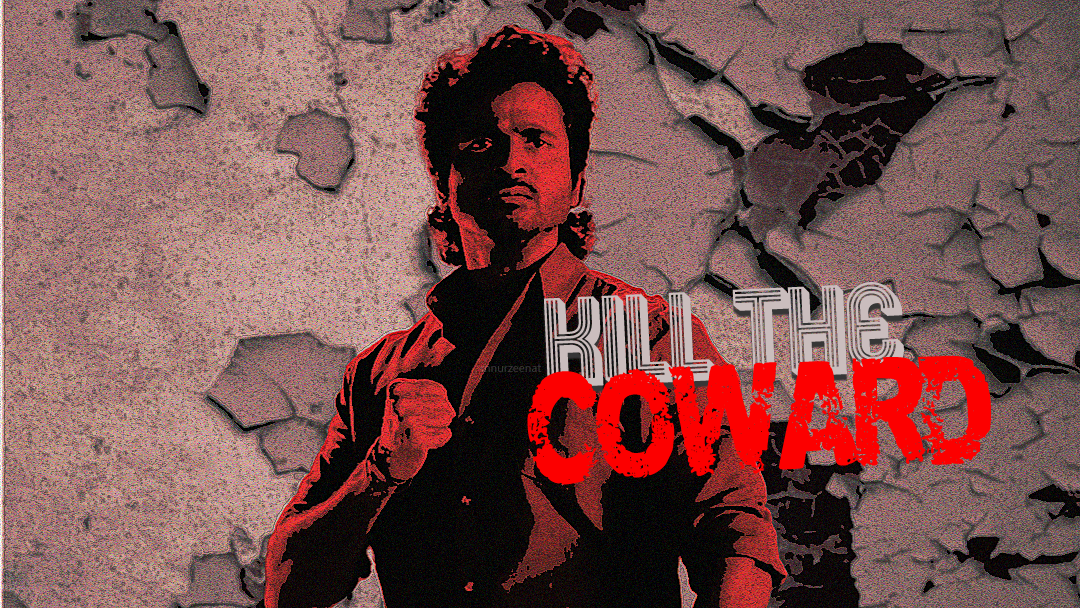
Sathya, the hero of the 2023 Tamil superhero film Maaveeran (The Great Warrior), has the most reasonable of origin stories: after a series of events leave him feeling like a failure, Sathya goes up to the roof of the shoddily-constructed, government-provided building where he lives with his family in order to take his own life. Though a timely missed call from his sister changes his mind, part of the ledge under his feet crumbles and he falls to a scaffolding below, hitting his head several times on the way down. Rushed to a hospital, Sathya dies but it's a temporary death: he's revived by the command of a newly acquired voice in his head, a voice that narrates his life as if he were the protagonist of the heroic comic strip he used to write.
Yes, our superhero's superpower is being brain-damaged.
The superhero genre has a patchy presence throughout Indian film history. Most of its core functions are fulfilled by the mass hero film, rendering it almost obsolete except where a filmmaker specifically wishes to closely emulate western superhero fare. A notable exception to this is 1987's Mr. India, about an ordinary man who one day discovers a device, invented by his deceased father, that can turn him invisible. Though styled as a superhero picture, it hews to the spirit of the mass hero film, because even if he's invisible and his nemesis, Mogambo, is an outsized Bond-esque supervillain, the issues Mr. India deals with are grounded and salient, such as the death of impoverished children from consuming adulterated grains — in one of the film's most iconic scenes, Mr. India punishes one of the grain dealers by forcing him to eat the adulterants while seated at the table of a five star restaurant.
In much the same way, Maaveeran centers its superheroics around the issue of slum rehabilitation, the Indian government's decades-long project of clearing slums from India's cities, the empty land subsequently given to developers who are tasked with using a small portion of it to develop housing for former slum residents. In the beginning of the film, the slum where Sathya, his family and hundreds of others have lived for decades is demolished and they are relocated to what at first appears to be a 'palace' but soon proves to be a crumbling death trap, what one character calls a 'pile of bricks and cement'.
The villain of Maveeran isn't a giant purple alien, wielding tacky jewelry to destroy a vague idea of 'the world'; he's an all too human politician, wielding a sickening amount of political power (and also wearing some rather tacky jewelry), threatening the very community that Sathya is a part of. Sathya's calling is to lay down his life to save his people from the consequences of greed and corruption.
Or at least, that's what the voice insists. Sathya refuses to accept this destiny, his biggest obstacle being his own cowardice and selfishness. He puts his and his family's well-being above everything else, refusing to stand up to the injustice he faces and sees others face every day, yet using it as fodder for his comics anyway — a fact that disgusts his mother and disappoints his love interest. How Sathya learns to overcome his weaknesses and put the collective good of his people above his individual desires forms the core of the movie.
Maaveeran stands as a testament to the nature of the industry from which it emerged. Mr. India was a Hindi film of the country's so-called 'socialist' period, displaying a characteristic affinity for the poor and a deep antipathy towards the rich. The onset of economic liberalization reversed this dynamic: the poor and their issues bled away from Hindi cinema, while the rich and their lifestyles gradually came to be idealized. This did not occur to the same extent in the South, especially on the Tamil film scene, whose origins are intimately tied to politics and whose economics are still influenced to a great degree by subaltern audiences.
The urban and rural poor are often at the forefront of Tamil films, with 2018's Kaala similarly focusing on the issue of slum rehabilitation and problems faced by relocated residents. With the advent of the Tamil new wave, the mainstream action film has been repurposed as an even more robust vehicle for social and political commentary.
It's lively movements like these that deserve the widest audience, a global resonance that connects the plight of one people to another. Films that travel with the force of shared experience, invigorate with ideas of change. What do Sathya's people face that isn't familiar to slum dwellers in Brazil or the Philippines, or even the unhoused in the global north? Movements like these act as an antidote to the endless glut of cinematic morphine that sloshes out of hollywood's gutters into our eyes and ears, dulling us not only to each other but to ourselves. Movements like these remind us that the brown and black faces have minds behind them, minds capable of making art, of using entertainment as a conduit for our stories; if those minds are not valued, if the traditions created by them are confined to cultural dustbins with broad negative adjectives, then that is nothing but a function of the racist and colonial mindset that prevails globally, and no amount of roided up brown comedians doing 'Bollywood dance' in an unwatchable film can hide it.
Much like machines can only play at being an artist but ultimately fail to capture the depth, feeling and spirit of art crafted by human hands, globalized hollywood pop culture factories can only ever create lifeless, farcical imitations of the lives and experiences of people on the periphery. Yet there remains a deep aversion to taking culture production from the global south on its own terms, part of a continued inability to assign full humanity to the people living here. What's tragic is that, often, the loudest condemnations of this culture production come from the global south itself, from the subset so isolated from their own people that they exist only as shadows of a nonexistent western self — their bodies in Mumbai, but their minds in Manhattan.
This is an obstacle, like Sathya's cowardice was an obstacle. He could not recognize his own strength and thus capitulated to his enemies, hoping for a scrap of mercy that would not come. No matter how much we beg for and celebrate scraps, no matter how much of ourselves we cut off to fit into a mould not made for us, no rise in our status is forthcoming.
But Sathya did eventually overcome his cowardice, and claim his true strength. Maaveeran is not a tale of superhuman shock and awe but a reflection of an utterly human revolutionary spirit: we, too, can break the chains of servility, fear and self-interest, move towards community, self-assurance and self-determination. Sathya's narrator is but an unusually powerful conscience, and a conscience is something that we all have.
Note: a very special thanks to Sagar, Roderic and Kris for providing feedback and valuable suggestions on how to improve this piece, as well as for their supportive comments! 💖
Maaveeran, directed by Madonne Ashwin, is available on Prime Video.